
For calendar-year S corporations, the federal return for tax year 2025 is due March 16, 2026. File Form 7004 by that date and you push the filing deadline to September 15, 2026. That extension covers paperwork only. Any tax you owe is still due March 16.
The March 16 date exists because March 15, 2026 falls on a Sunday, and federal tax law automatically rolls deadlines that land on a weekend or holiday to the next business day. It's a small quirk, but it trips up owners every year who mark their calendar for "the 15th" out of habit.
Here's what every S corp owner and preparer needs locked in for 2026:
- March 16, 2026 — Form 1120-S filing deadline and Schedule K-1 distribution deadline for calendar-year S corps
- March 16, 2026 — Deadline to file Form 7004 for an automatic six-month extension
- September 15, 2026 — Extended filing deadline if Form 7004 was filed on time
The rule that catches people off guard: an extension to file is not an extension to pay. If you owe tax on your 2025 S corp return, that payment is due March 16, 2026, whether or not you extend the paperwork. Missing that distinction is the single most common and most expensive mistake we see at Thetaxrefinery among owners who assume "extended" means "everything's extended."
Key Takeaways
Meeting every 2026 S corp deadline requires treating the March 16 filing date, the September 15 extended date, and all payment obligations as three separate tracks that must each be managed on their own terms.
| Point | Details |
|---|---|
| March 16 is the anchor date | Form 1120-S, Schedule K-1s, Form 2553, and the Form 7004 extension request all share this 2026 deadline. |
| Extension covers paperwork only | Form 7004 pushes filing to September 15, 2026, but any tax owed is still due March 16. |
| Per-shareholder penalties add up fast | IRC §6699 penalizes late filing per shareholder, with a $525 minimum per month for returns over 60 days late. |
| Payroll deadlines never move | Form 941, Form 940, and W-2/1099 deadlines run independently of any S corp extension filed. |
| State rules need separate verification | Most states mirror the federal date, but franchise taxes and apportionment rules can differ by state. |
Table of Contents
- Your 2026 S Corp Deadlines at a Glance
- What Form 7004 Actually Extends (and What It Doesn't)
- Which Forms Matter Most and When They're Due
- Shareholder Estimated Taxes and Payroll Deadlines That Don't Move
- What a Late S Corp Return Actually Costs You
- State S Corp Deadlines Don't Always Match Federal Ones
- What to Do the Moment You Miss a Deadline
- The Pre-March Checklist Every S Corp Should Run
- How Thetaxrefinery Keeps Clients Ahead of Every 2026 Deadline
- Why the Real Risk Isn't the Date, It's the Coordination
- Sources
Your 2026 S Corp Deadlines at a Glance
Here's a condensed reference for the dates that matter most this year, built for anyone who wants to copy it straight into their planner.
| Deadline | Date (2026) | What's Due |
|---|---|---|
| S election deadline | March 16, 2026 | Form 2553 for calendar-year businesses electing S status for tax year 2026 |
| Original 1120-S due date | March 16, 2026 | Form 1120-S and Schedule K-1s to all shareholders |
| Extension filing deadline | March 16, 2026 | Form 7004 to request a six-month extension |
| Q1 estimated tax (shareholders) | April 15, 2026 | Individual quarterly estimated payment on K-1 income |
| Q2 estimated tax (shareholders) | June 15, 2026 | Individual quarterly estimated payment |
| Q3 estimated tax (shareholders) | September 15, 2026 | Individual quarterly estimated payment |
| Extended 1120-S due date | September 15, 2026 | Extended Form 1120-S and final Schedule K-1s |
| Q4 estimated tax (shareholders) | January 15, 2027 | Final quarterly estimated payment for 2026 tax year |
A few things this table doesn't show but matters just as much:
- Payroll deposits and Form 941 quarterly filings run on their own schedule, untouched by any extension you file for the S corp return.
- If your S corp operates on a fiscal year rather than a calendar year, every date above shifts. Your due date is always the 15th day of the third month after your fiscal year closes.
- Shareholders who rely on K-1 income to plan their own estimated payments need the K-1 in hand well before these quarterly dates, not after.
The Taxpayer Advocate's 2026 tax calendar confirms March 16 as the filing date for partnerships and S corporations reporting calendar-year 2025 activity, which lines up exactly with the IRS instructions for Form 1120-S.
What Form 7004 Actually Extends (and What It Doesn't)
Form 7004 buys you six extra months to file paperwork. It buys you zero extra days to pay. That single sentence should be taped to the inside of every S corp owner's laptop.
Here's the breakdown of what the extension covers:
- Filing Form 1120-S itself, pushed from March 16 to September 15, 2026
- Distribution of final Schedule K-1s to shareholders, which follows the return's due date
And here's what it does not touch:
- Any tax liability tied to built-in gains tax or excess net passive income owed by the corporation itself
- Shareholders' personal quarterly estimated tax obligations
- Payroll tax deposits and filings, including Form 941 and Form 940
- The Form 2553 S-election deadline, which has no extension mechanism at all
Filing Form 7004 is straightforward: e-file through IRS-authorized software or your tax professional's system, or mail a paper copy postmarked by March 16. E-filing is the better call for one simple reason. The IRS doesn't send you a confirmation letter that your extension was accepted, so an e-file acceptance record is often your only proof the extension went in on time. Newsweek's coverage of Form 7004 filing makes the same point: don't assume silence means acceptance.
Pro Tip: Save your e-file confirmation, your EFTPS payment receipt, and, if you mailed anything, a certified-mail postmark. If the IRS ever questions timely filing, that documentation is your entire defense, and reconstructing it after the fact is far harder than saving it now.
If you're still building out your tax strategy, understanding S corp tax planning for 2026 before you hit extension season saves a lot of March scrambling.
Which Forms Matter Most and When They're Due
Not every form on an S corp's calendar plays by the same rules. Some extend automatically with Form 7004. Others never budge no matter what you file.
- Form 1120-S. Due the 15th day of the third month after the tax year closes, which for calendar-year corporations means March 16, 2026. File Form 7004 and it moves to September 15, 2026.
- Schedule K-1. Tied directly to the 1120-S due date. If you extend the corporate return, K-1s go out later too, but that delay cascades: shareholders can't finalize their personal returns until they have the K-1 in hand, which often forces them to extend their own Form 1040.
- Form 2553. The S-election form has no extension option, period. For an existing calendar-year entity electing S status for tax year 2026, the deadline is the same March 16 window, and missing it typically means waiting until the following tax year (barring a late-election relief request).
- Form 941. Quarterly payroll tax return, due the last day of the month following each quarter. It runs entirely independent of the S corp's income tax deadlines.
- Form 940. Annual FUTA return, generally due January 31 for the prior calendar year, with no connection to Form 7004 whatsoever.
The K-1 timing point deserves extra emphasis. When an S corp files late, or extends without communicating clearly to shareholders, it creates what practitioners call a K-1 cascade: shareholders miss the information they need, file their own extensions defensively, and sometimes underpay estimated tax because they're guessing at pass-through numbers. If your entity structure involves distributions on top of K-1 income, reviewing S corp distributions and how they interact with basis calculations before filing season starts prevents a lot of downstream confusion. Shareholders who want a refresher on how K-1 income affects their own basis should look at how S corp basis is calculated.
Shareholder Estimated Taxes and Payroll Deadlines That Don't Move
S corp income flows through to shareholders' personal returns, and that pass-through structure creates its own set of deadlines that have nothing to do with when the corporate return gets filed.
Shareholders receiving K-1 income generally owe quarterly estimated tax on four dates in 2026: April 15, June 15, September 15, and a final payment on January 15, 2027, for the 2026 tax year. Here's where it gets tricky. If the S corp extends its filing to September 15, that's the exact same day the shareholder's third quarterly estimate is due. Shareholders juggling both dates need clean estimates well before September, not last-minute guesses based on an unfinished K-1.
If the S corp itself extends, shareholders often need to extend their own Form 1040 too, particularly when K-1 figures aren't finalized until close to September. That's a coordination problem, not a paperwork problem, and it's one reason a subscription-style advisory relationship works better than annual, once-a-year contact. Owners can find more detail on this coordination in our guide to estimated taxes for S corp shareholders, including how Oregon-based owners handle state-level estimated payments alongside federal ones.
Payroll deadlines run on an entirely separate track. S corp owners who take a salary, which the IRS requires for anyone providing substantial services to the business, must meet:
- Quarterly Form 941 deadlines (generally the last day of the month following each quarter)
- Deposit schedules that depend on total tax liability, either monthly or semiweekly under IRS lookback rules
- Annual Form 940 for FUTA, plus W-2 and 1099 issuance deadlines, both generally due to recipients by January 31
Pro Tip: If your payroll tax deposits exceeded $50,000 during the lookback period, you're on a semiweekly deposit schedule, not monthly. Confirm your deposit frequency every January. It's one of the most commonly missed compliance checks we see, and it's checked automatically against your prior-year liability, not your current guess. Reasonable compensation questions and deposit timing both get covered in our payroll compliance guide for S corp owners and our breakdown of S corp reasonable salary rules.
What a Late S Corp Return Actually Costs You
The penalty structure for late S corp filings is unusual, and it's often worse than owners expect precisely because it doesn't depend on whether tax is owed.
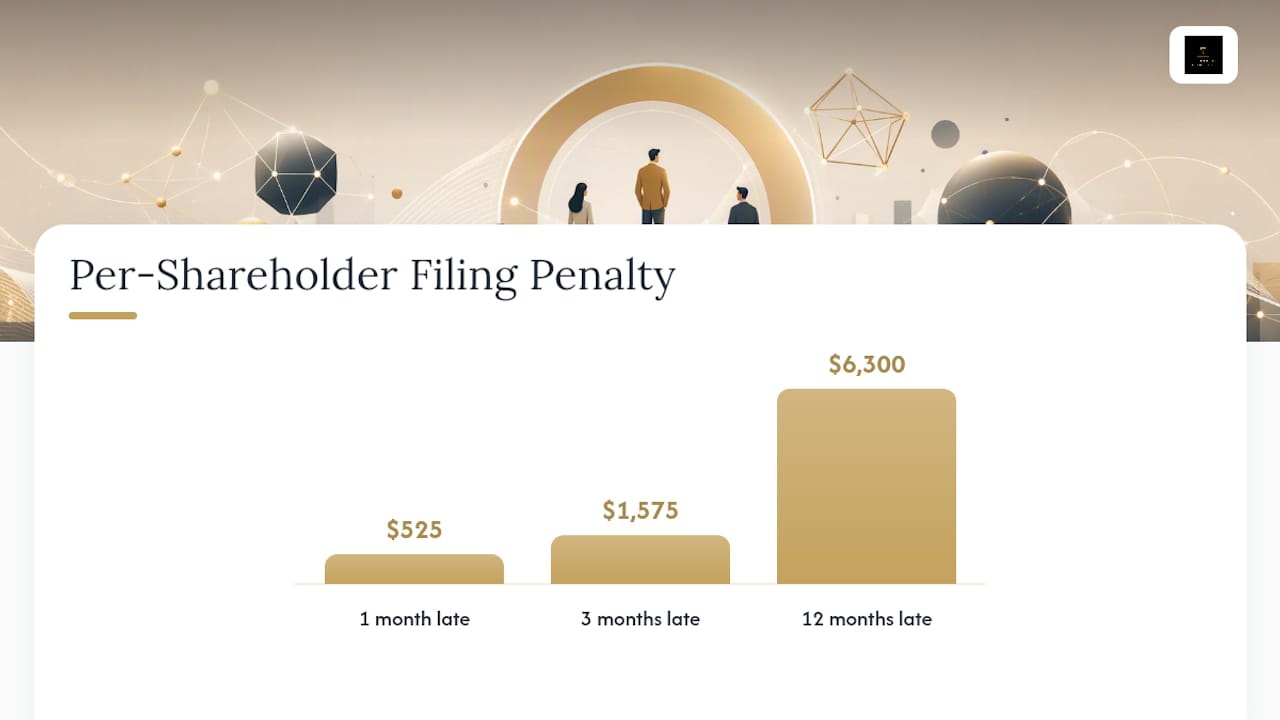
Under IRC §6699, the failure-to-file penalty applies per shareholder, not as a flat corporate fine. For returns required in 2026, if a return is filed more than 60 days late, the minimum penalty is the smaller of the tax due or a specified minimum amount per shareholder, per month, for up to twelve months. Here's why that structure matters: an S corp with zero tax liability at the entity level can still rack up real penalty exposure just from being late, because the penalty is triggered by the number of shareholders and months late, not by a balance owed.
Consider the math. A five-shareholder S corp that files three months late is looking at a penalty calculation running through five shareholders across three months, using that $525-per-month baseline as the floor before other adjustments apply. That adds up fast, and it applies whether or not the corporation itself owes a dime.
Separately, failure-to-pay penalties accrue on any unpaid tax balance, generally at 0.5% per month, plus interest that compounds daily based on the federal short-term rate. Here's a sequence worth internalizing:
- File late without an extension, and you're exposed to both the per-shareholder late-filing penalty and failure-to-pay penalties simultaneously.
- File Form 7004 on time but pay late, and you avoid the late-filing penalty entirely while still owing failure-to-pay penalties and interest on the unpaid balance.
- File and pay on time, and none of the above applies. This is the only scenario with zero penalty exposure.
If reasonable cause exists (a serious illness, a natural disaster, reliance on incorrect professional advice), the IRS will consider an abatement request, but it requires a specific written explanation tied to the circumstances, not a generic apology. First-time abatement relief is also worth checking if your entity has a clean three-year filing history.
State S Corp Deadlines Don't Always Match Federal Ones
Most states follow the same 15th-day-of-the-third-month rule the IRS uses for calendar-year S corps, which means your state return often lines up with March 16, 2026. But "most" isn't "all," and assuming your state mirrors federal timing is a mistake that shows up every filing season.
A few things worth checking directly with your state revenue department:
- Some states require a separate state-level extension form even when you've already filed federal Form 7004; a federal extension doesn't automatically extend your state obligation everywhere.
- Franchise taxes, minimum entity fees, or gross receipts taxes can be due on entirely separate schedules from your income tax return, regardless of any federal extension you've filed.
- Oregon S corp taxes carry their own filing nuances for owners operating across state lines, particularly around apportionment when income is earned in multiple states. S corp state apportionment rules determine how much of your pass-through income each state taxes, and getting that wrong is a common source of amended returns.
- A handful of states tax S corps at the entity level in ways federal law doesn't, so "pass-through" federally doesn't always mean "pass-through" for state purposes.
Publication 509 is a solid cross-reference for federal dates, but it won't tell you anything about state rules. For a broader external reference point on business deadlines, Tolliver's tax deadline calendar is a useful supplemental check, particularly for fiscal-year variations. When in doubt, go straight to your state's department of revenue website rather than relying on a generic guide.
What to Do the Moment You Miss a Deadline
Missing March 16 isn't the end of the world, but what you do in the following days determines how expensive the mistake becomes.
- File immediately, even without full payment. The failure-to-file penalty clock keeps running until you file, so stopping that accrual matters more than having every number perfect.
- Pay whatever you can right now. Failure-to-pay penalties calculate against the outstanding balance, so a partial payment today measurably reduces the penalty base going forward.
- Draft a reasonable-cause statement if circumstances warrant it. Be specific: dates, documentation, and a clear explanation of what happened and when it was resolved.
- Get K-1s to shareholders as fast as possible. Every day of delay increases the odds a shareholder has to scramble on their own extension or file an inaccurate estimate.
- Explore payment plan options if the balance is too large to pay outright. An IRS payment plan stops some penalty escalation and shows good faith, which matters if you later request abatement.
Pro Tip: Don't wait until you've "figured everything out" to file. A filed return with an estimated number, corrected later with an amended return, almost always costs less than an unfiled return sitting untouched while you look for missing documents.
If the situation involves multiple entities, complicated basis questions, or a shareholder dispute over K-1 allocations, that's the point to bring in a tax resolution professional rather than handling it solo.
The Pre-March Checklist Every S Corp Should Run
Getting to March 16 without a scramble comes down to what you gather in January and February, not what you do in the final week.
Documents to have assembled before you or your preparer sit down to file:
- Final payroll reports and W-2s for all shareholder-employees
- 1099s issued to any contractors paid $600 or more during the year
- Depreciation schedules for any real estate or equipment additions
- Board minutes or written resolutions documenting major business decisions and distributions
- Prior-year K-1s for comparison, to catch inconsistencies before they become filing errors
Internally, assign clear ownership: someone collects documents, someone reviews and signs the return, and someone confirms the e-file was actually transmitted and accepted. Small S corps often skip this division of labor and end up with nobody actually confirming the filing went through.
Pro Tip: Build a simple shared folder or checklist that tracks every document by name and due date. The single biggest cause of March filing delays isn't complicated tax law. It's a missing 1099 or an unsigned resolution nobody noticed until the deadline was three days away.

Owners who want a full year-end runway rather than a February scramble should look at a proper year-end tax planning checklist, which covers the groundwork that makes March filing almost mechanical.
How Thetaxrefinery Keeps Clients Ahead of Every 2026 Deadline
A once-a-year phone call with your accountant is how deadlines get missed. A quarterly advisory relationship is how they don't.
Thetaxrefinery structures its engagements around checkpoints that land well before the dates that matter: a January review to confirm payroll and 1099 readiness, a February checkpoint to finalize numbers before March 16, and a mid-year review for any S corp that extended, so nothing sits untouched until September. That rhythm mirrors the year-round tax planning approach we recommend for any owner tired of tax season surprises.
Verification standards matter as much as the calendar itself. Every filing gets an e-file confirmation on record, every payment gets matched against an EFTPS receipt, and every return gets an internal sign-off before submission, exactly the documentation trail that protects a client if the IRS ever questions timely filing.
- Complicated built-in gains tax calculations on converted C corps get flagged early, not discovered in March.
- Multi-entity owners with allocations across several pass-through structures get a coordinated review, not a form-by-form guess.
- Any K-1 cascade risk, where a late corporate filing would force multiple shareholders to extend personal returns, gets addressed before it happens, not after.
Owners building a long-term tax strategy rather than reacting to deadlines one year at a time can start with proactive tax planning, review current pricing for tax preparation and strategy work, or book a strategy conversation directly with Thetaxrefinery.
Why the Real Risk Isn't the Date, It's the Coordination
Most advice on S corp deadlines treats March 16 and September 15 as the whole story. They're not. The dates themselves are simple; anyone can write them on a calendar. What actually causes penalty exposure is the coordination failure between the corporate filing and everything downstream of it: shareholder estimates, K-1 timing, payroll deposits that never pause for an extension.
The conventional advice oversells the extension. Too many owners treat Form 7004 as a stress valve that buys six months of breathing room, when it only buys six months on one form while payment deadlines and payroll obligations keep running underneath it. That gap between what an extension promises and what it delivers is where most penalty exposure actually comes from.
If you take one thing from this, prioritize documentation over deadlines. A missed date with proof of reasonable cause and a fast follow-up filing costs far less than an on-time filing with no verification trail behind it.
— Melissa
This article is general information, not a substitute for advice from a qualified financial advisor. Consult a qualified financial professional about your own circumstances before acting on anything here.
Sources
- Instructions for Form 1120-S
- Failure-to-file penalty
- Your tax 'to-do' list: important tax dates for 2026