
Your S corp basis is the number that determines whether you can deduct a loss, take a tax-free distribution, or owe capital gains tax when you sell your shares. Every S corporation shareholder needs to track it annually, and the IRS expects you to document it on Form 7203 and attach it to your Form 1040 when you claim pass-through losses.
Three actions matter most right now:
- Pull every Schedule K-1 you have received since you acquired your shares and reconstruct your beginning basis for the current year.
- Complete Form 7203 to compute your stock and debt basis and determine whether any losses are currently deductible.
- Pause discretionary distributions if your stock basis is low — distributions in excess of basis are taxable as capital gain, not tax-free returns of investment.
The IRS treats basis as the shareholder's responsibility, not the S corporation's. The company issues a Schedule K-1, but the shareholder must maintain the workpapers, loan documentation, and contribution records that support every number on Form 7203.
This guide walks through every rule you need: definitions, the statutory ordering rules, a fully worked numeric example, debt basis mechanics, suspended losses, Form 7203 completion, and the recordkeeping habits that keep you out of an audit.
Key Takeaways
Shareholder basis in an S corporation controls loss deductibility, distribution taxability, and gain on sale, making annual tracking with Form 7203 one of the highest-value compliance habits an S corp owner can build.
| Point | Details |
|---|---|
| Track basis every year | Ending basis from one year is beginning basis for the next; gaps compound into errors. |
| Use Form 7203 | Attach it to your Form 1040 whenever you claim pass-through losses or receive distributions. |
| Order of adjustments matters | Income increases basis first, then distributions reduce it, then nondeductibles, then losses. |
| Debt basis is separate | Only direct shareholder loans create debt basis; guarantees do not. |
| Thetaxrefinery integrates basis tracking | Year-round advisory keeps your basis workpaper current before distributions, not at filing time. |
Table of Contents
- What is S corp basis and why does it matter for your taxes?
- What increases and decreases your stock basis each year?
- How to calculate your year-end stock basis, with a worked example
- How debt basis works and when it lets you deduct more losses
- How basis limits affect loss deductions and distributions
- How to complete Form 7203 and map your Schedule K-1 items
- Recordkeeping, common mistakes, and IRS audit red flags
- Year-end planning checklist and when to get professional help
- Primary sources and further reading
- Sources
What is S corp basis and why does it matter for your taxes?
S corp basis comes in two distinct forms, and conflating them is one of the most common and costly mistakes shareholders make.
Outside (shareholder) basis is the number that controls your tax life as a shareholder. It represents your investment in the S corporation from your personal tax perspective. Loss deductibility, distribution taxability, and gain or loss on the sale of your shares all flow from outside basis. IRC §1367 codifies exactly how outside basis increases and decreases each year.
Inside (corporate) basis is the S corporation's own basis in its assets. It lives on the corporate books and drives depreciation, gain on asset sales, and the corporation's own accounting. Inside basis does not directly control whether you, the shareholder, can deduct a loss this year. Tax planning focuses almost entirely on outside basis for that reason.
Within outside basis, you track two separate accounts:
- Stock basis — your equity investment, adjusted annually for income, losses, distributions, and nondeductible expenses.
- Debt basis — created only when you make a direct loan to the S corporation. Guaranteed debt does not create debt basis. Debt basis becomes available to absorb losses only after stock basis reaches zero.
The table below maps these concepts to the forms you will use:
| Term | What it measures | Where it appears |
|---|---|---|
| Outside (shareholder) basis | Shareholder's tax investment in the S corp | Form 7203, Parts I and II |
| Stock basis | Equity portion of outside basis | Form 7203, Part I |
| Debt basis | Loan portion of outside basis | Form 7203, Part II |
| Inside (corporate) basis | S corp's basis in its own assets | Form 1120S balance sheet |
| Schedule K-1 items | Annual income, loss, and distribution pass-throughs | Feed into Form 7203 lines |
The IRS S corporation stock and debt basis page confirms that stock and debt basis limitations are the first of four sequential loss tests a shareholder must pass before claiming a deduction. The other three are at-risk limitations, passive activity loss limitations, and excess business loss limitations. Passing the basis test is necessary, but it is not always sufficient.
What increases and decreases your stock basis each year?
Stock basis is not static. It adjusts every tax year based on items flowing through from the S corporation, and the order in which those adjustments happen is set by statute.
Increases to stock basis
Under IRC §1367, your stock basis increases for:
- Capital contributions you make to the corporation during the year.
- Your pro-rata share of ordinary business income from Schedule K-1, Box 1.
- Separately stated income items (interest income, rental income, capital gains) from K-1 Boxes 2–10.
- Tax-exempt income, including PPP loan forgiveness, reported on K-1 Box 16B.
- Excess depletion (non-oil-and-gas depletion exceeding the property's basis) from K-1 Box 17.
Decreases to stock basis
Basis decreases in this order, and it cannot go below zero:
- Non-dividend distributions (cash or property) from K-1 Box 16D.
- Nondeductible expenses and non-capital expenditures from K-1 Box 16C.
- Depletion for oil and gas properties to the extent of the property's basis.
- Items of loss and deduction, including ordinary loss (K-1 Box 1) and separately stated loss items.
The statutory ordering rule and the 1.1367-1(g) election
The IRS practice unit on stock basis ordering rules sets the default sequence: first increase basis for income and excess depletion, then decrease for distributions, then decrease for nondeductible non-capital items, and finally decrease for losses and deductions. This sequence protects distributions from being taxable before losses are applied.
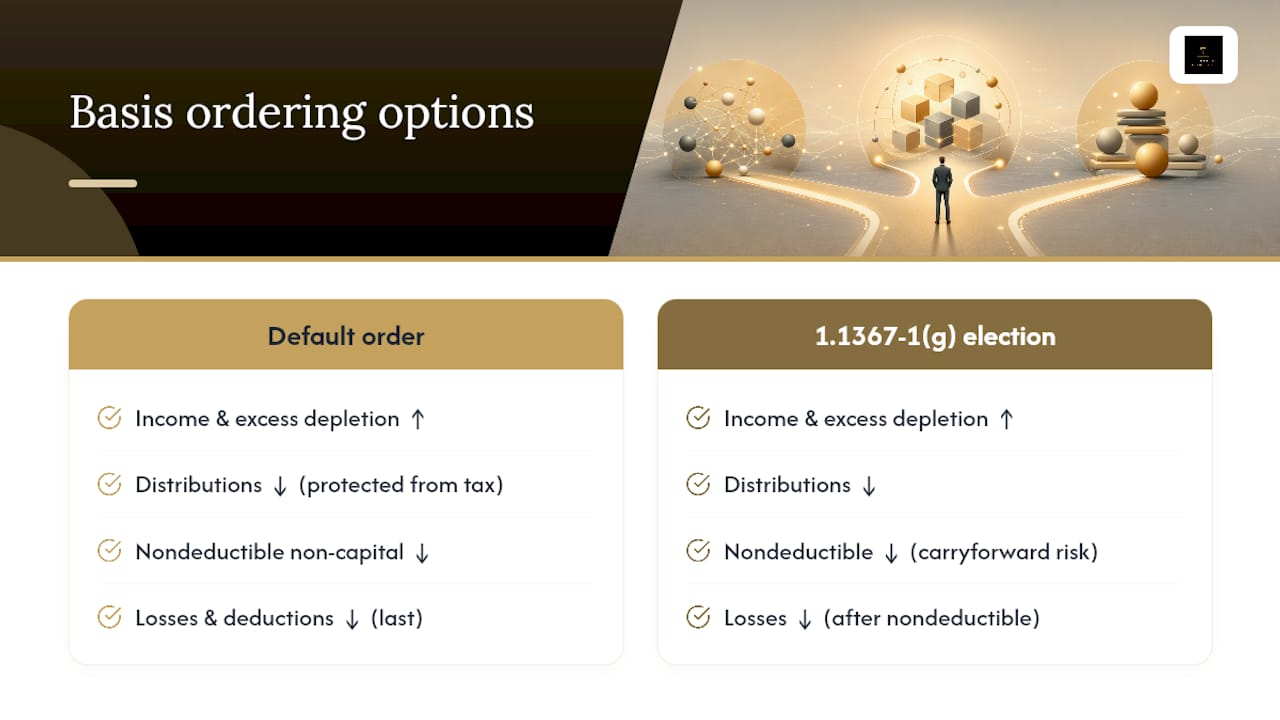
Treasury Regulation 1.1367-1(g) allows shareholders to elect an alternative order that applies nondeductible expenses before losses. That election can increase the amount of loss deductible in the current year, because nondeductibles consume basis that would otherwise absorb losses. The trade-off: nondeductible expenses that exceed basis under the election carry forward, whereas under the default rule they simply reduce basis before losses do. The election should only be made after multi-year modeling, because it can create carryforward complications that cost more than the current-year benefit.
Pro Tip: Never make the 1.1367-1(g) election without running a three-to-five year projection of basis restoration. A one-year gain in deductible losses can produce a multi-year carryforward problem if the corporation's income is uneven.
How to calculate your year-end stock basis, with a worked example
The formula for ending stock basis is straightforward. The complexity is in applying the ordering rules correctly and mapping each item to the right Form 7203 line.
Steps to compute ending stock basis:
- Start with beginning stock basis (your ending basis from the prior year, or your original purchase price if this is year one).
- Add capital contributions made during the year.
- Add your share of income items from Schedule K-1 (ordinary income, separately stated income, tax-exempt income, excess depletion).
- Subtract distributions received during the year.
- Subtract nondeductible expenses and non-capital expenditures.
- Subtract allowable losses and deductions (capped at remaining basis — excess is suspended).
- Ending stock basis cannot be less than zero.
Worked numeric example
Your beginning stock basis on January 1 is $30,000.
During the year, your Schedule K-1 reports:
- Ordinary business income (Box 1): $20,000
- Tax-exempt income (Box 16B): $5,000
- Cash distribution (Box 16D): $40,000
- Nondeductible expenses (Box 16C): $3,000
- Ordinary loss (Box 1, if applicable): $0 in this example
In this scenario, the $40,000 distribution is fully tax-free because it does not exceed the $55,000 pre-distribution basis. Ending basis is $12,000, which is the maximum loss the shareholder could deduct if a loss had been reported.
Documents to gather before you compute:
- Prior year Form 7203 or basis workpaper showing beginning basis.
- All Schedule K-1s for the current year.
- Loan statements for any direct loans you made to the S corporation.
- Bank records and capital contribution documentation.
- Corporate meeting minutes reflecting capital calls or loan approvals.
Pro Tip: If you are reconstructing basis for multiple prior years, work forward chronologically from the year you acquired your shares. Each year's ending basis becomes the next year's beginning basis. Missing even one year creates errors that compound.
How debt basis works and when it lets you deduct more losses
Debt basis is separate from stock basis and follows its own set of rules. It does not arise automatically from the S corporation taking on debt. You create debt basis only by making a direct loan from your personal funds to the S corporation.
A guarantee of third-party debt does not create debt basis. Back-to-back loans where a bank lends to you and you re-lend to the corporation can create debt basis, but the IRS scrutinizes these arrangements closely. The loan must be a genuine economic transaction with documentation to match.
How debt basis is computed:
- Beginning debt basis equals the outstanding loan balance at the start of the year.
- Debt basis decreases when the corporation uses it to absorb losses that exceed stock basis.
- Debt basis is restored by subsequent net increases (income items) before those increases flow to stock basis.
- Repayment of a loan whose basis has been reduced is partially taxable as capital gain to the extent the repayment exceeds the remaining debt basis.
When debt basis becomes available
Once stock basis reaches zero, losses can flow through and be deducted against debt basis. If both stock and debt basis are exhausted, the remaining losses are suspended and carried forward indefinitely, per the IRS S corporation stock and debt basis guidance. Those suspended losses are released when basis is restored in a future year, or they are lost permanently if you dispose of your shares without sufficient basis restoration.
Documentation the IRS expects to see:
- A signed promissory note with a stated interest rate and repayment schedule.
- Bank records showing the transfer of funds from your personal account to the corporation.
- Corporate board minutes or written consent authorizing the loan.
- Consistent treatment of the loan on the corporation's books (liability, not equity).
- Evidence of actual repayments made on schedule.
Pro Tip: If you are considering a shareholder loan to unlock suspended losses, document it before the end of the tax year. A loan agreement signed in January for the prior year will not create debt basis retroactively.
How basis limits affect loss deductions and distributions
The basis limitation is the first gate a loss must pass through, but it is not the only one. The IRS requires shareholders to clear four sequential tests before claiming a pass-through loss: basis, at-risk, passive activity, and excess business loss. Passing the basis test means the loss clears the first gate. It still must clear the remaining three.
Loss deductibility in practice:
- Compute your total stock and debt basis at year-end.
- Compare that total to your share of losses and deductions from the K-1.
- Losses up to the combined basis are potentially deductible (subject to the remaining three tests).
- Losses exceeding combined basis are suspended and carried forward indefinitely.
Suspended losses are not lost permanently. They revive when basis is restored through future income, contributions, or new loans. They are lost only if you dispose of your shares while the losses remain suspended and basis is insufficient to absorb them.
Distributions and capital gain exposure:
A cash distribution reduces stock basis dollar for dollar. Distributions within stock basis are tax-free returns of investment. A distribution that exceeds stock basis is taxable as capital gain in the year received. This is a common and avoidable surprise for shareholders who take large distributions in a year when income was lower than expected.

Illustrative example: Your stock basis at the start of the year is $15,000. The corporation reports a $5,000 loss and distributes $18,000 to you. After applying the ordering rules, basis increases by zero (no income), decreases by $18,000 for the distribution, but basis cannot go below zero. The first $15,000 of the distribution is tax-free. The remaining $3,000 is taxable capital gain. The $5,000 loss is fully suspended because basis is zero.
Pro Tip: Run a pre-distribution basis test before any significant distribution. Compute what your basis will be after the distribution, then check whether any anticipated losses will still be deductible. A distribution that looks routine can silently suspend losses you were counting on.
How to complete Form 7203 and map your Schedule K-1 items
Form 7203 is the IRS worksheet for computing stock and debt basis and documenting allowable losses. Attach it to your Form 1040 in any year you claim a pass-through loss, receive a distribution, or dispose of S corporation stock. The Form 7203 instructions map each Schedule K-1 box to a specific line in Parts I, II, and III.
Key K-1 to Form 7203 mappings:
| Schedule K-1 box | What it reports | Form 7203 location |
|---|---|---|
| Box 1 | Ordinary business income or loss | Part I, Lines 3 or 10 |
| Box 2–10 | Separately stated income or loss items | Part I, Lines 4–10 |
| Box 16B | Tax-exempt income | Part I, Line 4 |
| Box 16C | Nondeductible expenses | Part I, Line 15 |
| Box 16D | Distributions | Part I, Line 12 |
| Box 17 | Oil and gas depletion information | Part I, Lines 5 and 15 |
Completing the three parts of Form 7203:
- Part I (Stock Basis): Enter beginning basis, add contributions and income items, subtract distributions and nondeductible expenses, then subtract allowable losses. The result is ending stock basis.
- Part II (Debt Basis): Enter each loan separately. Adjust for income restorations and loss absorptions. Compute ending debt basis per loan.
- Part III (Allowable Losses): Allocate losses first against stock basis, then against debt basis. Any excess is the suspended loss carryforward.
Common errors to avoid:
- Entering the K-1 loss amount without first checking whether basis supports it.
- Omitting tax-exempt income from the basis increase (it increases basis even though it is not taxable).
- Treating a shareholder guarantee as debt basis.
- Forgetting to restore debt basis before increasing stock basis when income flows through in a later year.
- Filing without Form 7203 when losses are claimed, which is an audit flag.
Recordkeeping, common mistakes, and IRS audit red flags
The shareholder bears sole responsibility for maintaining basis records. The S corporation issues a Schedule K-1, but it does not track your outside basis. That obligation is yours, and the Form 7203 instructions make that explicit.
Records to retain:
- All prior year Forms 7203 or equivalent basis workpapers.
- Every Schedule K-1 received since you acquired your shares.
- Cancelled checks, wire confirmations, and bank statements for capital contributions.
- Signed loan agreements, promissory notes, and repayment records for any shareholder loans.
- Corporate meeting minutes reflecting capital calls, loan authorizations, and distribution approvals.
- Basis workpapers for at least 3–7 years after you dispose of your shares; loan documentation for as long as the loan exists.
The IRS can reconstruct income, but it cannot reconstruct your basis for you. If you cannot produce workpapers showing how your basis was computed year by year, the IRS will treat your basis as zero — and every distribution and loss deduction becomes suspect.
Top mistakes shareholders make:
- Failing to track basis annually and trying to reconstruct it years later from incomplete K-1s.
- Treating shareholder loans as capital contributions without documentation, which eliminates debt basis and may recharacterize the transaction.
- Ignoring the ordering rules and applying losses before distributions, which produces an incorrect (usually overstated) deductible loss.
- Failing to report income items that increase basis, which understates basis and may cause the shareholder to miss deductible losses they were entitled to claim.
IRS audit red flags:
- Large, recurring nondeductible travel and entertainment expenses with no supporting documentation.
- Distributions taken when basis is near zero or negative on the shareholder's own workpapers.
- Shareholder loans with no promissory note, no interest, and no repayment history.
- Inconsistent K-1 reporting across years, particularly when ownership percentages change.
- Claiming losses in excess of basis without attaching Form 7203.
Year-end planning checklist and when to get professional help
Basis planning is not a December scramble. It is a year-round discipline, and the shareholders who benefit most from their S corporation structure are the ones who treat basis as a live number, not an annual afterthought.
Year-end basis checklist:
- Reconcile beginning basis against last year's Form 7203 or workpaper.
- Confirm all K-1 items are final and match the corporation's Form 1120S.
- Run a pre-distribution basis test before taking any year-end distribution.
- Document any new shareholder loans made during the year with signed agreements.
- Draft Form 7203 before filing and test for suspended losses.
- Decide whether the 1.1367-1(g) ordering election is appropriate, with advisor input.
Practitioner signals that warrant immediate attention:
- You have multi-year suspended losses that have not been deducted.
- The corporation made a property distribution, which may trigger IRC §311 gain at the corporate level.
- Your ownership percentage changed during the year due to a stock transfer or new shareholder.
- You converted a shareholder loan to equity, which eliminates debt basis and may affect loss carryforwards.
- You are planning to sell your shares and want to know whether suspended losses will be deductible before disposition.
For S corp tax planning that goes beyond basis mechanics, the interaction between reasonable salary, distributions, and basis deserves its own annual review. Shareholders who take distributions without coordinating with their payroll obligations sometimes create basis problems they did not anticipate.
Thetaxrefinery integrates basis tracking into its year-round advisory model. Rather than reconstructing basis at filing time, clients maintain a live basis workpaper updated with each K-1 cycle. That approach catches distribution problems before they become taxable events and identifies suspended loss opportunities before they expire on disposition.
Pro Tip: Time capital contributions or new shareholder loans to restore basis before the tax year closes if you have suspended losses you want to release. A contribution made on December 31 increases basis for that year and may unlock losses that would otherwise carry forward another twelve months.
What the basis rules reveal about S corp planning
Most shareholders understand that an S corporation can reduce self-employment tax. Fewer understand that the basis rules are where the real planning leverage lives.
The ability to deduct losses, take tax-free distributions, and avoid capital gain on repaid loans all depend on a number that most shareholders have never actually computed. Form 7203 made that number visible and required, which is genuinely useful. But the form only works if the underlying workpapers are accurate, and those workpapers only exist if someone has been tracking basis every year.
The ordering rules under Treas. Reg. 1.1367-1(g) are a good example of where planning creates real value. The default ordering protects distributions first, which is the right default for most shareholders. But for a shareholder with large nondeductible expenses and a year with significant losses, the election can shift thousands of dollars from a carryforward to a current deduction. That is not a technicality. It is a planning decision with a measurable dollar outcome, and it requires multi-year modeling to get right.
The same logic applies to shareholder loans. A loan made before year-end with proper documentation can create debt basis that releases suspended losses immediately. A loan made without documentation is just a transfer that the IRS will recharacterize, and the debt basis disappears with it.
Basis tracking is not complicated once you build the habit. The shareholders who struggle are the ones who skip a year, lose a K-1, or forget to document a contribution. Reconstruction is possible but expensive. Annual maintenance is not.
Thetaxrefinery's S corp basis advisory and year-round service
Tracking S corp basis correctly year after year requires more than a spreadsheet. It requires someone who knows the ordering rules, watches for distribution traps, and builds Form 7203 from a live workpaper rather than a last-minute reconstruction.
Thetaxrefinery works with S corporation owners, multi-entity operators, and high-earning professionals who want basis tracking built into their annual tax strategy, not bolted on at filing time. The firm's subscription-based advisory model means your basis workpaper is current before you take a distribution, not after.
Who benefits most:
- S corp founders with multi-year suspended losses waiting for basis restoration.
- Multi-entity owners managing shareholder loans across multiple corporations.
- High earners whose distributions and losses need to be coordinated with payroll planning.
The outcome: fewer audit surprises, more deductible losses claimed in the right year, and distributions taken with confidence. See the S corp advisory services to find the engagement model that fits your situation.
Primary sources and further reading
The following IRS and statutory sources are the authoritative references for every rule covered in this guide:
- S corporation stock and debt basis — IRS.gov: The IRS overview page explaining what increases and decreases stock and debt basis, the four sequential loss tests, and the shareholder's responsibility for tracking.
- Form 7203 (Rev. December 2022) — IRS PDF: The official worksheet for computing stock and debt basis and allowable losses, organized in Parts I, II, and III.
- Instructions for Form 7203 (12/2022) — IRS.gov: Line-by-line instructions mapping Schedule K-1 boxes to Form 7203 entries and explaining how to complete each part.
- Stock basis ordering rules — IRS Practice Unit: Detailed explanation of the statutory ordering rules, the Treas. Reg. 1.1367-1(g) election, and worked examples showing the election's trade-offs.
This article is general information, not a substitute for advice from a qualified financial advisor. Consult a qualified financial professional about your own circumstances before acting on anything here.
Sources
- S corporation stock and debt basis | Internal Revenue Service
- Instructions for Form 7203 (12/2022) | Internal Revenue Service
- Form 7203 (Rev. December 2022) | Internal Revenue Service
- Stock basis ordering rules | IRS practice units