
S Corp owner payroll is defined as the process of paying yourself a W-2 salary subject to FICA taxes before taking any profit distributions exempt from those taxes. The IRS requires this structure specifically to prevent owners from avoiding payroll taxes by routing all compensation through distributions. Get it right, and you keep more of what your business earns. Get it wrong, and you face reclassification, back taxes, and penalties. This guide walks you through every step: registrations, salary determination, payroll execution, and distribution management, with examples built for Idaho business owners running trades, services, and professional practices.
What payroll setup does an S Corp owner need first?
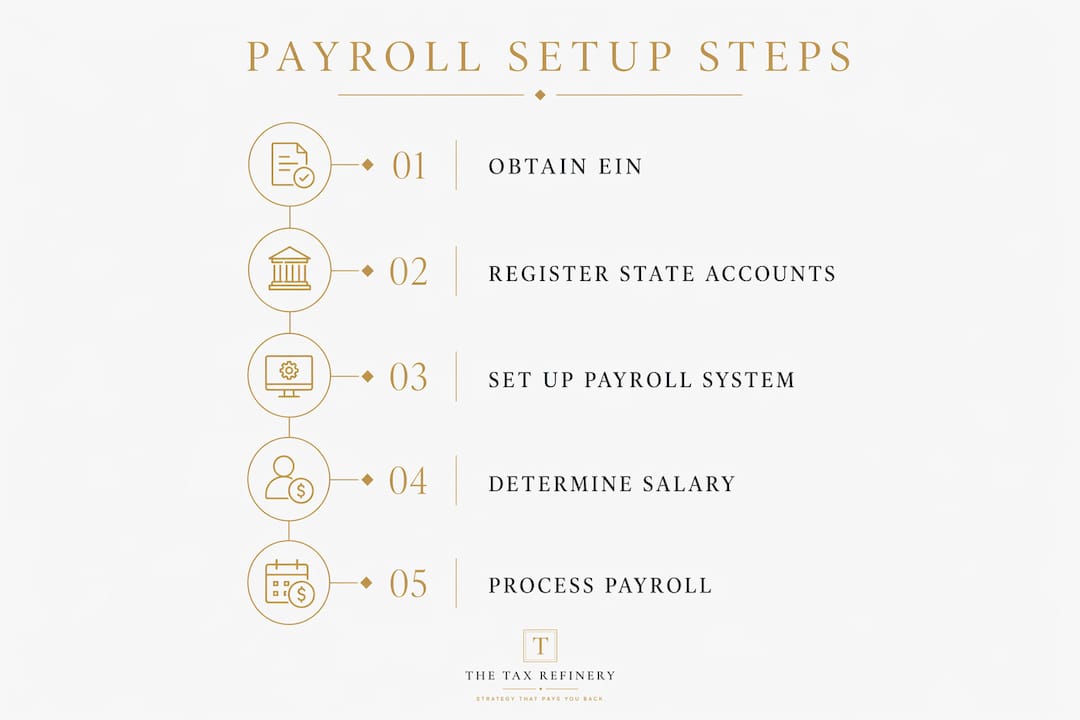
Before you cut your first paycheck, you need the right accounts in place. Payroll registration requires an Employer Identification Number (EIN) for federal payroll tax reporting, plus state unemployment insurance and income tax withholding accounts through the Idaho Department of Labor and Idaho State Tax Commission. Skipping these steps means your first payroll is already out of compliance.
Many owners assume payroll is optional when they are the only employee. That assumption is wrong. Electing S Corp status triggers a payroll obligation the moment you perform services for the business, regardless of how many employees you have.

The table below outlines the core registrations and setup tasks every S Corp owner needs to complete before processing a first paycheck.
| Registration or Setup Task | Purpose |
|---|---|
| Obtain federal EIN | Required for all federal payroll tax filings |
| Register with Idaho Department of Labor | State unemployment insurance (SUI) account |
| Register with Idaho State Tax Commission | State income tax withholding account |
| Set up payroll processing system | Automates withholding, deposits, and filings |
| Obtain workers' compensation insurance | Required for owner-employees in most Idaho industries |
| Open a dedicated payroll bank account | Separates payroll funds from operating cash |
A small business payment checklist can help you track these setup tasks before your first pay date.
Pro Tip: Register your payroll accounts at least 30 days before your intended first paycheck. Federal and state processing times vary, and a delayed EIN or state account number will push back your entire payroll launch.
How do you determine a reasonable salary as an S Corp owner?
"Reasonable compensation" is the IRS standard for what an S Corp owner must pay themselves. The IRS defines it as the salary a comparable business would pay for the same services in the same market. That definition gives you a framework, but it also puts the burden of proof on you.
Three factors drive the reasonable salary calculation:
- Duties and time. The salary must reflect what you actually do. An HVAC owner who runs service calls, manages crews, and handles sales performs multiple roles. Each role carries a market rate.
- Industry salary data. The Bureau of Labor Statistics (BLS) Occupational Employment and Wage Statistics database is the most defensible source for comparable salary benchmarks. Pull data for your specific occupation and Idaho region.
- Experience and qualifications. A licensed plumber with 15 years of experience commands a higher market rate than a first-year technician. Your salary should reflect your credentials.
Documenting your methodology in writing is not optional. The IRS expects job descriptions, market salary reports, and CPA validation on file. An arbitrary low salary with no documentation is one of the clearest audit triggers in S Corp taxation.
Consider a concrete example. A Boise landscaping company owner who manages a crew of six, handles all client sales, and performs field work might reasonably earn $65,000 to $75,000 annually as a W-2 salary based on BLS data for landscape managers in Idaho. Taking $20,000 as a salary and $80,000 as distributions on $100,000 of net income would invite IRS scrutiny.
Pro Tip: Build a one-page salary justification document each year. Include your job title, key duties, the BLS wage data you referenced, and your CPA's sign-off. Store it with your corporate records. If the IRS ever asks, you hand them the answer.
Working with a fractional CFO or tax advisor to validate your salary methodology adds a layer of professional credibility that holds up in an audit.
How do you run payroll for an S Corp owner step by step?
Running payroll for an S Corp owner follows the same mechanical process as running payroll for any employee, with one added layer of strategic discipline. Consistent payroll processing on a fixed schedule is itself a compliance signal. Erratic payments and lump-sum year-end salaries raise IRS scrutiny flags.
Follow these steps for each pay period:
- Set your payroll schedule. Choose biweekly or monthly. Biweekly is more common and creates a cleaner audit trail. Stick to the same dates every period.
- Calculate gross wages. Divide your annual reasonable salary by the number of pay periods. A $72,000 annual salary paid biweekly equals $2,769.23 per paycheck.
- Withhold payroll taxes. Deduct the employee share of Social Security (6.2%) and Medicare (1.45%) from each paycheck. Also withhold federal and Idaho state income taxes based on your W-4 and Idaho Form ID W-4.
- Match employer payroll taxes. As the employer, you pay an equal share of Social Security (6.2%) and Medicare (1.45%). This is the FICA cost that makes your salary vs. distributions split so financially significant.
- Deposit taxes via EFTPS. Use the Electronic Federal Tax Payment System to deposit withheld and employer taxes. Most small S Corps deposit monthly or semiweekly depending on their lookback period.
- File quarterly returns. Submit IRS Form 941 each quarter to report wages paid and taxes withheld. Idaho requires quarterly state withholding returns as well.
- Issue W-2 at year-end. Provide yourself a W-2 by january 31 of the following year. This form reports your wages and withheld taxes to the IRS and to you as an individual filer.
Pro Tip: Use a payroll service built for small S Corps rather than managing deposits and filings manually. The cost is modest, and the compliance protection is significant. Manual errors on Form 941 or missed EFTPS deposits generate penalties that quickly exceed the cost of the service.
How should S Corp owners manage distributions after salary?
Distributions are the second half of the S Corp compensation structure. Distributions are exempt from payroll taxes but must come from profits remaining after salary, operating expenses, and tax reserves are accounted for. They are reported on Schedule K-1 and taxed once on your personal income tax return.
Key principles for managing distributions correctly:
- Pay salary first, always. Distributions taken before or instead of salary are the core audit trigger. The IRS has ruled repeatedly that salary must precede distributions.
- Separate the transactions. Run payroll through your payroll system. Transfer distributions separately from your business operating account. Never blend the two in a single transfer.
- Time distributions to cash flow. Quarterly distributions work well for most Idaho service businesses. They align with estimated tax payment deadlines and give you a clear picture of available profit before you transfer funds.
- Reserve for taxes. Distributions are not subject to payroll taxes, but they are subject to income tax. Set aside a portion of each distribution for your quarterly estimated tax payments to avoid underpayment penalties.
- Document every distribution. Record the date, amount, and business purpose in your corporate minutes or a simple distribution log. This documentation supports the separation between salary and profit sharing.
Frequent, consistent payroll combined with documented distributions creates the audit trail that keeps the IRS satisfied. The goal is a clear, repeatable pattern that shows salary and distributions are two distinct and deliberate decisions.
What are the most common S Corp payroll mistakes?
The most costly S Corp payroll mistakes are also the most preventable. Skipping payroll entirely and taking only distributions is the single highest-risk move an S Corp owner can make. The IRS has the authority to reclassify those distributions as wages, assess back payroll taxes, and add penalties and interest going back multiple years.
Other common mistakes include:
- Paying an unreasonably low salary. A $10,000 salary on $200,000 of net income is not defensible. The IRS compares your salary to market rates for your actual duties.
- Irregular or lump-sum payments. Paying yourself a salary once a year in december looks like a retroactive fix, not genuine payroll. The IRS notices the pattern.
- No documentation. A salary number without a written justification is an audit waiting to happen.
- Misclassifying yourself as a contractor. S Corp owners who perform services for the business are employees. You cannot pay yourself on a 1099.
- Skipping quarterly filings. Missing Form 941 deadlines generates automatic penalties, even if you paid the taxes on time.
"The IRS does not require perfection. It requires documentation, consistency, and a salary that a reasonable employer would pay for the same work. Owners who treat payroll as a formality rather than a compliance system are the ones who end up in trouble."
Annual salary reviews with a CPA are the most practical defense against these risks. Business revenue changes, your role evolves, and market salary data shifts. Your compensation should reflect all three.
Key Takeaways
S Corp owners who pay a documented, market-rate salary through consistent payroll and take residual profits as separate distributions protect their tax savings and satisfy IRS reasonable compensation requirements.
| Point | Details |
|---|---|
| Salary before distributions | Pay yourself a W-2 salary subject to FICA taxes before taking any profit distributions. |
| Document your methodology | Keep written salary justification using BLS data, job duties, and CPA validation on file. |
| Consistent payroll schedule | Run payroll biweekly or monthly on fixed dates to create a clear, defensible audit trail. |
| Separate salary from distributions | Process payroll and distributions as distinct transactions from separate accounts. |
| Annual salary review | Revisit your salary and distribution split each year with a CPA to stay current with market rates. |
What I've learned from watching owners get this wrong
The owners who get into trouble with S Corp payroll are rarely trying to cheat the system. They are usually just trying to keep things simple. They set up the S Corp, skip the payroll setup because it feels complicated, and start pulling money out as distributions. A year or two passes, and then either their accountant catches it or the IRS does.
What I've found after working with business owners across the Treasure Valley is that the payroll structure itself is not complicated. What trips people up is the documentation. They know they should pay themselves a salary, but they don't write down why that number is what it is. When the IRS asks, they have nothing to hand over.
The other pattern I see constantly is owners who set a salary once and never revisit it. Your business grows, your role changes, and your salary stays frozen at the number you picked three years ago. That creates a growing gap between what you pay yourself and what the market says your work is worth. The IRS notices that gap.
My advice is straightforward: treat your salary decision like a business decision, not a tax hack. Pick a number you can defend, document why you picked it, run payroll on a fixed schedule, and review the number every year. That combination keeps you compliant and keeps more money in your pocket through distributions.
— Melissa
How Thetaxrefinery helps S Corp owners get payroll right
S Corp payroll is one of the highest-leverage decisions a business owner makes, and it deserves more than a one-time setup conversation.

Thetaxrefinery works with S Corp owners across Idaho to build payroll structures that hold up to IRS scrutiny and actually reduce tax liability. Melissa Korber, Enrolled Agent, reviews your reasonable compensation methodology, helps you document your salary justification, and builds a year-round tax plan that coordinates your salary, distributions, and estimated payments. Use the tax strategy calculator to see how your current salary and distribution split affects your tax bill, or book a strategy session to get a plan built for your specific business. Owners across the Treasure Valley trust Thetaxrefinery to turn payroll compliance into a tax advantage.
FAQ
What is reasonable compensation for an S Corp owner?
Reasonable compensation is the salary a comparable business would pay for the same services in the same market. The IRS expects you to document this using industry salary data, your specific duties, and your experience level.
Can an S Corp owner take only distributions and skip payroll?
No. Skipping payroll and taking only distributions is the most common S Corp audit trigger. The IRS can reclassify distributions as wages and assess back payroll taxes, penalties, and interest.
How often should an S Corp owner run payroll?
Biweekly or monthly payroll schedules are standard. Consistent payroll timing on fixed dates creates a clear audit trail and separates salary from distributions.
Are S Corp distributions subject to payroll taxes?
Distributions are not subject to Social Security or Medicare taxes. They are reported on Schedule K-1 and taxed as ordinary income on your personal return, but only after a reasonable salary has been paid.
How do I set up payroll as an S Corp owner in Idaho?
Obtain a federal EIN, register with the Idaho Department of Labor for state unemployment insurance, and register with the Idaho State Tax Commission for state income tax withholding. Then set up a payroll processing system before issuing your first paycheck.