
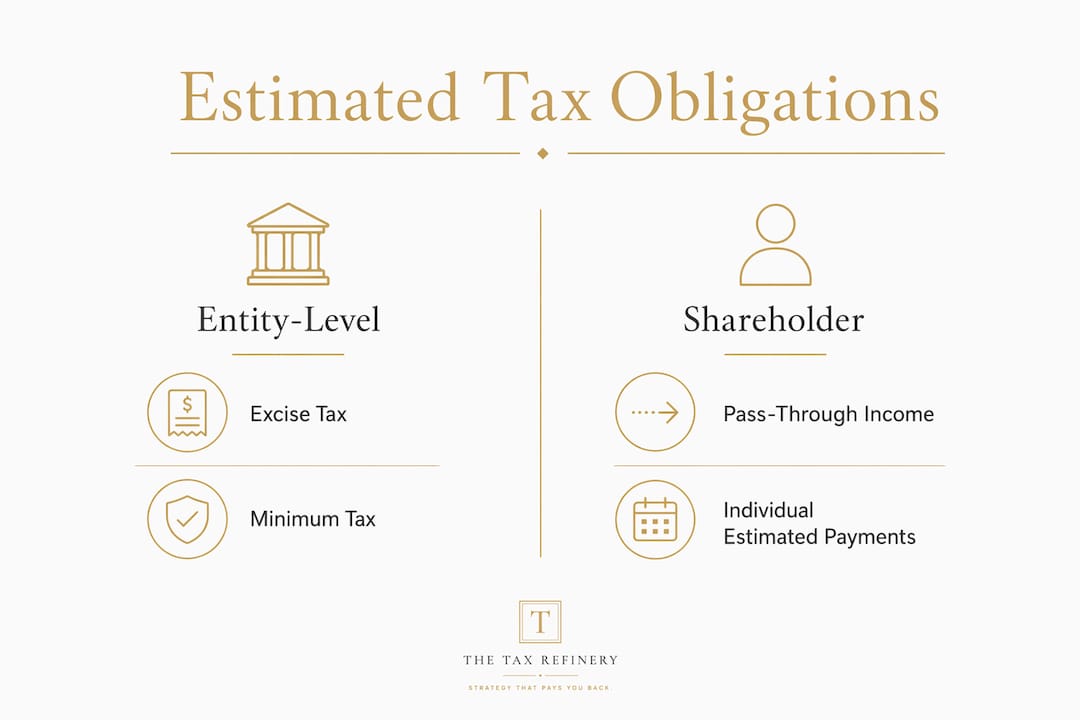
Yes, both the S corporation and its shareholders typically owe estimated tax payments. The S corp pays entity-level excise tax to Oregon when its total liability reaches $500 or more, and each shareholder handles their own estimated payments on pass-through income flowing through their K-1. Here are three things to do right now:
- Check whether your Oregon corporate tax liability will hit the $500 threshold that triggers required estimated payments for the entity.
- Confirm your S corp's obligations on the Oregon DOR corporate page, including the minimum excise tax that applies regardless of profit.
- Set calendar reminders for both Oregon and federal quarterly due dates so neither obligation slips through.
This guide covers every layer: entity vs. shareholder obligations, exact due dates, calculation steps, filing mechanics, and what to do if you overpay.
Table of Contents
- Who actually owes estimated taxes on an S corp?
- When are Oregon and federal estimated payments due?
- How to calculate what your S corp and shareholders owe
- What penalties apply and how do safe harbors protect you?
- How to file and pay Oregon estimated taxes
- What happens when you overpay, and the Oregon 3-year rule
- Payroll withholding vs. estimated payments: which path fits your situation?
- The Tax Refinery's recommended quarterly workflow for Oregon S corps
- Key Takeaways
- Why proactive quarterly estimates protect Oregon S corp owners
- How Thetaxrefinery helps Oregon S corp owners stay current
- Useful sources and official tools
Who actually owes estimated taxes on an S corp?
Two separate obligations run in parallel, and mixing them up is one of the most common compliance mistakes Oregon S corp owners make.
Entity-level obligations. Oregon requires every S corporation carrying on or doing business in the state to pay a $150 minimum excise tax, even in a loss year. This $150 minimum excise tax applies regardless of whether the entity owes additional tax. If the corporation expects its total Oregon tax liability to reach $500 or more, it must make quarterly estimated payments in addition to paying the minimum excise tax. The taxes that can push an S corp over that threshold include the built-in gains tax, excess net passive income tax, and investment credit recapture tax. Ordinary operating income generally passes through to shareholders rather than being taxed at the entity level, but those special taxes are real and can be substantial for recently converted C corps or passive-income-heavy businesses.
Shareholder obligations. Pass-through income appears on each shareholder's Schedule K-1 and becomes part of their individual taxable income. The IRS rule for individuals is a $1,000 threshold: if a shareholder expects to owe $1,000 or more when filing, they generally must make estimated payments using Form 1040-ES. Oregon mirrors this requirement at the individual level, so an Oregon resident shareholder typically owes both federal and state estimated payments on their K-1 income.
How they reconcile at filing. The S corp files Form OR-20 (Oregon Corporation Excise and Income Tax return) and issues K-1s to shareholders. Shareholders then report their allocated income on their personal returns and reconcile any estimated payments made during the year. The timing matters: K-1s are usually finalized after year-end, so shareholders must estimate their share of income throughout the year using interim P&L data and their ownership percentage.
| Obligation | Who Pays | Oregon Threshold | Federal Threshold |
|---|---|---|---|
| Entity-level excise/minimum | S corporation | $150 minimum excise tax always applies; when total liability reaches $500, quarterly estimates are required | $500 triggers quarterly estimates |
| Pass-through income tax | Each shareholder individually | Oregon individual estimated tax rules | $1,000 expected tax owed |
| Built-in gains / passive income tax | S corporation | Included in $500 entity threshold | Included in $500 entity threshold |
Pro Tip: Keep a simple ledger that records every estimated payment by date, amount, payer (entity vs. shareholder), and confirmation number. Electronic payment receipts from Revenue Online or EFTPS serve as your audit trail and make penalty defenses far easier to support.
When are Oregon and federal estimated payments due?
Oregon and the IRS use nearly identical quarterly schedules for calendar-year filers, but the labels differ slightly and fiscal-year filers must map their own dates.

Oregon schedule. For calendar-year filers, Oregon estimated payments are due on the 15th day of the 4th, 6th, 9th, and 12th months of the tax year. In practice, that means April 15, June 15, September 15, and December 15. When any due date falls on a weekend or legal holiday, payment is generally due the next business day.
Federal schedule. The IRS uses April 15, June 15, September 15, and January 15 of the following year for calendar-year individual filers. Note the difference: Oregon's fourth installment is December 15, while the federal fourth installment for individuals is January 15. Missing that distinction costs Oregon S corp owners money every year.
Fiscal-year filers. If your S corp operates on a non-calendar tax year, you shift each due date to the 15th day of the 4th, 6th, 9th, and 12th months of your fiscal year. Map both Oregon and federal schedules against your fiscal calendar at the start of each year and confirm with the Oregon DOR and IRS whether any date adjustments apply.
| Payment | Oregon Due Date (Calendar Year) | Federal Due Date (Individuals) |
|---|---|---|
| 1st installment | April 15 | April 15 |
| 2nd installment | June 15 | June 15 |
| 3rd installment | September 15 | September 15 |
| 4th installment | December 15 | January 15 (following year) |
Confirm current-year dates directly with the Oregon DOR and IRS each January, since statutory holidays occasionally shift a due date by one or two days.
How to calculate what your S corp and shareholders owe
The calculation has two tracks: one for the entity, one for each shareholder. Running both in parallel each quarter keeps you from surprises at filing.
Track 1: Entity-level Oregon estimated tax
- Pull your year-to-date P&L and identify any income categories that trigger entity-level tax: built-in gains, excess net passive income, or investment credit recapture.
- Project those amounts to year-end using your current run rate or known transactions.
- Apply the applicable Oregon corporate rate to the projected taxable amount.
- Check the result against the minimum excise tax. If your calculated tax is below $150, you owe $150. If it reaches $500 or more, divide the annual estimate by four and pay that amount each quarter.
- Cross-check against last year's Oregon corporate return as a reasonableness test.
Worked example: An Oregon S corp expects $8,000 in built-in gains income for the year. Oregon's corporate excise rate applies to that amount. If the resulting tax estimate is $1,200, the quarterly installment is $300. Because $1,200 exceeds the threshold triggering estimated payments, quarterly payments are required.
Track 2: Shareholder estimated tax
- Obtain your current ownership percentage and the corporation's projected net income (ordinary income, separately stated items).
- Multiply projected net income by your ownership percentage to get your estimated K-1 share.
- Add that figure to your other expected income for the year (wages, investment income, etc.).
- Subtract your expected deductions and credits to arrive at estimated taxable income.
- Apply federal and Oregon individual tax rates to compute estimated tax owed.
- Subtract any withholding already being taken from your W-2 salary as an owner-employee.
- Divide the remaining balance by four and pay that amount each quarter using Form 1040-ES (federal) and the Oregon individual estimated payment process.
Worked example: A 100% owner projects $120,000 in S corp net income. After a $60,000 reasonable salary (already subject to payroll withholding), the remaining $60,000 flows as a distribution. At a combined federal and Oregon marginal rate of roughly 35%, the estimated tax on that $60,000 is approximately $21,000 for the year, or about $5,250 per quarter. Withholding from the salary reduces that balance further.
The IRS Tax Withholding Estimator recommends using current payroll and year-to-date income figures as your primary inputs. Reasonable compensation is fact-specific and has no universal salary-to-profit percentage; the IRS evaluates duties, experience, time devoted, and comparable market pay when assessing whether an owner's salary is defensible.
Pro Tip: Overestimating your quarterly payment by 5–10% is almost always cheaper than paying an underpayment penalty. The penalty accrues daily; a modest overpayment simply becomes a credit or refund at filing.
What penalties apply and how do safe harbors protect you?
Oregon and the IRS both impose underpayment penalties when estimated payments fall short, but safe-harbor rules give you a clear target to aim for.
Oregon corporate underpayment. Oregon's rules, including Oregon SOS administrative rule provisions on estimated tax payments, require corporations to pay sufficient installments to avoid penalty. The penalty applies when the corporation fails to pay the required amount by each installment due date. Citing ORS Chapter 317 and related administrative rules, Oregon computes the penalty on the underpaid amount for the period it remained unpaid.
Federal safe harbors for shareholders. Individual shareholders can avoid federal underpayment penalties by meeting one of two tests:
Pay at least 90% of the current year's tax liability, or pay 100% of the prior year's tax (110% if your prior-year adjusted gross income exceeded $150,000). Meeting either test shields you from the federal underpayment penalty even if you owe a balance at filing.
These safe-harbor thresholds are the practical benchmarks most Oregon S corp shareholders use when setting quarterly payment amounts.
Penalty math example. Suppose a shareholder owed $20,000 in federal tax for the year but paid only $14,000 through withholding and estimated payments. The $6,000 shortfall is subject to the IRS underpayment rate (which adjusts quarterly) for each period it was underpaid. On a $6,000 shortfall at a 7% annual rate, the penalty approaches $420 for a full year of underpayment. That number grows quickly when income is higher.
Annualizing uneven income. If your S corp income spikes in one quarter, you can annualize income and make unequal payments to reduce penalties. Form 2210 (individuals) and Form 2220 (corporations) let you compute or request a waiver of the underpayment penalty when income was not received evenly throughout the year. This is especially useful for seasonal businesses in Oregon's construction, landscaping, or hospitality sectors.
How to file and pay Oregon estimated taxes
Filing and paying correctly means using the right forms, the right portals, and including the right identifying details so payments are credited accurately.
Oregon payment steps
- Download the current-year Form OR-20 and its associated payment vouchers from the Oregon DOR website.
- Log in to Revenue Online at the Oregon DOR portal to make an electronic payment. Enter your Federal Employer Identification Number (FEIN), the applicable tax period, and the voucher number.
- Alternatively, arrange an Electronic Funds Transfer (EFT) directly with Oregon DOR if your annual tax liability meets the EFT threshold. Contact Oregon DOR to enroll.
- If mailing a check, attach the correct payment voucher and write your FEIN and tax period on the check.
- Record the confirmation number and payment date in your bookkeeping system immediately.
Federal payment steps
- Use EFTPS (Electronic Federal Tax Payment System) for corporate estimated tax deposits. Enroll at eftps.gov if you have not already.
- Individual shareholders use the IRS Online Account or IRS Direct Pay to submit Form 1040-ES payments. The IRS Online Account lets you track payment history in real time, which supports safe-harbor documentation.
- Schedule each payment at least one business day before the due date to allow processing time.
| Payment Type | Oregon Method | Federal Method |
|---|---|---|
| Corporate estimated tax | Revenue Online / EFT / OR-20 voucher | EFTPS |
| Shareholder estimated tax | Oregon individual estimated payment | IRS Direct Pay / EFTPS / 1040-ES |
| Required identifying info | FEIN, tax period, voucher number | EIN or SSN, tax year, payment type |
- After each payment, reconcile the amount against your quarterly calculation worksheet and note it in your general ledger under "estimated tax payments." This step makes K-1 and payroll reconciliation at year-end straightforward.
What happens when you overpay, and the Oregon 3-year rule
Overpayments are common when income projections run high, and Oregon has specific rules about how and when you can recover them.
- Requesting a refund or credit. When the S corp files Form OR-20, any overpayment of estimated taxes can be applied as a credit to the next year's liability or refunded. Oregon SOS administrative rules address how refunds are handled prior to filing and what documentation supports a refund claim.
- The 3-year statute of limitations. Oregon generally allows a corporation to claim a refund within three years of the original return due date (or two years from the date the tax was paid, whichever is later). This "3-year rule" is why timing matters: waiting too long to file an amended return or claim a refund can permanently forfeit the overpayment.
- Mid-year S election changes. If your corporation changes its S election status mid-year, or if shareholder composition shifts, estimated payment obligations can change immediately. Oregon SOS administrative rules include provisions that address how refunds and estimated payments are handled when corporate status changes during the tax year. Document the effective date of any status change and notify Oregon DOR promptly.
- Practical next steps if you believe you overpaid. Gather your Form OR-20, all payment confirmation records, and the relevant tax year's P&L. Contact Oregon DOR directly to confirm the overpayment amount before filing an amended return or requesting a refund. Keep copies of all correspondence.
- Shareholder-level overpayments. If a shareholder overpaid individual estimated taxes because K-1 income came in lower than projected, the excess is reconciled on their personal return and either refunded or credited forward.
Payroll withholding vs. estimated payments: which path fits your situation?
The choice between increasing payroll withholding and making separate quarterly estimates is not just administrative preference. It has real compliance and cash-flow implications.
Scenarios where payroll withholding makes more sense:
- Your owner salary is stable and predictable throughout the year.
- You want withholding to cover most of your individual tax liability automatically, reducing the number of manual estimated payment transactions.
- Your bookkeeper or payroll provider can adjust withholding mid-year when income projections change.
Reviewing common payroll compliance mistakes before adjusting owner withholding can prevent errors that create their own penalty exposure.
Scenarios where quarterly estimates are the better path:
- S corp income is uneven (seasonal revenue, large project completions, or irregular distributions).
- You receive significant non-wage income that withholding cannot cover.
- Your reasonable salary is set conservatively and distributions make up a large share of your total draw.
Red flags that mean it's time to call an advisor:
- A large unexpected distribution late in the year that was not factored into earlier estimates.
- Revenue swings of 30% or more from one quarter to the next.
- Missing payroll runs or gaps in owner W-2 wages.
- K-1 allocations that do not match your ownership percentage or the operating agreement.
- Inconsistent bookkeeping that makes it impossible to produce a reliable year-to-date P&L.
Questions to ask your payroll provider or tax advisor this quarter:
- Is my current withholding rate sufficient to cover my projected individual tax liability, including K-1 income?
- Have we accounted for Oregon's December 15 fourth-installment deadline in the payroll calendar?
- Does my reasonable salary reflect current market rates, and is it documented? (See the S Corp reasonable salary guide for a compliance framework.)
The Tax Refinery's recommended quarterly workflow for Oregon S corps
A repeatable quarterly process is what separates owners who stay ahead of their tax obligations from those who scramble every April. Here is the workflow Thetaxrefinery recommends for Oregon S corp clients.
Monthly tracking (takes 30 minutes or less)
- Pull a current P&L from your accounting software and note year-to-date net income.
- Confirm payroll ran correctly and owner W-2 wages are on track.
- Log any distributions taken and compare them to your projected annual draw.
Quarterly calculation checkpoints
- Update your income projection. Multiply year-to-date net income by (12 ÷ months elapsed) to get an annualized estimate.
- Calculate your K-1 share. Multiply projected net income by your ownership percentage.
- Subtract withholding. Deduct year-to-date payroll withholding from your projected individual tax.
- Divide by remaining installments. Spread the balance across the quarters still due.
- Check the entity threshold. Confirm whether the S corp's entity-level tax (built-in gains, passive income) will exceed $500 and calculate the corporate installment separately.
Sample spreadsheet fields:
| Field | Formula / Input |
|---|---|
| Projected annual net income | YTD net income × (12 ÷ months elapsed) |
| Owner K-1 share | Projected net income × ownership % |
| Estimated individual tax | K-1 share × combined marginal rate |
| Less: payroll withholding | YTD W-2 withholding |
| Remaining estimated tax | Estimated individual tax minus withholding |
| Quarterly installment | Remaining estimated tax ÷ remaining quarters |
Documentation to keep
- Payroll records and W-2 year-to-date summaries each quarter.
- Job description and market compensation data supporting your reasonable salary decision.
- Payment confirmation numbers for every Oregon and federal estimated payment.
- The quarterly P&L and calculation worksheet used to set each installment.
For owners who want a proactive tax planning framework built around these quarterly checkpoints, Thetaxrefinery's advisory engagements are structured around exactly this workflow.
Key Takeaways
Oregon S corps and their shareholders face two parallel estimated-tax obligations, and meeting both on time requires a documented quarterly workflow tied to current P&L data.
| Point | Details |
|---|---|
| Check the $500 entity threshold | Oregon S corps must make quarterly estimated payments when total entity-level tax reaches $500 or more. |
| $150 minimum always applies | Oregon's $150 minimum excise tax is required to be paid every year, even in a loss year, and does not pass through to shareholders. |
| Shareholders use the $1,000 rule | Individual shareholders must make estimated payments when they expect to owe $1,000 or more at filing. |
| Oregon's 4th installment is December 15 | Oregon's fourth quarterly due date is December 15, not January 15 like the federal individual schedule. |
| Thetaxrefinery builds the workflow for you | Thetaxrefinery's quarterly advisory engagements cover calculation, payroll coordination, and Oregon and federal filing support. |
Why proactive quarterly estimates protect Oregon S corp owners
Most S corp owners I work with underestimate one thing: how quickly the gap between projected and actual income can create a penalty problem. The math is straightforward, but the execution requires discipline that is hard to maintain when you are also running a business.
The conventional wisdom is to wait until late in the year, look at the numbers, and make a catch-up payment. That approach works until it doesn't. A large distribution in October, a project that closes in November, or a bookkeeping delay that pushes reconciliation into January can all leave you with an underpayment that accrues penalties from the missed installment date, not from the filing date. Oregon's December 15 fourth-installment deadline makes this especially unforgiving.
What actually works is treating estimated tax as a monthly cash-flow line item, not an annual surprise. Owners who pull a P&L every month, confirm payroll ran correctly, and adjust their quarterly estimate based on real numbers almost never face material underpayment penalties. The process takes less time than most people think, and the cost of getting it wrong, measured in penalties, interest, and the stress of a surprise balance due, is almost always higher than the cost of staying current.
Year-round advisory involvement also creates a defensible record. When the IRS or Oregon DOR asks about reasonable compensation or the basis for an estimated payment, a documented quarterly calculation worksheet is far more persuasive than a year-end reconstruction.
How Thetaxrefinery helps Oregon S corp owners stay current
Estimated tax compliance for an Oregon S corp is not a once-a-year task. It requires quarterly calculation, payroll coordination, and clean documentation across both Oregon and federal obligations.

Thetaxrefinery works with Oregon S corp owners on exactly this: quarterly tax projections built from your actual P&L and payroll data, reasonable compensation documentation, and coordinated Oregon DOR and IRS filing support. An initial consultation reviews your prior-year returns and current year-to-date P&L to recommend specific quarterly installment amounts for both the entity and each shareholder. The firm's S-Corp Accelerator is built for owners who want a repeatable, defensible quarterly process without managing it alone. To see how the firm's advisory model compares to traditional annual-only tax prep, visit the tax strategy comparison page and schedule a consultation.
This article is general information, not professional tax or legal advice. Confirm current Oregon DOR rules and IRS requirements with a qualified tax professional for your specific situation.
Useful sources and official tools
- Oregon DOR Corporation Excise and Income Tax page — Official source for Oregon S corp requirements, minimum excise tax, estimated payment rules, and Form OR-20. Start here for any Oregon-specific question.
- Oregon Secretary of State Administrative Rules (Rule 150-317-1300) — Official administrative rule language on estimated tax payments, refunds, and mid-year status changes. Cite this when documenting your compliance position.
- IRS Estimated Taxes page — Covers federal thresholds ($500 for corporations, $1,000 for individuals), due dates, Form 2210, Form 2220, and safe-harbor rules. Official government source.
- IRS Publication 505: Tax Withholding and Estimated Tax — Detailed IRS guidance on calculating withholding and estimated payments, including the annual estimated tax worksheet. Useful for shareholders modeling their individual liability.
- IRS Tax Withholding Estimator — Free IRS calculator that uses payroll and income data to estimate tax and flag underpayment risk. Practical tool for shareholders adjusting mid-year.
- IRS FAQ: Is an S corporation required to pay quarterly estimated tax? — Direct IRS answer on when S corps must make installment payments and which taxes trigger the requirement. Official government source.