
S corp distributions are tax-free only up to your stock basis; any amount beyond that is taxed as capital gain under IRC §1368. That single rule governs every cash withdrawal you take from your S corporation, and getting it wrong creates audit exposure, unexpected tax bills, and potential penalties.
Before you take another distribution, verify three things:
- Confirm your year-end stock basis. Basis is computed as of the last day of the corporation's taxable year, not the day you write the check. Use Form 7203 to document it.
- Confirm your S corp's AAA, PTI, and AE&P positions. If your corporation converted from a C corp or acquired one, accumulated earnings and profits (AE&P) can convert what looks like a tax-free return of capital into a taxable dividend.
- Document reasonable compensation before taking large distributions. Owner-employees must receive a defensible W-2 salary first. Distributions are not a substitute for wages.
The IRS, through Irs, provides the reporting framework for Form 1120-S and Schedule K-1. Thetaxrefinery, founded by Enrolled Agent Melissa Korber, advises S corp owners on exactly these compliance points year-round.
Key Takeaways
S corp distributions are tax-free only to the extent of your stock basis; any excess is taxed as capital gain, and AE&P from prior C corp years can convert distributions into taxable dividends.
| Point | Details |
|---|---|
| Basis determines taxability | Distributions are tax-free up to stock basis; amounts beyond basis are taxed as capital gain under IRC §1368. |
| Sourcing order governs AE&P exposure | Distributions are sourced AAA first, then PTI, then AE&P (taxable dividend), then OAA — track all four accounts annually. |
| Salary must come before distributions | Owner-employees must receive reasonable W-2 compensation before taking distributions; zero officer pay is a top audit trigger. |
| Form 7203 is your basis record | Shareholders are responsible for tracking their own basis; Form 7203 is the IRS worksheet and should be attached to the individual return. |
| Thetaxrefinery delivers year-round compliance | Thetaxrefinery provides annual basis schedules, compensation memos, AE&P sourcing analysis, and amended return preparation for S corp owners. |
Table of Contents
- What are S corp distributions, exactly?
- How are S corp distributions taxed? The sourcing and ordering rules
- How to compute your stock basis step by step
- Salary vs. distributions: how to set and document the split
- How to report distributions: forms, lines, and recordkeeping
- AE&P, redemptions, liquidations, and elections that change sourcing
- Common mistakes S corp owners make with distributions
- How Thetaxrefinery advises clients on S corp distributions
- What most owners get wrong about S corp distributions
- Thetaxrefinery handles S corp distribution compliance for you
- Sources
What are S corp distributions, exactly?
A distribution is any transfer of cash or property from the S corporation to a shareholder with respect to their stock. That phrase "with respect to stock" matters because it separates distributions from wages, loan repayments, and expense reimbursements, each of which carries different tax treatment.
Cash distributions are the most common: the corporation transfers funds from its bank account to the shareholder's personal account. Property distributions (equipment, inventory, real estate) are valued at fair market value on the distribution date, and the corporation may recognize gain as if it sold the property at that value.
Beyond cash and property, the type of distribution also shapes the tax outcome:
- Non-dividend distributions are returns of capital. They reduce stock basis and are tax-free up to that basis. Most S corp withdrawals fall here when no AE&P exists.
- Dividend distributions arise when the corporation has AE&P from prior C corporation years. These are taxable to the shareholder as ordinary dividend income.
- Liquidating distributions occur when the corporation winds down. They are governed by IRC §§331 and 336, which generally treat the shareholder as selling their stock and the corporation as selling its assets.
- Redemptions are buybacks of a shareholder's stock. Under IRC §302, a qualifying redemption is treated as a sale or exchange (capital gain treatment). A redemption that fails the IRC §302 tests is recharacterized as a distribution under IRC §1368.
On Schedule K-1, non-dividend distributions appear in Box 16, Code D. When a distribution is taxable as a dividend, the corporation issues Form 1099-DIV.
How are S corp distributions taxed? The sourcing and ordering rules
The tax treatment of any distribution depends on where it is sourced. When an S corporation has no AE&P, the rule is straightforward: distributions are non-taxable up to stock basis and taxed as capital gain beyond it. When AE&P exists, the sourcing order becomes critical.
The four-tier sourcing order
Per IRS LB&I practice guidance and IRC §1368, distributions are sourced in this sequence:
| Source | Tax Treatment | Reporting | Practical Effect |
|---|---|---|---|
| Accumulated Adjustments Account (AAA) | Non-dividend; tax-free up to stock basis | Schedule K-1, Box 16D | Reduces AAA and stock basis dollar-for-dollar |
| Previously Taxed Income (PTI) | Non-dividend; tax-free up to PTI balance | Schedule K-1, Box 16D | Rare; applies to pre-1983 S corp earnings |
| Accumulated Earnings & Profits (AE&P) | Taxable dividend at ordinary dividend rates | Form 1099-DIV | Arises only from prior C corp history |
| Other Adjustments Account (OAA) | Non-dividend; tax-free up to stock basis | Schedule K-1, Box 16D | Covers tax-exempt income items |
Worked numeric example
At the start of the year: AAA balance is $30,000, AE&P from a prior C corp conversion is $20,000, and stock basis is $35,000.
During the year, the corporation distributes $60,000 total in two payments of $30,000 each.
- First $30,000: Sourced entirely from AAA. AAA drops to $0. Stock basis drops from $35,000 to $5,000. Tax-free to the shareholder.
- Next $20,000 of the second distribution: Sourced from AE&P. Taxable as a dividend. Stock basis is unaffected by dividend distributions.
- Remaining $10,000 of the second distribution: AAA is exhausted and AE&P is exhausted. This amount is sourced from OAA or treated as a non-dividend distribution in excess of basis. With only $5,000 of stock basis remaining, $5,000 is tax-free and $5,000 is taxed as capital gain.
The shareholder's total tax exposure: $20,000 in dividend income plus $5,000 in capital gain, on a $60,000 distribution. Without tracking AAA and AE&P, that exposure is invisible until the return is filed.
Pro Tip: Elections that change the sourcing order (such as electing to distribute AE&P before AAA) are irrevocable for the tax year and require the consent of all affected shareholders. Use them deliberately, not as a last-minute fix. They can be valuable when shareholders want to purge AE&P and eliminate future dividend risk, but the timing and consent requirements make them a decision for early in the tax year, not December.
How to compute your stock basis step by step
Stock basis is determined as of the end of the corporation's taxable year, and shareholders are responsible for tracking it themselves. The IRS does not maintain a basis record for you. Relying solely on the corporation's books without an annual basis schedule leaves you exposed in an audit.
Annual basis adjustment order under IRC §1367
Start with your prior year-end basis, then apply adjustments in this sequence:
- Add ordinary business income and separately stated income items (including tax-exempt income).
- Subtract distributions received during the year.
- Subtract nondeductible, noncapital expenses.
- Subtract passed-through losses and deductions.
This order matters. Distributions reduce basis before losses do, which means a large distribution early in the year can eliminate basis and push losses into a suspended category.
Basis worksheet: worked example
| Item | Amount |
|---|---|
| Beginning stock basis (prior year-end) | 30,000 |
| + Ordinary business income (pass-through) | 30,000 |
| + Tax-exempt income items | 30,000 |
| Subtotal before distributions | $66,000 |
| – Cash distributions received | ($30,000) |
| – Nondeductible expenses | ($3,000) |
| – Passed-through losses | ($8,000) |
| Ending stock basis | $36,000 |
In this example, the $30,000 distribution is fully tax-free because basis after income additions ($66,000) exceeds the distribution. If the distribution had been $70,000 instead, $4,000 would be taxable as capital gain.
Form 7203 (Stock and Debt Basis Limitations) is the IRS worksheet for this computation. Shareholders with losses, deductions, or distributions should attach it to their individual return.
Sample corporate journal entry for a $30,000 cash distribution:
Debit: Retained Earnings / Shareholder Equity — $30,000 Credit: Cash — $30,000
The corporation records the distribution as a reduction in equity. No income or expense is recognized at the corporate level for a cash distribution. Retain the board minutes authorizing the distribution alongside this entry for audit documentation.
One timing note: if the S corporation and a shareholder have different tax year ends (uncommon but possible), the shareholder picks up basis adjustments in the year the corporation's tax year ends, not when the distribution is received. This can create a mismatch that requires careful coordination at filing.
Salary vs. distributions: how to set and document the split
Owner-employees must receive reasonable compensation for services before taking profit distributions. Distributions are not a substitute for wages, and the IRS knows it. That gap is exactly why the IRS scrutinizes S corp owners who report minimal or no officer compensation.
The IRS guidance on S corporation employees and officers is clear: compensation must be reasonable for the services actually performed. Courts and examiners evaluate reasonable compensation using factors that include:
- Duties performed and hours worked by the owner in the business
- Comparable wages paid to non-owner employees doing similar work
- Compensation paid by similar companies in the same industry and geography
- Business size, revenue, and profitability relative to the compensation paid
- Fringe benefits and other non-cash compensation included in the package
No fixed salary-to-distribution ratio is defensible on its own. A 60/40 split that works for one business may be indefensible for another. The standard is what an arm's-length employer would pay for the same services.
Pro Tip: Document your reasonable compensation decision with a contemporaneous memo that references third-party wage data (Bureau of Labor Statistics Occupational Employment Statistics, industry salary surveys, or a formal compensation study). Run payroll on a regular schedule rather than in a single year-end lump. A documented compensation study and consistent payroll runs are the two factors that most reduce audit risk on this issue, per WageProof's guidance on S corp owner compensation.
A practical owner pay-policy checklist:
- Write a job description for your role in the business
- Pull at least one third-party wage benchmark for that role in your market
- Document the benchmarking source and the date you reviewed it
- Set payroll on a regular schedule (monthly or bi-weekly, not annual)
- Record board minutes authorizing the salary level
- Retain the compensation memo and benchmarking data in your corporate records
For deeper guidance on setting and documenting your salary, Thetaxrefinery's S corp reasonable salary guide walks through the IRS factors and documentation process in detail.
How to report distributions: forms, lines, and recordkeeping
The reporting chain for S corp distributions runs from the corporation's Form 1120-S through Schedule K-1 to the shareholder's individual return, with Form 1099-DIV added when AE&P dividends are involved.
Form 1120-S: The corporation reports total distributions on Schedule K, Line 16d (non-dividend distributions). If AE&P dividends were paid, they appear separately. The IRS S corporations page outlines the full reporting flow for pass-through items.
Schedule K-1: Each shareholder receives a K-1 showing their share of income, losses, deductions, and distributions. Non-dividend distributions appear in Box 16, Code D. Shareholders use this figure, combined with their own basis schedule, to determine taxability. The K-1 does not tell the shareholder whether the distribution is taxable; that determination depends on the shareholder's individual stock basis.
Form 1099-DIV: When distributions are sourced from AE&P and treated as dividends, the corporation must issue a 1099-DIV to the shareholder. This is a separate reporting obligation from the K-1 and is often missed when AE&P history is not tracked.
Recordkeeping checklist:
- Annual stock basis schedule (updated each year, retained indefinitely)
- Board minutes authorizing each distribution and the compensation level
- Payroll records and W-2s for owner-employees
- K-1 copies for all tax years (at minimum, the open statute of limitations period)
- AE&P computation workpapers when prior C corp history exists
- Form 7203 for any year with losses, deductions, or distributions
State tax note: State treatment of S corp distributions varies. Some states do not recognize the S election and tax the corporation at the entity level. Others conform to federal treatment but apply different rates or basis rules. Idaho, for example, conforms to the federal S corp election but has its own income tax rates and filing requirements. Oregon similarly conforms but imposes a minimum excise tax on S corporations. For state-specific filing impacts, consult a tax advisor familiar with your state's rules or review your state's department of revenue guidance directly. Thetaxrefinery's Oregon S corp estimated tax guide covers state-level obligations for owners operating in that market.
AE&P, redemptions, liquidations, and elections that change sourcing
AE&P from prior C corporation years
When an S corporation was previously a C corporation (or acquired one in a tax-free reorganization), it may carry AE&P into its S corp years. That AE&P does not disappear. It sits on the books and converts distributions that exceed AAA into taxable dividends. Owners who have never seen a dividend on their K-1 can be surprised when a large distribution triggers one because AE&P was never cleared.
Before any significant cash withdrawal from a corporation with C corp history, run a distribution sourcing analysis. The question is whether AAA is sufficient to cover the planned distribution. If not, the excess is sourced from AE&P and becomes a taxable dividend.
Redemptions under IRC §302
A redemption is not automatically a distribution. When a corporation buys back a shareholder's stock, IRC §302 tests determine whether the transaction qualifies as a sale or exchange (capital gain treatment) or is recharacterized as a distribution under IRC §1368.
A redemption qualifies for sale treatment when it is:
- Not essentially equivalent to a dividend (a facts-and-circumstances test)
- Substantially disproportionate (the shareholder's ownership drops below 80% of their pre-redemption percentage and below 50% of total voting stock)
- A complete termination of the shareholder's interest
- A partial liquidation of the corporation
Sale treatment is generally preferable because it allows the shareholder to offset their basis against the proceeds and potentially access long-term capital gain rates. A redemption that fails all four tests is treated as a distribution under IRC §1368, sourced through AAA and AE&P in the normal order.
Liquidating distributions under IRC §§331 and 336
When an S corporation liquidates, shareholders treat distributions as proceeds from the sale of their stock under IRC §331. The corporation recognizes gain or loss on distributed assets as if it sold them at fair market value under IRC §336. Both the corporate-level gain and the shareholder-level gain flow through the S corp's pass-through structure, so the tax consequences can be significant. Get tax counsel before executing a liquidation.
Elections that alter sourcing
Four elections can change the distribution sourcing order for a tax year:
- Elect to distribute AE&P before AAA (useful for purging AE&P and eliminating future dividend risk)
- Forego PTI (rarely used; applies to pre-1983 earnings)
- Deemed dividend election (treats a distribution as a dividend to the extent of AE&P, bypassing AAA)
- Separate tax year election (applies when a shareholder's interest terminates mid-year)
All four elections are irrevocable for the tax year in which they are made and require the consent of all affected shareholders. Timing and unanimous consent are non-negotiable requirements.
Common mistakes S corp owners make with distributions
Most distribution errors trace back to three root causes: no basis tracking, no documented salary, and no AE&P awareness. Here is where owners go wrong and what to do about it.
-
Failing to maintain an annual stock basis schedule. Without a current basis schedule, you cannot determine whether a distribution is taxable. The fix: reconstruct basis from the earliest open tax year using K-1s, contribution records, and loan documentation. Attach Form 7203 going forward.
-
Taking distributions before setting a defensible salary. If the IRS reclassifies distributions as wages, the corporation owes back payroll taxes, penalties, and interest. The fix: run a compensation study, correct payroll filings, and file amended payroll tax returns (Form 941-X) if needed.
-
Ignoring AE&P from a prior C corp. Owners who converted from a C corp or acquired an S corp in a stock purchase often do not know AE&P exists. The fix: pull the corporate tax returns from the C corp years, compute the AE&P balance, and run a sourcing analysis before the next distribution.
-
Misreporting on Schedule K-1 or failing to issue Form 1099-DIV. When AE&P dividends are paid but reported only as non-dividend distributions on the K-1, the shareholder underreports income. The fix: amend the corporate return (Form 1120-S) and issue corrected K-1s and 1099-DIVs.
Red-flag audit triggers to watch for:
- Zero officer compensation on Form 1120-S with large distributions
- Large distributions relative to documented stock basis
- Disproportionate distributions among shareholders without a written agreement or minutes
- AE&P on the books with no sourcing analysis in the file
Documentation checklist to implement today:
- Open a dedicated folder for corporate records: minutes, payroll, K-1s, basis schedules
- Update your stock basis schedule annually before filing the corporate return
- Run payroll on a regular schedule and retain all W-2s and 941s
- Document every distribution with board minutes stating the amount, date, and authorization
How Thetaxrefinery advises clients on S corp distributions
Thetaxrefinery's advisory process for S corp distribution clients follows a structured sequence designed to surface compliance gaps before they become audit issues.
Typical client deliverables include:
- Annual stock basis worksheet: Reconstructed or updated each year using K-1s, contribution records, and loan documentation. Attached to the shareholder's individual return via Form 7203.
- Written reasonable compensation memo: Documents the owner's role, hours, duties, and the third-party benchmarking data used to set the salary. Retained in the corporate file.
- AE&P sourcing memo: Prepared when prior C corp history exists or when the corporation was acquired in a stock purchase. Identifies the AE&P balance and maps planned distributions against the sourcing order.
- Minutes and payroll documentation: Board minutes authorizing compensation levels and distributions, coordinated with payroll records.
- Amended returns and voluntary corrections: When prior-year distributions were misreported or basis was not tracked, Thetaxrefinery prepares amended Form 1120-S returns, corrected K-1s, and, where needed, amended payroll tax filings.
Advisory intake checklist:
- Document review: prior-year corporate returns, K-1s, payroll records, and any C corp history
- Basis recomputation: reconstruct stock basis from the earliest open year
- Compensation benchmarking: pull market data and draft the compensation memo
- Distribution policy: set a written distribution policy with minutes and a sourcing analysis
- Year-end reporting: coordinate K-1 preparation, Form 7203 attachment, and 1099-DIV issuance
When to engage a tax advisor: Complex AE&P history, large redemptions or buyouts, IRS audit or inquiry, inconsistent payroll history, multistate operations, or any year where distributions exceeded documented stock basis. These situations carry enough risk that the cost of professional guidance is typically a fraction of the potential tax and penalty exposure.
Melissa Korber, EA, founded Thetaxrefinery to serve business owners who need year-round strategy, not a once-a-year filing. For owners navigating S corp distribution planning as part of a broader tax strategy, the S corp tax planning guide on the Thetaxrefinery blog covers the full planning roadmap.
What most owners get wrong about S corp distributions
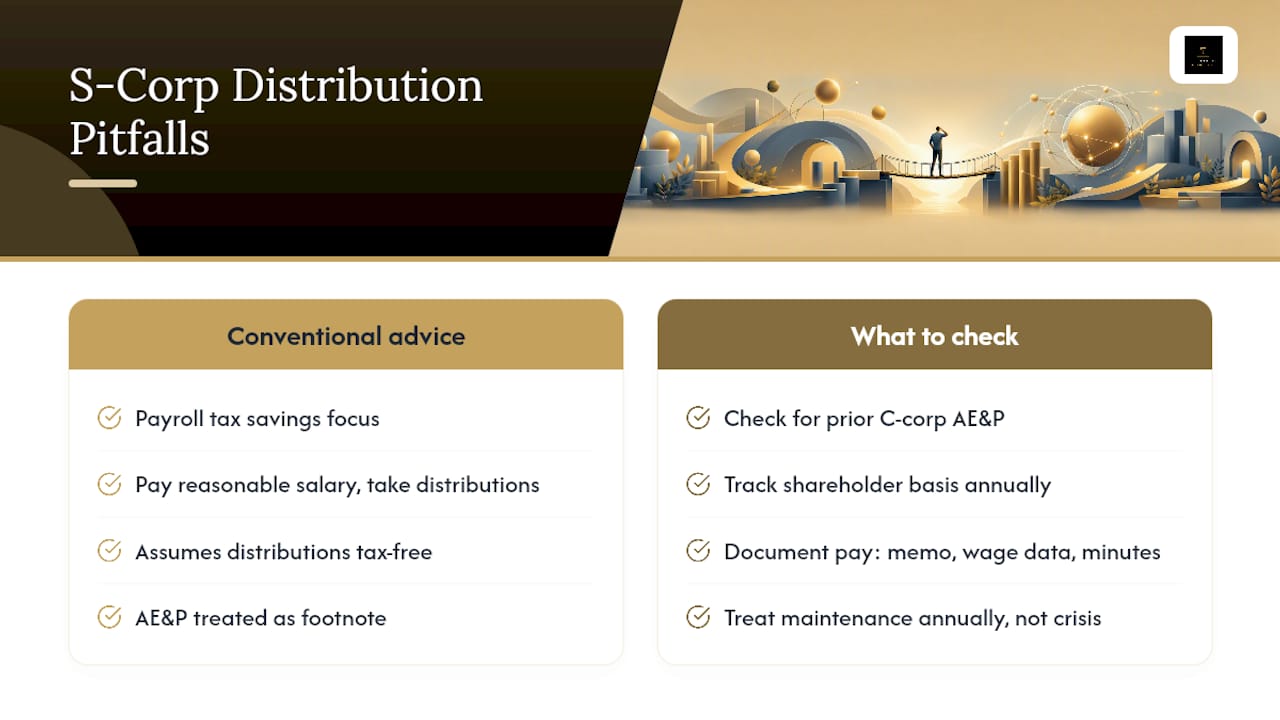
The conventional advice on S corp distributions focuses almost entirely on the payroll tax savings: pay yourself a "reasonable" salary, take the rest as distributions, and pocket the FICA difference. That framing is not wrong, but it is dangerously incomplete for the owners who need it most.
The owners who get hurt are not the ones who ignore S corps entirely. They are the ones who set up the structure, take distributions for several years without tracking basis, and then face a large redemption, a sale, or an IRS inquiry. At that point, reconstructing basis from scratch across multiple years is expensive, time-consuming, and sometimes impossible if records were not kept. The tax bill on a distribution that was assumed to be tax-free can arrive years after the cash was spent.
Two things are consistently underweighted in standard guidance. First, AE&P from prior C corp history is treated as a footnote when it should be a threshold question. Before any S corp owner takes a large distribution, the first question should be whether AE&P exists, not how much basis is available. Second, the documentation standard for reasonable compensation is higher than most owners realize. A verbal agreement with yourself about what your salary "should be" is not documentation. A written memo with third-party wage data, a regular payroll schedule, and board minutes is.
The owners who navigate this cleanly are the ones who treat basis tracking and compensation documentation as annual maintenance, not a crisis response. That discipline is not complicated. It just requires doing it every year, not only when something goes wrong.
Thetaxrefinery handles S corp distribution compliance for you
S corp distribution planning done right means annual basis schedules, a defensible compensation memo, and a sourcing analysis before every significant withdrawal. Most owners are doing one of those three things. Few are doing all three consistently.

Thetaxrefinery works with S corp owners netting $300,000 or more who want year-round advisory support, not a once-a-year filing. The firm's subscription-based engagement model means your basis schedule is updated annually, your compensation is benchmarked against real market data, and your distribution policy is documented before the IRS asks about it. Melissa Korber, EA, leads the advisory work directly. If you have C corp history, a recent acquisition, or years of undocumented distributions behind you, that is exactly the situation Thetaxrefinery is built for. Review the tax strategy and advisory packages to see which engagement level fits your business, or use the tax calculator to get a quick read on your current exposure.
Sources
- 26 U.S. Code § 1368 - Distributions | LII / Cornell Law School
- S Corporations | Internal Revenue Service