
S-Corp owners can use a Solo 401(k), and if you pay yourself W-2 wages and adopt the plan by December 31, you can stack employee deferrals and employer profit-sharing contributions to shelter up to the legal maximum contribution limit in 2026, which is higher if you're 50 or older. The math works in your favor, but only if you follow the right sequence.
Three steps to take now:
- Confirm W-2 wages and employee count. Solo 401(k) eligibility requires that you pay yourself W-2 wages from the S-Corp and that no eligible non-owner employees exist. K-1 distributions do not count toward contributions.
- Adopt the plan document by December 31. Missing this date eliminates your ability to make employee elective deferrals for the entire tax year, even if you fund employer contributions later.
- Set payroll to withhold deferrals and document reasonable compensation. Your W-2 salary is the foundation of every contribution calculation, so the number needs to be defensible before year-end.
Two contribution buckets make up your total: the employee elective deferral (up to $24,500 in 2026, or $32,500 with catch-up for ages 50+) and the employer profit-sharing contribution (up to 25% of W-2 wages). Both count toward the combined annual cap. The most common pitfall is using K-1 distributions as the contribution base, which is incorrect and creates audit exposure.
Table of Contents
- How does a Solo 401(k) work for an S-Corp?
- How do you calculate your Solo 401(k) maximum as an S-Corp owner?
- What counts as reasonable W-2 compensation for an S-Corp owner?
- What are the plan adoption and funding deadlines you must meet?
- How do payroll and tax reporting work for Solo 401(k) contributions?
- Solo 401(k) vs. SEP IRA: which plan fits your situation?
- What strategies help S-Corp owners maximize Solo 401(k) savings?
- What compliance pitfalls do S-Corp owners need to avoid?
- Key Takeaways
- What Thetaxrefinery sees working in practice
- How Thetaxrefinery helps you set up and maximize your Solo 401(k)
- Authoritative sources for further reading
How does a Solo 401(k) work for an S-Corp?
The IRS classifies a Solo 401(k), sometimes called a one-participant 401(k) or individual 401(k), as a standard 401(k) plan that covers only the business owner and their spouse. Because no other employees participate, it is exempt from nondiscrimination testing, which is one of its most practical advantages.
Eligibility: the owner-only rule
An S-Corp can sponsor a Solo 401(k) as long as no eligible non-owner employees exist. "Owner-only" is a functional test, not a legal one. A multi-owner S-Corp with two shareholders and no other eligible staff still qualifies. The plan loses its Solo 401(k) status the moment a non-owner employee meets the plan's eligibility criteria, typically age 21 and one year of service with 1,000+ hours.
Long-term part-time (LTPT) worker rules add a newer wrinkle: employees who log 500 or more hours in two consecutive years can become eligible under SECURE 2.0, which may force a plan reclassification. If you have part-time staff, track their hours annually.
The owner's spouse can participate in the plan if they receive W-2 wages from the S-Corp. That doubles the household contribution capacity, which is one of the most underused strategies in small-business retirement planning.
Two contribution buckets
- Employee elective deferral: You contribute as an employee, up to $24,500 in 2026. This can be pre-tax (traditional) or Roth. For ages 50+, a catch-up of $8,000 raises the limit to $32,500. Under SECURE 2.0, owners whose prior-year Social Security wages (Box 3 of the W-2) exceeded $150,000 must treat catch-up contributions as Roth starting in 2026, regardless of their preference.
- Employer profit-sharing contribution: The S-Corp contributes up to 25% of your W-2 wages. This is a corporate deduction on Form 1120-S and does not reduce your W-2 for payroll-tax purposes.
Both buckets stack toward the combined annual limit. The compensation cap for 2026 limits the W-2 wages that can be used in the employer contribution calculation.
Why W-2 wages are the only valid base
Contributions must be calculated on W-2 wages paid to the owner-employee, not on K-1 distributions or net S-Corp income. This is the single most misunderstood rule in Solo 401(k) planning for S-Corp owners. A $200,000 K-1 distribution with a $40,000 W-2 salary produces a very different contribution ceiling than most owners expect.
How do you calculate your Solo 401(k) maximum as an S-Corp owner?
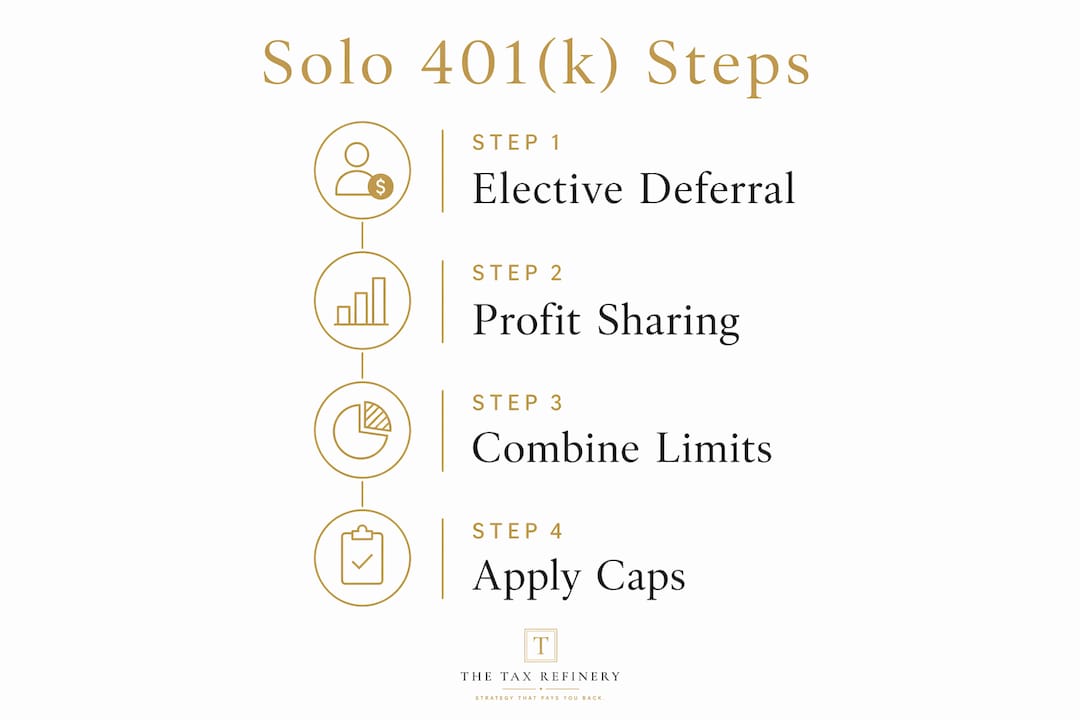
The formula is straightforward once you know your W-2 wages. Here it is in two steps:
Step 1: Employee elective deferral = up to the annual limit (higher with catch-up if age 50+), but cannot exceed your actual W-2 wages.

Step 2: Employer profit-sharing = up to 25% of W-2 wages, subject to the compensation cap.
Combined maximum = Step 1 + Step 2, capped at the annual combined limit.
2026 Solo 401(k) contribution limits
| Limit Type | 2026 Amount | Notes |
|---|---|---|
| Employee elective deferral | $24,500 | Pre-tax or Roth |
| Catch-up contribution (age 50+) | $8,000 | Raises deferral limit to $32,500 |
| Employer profit-sharing | Up to 25% of W-2 wages | Corporate deduction on Form 1120-S |
| Combined annual cap (under 50) | $72,000 | Employee + employer total |
| Combined annual cap (age 50+) | $80,000 | Includes catch-up |
| Compensation cap | — | Maximum W-2 wages used in employer calculation |
Sources: 2026 combined limits; elective deferral and catch-up
Worked example A: early-career owner, age 38, W-2 salary $60,000
- Employee deferral: $24,500
- Employer profit-sharing: 25% × $60,000 = $15,000
- Combined total: $39,500
- Room to the cap: $32,500 remaining, but employer contribution is limited by the 25% formula
At this salary level, the employee deferral bucket does most of the work. Raising the W-2 salary to $80,000 would increase the employer contribution to $20,000, pushing the combined total to $44,500.
Worked example B: mid-income owner, age 47, W-2 salary $120,000
- Employee deferral: $24,500
- Employer profit-sharing: 25% × $120,000 = $30,000
- Combined total: $54,500
- Room to the $72,000 cap: $17,500
This owner is not yet hitting the combined cap. A salary increase to $150,000 would produce a $37,500 employer contribution, for a combined total of $62,000.
Worked example C: high-earner, age 55, W-2 salary $192,000
- Employee deferral (with catch-up): $32,500
- Employer profit-sharing: 25% × $192,000 = $48,000
- Combined before cap check: $80,500
- Applied cap (age 50+): $80,000
- Final deductible total: $80,000
At this salary, the owner hits the combined cap with a small amount of employer contribution left on the table. The catch-up contribution is a mandatory Roth if prior-year Box 3 wages exceeded $150,000.
Coordination with other employer plans
If you also receive W-2 income from a second employer with its own 401(k), the $24,500 employee elective deferral limit is shared across all plans. You cannot defer $24,500 into each plan separately. The employer profit-sharing limit, however, is plan-specific and does not aggregate across unrelated employers.
What counts as reasonable W-2 compensation for an S-Corp owner?

The reasonable compensation requirement is the anchor of S-Corp retirement strategy. The IRS expects S-Corp owner-employees to receive a salary comparable to what a third party would earn performing the same work. Set it too low to minimize payroll taxes, and you shrink your Solo 401(k) contribution capacity while inviting IRS scrutiny.
The tension is real: a higher W-2 salary increases FICA taxes (7.65% employee, 7.65% employer) but also increases the employer profit-sharing ceiling. The right salary is one that is defensible and strategically sized to hit your retirement savings target.
How to determine a market-rate salary
The IRS looks at several factors when evaluating reasonable compensation: the owner's duties, hours worked, training and experience, and what comparable businesses pay for similar roles. Practical sources for comparable data include the Bureau of Labor Statistics Occupational Employment and Wage Statistics, industry salary surveys, and regional wage data from Idaho Department of Labor resources.
For an Idaho-based HVAC business owner who also manages operations, a salary in the range of what a general manager and lead technician would earn combined is a reasonable starting point. Document your reasoning, not just the number.
Documentation checklist
- Written job description listing all roles performed
- Comparable salary data from at least two sources (BLS, industry surveys, or a compensation consultant)
- Board of directors minutes or shareholder resolution approving the salary
- Payroll records showing consistent, timely W-2 payments
- Time log or summary of hours worked in each role
For a deeper look at the IRS compliance framework, Thetaxrefinery's guide on S-Corp reasonable salary covers the documentation standards and audit-risk factors in detail.
Red flags the IRS watches for
- W-2 salary that is a small fraction of total S-Corp distributions
- Salary that does not change year over year despite growing revenue
- No payroll records or irregular payment timing
- Contributions calculated on K-1 income rather than W-2 wages
Pro Tip: Balance payroll-tax efficiency against retirement contribution capacity. For many owners, the payroll-tax cost of a modest salary increase is more than offset by the additional tax-deferred retirement savings the higher W-2 enables. Run the numbers before defaulting to the lowest defensible salary.
What are the plan adoption and funding deadlines you must meet?
Deadlines for a Solo 401(k) are not flexible in the way that SEP IRA deadlines are, and missing the critical one costs you an entire year of employee deferrals.
The December 31 adoption deadline
To make employee elective deferrals for a tax year, the Solo 401(k) plan document must be legally adopted by December 31 of that year. If you miss it, you cannot make employee deferrals for that year, even if you later adopt the plan and fund employer contributions by the filing deadline.
A SEP IRA, by contrast, can be established and funded all the way up to the tax-filing deadline including extensions. That flexibility is one reason some late-deciding owners choose a SEP IRA in the short term.
Employer contribution funding deadline
Employer profit-sharing contributions can be made up to the S-Corp's tax-filing deadline, including extensions. For a calendar-year S-Corp, the base filing deadline is March 15. With a six-month extension, the funding deadline extends to September 15. This gives owners meaningful flexibility to size the employer contribution after reviewing final year-end financials.
Form 5500-EZ filing
Once plan assets exceed $250,000, you must file Form 5500-EZ annually. The filing deadline is July 31 of the following year. Plans with assets at or below $250,000 at year-end are exempt from this requirement, though a final return is required when the plan is terminated.
Year-end action checklist
- By early December: Confirm plan document is adopted or will be adopted before December 31
- By December 31: Execute plan adoption; set payroll to withhold employee deferrals from remaining paychecks
- By March 15 (or September 15 with extension): Fund employer profit-sharing contribution
- By July 31: File Form 5500-EZ if plan assets exceeded $250,000 at prior year-end
The year-end tax planning checklist from Thetaxrefinery covers these dates alongside other S-Corp year-end actions worth coordinating.
How do payroll and tax reporting work for Solo 401(k) contributions?
Getting the mechanics right on payroll and tax reporting is where many S-Corp owners stumble, even after they understand the contribution math.
Employee deferrals on the W-2
Employee elective deferrals are withheld from the owner's paycheck before taxes and reported in Box 12 of Form W-2 using code D for pre-tax 401(k) deferrals (or code AA for Roth 401(k) deferrals). The deferral amount reduces federal and state taxable income but does not reduce FICA wages. Your W-2 Box 1 (federal wages) will be lower than Box 3 (Social Security wages) by the amount of pre-tax deferrals.
Employer contributions on Form 1120-S
The S-Corp deducts employer profit-sharing contributions on Form 1120-S as a business expense. This deduction flows through to reduce the owner's taxable income on Schedule K-1, but it does not reduce the W-2 wages used to calculate the contribution itself. Employer contributions are not subject to FICA, which is one of their tax advantages over additional salary.
Payroll provider checklist
- Confirm your payroll provider supports 401(k) deferral withholding and W-2 Box 12 coding
- Set up the deferral election in writing before the first paycheck you want to defer from
- Verify that deferrals are deposited to the plan account promptly after each payroll run
- Reconcile total deferrals at year-end against the W-2 Box 12 amount
- If a deferral was missed, correct it as soon as possible; late deposits can trigger IRS correction procedures
For a complete walkthrough of S-Corp payroll setup, Thetaxrefinery's payroll compliance guide covers W-2 coding, deposit timing, and year-end reconciliation steps.
When you have W-2 income from a second employer
If you also receive W-2 wages from an unrelated employer with a 401(k), your employee elective deferral limit of $24,500 applies across all plans combined. Coordinate with your payroll provider and tax advisor to avoid excess deferrals, which trigger a taxable correction if not unwound by April 15 of the following year.
Solo 401(k) vs. SEP IRA: which plan fits your situation?
For most higher-earning S-Corp owners, the Solo 401(k)'s stacked contribution buckets produce materially larger tax-deferred savings than a SEP IRA at the same income level. But the right answer depends on your income, timing, and administrative tolerance.
| Decision Factor | Solo 401(k) | SEP IRA | SIMPLE IRA |
|---|---|---|---|
| Contribution potential | Higher at most income levels (stacked buckets) | Up to 25% of W-2 wages only | Lower annual limits |
| Roth option | Yes (employee deferral bucket) | No | Yes (SIMPLE Roth under SECURE 2.0) |
| Loan feature | Yes, if plan document allows | No | No |
| Adoption deadline | December 31 for deferrals | Up to tax-filing deadline | October 1 of the plan year |
| Form 5500-EZ filing | Required above $250,000 | Not required | Not required |
| Administrative burden | Moderate | Low | Low |
Owner profiles and one-line recommendations
- Low-to-mid income owner (W-2 salary under $60,000): The Solo 401(k) employee deferral bucket still outperforms a SEP IRA at this income level; adopt early in the year.
- High-earner targeting the $72,000 or $80,000 cap: Solo 401(k) is the clear choice; the SEP IRA's 25%-of-wages formula cannot reach the combined cap without a very high salary.
- Late-year decision-maker (past December 31): A SEP IRA can still be established and funded up to the filing deadline; a Solo 401(k) loses the employee deferral bucket for that year.
- Owner who wants Roth flexibility or a plan loan: Solo 401(k) is the only option among these three that offers both.
The SEP IRA's main advantage is simplicity and deadline flexibility. If you are setting up a plan for the first time in January after a strong prior year, a SEP IRA may be the practical short-term choice while you establish a Solo 401(k) for the current year.
What strategies help S-Corp owners maximize Solo 401(k) savings?
Contribution maximization is not just about knowing the limits. It requires deliberate salary design, timing decisions, and plan document features that many owners never use.
Salary design within reasonable-compensation guidelines
The employer profit-sharing contribution scales directly with your W-2 salary and retirement planning. An owner earning $100,000 in W-2 wages can contribute $25,000 as an employer contribution; at $150,000, that rises to $37,500. Within the bounds of reasonable compensation, increasing your W-2 salary by $30,000 can add $7,500 in employer contributions while costing roughly $4,590 in additional FICA taxes (employer and employee combined). The net tax benefit often favors the higher salary when the retirement savings are factored in.
Catch-up contributions for ages 50 and older
Owners who are 50 or older should elect the full $8,000 catch-up contribution, raising their 2026 employee deferral limit to $32,500 and the combined cap to $80,000. For owners in the 60–63 age range, SECURE 2.0 introduced a super catch-up provision that may allow a larger catch-up in some circumstances; confirm the rules with your plan provider.
Mega Backdoor Roth strategy
If your Solo 401(k) plan document permits after-tax contributions and in-plan Roth conversions, you can execute a Mega Backdoor Roth strategy. After-tax contributions fill the gap between your pre-tax and Roth deferrals and the combined annual cap. Those after-tax dollars are then converted to Roth within the plan, producing tax-free growth. Not all plan providers support this feature; it requires explicit language in the plan document.
Spousal participation
If your spouse works for the S-Corp and receives W-2 wages, they can participate in the Solo 401(k) as a separate employee. Each spouse has their own employee deferral limit and the employer can contribute 25% of each spouse's W-2 wages. A household with two participating spouses can effectively double the retirement savings capacity within a single plan.
When to add a defined-benefit or cash-balance plan
High-earning owners who have already maximized the Solo 401(k) can layer in a defined-benefit or cash-balance plan to shelter additional income. These plans allow much larger annual contributions based on actuarial calculations, but they require annual actuarial certifications and minimum funding commitments. For owners with consistent high income and a multi-year planning horizon, the combination of a Solo 401(k) and a cash-balance plan is one of the most powerful tax-deferral structures available. Thetaxrefinery's guide on tax planning for high earners covers this combination in detail.
When to call a tax advisor
Complex situations, including multi-entity ownership, a second employer plan, imminent IRS audit, or approaching the combined contribution cap, warrant a conversation with a tax professional before year-end. The cost of a planning session is typically a fraction of the tax savings at stake.
What compliance pitfalls do S-Corp owners need to avoid?
The Solo 401(k) is a powerful tool, but its rules are specific. These are the mistakes that most commonly result in lost contributions, IRS scrutiny, or plan disqualification.
Missing the December 31 adoption deadline
This is the most frequently missed administrative task in Solo 401(k) planning. If the plan document is not legally adopted by December 31, you lose the ability to make employee elective deferrals for that entire tax year. Adopt the plan in early December at the latest if you intend to defer wages for the year. The employer profit-sharing contribution can still be made by the filing deadline, but the deferral opportunity is gone permanently.
Using K-1 distributions as the contribution base
Many S-Corp owners incorrectly calculate employer contributions using K-1 income or net business income rather than W-2 wages. This produces overstated contributions, incorrect tax filings, and audit exposure. The correct base is always W-2 wages paid to the owner-employee.
Hiring employees who trigger eligibility
Bringing on a non-owner employee who meets the plan's age and service requirements ends the plan's Solo 401(k) status. At that point, the plan must be amended to cover eligible employees or terminated. LTPT employees who accumulate 500+ hours over two consecutive years can also trigger eligibility requirements under SECURE 2.0 rules. Monitor employee hours carefully as the business grows.
Commingling plan assets
Plan assets must be held in a separate trust or custodial account. Mixing plan funds with business operating accounts is a prohibited transaction that can disqualify the entire plan.
Corrective action checklist
- Document the plan adoption date with a signed plan document and trustee acceptance
- Correct any payroll errors by making corrective contributions as soon as discovered
- If an employee becomes eligible, consult an ERISA attorney before the next plan year
- For excess deferrals, distribute the excess plus earnings by April 15 of the following year
- Maintain plan records for at least six years after the plan year they relate to
Key Takeaways
S-Corp owners who pay themselves W-2 wages and adopt a Solo 401(k) by December 31 can shelter up to $72,000 in 2026, or $80,000 with catch-up contributions for ages 50 and older, using stacked employee deferral and employer profit-sharing buckets.
| Point | Details |
|---|---|
| W-2 wages are the only valid base | All Solo 401(k) contributions must be calculated on W-2 wages, not K-1 distributions or net S-Corp income. |
| December 31 is a hard deadline | The plan document must be adopted by December 31 to make employee elective deferrals for that tax year. |
| 2026 combined cap is $72,000 ($80,000 with catch-up) | Employee elective deferral up to $24,500 (or $32,500 with $8,000 catch-up for age 50+), plus employer profit-sharing up to 25% of W-2 wages, stacks to the annual combined cap ($72,000 or $80,000). |
| Salary design drives contribution capacity | Increasing W-2 salary within reasonable-compensation guidelines directly raises the employer profit-sharing ceiling. |
| Thetaxrefinery provides hands-on implementation | Thetaxrefinery helps S-Corp owners set reasonable salary, coordinate payroll, and maximize annual contributions through year-round advisory. |
What Thetaxrefinery sees working in practice
Most S-Corp owners who come to Thetaxrefinery have the right instinct: they know a Solo 401(k) can shelter significant income. What they often lack is the salary analysis and payroll coordination to make the math work at its full potential. Melissa Korber, Enrolled Agent and founder of Thetaxrefinery, works with business owners across Idaho to set a defensible W-2 salary, size the employer profit-sharing contribution to hit the annual cap, and coordinate plan adoption deadlines with year-end payroll. For owners with multiple entities or a spouse on payroll, the household contribution capacity is often larger than they realized.
If you are an S-Corp owner in Idaho and want to know exactly how much you can shelter in 2026, bring your most recent W-2, your K-1, and your payroll schedule to a contribution analysis session. The calculation takes minutes when the inputs are right.
How Thetaxrefinery helps you set up and maximize your Solo 401(k)
Running an S-Corp in Idaho means you already understand the value of keeping more of what you earn. A Solo 401(k) is one of the most effective tools for doing exactly that, and the difference between a plan that reaches $72,000 in annual contributions and one that reaches $39,500 often comes down to salary design and payroll execution.

Thetaxrefinery offers S-Corp owners a structured path from plan setup to maximum contribution: reasonable-salary analysis grounded in Idaho market data, payroll coordination with your provider, year-end contribution planning, and audit representation if the IRS ever questions your compensation structure. For owners evaluating plan providers, look for a Solo 401(k) document that supports Roth deferrals, after-tax contributions for Mega Backdoor Roth, in-plan Roth conversions, and loan features. Plan document flexibility matters more than most owners realize when their income grows.
The S-Corp Accelerator at Thetaxrefinery is built specifically for owners who want hands-on implementation, not a once-a-year tax conversation. To see how your current W-2 salary and payroll structure translate into 2026 contribution capacity, visit the tax strategy comparison page or schedule a consultation directly. The numbers are worth knowing before December 31.
This article is general information, not professional tax or legal advice. Contribution limits, deadlines, and eligibility rules can change. Confirm current figures with the IRS or a qualified tax professional for your specific situation.
Authoritative sources for further reading
The following IRS publications and practitioner resources were used to verify the contribution limits, deadlines, and payroll rules in this article.
- IRS: One-Participant 401(k) Plans — The primary IRS page covering eligibility, contribution rules, and filing requirements for Solo 401(k) plans. Consult this for plan qualification standards and LTPT employee rules. IRS one-participant 401(k)
- IRS: Retirement Plans for Self-Employed People — Covers contribution limits, deduction rules, and plan-type comparisons for self-employed and small-business owners. Use this to verify current-year limits and deductibility. IRS retirement plans for self-employed
- U.S. Department of Labor: 401(k) Plans for Small Businesses — Covers plan types, filing requirements, and the Form 5500 threshold for one-participant plans. DOL 401(k) for small businesses
- MySolo401k.net: 2025 Solo 401(k) Setup and Contribution Deadlines for S-Corps — Detailed practitioner guidance on adoption deadlines, funding windows, and the December 31 trap. Use this to verify deadline rules and S-Corp filing cadence. MySolo401k deadline guide
- Solo401k.com: S-Corp Compensation for Solo 401(k) Contributions — Explains the W-2 wage requirement, K-1 exclusion, and reasonable-compensation framework. Use this to verify the employer contribution base. Solo401k.com compensation guide
- Carry: S-Corp Compensation for Self-Directed Solo 401(k) Contributions — Source for 2026 combined contribution limits, Form 5500-EZ threshold, and Mega Backdoor Roth plan document requirements. Carry 2026 limits guide
- Beancount.io: Solo 401(k) vs. SEP IRA 2026 Guide — Practitioner comparison of plan types with decision rules by owner profile. Use this to evaluate which plan type fits your income and timing. Beancount Solo 401(k) vs SEP IRA