
A reasonable cause letter can get your IRS penalty abated when it proves two things at once: you exercised ordinary business care, and a documented event overlapped your filing or payment deadline. Start now by pulling together your key dates and supporting records, then send a written request or Form 843 where required. Expect several weeks for a decision, and a 30 day window to appeal if the answer is no.
TL;DR:
- A reasonable cause letter requires documented evidence that the filing or payment deadline was affected by an event directly overlapping with the deadline.
- Strong evidence includes hospital records, disaster declarations, police reports, or official communications that prove the event and timeline.
- A clear, concise letter should detail the event, include an exhibit index, and reference specific IRS regulations to demonstrate understanding of the standard.
- Submitting requests via certified mail with supporting documentation and a well-organized exhibit list improves chances of approval.
- Denials can be appealed within 30 days, and professional help is advisable for large penalties, complex cases, or disputes in Appeals.
Table of Contents
- What Is Reasonable Cause, and Which Penalties Qualify?
- Which Circumstances Actually Get Penalties Removed?
- How Do You Structure a Reasonable Cause Letter?
- What Documents Make the Strongest Exhibits?
- How and Where Do You Submit Your Request?
- What Happens If the IRS Denies Your Letter?
- Who Wrote This, and When Should You Bring in a Professional?
- What Most Guidance Gets Wrong About Reasonable Cause
- How The Tax Refinery Handles Penalty Abatement and Appeals
- Sources
What Is Reasonable Cause, and Which Penalties Qualify?
The IRS grants reasonable cause relief when a taxpayer used ordinary business care and prudence but still could not meet a tax obligation because of circumstances outside their control. That standard comes straight from IRS guidance on penalty relief, and it is deliberately fact-specific. There is no checklist that guarantees an approval. Treasury regulation 26 CFR §1.6664-4 reinforces this by directing examiners to weigh all facts and circumstances, with the taxpayer's effort to determine correct tax liability treated as the most important factor.
Certain situations show up again and again in approved cases:
- Death or serious illness of the taxpayer or an immediate family member
- Natural disaster, fire, or casualty that destroyed records or disrupted operations
- Inability to obtain records needed to file or pay accurately
- Erroneous written advice from the IRS, or reasonable reliance on a qualified tax professional who had complete information
Failure-to-file, failure-to-pay, and many accuracy-related penalties under section 6662 are typically eligible for this relief. The estimated tax penalty is often excluded, so check your notice type before you invest time drafting a letter for it. For a deeper look at how accuracy-related penalties get triggered in the first place, see what §6662 means for you.
Which Circumstances Actually Get Penalties Removed?
Strong cases share a common trait: the evidence proves the event and the deadline collided. Hospitalization records with admission and discharge dates that fall directly on top of a filing deadline carry far more weight than a general statement about being sick that year. A federally disaster-declared loss with a FEMA declaration number beats a vague reference to "the flood." Destroyed records paired with a police or insurance report outperform "I couldn't find my paperwork."
Weak narratives tend to share the opposite trait: they describe a feeling rather than a fact. "I was busy," "I forgot," or "my accountant never told me" rarely survive review on their own, because they don't show an impediment beyond the taxpayer's control.
Before you write a word, run through this self-check:
- Does your documented event's date range overlap the actual deadline you missed?
- Did you take corrective action promptly once the impediment ended?
- Can you attach at least one independent document that doesn't rely solely on your word?
- Can you show ordinary care elsewhere, such as requesting an extension, making a partial payment, or contacting a professional for help?
Examiners also weigh your sophistication as a taxpayer and your prior compliance history. A first-time issue from someone with a clean filing record reads very differently than a repeat pattern from an experienced business owner.
Pro Tip: Open your letter with your single strongest piece of independent evidence, not your personal narrative. Examiners scan quickly, and the first fact they read anchors how they view everything that follows.
How Do You Structure a Reasonable Cause Letter?
An examiner-ready letter runs one to two pages and maps every claim to an exhibit. Build it in this order:
- Identification block — your name or business name, SSN or EIN, tax year, form number, and the notice number from your IRS letter.
- Facts and circumstances — a plain statement of what happened, with specific dates.
- Timeline — a short bulleted sequence showing exactly how the event overlapped your deadline and when you came back into compliance.
- List of attachments — each exhibit labeled and referenced by letter.
- Explicit request for abatement — state plainly which penalty, tax year, and dollar amount you want removed.
- Signed statement under penalty of perjury, as required for many written requests.
Keep the timeline section in tight bullets rather than dense paragraphs:
- Date of the qualifying event
- Date it ended or resolved
- Date you filed or paid once able
- Reference to the exhibit that proves each date
Cite the governing standard briefly. A single line referencing Treas. Reg. §1.6664-4 or IRM 20.1.1.3.2 signals to the reviewer that you understand the standard they're applying, not just that you want relief. If your notice or the underlying penalty requires a formal claim, reference Form 843 directly in your narrative and attach it as the cover document rather than relying on the letter alone.
What Documents Make the Strongest Exhibits?
Documentation carries the letter. The strongest exhibits independently confirm the exact dates you're claiming:
- Hospital admission and discharge records or a physician's letter
- Death certificates
- FEMA or state disaster declarations
- Police or fire department reports
- Employer leave records
- Certified mail receipts and tracking confirmations
- Bank statements showing partial payments made during the impediment
Label every exhibit (Exhibit A, Exhibit B, and so on) and put a one-page exhibit index at the front of your submission so a reviewer can verify each claim in seconds rather than digging through a stack of paper. Submit copies, keep your originals, and hold onto every certified mail receipt.
Pro Tip: An exhibit index costs you five minutes and often saves the examiner ten. Reviewers who can verify a claim quickly are far less likely to send a boilerplate denial.
How and Where Do You Submit Your Request?
- Check your IRS notice first. It lists the service center address and phone number where your request should go.
- Some centers will consider relief over the phone, but a written request carries far more weight and is required for many accuracy-related and larger penalties.
- Follow the notice instructions to determine whether you need Form 843 or a signed written statement, and reference your notice or letter number in your submission.
- Mail everything certified, with tracking, and keep a complete copy of what you sent.
- Expect roughly 8 to 12 weeks for a response, longer during filing season. If you haven't heard anything by 90 days, call the service center and reference your certified mail tracking number.
What Happens If the IRS Denies Your Letter?
A denial isn't the end of the process. You generally have 30 days from the denial letter to appeal to the IRS Independent Office of Appeals.
- For disputes of $25,000 or less, a Small Case Request offers simpler procedures than a formal written protest.
- Larger disputes typically require Form 12203 or a full written protest addressing each stated reason for denial.
- Appeals conducts an independent review and weighs the hazards of litigation, according to Publication 4576, which means a well-targeted protest that answers the specific denial reasons often succeeds where a repeat of the original letter won't.
- If Appeals also denies your claim, litigation in U.S. District Court or the Court of Federal Claims is possible, but both generally require full payment of the disputed amount first.
If your denial stemmed from an examination issue rather than a penalty notice alone, audit reconsideration may be a parallel path worth exploring.
Who Wrote This, and When Should You Bring in a Professional?
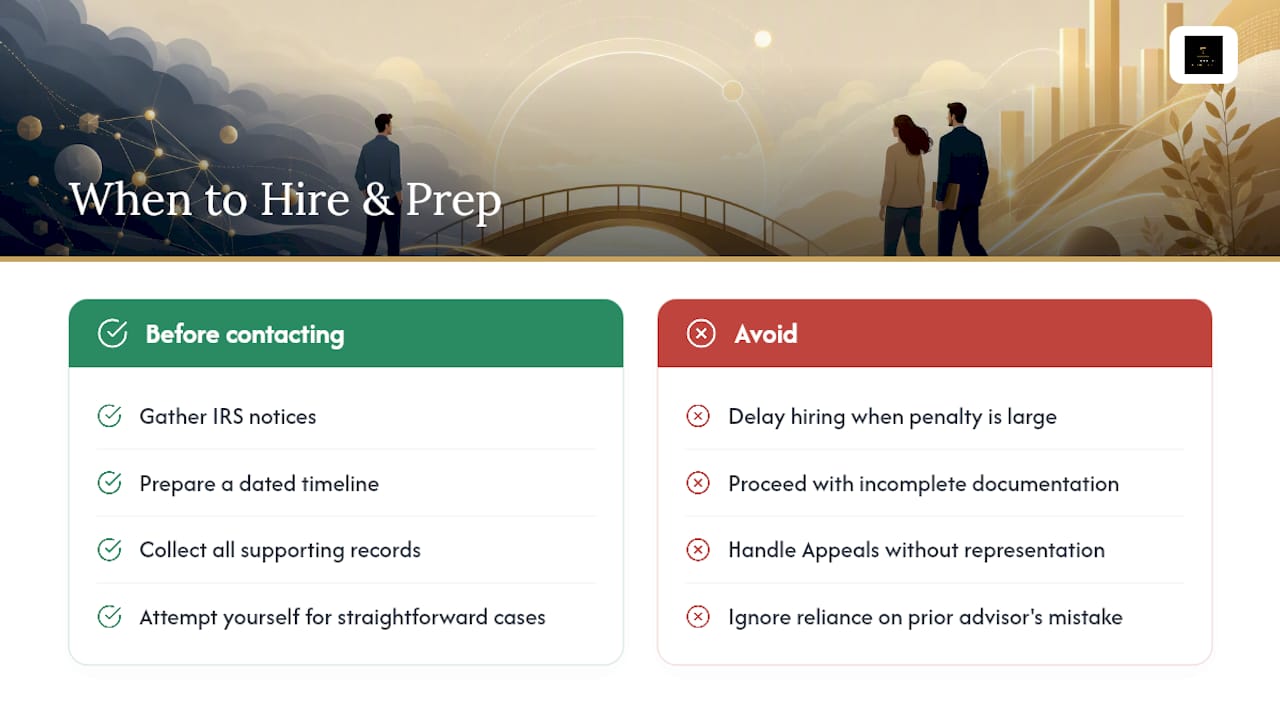
This guide reflects the practical experience of Melissa Korber, an Enrolled Agent and founder of Thetaxrefinery, drawing on primary IRS and Treasury sources rather than secondhand summaries. Straightforward, well-documented cases are often manageable on your own. Bring in professional representation when the penalty amount is large, your case is headed to Appeals, your documentation is incomplete, or your circumstances involve reliance on a prior advisor's mistake. Before contacting anyone, gather your IRS notices, a dated timeline, and copies of every supporting record.
What Most Guidance Gets Wrong About Reasonable Cause
Most articles on this topic treat reasonable cause like a form to fill out correctly. It isn't. It's a facts-and-circumstances argument, and the IRS built it that way on purpose so no template can game it. The regulation itself says the taxpayer's effort to get things right matters more than the excuse itself, and that single detail changes how you should write the whole letter.
The conventional advice to "explain what happened" undersells the actual task, which is to prove it happened when it mattered. A taxpayer who requested an extension, made a partial payment, or called for help before the deadline has a materially stronger case than one who did none of that, even with an identical hardship. That's the detail most templates skip, and it's often the difference between an approval and a form denial letter.
If you take one thing from this guide, prioritize the overlap between your documented event and your actual deadline before you write a single sentence of narrative. Everything else in the letter exists to support that overlap, not replace it.
— Melissa
How The Tax Refinery Handles Penalty Abatement and Appeals
Professional representation can help business owners navigate IRS procedures, especially in Appeals or cases involving significant penalties.

Thetaxrefinery works with established business owners, real estate investors, and high-earning professionals across Idaho and Oregon on penalty abatement requests, appeals protests, and broader tax resolution matters. Engagements are scoped to the case, whether that means drafting a reasonable cause letter with a full exhibit package, building a Small Case Request, or representing you directly before the IRS. Before reaching out, gather your notices, a dated timeline of the event, and any independent records tied to those dates. Review the tax strategy and resolution services page to see how engagements are structured, then schedule a consultation to walk through your specific notice and documentation.
This article is general information, not a substitute for advice from a qualified financial advisor. Consult a qualified financial professional about your own circumstances before acting on anything here.
Sources
- 26 CFR 1.6664-4 | Reasonable cause and good faith exception to section 6662 penalties
- About Form 843, Claim for Refund and Request for Abatement | Internal Revenue Service