
Under IRC §6662, the IRS can add an accuracy-related penalty equal to 20% of the portion of an underpayment caused by negligence or a substantial understatement. That exposure rises to 40% in specified valuation or nondisclosure cases. If you have received a notice proposing this penalty, or you are worried a filing position might trigger one, here is what you need to know before you respond.
The penalty applies when the IRS finds negligence, disregard of the rules, a substantial understatement of tax, or a valuation misstatement on your return. You are not defenseless. Two paths can reduce or eliminate the penalty in many cases:
- Disclosure: Filing Form 8275 or Form 8275-R on a position with a reasonable basis can prevent the disregard or substantial-understatement piece of the penalty from attaching.
- Reasonable cause: Under §6664, showing you acted in good faith with adequate documentation can support full abatement, even without disclosure.
Both defenses require paperwork you should be assembling now, not after a notice arrives.
Key Takeaways
| Point | Details |
|---|---|
| Standard rate is 20% | Applies to the underpayment portion tied to negligence, disregard, or substantial understatement. |
| 40% rate is narrower | Reserved for gross valuation misstatements and certain nondisclosed transactions, never stacked with the 20% rate. |
| Substantial understatement has a number | Individuals hit the threshold at the greater of 10% of tax owed or $5,000, tighter at 5% for QBI claimants. |
| Disclosure is proactive, not reactive | Form 8275 or 8275-R filed with a reasonable basis can remove disregard and understatement grounds before an audit starts. |
| Documentation timing matters most | Reasonable cause under §6664 depends on records created when the return was filed, not explanations written after a notice arrives. |
| Thetaxrefinery builds in prevention | Pre-filing review and proactive disclosure are part of the firm's standard year-round advisory engagement, not an add-on. |
Table of Contents
- Where the Accuracy-Related Penalty 6662 Rules Come From
- What Counts as Negligence, Disregard, or a Substantial Understatement?
- How Much Is the Penalty, and What Are the Dollar Thresholds?
- Which Common Filing Mistakes Trigger a §6662 Penalty?
- How Does Filing Form 8275 Protect You?
- What Qualifies as Reasonable Cause and Good Faith?
- How Should You Respond to an IRS Notice Proposing This Penalty?
- What Do Two Worked §6662 Penalty Examples Look Like?
- What The Tax Refinery Sees in Practice With §6662 Exposure
- What Actually Reduces §6662 Exposure, and What Does Not
- How The Tax Refinery Helps You Avoid or Resolve a §6662 Penalty
- Sources
Where the Accuracy-Related Penalty 6662 Rules Come From
The accuracy-related penalty 6662 rules sit in 26 U.S. Code § 6662, and the statute is more precise than most summaries suggest. It applies a penalty to the portion of an underpayment attributable to one or more listed grounds: negligence or disregard of rules and regulations, any substantial understatement of income tax, any substantial valuation misstatement, substantial overstatement of pension liabilities, substantial estate or gift tax valuation understatements, and undisclosed foreign financial asset understatements. Congress wrote these as separate triggers, but the IRS assesses the penalty against the dollar amount of underpayment, not against each legal theory separately.
That distinction matters when you read the regulations. Treasury Regulation §1.6662-2 lays out the mechanics: if a single underpayment traces to more than one type of misconduct, the IRS does not stack penalties. A $50,000 underpayment tied to both negligence and a substantial understatement still gets one 20% penalty, not two. This "no stacking" principle keeps exposure from compounding just because a return has multiple problems in the same dollar figure.
The regulations also carve out the higher rate. Standard accuracy-related conduct draws 20%. Gross valuation misstatements and certain nondisclosed transactions draw 40%, and the two rates never combine on the same underpayment amount either.
One more regulatory wrinkle worth knowing: the rules governing carrybacks and carryovers determine how a "tainted item" in one tax year affects penalty exposure in a year where a loss or credit gets used. If your CPA has warned you about a position "infecting" a carryforward, this is the regulatory basis for that warning.
What Counts as Negligence, Disregard, or a Substantial Understatement?
Negligence and disregard sound similar, but the IRS treats them as distinct failures. Negligence covers a failure to make a reasonable attempt to comply with the tax code, or a failure to exercise ordinary and reasonable care in preparing a return. Disregard means something more deliberate: careless, reckless, or intentional disregard of rules or regulations you knew or should have known applied.
A substantial understatement is a numeric test, not a judgment call about your intent. If your understatement of tax exceeds a set threshold, the penalty can apply even if you made an honest, well-reasoned mistake. This is the piece that catches taxpayers off guard, because it does not require sloppiness. A well-documented but ultimately wrong position can still trigger it if the dollar amount clears the bar.
The remaining §6662(b) categories are narrower but carry real weight for specific taxpayer profiles:
- Substantial valuation misstatements apply when a claimed value on the return is a specified percentage off from the correct value, common in charitable donation and business valuation disputes.
- Pension liability overstatements and estate or gift tax valuation understatements apply to specialized filings most individual taxpayers never encounter.
- Undisclosed foreign financial asset understatements target taxpayers who have not properly reported foreign accounts or assets, layering onto other foreign-reporting penalty regimes.
If none of these categories describe your filing, your realistic exposure is negligence or substantial understatement. Those two cover the overwhelming majority of accuracy-related penalty assessments against individual filers and small business owners.
How Much Is the Penalty, and What Are the Dollar Thresholds?
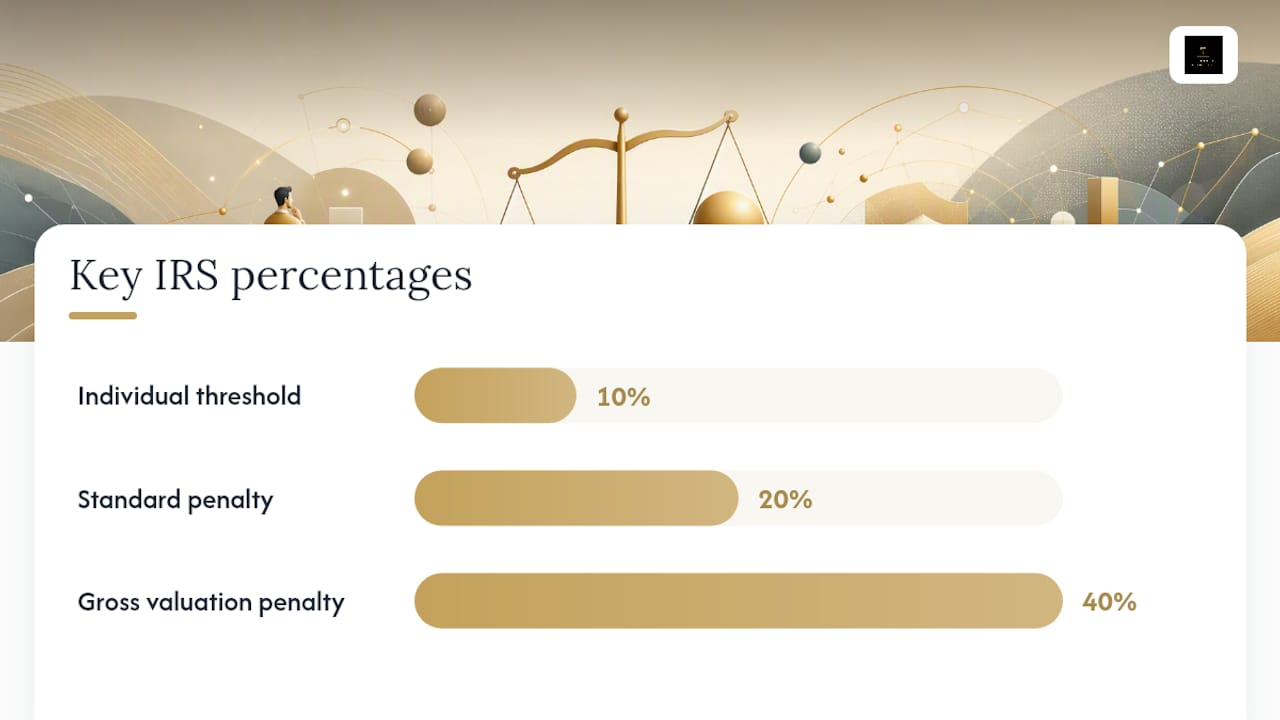
The math starts with whether your understatement even qualifies as "substantial." For individuals, the IRS sets that threshold at the greater of 10% of the tax required to be shown on the return or $5,000.
Corporate taxpayers face their own structure, generally keyed to the lesser of a percentage-based figure or a fixed dollar amount, with statutory caps that differ from the individual rules. If you operate through a C corporation, your accountant needs to run this test separately from any personal exposure you might also carry.
If your total tax liability is $60,000 and you are worried about a $7,000 deduction getting disallowed, you are right at the edge of "substantial" — and that is exactly the number worth double-checking with backup documentation before you file, not after a notice shows up.*
Once you know an item is substantial, the calculation itself is simple.
| Threshold or Rate | Detail |
|---|---|
| Individual substantial understatement | A specified percentage or fixed amount threshold of tax required to be shown on the return, per IRS rules |
| — | A tighter percentage or fixed amount threshold applied to tax required to be shown, reflecting additional scrutiny |
| Standard penalty rate | 20% of the underpayment portion attributable to the violation |
| Gross valuation misstatement rate | 40% of the underpayment portion, no stacking with the 20% rate |
Which Common Filing Mistakes Trigger a §6662 Penalty?
Most accuracy-related penalty cases the Tax Adviser has documented trace back to a short list of recurring problems, not exotic tax shelters. Recognizing your own return in this list is the fastest way to gauge real exposure.
- Omitted income the IRS already has on file. Missing a 1099-NEC, 1099-K, or K-1 is the single most common trigger, because IRS matching programs catch it automatically.
- Unsupported deductions or credits. Claiming a home office, vehicle expense, or business deduction with no mileage log, receipt, or contemporaneous record.
- Aggressive valuation positions. Overstating a charitable donation's fair market value, or claiming a depreciation basis that is not supportable, both feed directly into the substantial valuation misstatement category discussed above.
- Rubber-stamping preparer work. Signing a return you never reviewed does not shift blame. The IRS still holds you responsible for what the return says.
- Weak recordkeeping on pass-through income. Real estate investors and multi-entity business owners who mix personal and business expenses without clean books create exactly the kind of gap an examiner flags first.
Pro Tip: *If a deduction or credit "feels aggressive" while you are preparing the return, using the Self-Employed Affordability Calculator can help you assess your cash flow and better document your position, as that instinct is data. Flag it for disclosure rather than hoping it slides through unnoticed. A disclosed position that gets disallowed usually costs you the tax and interest.
How Does Filing Form 8275 Protect You?
Disclosure is the most underused defense available to taxpayers, and it works differently than most people assume. Filing Form 8275 or Form 8275-R does not guarantee the IRS accepts your position. What it does is remove the "disregard" and "substantial understatement" grounds for the accuracy-related penalty on that specific item, provided you had a reasonable basis for the position when you took it.
- Confirm you have a reasonable basis, not just a hope. Reasonable basis is a real legal standard, higher than "arguable" but lower than "more likely than not." If your position has no support in the code, regulations, or case law, disclosure will not save it.
- Complete Form 8275 for standard disclosures, or Form 8275-R when the position contradicts a specific Treasury regulation. The instructions require you to describe the item, cite the relevant law, and explain your position in enough detail that an examiner understands exactly what you did and why.
- Attach the form to a timely filed original return, or to a qualified amended return before the IRS contacts you about the issue. Disclosure filed after an audit begins does not carry the same protective weight.
- Keep a copy with your supporting workpapers. If the position is questioned years later, you want the disclosure and the analysis behind it in the same file.
Disclosure has real limits. Thetaxrefinery's own disclosure practices reflect this: disclosure is a tool for defensible positions, not a blanket shield for weak ones.
What Qualifies as Reasonable Cause and Good Faith?
The reasonable cause and good faith exception under §6664 is the broadest defense against the accuracy-related penalty, and it applies whether or not you disclosed anything. The regulation frames it as a facts-and-circumstances test. No single factor decides the outcome, but a few recur constantly in cases where taxpayers succeed:
- An unusual or complicated tax issue where a competent professional's advice was reasonably relied upon.
- A good-faith reliance on erroneous information from a third party, such as an incorrect Schedule K-1 or a mislabeled 1099.
- Reasonable efforts to determine the correct treatment despite an ultimately wrong conclusion, documented at the time the return was filed.
Reliance on a tax professional is a real defense, but it has a catch most taxpayers do not realize until it is too late. The regulation requires that you gave your advisor complete and accurate facts, and that the advisor's analysis was objectively reasonable given those facts. Blaming your preparer after the fact, without evidence you told them everything relevant, generally does not work. The defense lives or dies on documentation created when the return was filed, not on a support memo drafted after an IRS notice shows up.
Pro Tip: Save the email where you sent your preparer your rental property details, or the text where you asked "does this count as a business expense?" That contemporaneous record, created before the return was filed, carries far more weight with an examiner than a polished explanation written six months into an audit.
If reasonable cause applies, the path forward is an administrative penalty abatement request, filed with the IRS office handling your case, supported by the documentation above. If the initial request is denied, IRS appeals remains available, and a well-documented first-time position often succeeds there even after an initial denial.
How Should You Respond to an IRS Notice Proposing This Penalty?
A notice proposing an accuracy-related penalty comes with a response deadline, and missing it narrows your options considerably. Work through this checklist as soon as the notice arrives.
- Read the notice completely and note the deadline. IRS notices cite the specific code section and tax year at issue, and the response window is usually 30 days from the notice date, though it varies by notice type.
- Pull the original return, all supporting documents, and any correspondence with your preparer. You need to reconstruct exactly what position was taken and why.
- Check whether Form 8275 was filed with the original return. If it was, that disclosure may already limit the grounds the IRS can use.
- Calculate the proposed penalty yourself. Confirm the IRS applied the correct rate to the correct underpayment amount. Errors in the IRS's own math are not rare.
- Draft a written response addressing the specific grounds cited, whether that means arguing the understatement does not clear the substantial threshold, or presenting a reasonable cause case with documentation attached.
- Decide whether to handle it yourself or bring in representation. Straightforward math errors or clear documentation gaps are sometimes resolvable directly. Cases involving valuation disputes, multiple tax years, or six-figure exposure usually justify professional representation, and an audit reconsideration request may be the right next procedural step if the initial determination already happened without your full input.
Never let the deadline pass while you decide what to do. An unanswered notice typically converts to an assessed penalty, which shifts you from a negotiation to a collections and appeals process that is harder to unwind.
What Do Two Worked §6662 Penalty Examples Look Like?
Example 1: Omitted 1099 income. A self-employed consultant nets $180,000 and omits a $15,000 1099-NEC that a client filed but the consultant forgot about. The IRS recalculates tax owed and finds a $3,200 underpayment tied directly to the omission.
Example 2: Overstated charitable donation. A business owner donates a piece of equipment and claims a $40,000 fair market value based on an informal estimate rather than a qualified appraisal. The IRS values it at $22,000, a difference large enough to qualify as a gross valuation misstatement under the applicable percentage test. No disclosure was filed, and gross valuation misstatement penalties are among the categories disclosure cannot fully neutralize. A qualified appraisal obtained before filing would have either supported the original value or flagged the problem early enough to adjust the claim.
Both examples illustrate the "no stacking" rule in practice: even if the IRS could argue negligence and substantial understatement on the same dollar amount, only one rate applies to that portion of the underpayment, never both added together.
What The Tax Refinery Sees in Practice With §6662 Exposure
Melissa Korber, an Enrolled Agent and founder of Thetaxrefinery, works with business owners, real estate investors, and wellness professionals across the Treasure Valley who come to us after a position they took years ago suddenly becomes an IRS conversation. The pattern is consistent: the penalty rarely comes from a wild deduction. It comes from a reasonable position that was never documented at the time.

Two habits prevent most of what we see. First, a pre-filing review of any position that would surprise an examiner, before the return is filed, not after a notice arrives. Second, proactive disclosure on close calls, using Form 8275 as a routine tool rather than a last resort. If you are already facing a notice, or your exposure runs into six figures across multiple tax years, that is the point to bring in representation rather than responding solo.
What Actually Reduces §6662 Exposure, and What Does Not
Most guidance on this topic treats the accuracy-related penalty as a filing hazard you avoid by being careful. That framing is incomplete. Careful taxpayers get hit with this penalty regularly, because carefulness alone does not create the paper trail the IRS wants to see. The taxpayers who avoid it are the ones who documented their reasoning at the time, not the ones who happened to be right.
The conventional advice to "just hire a good CPA" also oversells what representation alone accomplishes. A competent preparer reduces errors, but the regulation is explicit: your reliance defense depends on what facts you gave that preparer and whether their analysis was objectively reasonable given those facts. A CPA cannot manufacture reasonable cause after the fact if you never told them about the side income or the aggressive valuation in the first place.
If you take one thing from this, prioritize disclosure and contemporaneous documentation over trying to guess which positions will survive scrutiny. Form 8275 is not an admission of weakness. It is the single most effective tool available for turning a defensible-but-uncertain position into one the IRS cannot penalize on disregard or understatement grounds.
How The Tax Refinery Helps You Avoid or Resolve a §6662 Penalty
Thetaxrefinery gives business owners and real estate investors something a once-a-year tax preparer cannot: a pre-filing review built into the engagement, so borderline positions get flagged and documented before the return goes out the door, not discovered by an IRS examiner two years later. That is the practical difference between year-round advisory and seasonal filing.

If you have already received an IRS notice proposing an accuracy-related penalty, our audit representation and penalty abatement work focuses on assembling the documentation §6664 requires, including reconstructing contemporaneous records where possible, and handling correspondence directly with the IRS on your behalf. If you have not received a notice yet but know a recent return carries risk, disclosure assistance and proactive strategy review can address it before it becomes a problem.
Compare your options and see how our tax strategy and resolution services fit your situation, or go straight to booking a consultation to walk through your specific exposure with our team.
Sources
These are the statutory and regulatory sources that govern the accuracy-related penalty and the basis for every figure and rule cited above.
- 26 U.S. Code § 6662 - Imposition of accuracy-related penalty on underpayments
- Accuracy-related penalty | Internal Revenue Service
- § 1.6662-2 Accuracy-related penalty. (e-CFR)
This article is general information, not a substitute for advice from a qualified financial advisor. Consult a qualified financial professional about your own circumstances before acting on anything here.