
An IRS CP2000 notice is a proposal from the IRS Automated Underreporter program to adjust your tax return based on income discrepancies. It is not a bill, and it is not an audit. The IRS sends this notice when information reported by third parties, such as employers or financial institutions, does not match what appears on your return. Your IRS CP2000 response determines whether you pay more, pay nothing, or successfully dispute the proposed changes. Acting quickly and correctly is the difference between a resolved case and an escalating tax problem.
What documents do you need before responding to a CP2000 notice?
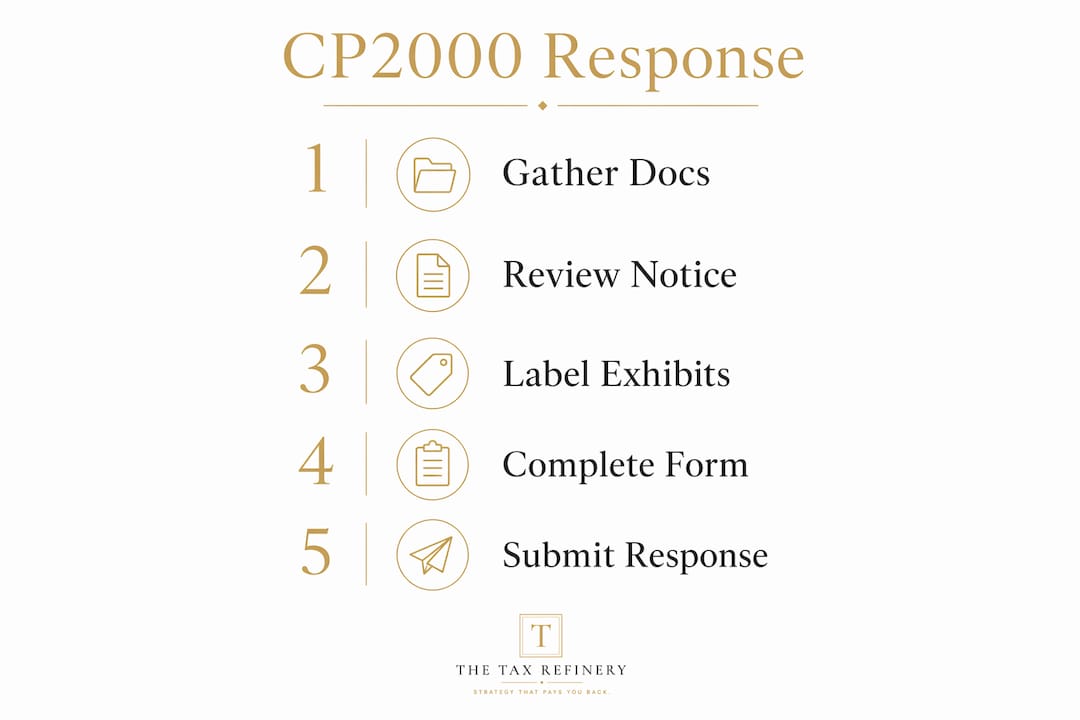
Preparation is the foundation of an effective response. Gather every relevant document before you write a single word to the IRS.
Start with these items:
- Your original filed tax return for the year in question
- The CP2000 notice itself, including the response form attached at the bottom
- All information returns for that tax year: W-2s, 1099s, K-1s, and any corrected versions
- Your IRS Wage and Income transcript, which shows exactly what third parties reported to the IRS
- Bank statements, brokerage statements, and receipts that support your original return figures
- Any corrected forms (1099-C, 1099-B, 1099-R) that a payer may have issued after the original filing
The IRS Wage and Income transcript is the most underused tool in CP2000 disputes. It shows the exact figures the IRS received from payers, which lets you identify whether the discrepancy is a data error, a missing form, or a legitimate difference. You can request this transcript through the IRS online account portal at no cost.
Pro Tip: Label every document before you submit anything. Use clear labels like "Exhibit A" and reference those labels explicitly in your written explanation. Labeled exhibits referenced directly in your letter significantly increase the chance of a successful dispute.

How to respond to an IRS CP2000 notice step by step
The response process follows a clear sequence. Missing any step can delay resolution or result in the IRS treating your submission as incomplete.
-
Review the notice carefully. Read every proposed change line by line. The CP2000 lists each discrepancy, the IRS's proposed adjustment, and the resulting tax difference. Confirm whether you agree, partially agree, or disagree with each item.
-
Complete the response form. The notice includes a detachable response form. Check the appropriate box: agree, partially agree, or disagree. For joint filers, both spouses must sign the response form. Missing a signature is one of the fastest ways to get your response rejected or delayed.
-
Write a clear disagreement statement if needed. Address each disputed item separately. State the IRS's proposed change, your position, and the outcome you are requesting. Reference your labeled exhibits directly. An issue-by-issue organized response helps the IRS examiner evaluate your case efficiently.
-
Attach copies, never originals. Send legible photocopies of all supporting documents. Keep every original in your files.
-
Submit your response before the deadline. You have 30 days from the notice date to respond if you live in the United States, or 60 days if you live outside the country. Missing this window means the IRS finalizes the proposed changes by default.
-
Choose your submission method. The IRS Document Upload Tool is the fastest option. Certified mail with return receipt is the safest paper option. Fax is also accepted. Keep proof of submission regardless of which method you use.
Pro Tip: If you agree with the proposed changes and owe additional tax, you can submit payment with your response or request an installment agreement using IRS Form 9465. Paying in full stops interest from accruing further.
Oregon business owners who file with multiple income streams, such as rental income, freelance payments, and S-corp distributions, face a higher chance of CP2000 discrepancies. Keeping organized records year-round makes this process far less stressful.
What happens after you submit your CP2000 response?
The IRS does not process CP2000 responses instantly. Understanding the timeline prevents unnecessary anxiety and premature calls that slow things down.
| Scenario | Typical Processing Time |
|---|---|
| Agreement with full payment | 4–6 weeks |
| Agreement with installment request | 6–8 weeks |
| Dispute requiring examiner review | 60–120 days or longer |
| Complex dispute during filing season | 120+ days |
Agreement responses process in roughly 4–6 weeks. Dispute responses that require manual examiner review take 60–120 days or longer depending on complexity and IRS workload. That is a significant wait, and it is normal.
After submitting, you may receive one of several follow-up letters:
- An acknowledgment letter confirming receipt of your response
- A request for additional documentation if the examiner needs more information
- A closing letter confirming no additional tax is owed
- A CP22A assessment notice if the IRS accepts your agreement and adjusts your account
- A revised CP2000 if the IRS partially accepts your dispute
- A CP3219A Notice of Deficiency if the IRS rejects your dispute entirely
Wait at least 60 days after submitting before calling the IRS about your response. Calling earlier rarely produces useful information and can increase hold times for everyone. IRS silence during this period is standard, not a sign of a problem.
Common mistakes that derail a CP2000 response
Several errors appear repeatedly in CP2000 cases. Avoiding them protects your timeline and your outcome.
- Filing an amended return at the same time. Filing an amended return alongside a CP2000 response creates duplicate IRS records and confuses examiners. The CP2000 response form is the correct and only mechanism for disputing the proposed changes.
- Sending original documents. The IRS does not return submitted documents. Send copies only.
- Missing signatures on joint returns. Both spouses must sign the response form. One missing signature triggers an immediate processing delay.
- Submitting disorganized evidence. A pile of unlabeled statements does not help an examiner. Label each exhibit and reference it by name in your written explanation.
- Missing the response deadline. Failing to respond by the deadline means the IRS treats the proposed changes as accepted. Interest and penalties begin accruing immediately.
- Treating the CP2000 as an audit. A CP2000 is a proposal, not an audit. Responding calmly and factually is more effective than treating it as an adversarial proceeding.
Ignoring a CP2000 notice does not make it go away. The IRS will finalize the proposed changes, assess interest and penalties, and eventually issue a CP3219A Notice of Deficiency. At that point, you face a strict deadline to petition U.S. Tax Court or lose your right to contest the assessment entirely.
For Oregon residents managing complex returns with real estate income or pass-through entities, the stakes of a missed deadline are especially high. Reviewing your tax resolution options early gives you more choices.
How to handle disagreements and the CP2000 notice appeal process
Disagreeing with the IRS requires a clear, documented, and methodical approach. Vague objections do not move cases forward.
-
Address each discrepancy separately. Do not write a general letter saying the notice is wrong. Identify each proposed change by line item, state your position, and explain why the IRS figure is incorrect.
-
Request corrected information returns from payers. If a 1099 was issued in error or contains wrong figures, contact the payer and request a corrected form. A corrected 1099 submitted with your response is strong evidence.
-
Label and reference all exhibits. Assign each document a label (Exhibit A, Exhibit B) and cite it directly in your written explanation. This structure mirrors how IRS examiners are trained to review cases.
-
Understand the escalation path. If the IRS rejects your dispute, it issues a CP3219A Notice of Deficiency. This document gives you 90 days to petition U.S. Tax Court. Missing that 90-day window eliminates your right to contest the assessment in court before paying.
-
Consider professional representation for complex cases. An Enrolled Agent or tax attorney can represent you before the IRS, communicate directly with examiners, and build a stronger case than most taxpayers can construct alone. For business owners with multiple income sources, professional help is not a luxury. It is a practical investment.
Homeowners facing CP2000 notices related to mortgage interest or property sales may also find it useful to review tax return planning strategies that clarify how these transactions are reported.
Key Takeaways
A timely, organized, and well-documented IRS CP2000 response is the most effective way to resolve a tax discrepancy without escalation to formal assessment or Tax Court.
| Point | Details |
|---|---|
| CP2000 is a proposal | It is not a bill or audit; you have the right to agree, partially agree, or dispute it. |
| Response deadline is firm | Domestic filers have 30 days; international filers have 60 days from the notice date. |
| Organization wins disputes | Label every exhibit and address each discrepancy issue by issue in your written response. |
| Processing takes time | Agreements resolve in 4–6 weeks; disputes can take 60–120 days or longer. |
| Inaction has consequences | Ignoring the notice leads to automatic assessment, penalties, and potential Tax Court deadlines. |
What I have learned from CP2000 cases that most articles skip
The CP2000 process looks straightforward on paper. In practice, the cases that go sideways almost always share one trait: the taxpayer panicked and moved too fast.
I have seen clients file amended returns the same week they received a CP2000, thinking they were being proactive. That move created duplicate records, confused the examiner, and added months to the resolution timeline. The CP2000 response form exists for a reason. Use it.
The other pattern I see constantly is disorganized submissions. A stack of bank statements with no labels and no written explanation is not a dispute. It is a pile of paper. IRS examiners review dozens of cases. A response that clearly states the issue, your position, and the supporting evidence by exhibit number gets resolved faster. That is not a theory. It is how the process works.
Patience matters more than most people expect. After you submit, the IRS goes quiet. That silence is not a bad sign. Calling before 60 days have passed rarely gets you useful information and can actually slow your case. Set a calendar reminder for 60 days post-submission and wait.
Finally, know when to bring in a professional. If your CP2000 involves multiple income sources, a business entity, real estate transactions, or a proposed change above a few thousand dollars, the cost of professional representation is almost always less than the cost of a poorly handled dispute.
— Melissa
How Thetaxrefinery helps with CP2000 notices and tax resolution
Receiving a CP2000 notice is stressful, but it does not have to derail your finances. Thetaxrefinery works with business owners, real estate investors, and self-employed professionals across Oregon and beyond to resolve IRS notices with clarity and confidence.

Melissa Korber, Enrolled Agent and founder of Thetaxrefinery, brings deep expertise in IRS correspondence, tax resolution, and year-round advisory. Whether you need help crafting a dispute response, organizing your documentation, or understanding your options before a deadline, Thetaxrefinery provides the structured support that makes a real difference. Review the tax strategy and resolution services available, or reach out directly to discuss your specific CP2000 situation.
FAQ
What is an IRS CP2000 notice?
An IRS CP2000 notice is a proposal from the IRS Automated Underreporter program to adjust your tax return due to a discrepancy between what you reported and what third parties reported to the IRS. It is not a bill or an audit.
How long do I have to respond to a CP2000 notice?
Domestic filers have 30 days from the notice date to respond. Filers living outside the United States have 60 days. Missing the deadline results in the IRS finalizing the proposed changes automatically.
Can I dispute a CP2000 if I disagree with the IRS?
Yes. Check the disagree box on the response form, write a clear issue-by-issue explanation, and attach labeled copies of supporting documents. If the IRS rejects your dispute, it will issue a CP3219A, giving you 90 days to petition U.S. Tax Court.
Should I file an amended return when I receive a CP2000?
No. Filing an amended return alongside a CP2000 response creates duplicate records and delays resolution. Use the CP2000 response form as your official dispute mechanism.
How long does it take the IRS to process a CP2000 response?
Agreement responses typically process in 4–6 weeks. Disputes requiring examiner review take 60–120 days or longer. Wait at least 60 days after submission before contacting the IRS for a status update.