
If you have a clean three-year compliance history and received an IRS penalty notice for a single tax period, you likely qualify for First-Time Penalty Abatement (FTA) or the new Automatic Exemption from Penalty (AEP). The single most important action you can take right now: pull your IRS account transcript and confirm whether relief was already applied before you call or write anything.
Here is what to do immediately:
- Log in to your IRS Online Account and navigate to the tax period in question.
- Pull your account transcript and look for penalty reason codes (PRC 018, 020, or 021), which confirm FTA was applied.
- Save your notice number, the penalty code listed on the notice, and the exact dollar amount assessed.
- If the transcript shows no abatement and the penalty is still active, call the number printed on your IRS notice.
Then, in order of priority:
- Check your IRS Online Account transcript first.
- Call the IRS using the number on your notice (or Practitioner Priority Service if you have a representative).
- File Form 843 as a written backup if the phone route does not resolve it.
Thetaxrefinery's Enrolled Agent team handle this verification workflow routinely. The sections below explain exactly how FTA and AEP work, who qualifies, and what to do if you are denied.
Table of Contents
- What are First-Time Penalty Abatement and AEP, and how do they differ?
- Do you qualify? The three-year clean history test explained
- Which penalties does FTA cover, and what is excluded?
- How to request First-Time Penalty Abatement: phone, Form 843, and sample language
- How long does abatement take, and how do you verify it worked?
- What to do if your FTA request is denied
- Enrolled Agent tips for monitoring, avoiding recurrence, and knowing when to hire help
- Key Takeaways
- A practitioner's honest read on FTA and AEP
- How Thetaxrefinery handles penalty relief and IRS representation
- Useful sources and IRS reference materials
What are First-Time Penalty Abatement and AEP, and how do they differ?
First-Time Penalty Abatement is an IRS administrative waiver that removes qualifying penalties for a single tax period when a taxpayer demonstrates a clean compliance history. It has existed for years as a request-based program: you ask, the IRS reviews your history, and if you qualify, the penalty comes off.
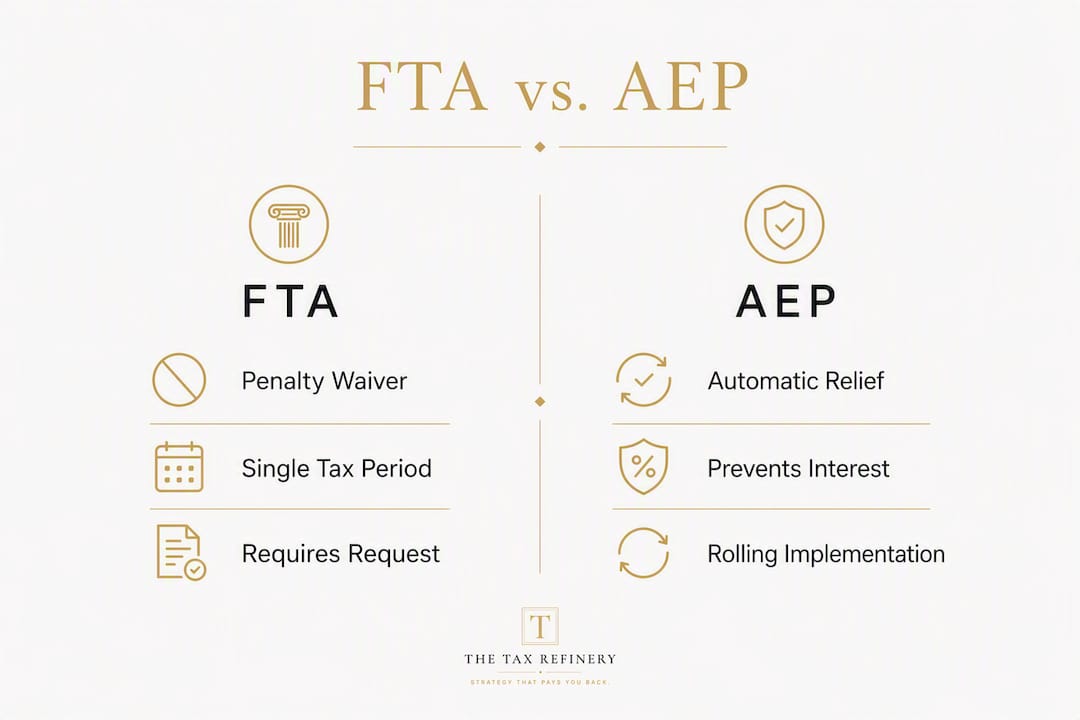
The Automatic Exemption from Penalty (AEP) is the IRS's next step. Rather than waiting for a taxpayer to request relief, AEP automatically suppresses qualifying penalties during original return processing. The penalty is never assessed in the first place. That distinction matters in a concrete way: when a penalty is suppressed rather than assessed and then removed, interest that would have accrued on the assessed penalty never accrues either.
| Feature | First-Time Penalty Abatement (FTA) | Automatic Exemption from Penalty (AEP) |
|---|---|---|
| How relief is triggered | Taxpayer requests it | Automatic during return processing |
| Effect on penalty | Removes an already-assessed penalty | Suppresses penalty before assessment |
| Interest on penalty | May accrue until abatement is granted | Does not accrue (penalty never assessed) |
| Effective dates | All open tax periods (legacy) | Eligible 2025 returns; 2026 quarterly returns during transition; full rollout for returns due on or after Jan. 1, 2027 |
| Verification needed | Yes — confirm via transcript | Yes — still confirm; system transitions can cause gaps |
The practical takeaway: AEP is better for your wallet because it prevents interest from piling up. But the rollout is phased, and some taxpayers with qualifying 2025 and 2026 periods may still need to request FTA manually if they receive a notice. Never assume automation handled it.
Do you qualify? The three-year clean history test explained
FTA eligibility rests on three conditions, all of which must be met for the tax period in question.

Filing compliance. You must have filed all required returns (or valid extensions) for the three tax years before the year you are requesting relief for. A missing return in that window disqualifies you, even if you later file it.
Payment compliance. You must have paid, or arranged to pay, any tax owed for those same three prior years. An active installment agreement counts, but you must be current on payments. Unpaid balances without an arrangement are disqualifying.
Clean penalty history. You must have no penalties (other than estimated tax penalties) assessed in the three years before the period you are requesting relief for. Penalties that were later reversed for IRS error or reasonable cause generally do not count against you, but you should confirm this on your transcript before assuming it.
For quarterly filers (payroll, estimated tax), the lookback covers 12 consecutive quarters rather than three calendar years.
A few edge cases worth knowing:
- Unreversed penalties — from prior years are the most common disqualifier. Pull your transcript before you call so you know what the IRS sees.
If you do not meet the three-year clean history test, FTA is not available. The correct pivot is reasonable cause relief, which is a separate pathway requiring documentation and a narrative explanation.
Pro Tip: Before you call the IRS, pull a "Record of Account" transcript for each of the three prior tax years. This shows you exactly what the IRS sees, including any penalty assessments you may have forgotten. It takes about five minutes through IRS Online Account and prevents wasted time on a call.
Which penalties does FTA cover, and what is excluded?
FTA and AEP cover three primary administrative penalties:
- Failure-to-file (FTF): The penalty for not filing a return by its due date (including extensions).
- Failure-to-pay (FTP): The penalty for not paying the tax owed by the due date.
- Failure-to-deposit (FTD): The penalty for business payroll tax deposits not made on time or in the correct amount.
These three penalties are the ones the IRS most commonly assesses for administrative compliance failures, and they are the only ones FTA and AEP address.
What is not covered:
- The estimated tax penalty (IRC §6654 for individuals, §6655 for corporations) is explicitly excluded from both FTA and AEP.
- Penalties tied to fraud or substantial understatement are not eligible.
- Certain excise tax and specialty penalties fall outside the program's scope.
- Interest on unpaid tax is not a penalty and cannot be abated through FTA. Interest follows the tax, not the penalty.
One nuance for business owners with payroll obligations: if you meet FTA criteria for an FTD penalty, the abatement applies, but multi-period deposit rules can interact with the lookback in ways that are not always straightforward. The IRS evaluates FTD eligibility at the deposit period level, and a single quarter with a deposit shortfall may affect multiple penalty assessments. For payroll-heavy businesses, this is an area where professional review pays for itself. See Thetaxrefinery's breakdown of trust fund recovery penalties for context on how payroll tax obligations escalate when deposits are missed.
A separate nuance for FTP: if your tax is still unpaid when you request FTA, the IRS can abate the FTP penalty while the Master File continues computing FTP until the tax is paid. Once you pay in full, the FTP penalty can be removed. This matters if you are on an installment agreement and want to request abatement before the balance is fully settled.
How to request First-Time Penalty Abatement: phone, Form 843, and sample language
The fastest route is almost always a phone call. Written requests work, but they take longer and require more documentation. Here is the full process in priority order.
Step 1: Confirm AEP status first
For recent and current year returns, check your IRS Online Account transcript before doing anything else. If AEP already suppressed the penalty, you are done. If the transcript still shows an active penalty assessment, proceed to the phone request.
Step 2: Call the IRS
Use the phone number printed on your IRS notice. If you have a tax professional, they can call the Practitioner Priority Service (PPS) line, which typically resolves these faster.

Sample phone script:
Document the call: write down the representative's name, the date and time, the IRS employee ID if provided, and any confirmation or reference number given.
Step 3: File Form 843 if the phone route fails
Form 843 is the formal written request for penalty abatement. Complete it as follows for an FTA request:
- Line 5a: — Check "IRS error" or "Other" and write "First-Time Penalty Abatement — Administrative Waiver" in the explanation box.
Mail Form 843 to the IRS address shown on your notice. Keep a copy and send it certified mail with return receipt.
Step 4: Send a written abatement letter (if needed)
A written letter can accompany Form 843 or stand alone if the penalty amount is small and the facts are straightforward. Keep it to one page.
Sample first-time penalty abatement letter structure:
[Your Name / Business Name] [SSN or EIN] [Address] [Date]
Internal Revenue Service [Address from your notice]
Re: Request for First-Time Penalty Abatement Tax Period: [Year or Quarter] Notice Number: [From your notice] Penalty Type and Amount: [e.g., Failure-to-File Penalty, $X,XXX]
I am writing to request abatement of the above penalty under the IRS First-Time Penalty Abatement administrative waiver. I have filed all required returns for the three tax years preceding this period, I have no outstanding balances for those years, and I have not had any penalties assessed in that same three-year window. I respectfully request that the IRS remove this penalty and confirm the abatement in writing or via my IRS Online Account transcript.
[Signature]
Pro Tip: Practitioner Priority Service is available to credentialed tax professionals, not directly to taxpayers. If your case involves payroll penalties, cross-TIN complications, or a denial, having an Enrolled Agent call PPS on your behalf can cut resolution time significantly compared to the general taxpayer line.
How long does abatement take, and how do you verify it worked?
Timelines vary by request method:
- Phone request: Relief can be applied during the call if the representative confirms eligibility. You should see the update on your transcript within a few weeks.
- AEP automatic suppression: For eligible returns, the penalty should never appear on the transcript. If it does appear, that is a signal the automation did not catch it.
- Form 843 / written letter: Processing typically takes several months. The IRS will send a written response.
Verification is not optional. Tax-resolution practitioners consistently advise confirming abatement on the IRS account transcript rather than assuming relief was applied. During the 2025–2026 AEP rollout, system transitions can generate temporary or false penalty assessments. A transcript showing no penalty code is the only reliable confirmation.
To verify, pull a "Tax Account" or "Record of Account" transcript from IRS Online Account for the relevant period. Look for penalty reason codes PRC 018, 020, or 021, which confirm FTA was applied. If the penalty line still shows a balance with no abatement code, the relief did not post.
Common transition hiccups for 2025–2026 periods:
- Penalties assessed before AEP fully rolled out may remain on account even if the taxpayer qualifies.
- Interest may briefly appear on a penalty that should have been suppressed.
- A notice may arrive after AEP suppression was supposed to apply, because notice generation and penalty suppression run on different IRS systems.
If your transcript shows a conflict (penalty assessed, no abatement code, but you believe you qualify), wait 30 days from your phone request before escalating. After 30 days with no update, call again with your documentation ready: notice number, penalty codes, transcript screenshot, and the name and date of your prior call. If the issue persists, that is the point where professional representation adds clear value.
What to do if your FTA request is denied
Denials happen for three main reasons: you did not meet the three-year clean history test, there is an account-matching issue (a prior penalty the IRS sees that you do not), or a payment or deposit in the lookback period was missed.
Here is how to respond:
- Request the specific reason for denial in writing. The IRS representative should be able to tell you which eligibility criterion you failed. Get the denial reason documented.
- Pull your transcript for all three lookback years. Compare what the IRS sees against your own records. Unreversed penalties you forgot about are the most common surprise.
- Determine whether reasonable cause applies. Reasonable cause is a separate relief pathway. It requires a narrative explaining why you failed to file, pay, or deposit on time, supported by documentation. Qualifying reasons include serious illness, a natural disaster, reliance on erroneous professional advice, or circumstances beyond your control.
- Gather your documentation. Depending on the reason, this might include medical records, a disaster declaration, correspondence with a prior tax advisor, or bank records showing a payment attempt.
- File a formal appeal if the denial stands. You can appeal through the IRS Office of Appeals. For penalties tied to a notice of deficiency (a statutory notice of deficiency or 90-day letter), you have 90 days from the notice date to petition the U.S. Tax Court. Missing that deadline eliminates your Tax Court option.
Documents to have ready before any appeal or escalation:
- All IRS notices received (with notice numbers and dates)
- Account transcripts for the tax period in question and the three prior years
- Proof of filing (return copies or e-file confirmation)
- Proof of payment or installment agreement status
- Any documentation supporting reasonable cause
When the denial involves payroll deposit penalties, cross-TIN complications, or a statutory notice of deficiency, the complexity typically warrants professional representation. An Enrolled Agent or CPA can assess whether the denial was correct, build a reasonable cause narrative, or file an appeal with the IRS Office of Appeals on your behalf.
Enrolled Agent tips for monitoring, avoiding recurrence, and knowing when to hire help
The most common mistake taxpayers make after requesting abatement: they assume it worked and never check. The second most common: they let the same compliance gap recur the following year and lose their clean history.
A few practitioner-level habits that prevent both:
- Set a transcript check reminder for 30 days after any phone request and again at 60 days if the first check shows no update.
- Use IRS Online Account alerts to monitor your account for new notices or balance changes. The system will not proactively notify you of every change, but logging in quarterly takes five minutes.
- Keep a dedicated abatement file for each notice. Include a screenshot of the transcript before and after the request, a log of every call (date, time, representative name, employee ID, confirmation number), and copies of any letters sent or received.
Pro Tip: When an EA confirms abatement for a client, the internal workflow looks like this: (1) pull transcript before the call, (2) note all active penalty codes, (3) call PPS and request abatement, (4) pull transcript again 14–21 days later, (5) confirm PRC 018/020/021 posted, (6) document in the client file. If the code is not there at day 21, escalate immediately rather than waiting for a second notice.
The non-obvious benefit of AEP that most taxpayers miss: because the penalty is suppressed before assessment, interest that would have accrued on that penalty never accrues. Under the old FTA process, if the penalty sat on your account for several months before you requested abatement, interest had already been building. AEP eliminates that window entirely for eligible returns.
When to hire professional help rather than handling it yourself:
- Your business has payroll deposit penalties across multiple quarters or multiple entities.
- The transcript shows conflicting codes or a denial you cannot reconcile with your records.
- You received a CP2000 notice or a statutory notice of deficiency alongside the penalty notice.
- The penalty amount is large enough that a mistake in the abatement request could cost more than professional fees.
- You have already been denied once and are considering an appeal.
Key Takeaways
FTA and AEP eligibility comes down to one test: a clean three-year compliance history, verified on your IRS account transcript before you make any request.
| Point | Details |
|---|---|
| Three-year clean history | File all returns, pay all balances, and carry no unreversed penalties for the three years before the period in question. |
| AEP suppresses, FTA removes | AEP prevents penalty assessment entirely; FTA removes a penalty already assessed. Verify both outcomes on your transcript. |
| Covered penalties | Failure-to-file, failure-to-pay, and failure-to-deposit qualify. The estimated tax penalty does not. |
| Verification is required | Pull your IRS account transcript 14–21 days after any request and confirm PRC 018, 020, or 021 posted. |
| Thetaxrefinery handles the full workflow | From transcript verification and Form 843 drafting to reasonable cause narratives and IRS representation, Thetaxrefinery manages FTA and AEP cases for business owners and high-earning professionals. |
A practitioner's honest read on FTA and AEP
The IRS's move to AEP is genuinely good policy. Shifting from a system where taxpayers had to know to ask for relief to one that automatically suppresses qualifying penalties during processing reduces both taxpayer burden and IRS workload. The accounting press has covered this as a systemic improvement, and it is.
But here is what the coverage tends to understate: the transition period is messy. Penalties assessed before AEP fully rolled out remain on account. Notice generation and penalty suppression run on different IRS systems, which means a taxpayer can receive a penalty notice for a period where AEP should have applied. The IRS has acknowledged that qualifying taxpayers may still need to request FTA manually for 2025 and 2026 periods. That is not a minor footnote. It means that for the next year or two, "automatic" relief still requires manual verification.
The clients who handle this well are the ones who treat transcript monitoring as a routine task, not a one-time reaction to a notice. They pull transcripts quarterly, document every IRS interaction, and know exactly what penalty reason codes to look for. That workflow is not complicated, but it requires consistency. The clients who get into trouble are the ones who call the IRS, hear "it's been taken care of," and never verify. Two months later, interest has accrued on a penalty that was never actually removed.
FTA is one of the few IRS relief programs where the eligibility test is binary and the outcome is predictable. If you qualify, you get the relief. The challenge is not the law. It is the verification.
How Thetaxrefinery handles penalty relief and IRS representation
Penalty relief is one of the clearest cases where professional verification pays for itself. Thetaxrefinery offers transcript verification, Form 843 drafting, reasonable cause narrative preparation, and full IRS representation for business owners and high-earning professionals dealing with FTA, AEP, and related penalty issues.

The firm's Enrolled Agent team pulls transcripts, confirms penalty reason codes, and handles IRS communication directly, so you are not navigating hold times and IRS system quirks on your own. For complex cases involving payroll deposit penalties, multi-entity returns, or a denial that needs to go to appeals, Thetaxrefinery provides the representation and documentation strategy to build the strongest possible case.
If you received a penalty notice and want to know whether you qualify for abatement, the right first step is a diagnostic review. Schedule a consultation with Thetaxrefinery's tax resolution team to confirm your eligibility, verify your transcript, and determine whether FTA, AEP, or reasonable cause is the right path for your situation.
Useful sources and IRS reference materials
The following primary and practitioner sources informed this guide. Each is worth bookmarking if you are managing an active penalty case.
- Administrative Penalty Relief | IRS.gov: The IRS's official page covering FTA eligibility, covered penalties, and the FTA-to-AEP transition. Start here for the authoritative rules.
- IRS Simplifies Penalty Relief, Introduces Automatic Process for Eligible Taxpayers | IRS.gov: The IRS announcement explaining AEP, its effective dates, and the transition timeline. Essential reading for understanding the 2025–2027 rollout.
- IRM 20.1.1.3.3.2.1 | Bradford Tax Institute: The Internal Revenue Manual section covering FTA eligibility criteria, penalty reason codes (PRC 018, 020, 021), and module-level rules. Practitioner-level detail on how the IRS evaluates requests internally.
- 90-Day Notice of Deficiency | Taxpayer Advocate Service: Explains the statutory notice of deficiency (Letter 3219), the 90-day response window, and your right to petition the U.S. Tax Court. Relevant if your penalty situation involves a proposed tax deficiency alongside the penalty.
- Understanding Your Letter 3219B | IRS.gov: IRS guidance on the statutory notice of deficiency, including what it means, how to respond, and the Tax Court petition process.
- IRS Streamlines Penalty Relief Process, Replacing First-Time Abate | Accounting Today: Trade press coverage of the AEP announcement, useful for understanding the policy context and practitioner reaction to the rollout.