
If the IRS assessed additional tax after your audit and that balance remains unpaid, you may qualify for IRS audit reconsideration, a formal administrative process that reopens a closed exam when you can present new information not previously reviewed. Locate your Form 4549 (Report of Income Tax Examination Changes) first. If the assessed amount is still unpaid and you have documents the examiner never saw, you have a viable path forward.
Here is what to do immediately:
- Find Form 4549. This is your audit report. It lists every adjustment the IRS made and is the roadmap for your reconsideration packet.
- Confirm the balance is unpaid. Reconsideration is not available once you have paid in full. If you paid, the remedy is Form 1040-X or a refund suit.
- Identify new evidence. Receipts, bank statements, corrected information returns, or an original delinquent return to contest a Substitute for Return (SFR) all qualify. Mere disagreement does not.
- Choose your submission path. Publication 3598 outlines the process; Form 12661 (Disputed Issue Verification) helps you organize disputed items; the IRS Document Upload Tool (DUT) is the preferred delivery method for correspondence audits.
- Know your escalation options. If reconsideration is denied, the Independent Office of Appeals and the Taxpayer Advocate Service (TAS) are both available. Thetaxrefinery offers IRS representation and audit reconsideration support to taxpayers who need professional help building and submitting a packet.
Table of Contents
- Who qualifies for audit reconsideration?
- What qualifies as "new information" — and what actually works
- Exactly how to file: forms, tools, and delivery
- How long reconsideration takes and how to check status
- If the IRS denies reconsideration: what to do next
- Special situations: SFRs, correspondence audits, and collection cases
- Your submission checklist and a sample cover letter
- Why the IRS rejects reconsideration requests — mistakes to avoid
- When to hire a tax professional for audit reconsideration
- Key Takeaways
- Why the presentation of evidence is often more decisive than the evidence itself
- Thetaxrefinery helps you build a reconsideration packet that works
- Official sources and forms to bookmark
Who qualifies for audit reconsideration?
The IRS will accept a reconsideration request under four specific conditions, all drawn from Publication 3598:
- The assessed tax remains unpaid (in full or in part).
- You have new information the examiner did not consider during the original audit.
- The IRS reversed tax credits you believe you were entitled to.
- The IRS made a processing or computational error in calculating the assessment.
"The IRS will consider your request for audit reconsideration if you provide new information that was not previously considered during the examination. Simply disagreeing with the audit results is not sufficient grounds for reconsideration." — Publication 3598, IRS
Who does not qualify:
- Taxpayers who have paid the full assessment (use Form 1040-X to claim a refund instead).
- Taxpayers who signed a closing agreement (Form 906 or Form 870-AD). These are final and binding.
- Cases resolved by a final court determination.
- Partnership-level final determinations under the centralized partnership audit regime.
Timing matters, too. You can request reconsideration any time after assessment while the balance remains unpaid. However, if the case eventually moves toward Appeals, the IRS generally wants at least 365 days remaining on the Assessment Statute Expiration Date (ASED). Waiting too long can close off that option. Publication 3498 confirms that reconsideration is available when a closed examination changed your tax liability and the assessment is unpaid, and it directs taxpayers to call 1-866-897-0161 for routing instructions.
What qualifies as "new information" — and what actually works
New information means documents that were not reviewed during the original examination. Per IRM 4.13.1, the standard is objective: records, not arguments. The examiner who handled your audit made a determination based on what was in front of them. Reconsideration gives you one more chance to put something new in front of a fresh reviewer.
Evidence that commonly succeeds:
| Document Type | What It Demonstrates | Notes |
|---|---|---|
| Bank statements | Deposits, payments, business expenses | Cross-reference to specific Form 4549 line items |
| Vendor invoices / receipts | Substantiates deductions the examiner disallowed | Must match the tax year and TIN on the return |
| Canceled checks | Confirms payment of deductible expenses | Pair with corresponding invoice for strongest effect |
| Corrected 1099s | Corrects income overstatement | Attach the corrected form and issuer contact info |
| Third-party correspondence | Corroborates business purpose or transaction | Contracts, letters, emails from clients or vendors |
| Affidavits | Explains missing records (e.g., records lost in a disaster) | Must be signed, dated, and as specific as possible |
| Ledger reconstructions | Rebuilds records from secondary sources | Include cross-references to bank data or receipts |
| Original delinquent return | Contests an SFR assessment | This alone counts as new information under IRM 4.13.1 |
How to present evidence so it gets reviewed:
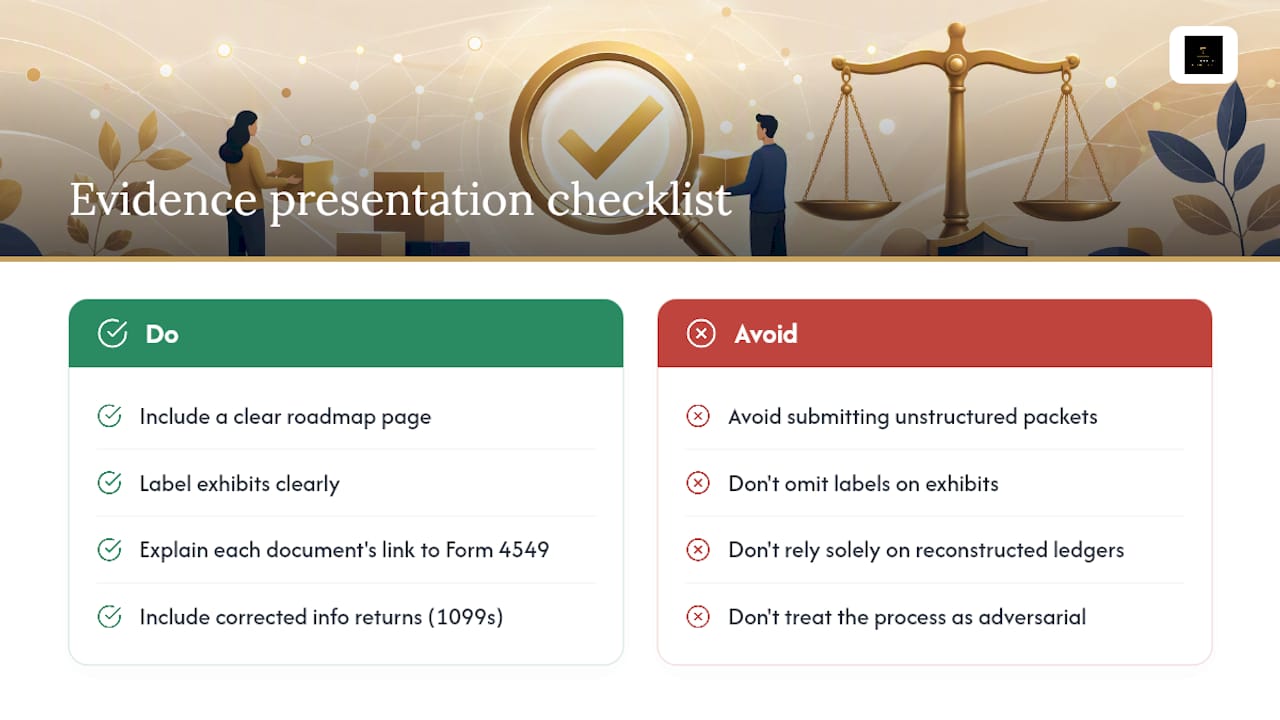
Label every page with the taxpayer identification number (TIN) and tax year in the header or footer. Do not send originals. Send copies, and keep a complete duplicate set for your records.
Examiners process dozens of reconsideration packets. The ones that move fastest have a clear issue-by-issue structure: state the adjustment from Form 4549, identify the document that addresses it, and write one sentence explaining the connection. A short roadmap page at the front of the packet listing each issue and its corresponding exhibit reduces processing friction significantly.
Pro Tip: Three evidence types that often sway reconsideration and are frequently overlooked: (1) corrected information returns from payers (a corrected 1099-NEC can eliminate phantom income in minutes); (2) contemporaneous contracts that establish business purpose for disputed deductions; and (3) third-party correspondence such as client emails or vendor letters that corroborate the nature of a transaction. These carry more weight than reconstructed ledgers alone because they originate outside the taxpayer's own records.
Hearsay and unsupported assertions carry little weight. A signed affidavit explaining why records are missing is acceptable; a letter saying "I remember paying this expense" without any corroborating document is not.
Exactly how to file: forms, tools, and delivery
The IRS correspondence audit reconsideration page recommends the Document Upload Tool (DUT) as the preferred submission method for correspondence (mail) audits. For field or office exams, mailing directly to the campus or area office that handled the audit is standard.
Step-by-step submission flow:
- Identify the correct IRS office. The address appears on your audit letter or Form 4549. For correspondence audits, the campus that issued the letter handles the request. Call 1-866-897-0161 if you are unsure of the routing.
- Gather Form 4549. This is your packet's anchor document. Every disputed item in your submission should tie back to a specific line on Form 4549.
- Complete Form 12661 (optional but recommended). Form 12661 is the IRS Disputed Issue Verification form. It is not mandatory, but it gives the reviewer a structured list of exactly which adjustments you are contesting and why.
- Draft a cover letter. State your name, TIN, tax year, and the Document Locator Number (DLN) or case/notice number from your audit letter. List every enclosure. Request reconsideration explicitly and, if collection activity is underway, request a suspension of collection in writing.
- Assemble and label exhibits. Label each document as "Exhibit 1," "Exhibit 2," etc., and note what it addresses (e.g., "Exhibit 3: Bank statement — January 2022 — ties to Schedule C expense adjustment on Form 4549, Line 4").
- Submit via DUT or certified mail. If using the DUT, follow the file-naming conventions and upload in PDF format. If mailing, use certified mail with return receipt and keep the tracking number.
- Retain a complete copy of the full packet before submission, including the cover letter, all exhibits, and proof of delivery.
DUT vs. mail:
The DUT creates a digital record of receipt and eliminates lost-mail risk. It is the better choice for correspondence audits. For field exams or cases with an assigned revenue agent, mailing to the specific office with a cover letter addressed to the examiner's group is often more direct. If you are unsure, call the number on your audit letter and confirm the preferred method.
Practical dos and don'ts:
- Do include a copy of the original return if you are contesting an SFR.
- Do request written confirmation of receipt.
- Do not send original documents. Ever.
- Do not submit a packet without identifying the specific disputed adjustments from Form 4549.
- Do not ignore active collection notices while reconsideration is pending. Request a suspension in writing and consider contacting TAS if collection enforcement continues.
How long reconsideration takes and how to check status
The Taxpayer Advocate Service notes that taxpayers should expect an acknowledgment within about a month of submission. Many straightforward cases, where the new evidence clearly resolves the disputed item, reach a resolution within a few months. Complex cases with multiple adjustments or significant dollar amounts can take longer.
What the acknowledgment looks like: The IRS will send a letter confirming receipt of your reconsideration request and indicating that the case is under review. If you do not receive an acknowledgment within 30 days, follow up.
How to check status:
- Call the phone number on your original audit letter and reference your TIN, tax year, and DLN.
- Log into your IRS online account at IRS.gov to check for any correspondence or account updates.
- Contact the campus or exam office that handled the audit directly.
- If delays extend beyond published response windows, contact the Taxpayer Advocate Service. TAS can intervene when systemic delays are causing hardship or when collection activity is continuing despite a pending reconsideration.
What to have ready when you call:
- Taxpayer Identification Number (TIN)
- Tax year(s) at issue
- Document Locator Number (DLN) or case/notice number from the audit letter
- Date you submitted the reconsideration request
- Proof of delivery (tracking number or DUT confirmation)
If the IRS denies reconsideration: what to do next
A denial is not the end of the road. Several options remain, and the right one depends on the dollar amount, the strength of your remaining evidence, and how much time is left on the ASED.
Sequential path after denial:
- Request an Appeals conference. The originating office must consider your protest before forwarding the case to the Independent Office of Appeals. You generally cannot bypass the reconsideration step and go directly to Appeals. Submit a written protest to the office that denied reconsideration.
- Prepare your protest per Publication 5 guidance. The Appeals request guidance specifies what a formal written protest must include: a statement of facts, the legal basis for your position, and a list of disputed items. For cases involving $25,000 or less per tax year, a Small Case Request (a simpler, shorter letter) is sufficient instead of a formal protest.
- File Form 12153 if collection notices are active. Form 12153 (Collection Due Process request) applies when you receive a Notice of Federal Tax Lien filing or a Notice of Intent to Levy. CDP gives you the right to an Appeals hearing before collection proceeds.
- Consider the pay-and-file-for-refund option. Pay the assessed tax in full, then file Form 1040-X to claim a refund. If the IRS denies the refund claim, you can take the case to U.S. Tax Court or U.S. District Court. This path is slower and carries upfront cost, but it preserves your right to judicial review.
- Contact TAS if delays or collection pressure are creating hardship. TAS can assist when the IRS has not followed its own procedures or when enforcement is causing significant financial harm.
ASED note: Appeals typically requires at least 365 days remaining on the Assessment Statute Expiration Date when a case reaches their office. If the ASED is approaching, the IRS may request a consent to extend it (Form 872). Refusing to extend can close off the Appeals path entirely, so weigh that decision carefully with a qualified representative.
Pro Tip: If you present new evidence to Appeals that was never shown to the original examiner, Appeals may return that evidence to the exam unit for review rather than considering it themselves. Structure your reconsideration packet so that every piece of evidence is clearly tied to a specific audited adjustment. Evidence that looks new at the Appeals stage creates unnecessary delays and can weaken your position.
Special situations: SFRs, correspondence audits, and collection cases
Substitute for Return (SFR)
When you fail to file a return, the IRS prepares one on your behalf using third-party information (W-2s, 1099s). An SFR typically includes no deductions, no filing status adjustments, and no credits. Filing your original delinquent return is itself new information under IRM 4.13.1 and Publication 3598. The original return replaces the SFR assessment and is the most direct path to reducing an SFR-based liability.
Correspondence audits (audits by mail)
These are handled by IRS campus locations, not field agents. Reconsideration requests for correspondence audits go back to the campus that issued the original notice. The DUT is the preferred submission method. The IRS correspondence audit reconsideration page provides the specific routing and submission instructions for this category.
Collection-related reconsiderations and CDP
- Collection Appeals Program (CAP): Allows you to appeal certain collection actions (liens, levies, seizures) quickly, but does not suspend collection and does not give you Tax Court rights.
- Collection Due Process (CDP): Form 12153 triggers a CDP hearing when you receive a lien or levy notice. CDP does suspend collection and does preserve Tax Court rights. It is the stronger tool when collection is imminent.
- Reconsideration of the underlying tax liability can be raised at a CDP hearing if you did not have a prior opportunity to dispute the assessment.
For taxpayers with cross-border documentation, such as foreign bank records or income from abroad, the IRS compliance checklist for those moving abroad provides a useful reference for understanding which records the IRS expects and how to organize them for submission.
Your submission checklist and a sample cover letter
Submission checklist
- Copy of Form 4549 (your audit report, the packet's roadmap)
- Form 12661 completed and signed (optional but recommended)
- Cover letter with TIN, tax year, DLN/case number, and list of all enclosures
- Copy of the original return (required if contesting an SFR)
- All new supporting documents, labeled as exhibits and copied (never originals)
- Written request to suspend collection activity (if applicable)
- Proof of delivery (certified mail tracking number or DUT upload confirmation)
Sample cover letter (adapt as needed)
[Your Name] [Address | TIN: XXX-XX-XXXX | Tax Year: 20XX]
Re: Request for Audit Reconsideration | DLN: | Tax Year:
I am writing to request reconsideration of the examination adjustments reflected on Form 4549 dated [date]. The assessed balance remains unpaid. I am submitting new information not previously considered during the examination, as described below.
The following adjustments are disputed: [List each item by line number and description from Form 4549]. Supporting documentation for each item is enclosed as Exhibits 1 through [X], with each exhibit labeled to identify the specific adjustment it addresses.
I request that collection activity be suspended while this reconsideration is pending. Please confirm receipt of this request in writing.
Respectfully, [Signature | Date]
Document-labeling table
| Exhibit | Document | Pages | Ties to Form 4549 Issue |
|---|---|---|---|
| Exhibit 1 | Bank statement, January–March 20XX | 1 of 4 | Schedule C expense, Line 4 |
| Exhibit 2 | Vendor invoice, ABC Supply Co. | 1 of 1 | Schedule C expense, Line 4 |
| Exhibit 3 | Corrected 1099-NEC from XYZ Corp | 1 of 1 | Income adjustment, Line 1 |
| Exhibit 4 | Signed contract, Client A | 1 of 2 | Business purpose, Line 7 |
DUT file-naming tip: Name each PDF file to match its exhibit label (e.g., "Exhibit1_BankStatement_Jan-Mar20XX.pdf"). Upload in the order they appear in your cover letter's enclosure list.
Why the IRS rejects reconsideration requests — mistakes to avoid
Most rejections trace back to a short list of preventable errors.
- No new evidence submitted — Sending a letter that simply restates disagreement with the audit result is not reconsideration. The IRS will close the case without action.
Immediate disqualifiers and their fixes:
| Situation | Why It Disqualifies | What to Do Instead |
|---|---|---|
| Tax paid in full | Reconsideration requires an unpaid balance | File Form 1040-X to claim a refund |
| Signed closing agreement (Form 906 / 870-AD) | Agreement is final and binding | Consult a tax attorney; options are very limited |
| Final court determination | Court decisions are not subject to administrative reconsideration | Appellate court review only |
| No new information | Reconsideration requires evidence not previously considered | Gather new documents before submitting |
When to hire a tax professional for audit reconsideration
Some reconsideration cases are straightforward: one disputed deduction, one missing receipt, one clear fix. Others are not. Knowing when to bring in a tax professional, specifically an Enrolled Agent (EA), CPA, or tax attorney, can be the difference between a resolved case and a prolonged dispute.
Hire representation when:
- The dollar amount at issue is significant enough that a professional fee is a reasonable investment relative to the potential tax reduction.
- Documentation reconstruction is needed (e.g., records were lost, destroyed, or never properly maintained).
- The audit involved multiple adjustments across several years or entities.
- Collection enforcement (liens, levies) is already underway while reconsideration is pending.
- The case is heading toward Appeals and requires a formal written protest.
- You are not comfortable corresponding directly with IRS exam units or Appeals officers.
What a qualified representative does:
- Reviews the original audit workpapers and Form 4549 to identify the strongest grounds for reconsideration.
- Reconstructs and organizes evidence into a structured packet with a clear issue-by-issue roadmap.
- Drafts Form 12661 and the cover letter with precise, examiner-friendly language.
- Files Form 2848 (Power of Attorney) to communicate directly with the IRS on your behalf, so you are not navigating IRS correspondence alone.
- Prepares a formal protest for Appeals if reconsideration is denied, and represents you at the Appeals conference.
- Advises on collection strategy, including whether to request a suspension, enter an installment agreement, or pursue an Offer in Compromise while reconsideration is pending.
On fees: Representation fees for audit reconsideration and Appeals work vary by complexity. For high-dollar cases, the return on investment is often substantial. A $5,000 professional fee that eliminates a $40,000 assessment is straightforward math. For lower-dollar cases, a limited-scope engagement (packet review and cover letter drafting only) may be the right fit.
Thetaxrefinery provides IRS representation and tax resolution services for taxpayers facing audit reconsideration, Appeals, and collection issues. If you are weighing whether professional help makes sense for your situation, a case review is the logical first step.
Key Takeaways
IRS audit reconsideration is available when your assessed tax is unpaid and you can submit new information the examiner never reviewed — acting quickly and organizing evidence by issue is what determines whether the request succeeds.
| Point | Details |
|---|---|
| Confirm eligibility first | The assessed balance must be unpaid; paid assessments require Form 1040-X, not reconsideration. |
| New evidence is required | Mere disagreement fails; receipts, corrected 1099s, and third-party records tied to Form 4549 adjustments succeed. |
| Submit to the right office | Send to the campus or exam office that handled the audit; use the DUT for correspondence audits. |
| Know your fallback options | If denied, Appeals, TAS assistance, and the pay-and-file-for-refund path are all available. |
| Thetaxrefinery can help | Thetaxrefinery offers audit reconsideration preparation, evidence reconstruction, and Appeals representation for taxpayers who need professional support. |
Why the presentation of evidence is often more decisive than the evidence itself
Most taxpayers who lose at reconsideration had the right documents. They just did not present them in a way that made the examiner's job easy.
Examiners reviewing reconsideration packets are working through a queue. A packet that arrives with a clear roadmap page, labeled exhibits, and a one-sentence explanation connecting each document to a specific Form 4549 adjustment gets reviewed faster and more favorably than an identical set of documents submitted without structure. That is not speculation. It reflects how IRM 4.13.1 describes the screening and review process, and it is consistent with what Publication 3598 recommends for presenting new information.
The cases that tend to succeed share a common trait: the taxpayer (or their representative) anticipated the examiner's question for each disputed item and answered it in writing before the examiner had to ask. Third-party documentation, specifically corrected information returns, vendor contracts, and client correspondence, carries disproportionate weight because it originates outside the taxpayer's own records. An examiner can verify a corrected 1099 with a phone call. They cannot easily verify a reconstructed ledger.
For taxpayers who went through an SFR assessment, filing the original delinquent return is often the fastest path to a dramatically lower liability. The SFR carries no deductions and no favorable filing status. A properly prepared original return, submitted as new information, can reduce the assessment significantly without requiring a lengthy evidence battle.
The IRS process is administrative, not adversarial. Approaching it that way, with organized evidence, clear labeling, and a professional tone, produces better outcomes than treating it as a fight.
Thetaxrefinery helps you build a reconsideration packet that works
Audit reconsideration is procedurally straightforward on paper. In practice, the difference between a successful request and a closed case often comes down to how the packet is assembled, whether the right evidence is included, and whether the submission reaches the correct IRS office. Thetaxrefinery handles all of it.

As an Enrolled Agent-led firm, Thetaxrefinery reviews your Form 4549, identifies the strongest grounds for reconsideration, reconstructs and organizes supporting documentation, and drafts your Form 12661 and cover letter with examiner-friendly precision. If reconsideration is denied, the firm prepares formal Appeals protests and represents you directly at the conference. Form 2848 is filed so you never have to navigate IRS correspondence alone.
Services include:
- Audit reconsideration packet preparation and evidence reconstruction
- Form 12661 drafting and issue-by-issue documentation mapping
- Direct IRS liaison for exam units and Appeals
- Collection strategy: suspension requests, installment agreements, and CDP guidance
- Appeals representation and formal protest drafting
To find out whether reconsideration applies to your case and what a professional engagement looks like, review your options or contact Thetaxrefinery directly for a case review.
Official sources and forms to bookmark
Use these directly. Each one is free and authoritative.
- Publication 3598, What You Should Know About the Audit Reconsideration Process
- Audit reconsideration process for correspondence examinations — IRS
- Publication 3498 (Rev.5-2025)
- Audit Reconsiderations - Taxpayer Advocate Service - IRS
- IRM 4.13.1 — Examination Audit Reconsideration Process
- Preparing a Request for Appeals | Internal Revenue Service
- Appeals — Internal Revenue Service
- Form 12661 | Internal Revenue Service
This article provides general information about the IRS audit reconsideration process and is not legal or tax advice. Tax rules and procedures change; confirm current requirements with the IRS directly or consult a qualified tax professional before taking action on your specific situation.