
Oregon's Pass-Through Entity Elective (PTE-E) tax lets qualifying partnerships and S corporations pay an entity-level state income tax, shifting the deduction from individual owners to the business itself and bypassing the federal $10,000 SALT cap. If your entity qualifies, the core actions are straightforward:
- Check eligibility: Your entity must be taxed as a partnership or S corporation, and every member must be an individual or a pass-through entity owned entirely by individuals.
- Register on Revenue Online at the Oregon Department of Revenue portal before making any estimated payments.
- Estimate your PTE-E tax liability. If it will reach $1,000 or more, quarterly estimated payments are required.
- File Form OR-21 with the Election box checked by the return due date to make the election official.
The program is available for tax years beginning on or after January 1, 2022 and before January 1, 2026, so 2025 is the final tax year eligible. The rate is 9 percent on the first portion of distributive proceeds up to a specified threshold and 9.9 percent on amounts exceeding that threshold.
Key Takeaways
Oregon's PTE-E election delivers its full benefit only when eligibility is confirmed, estimated payments are made on time, and every member's individual return accounts for both the refundable credit and the required Oregon addition.
| Point | Details |
|---|---|
| Eligibility requirement | Partnerships and S corps qualify; every member must be an individual or a PTE owned entirely by individuals. |
| Rate structure | 9% on the first $250,000 of Oregon-source proceeds; 9.9% above that, with a $22,500 baseline shortcut. |
| Estimated payment threshold | Quarterly payments are required when projected PTE-E tax reaches $1,000 or more. |
| Registration before payment | Register on Revenue Online and obtain a PTE-E account number before making any installment payments. |
| Filing deadline | Form OR-21 with the Election box checked is due March 15 (extended to September 15); 2025 is the final eligible year. |
| Thetaxrefinery | Models the combined federal-Oregon projection, manages OR-21 filing, and coordinates K-1 delivery for electing entities. |
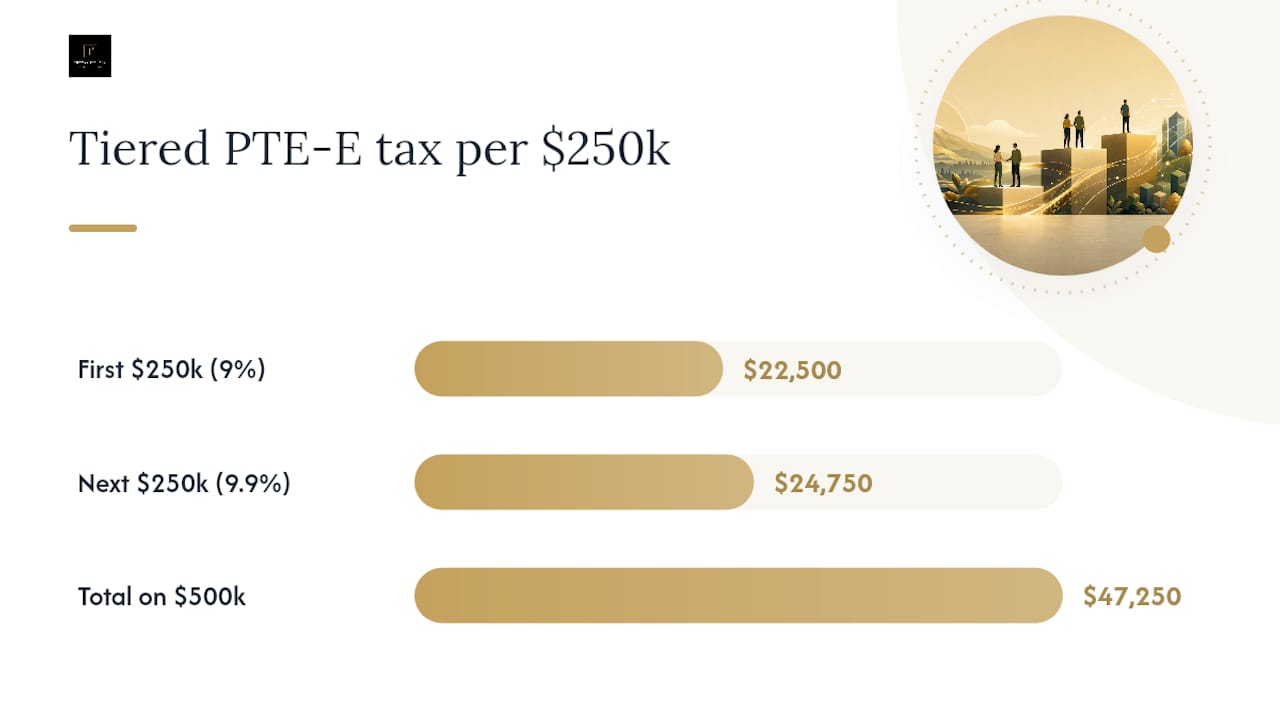
Table of Contents
- What is the Oregon PTE-E tax and why does it exist?
- Who qualifies to make the Oregon PTE-E election?
- How do you make the election and file Form OR-21?
- How do you calculate estimated PTE-E tax payments?
- How do members claim the credit and report the Oregon addition?
- What counts as Oregon-source distributive proceeds?
- What are the penalties and interest for underpayment or late filing?
- Oregon PTE-E compliance checklist and key dates
- When does the Oregon PTE election actually help, and when does it not?
- Sources
What is the Oregon PTE-E tax and why does it exist?
The Oregon PTE-E tax is an elective, entity-level income tax for partnerships and S corporations. Without it, pass-through owners pay Oregon income tax on their share of business income at the individual level, and that state tax payment counts against the federal $10,000 SALT deduction cap. By electing the PTE-E tax, the entity pays Oregon tax directly, deducting it as a business expense on the federal return, which is not subject to the SALT cap. Members then claim a refundable Oregon credit on their individual returns, effectively recovering the tax they would have paid anyway.
The statutory foundation is SB 727 (2021), which created the program, later amended by SB 1524 (2022) to refine eligibility and mechanics. The program mirrors similar SALT cap workarounds enacted in more than 30 states after the Tax Cuts and Jobs Act of 2017 capped the individual SALT deduction.
Key statutory and rate facts:
- Available for tax years beginning on or after January 1, 2022 and before January 1, 2026 (2025 is the last eligible year).
- The program sunsets automatically if the federal SALT cap is repealed or significantly changed.
- Tax rate: 9% on the first $250,000 of Oregon-source distributive proceeds.
- Tax rate: 9.9% on any amount exceeding $250,000.
- For amounts over $250,000, the shortcut formula is: $22,500 + 9.9% of the excess over $250,000.
The rate math in practice: An entity with $500,000 in Oregon-source distributive proceeds owes $22,500 on the first $250,000, plus 9.9% of the remaining $250,000 ($24,750), for a total PTE-E tax of $47,250.
The program's dependency on the federal SALT cap is worth watching. If Congress eliminates or raises the cap, the Oregon DOR may revisit the program's value, though the statutory sunset at January 1, 2026 already limits exposure for most planning purposes.
Who qualifies to make the Oregon PTE-E election?
Eligibility is more specific than it looks at first glance, and getting it wrong can invalidate the election entirely.
Entity types that qualify:
- Partnerships (including multi-member LLCs taxed as partnerships)
- S corporations (including LLCs that have elected S corporation status)
- Tiered structures where a lower-tier PTE meets the member-composition rules
Member composition rules:
- Every member must be an individual, or a pass-through entity whose members are all individuals.
- If any member is a C corporation, a trust (in most cases), or another entity that breaks the individual-ownership chain, the lower-tier PTE cannot elect.
- Single-member LLCs taxed as disregarded entities are generally excluded because they are not treated as partnerships or S corporations for Oregon purposes.
Upper-tier entity rules:
When a lower-tier PTE elects, an upper-tier PTE that holds an interest in it must pass through the lower-tier's PTE-E items using Schedule OR-21-MD-PT. The upper-tier then issues Schedule OR-21-K-1 to its own members. Critically, the election is only available to the lower-tier entity if every member of the upper-tier entity is an individual. This creates a reporting chain that requires careful coordination between entities.
Fiscal-year filers:
Administrative Rule 150-314-0522 clarifies that the PTE-E program operates on a calendar-year basis. A fiscal-year entity cannot simply apply its fiscal year to the election. The election maps to the calendar year in which the entity's tax year begins, and the entity must follow calendar-year installment due dates regardless of its own fiscal year.
Two quick scenarios:
Scenario A: A two-member S corporation with both owners as individuals qualifies without complication. Both members must agree to the election, and the entity files Form OR-21 with the Election box checked.
Scenario B: A partnership where one partner is a family LLC owned entirely by two siblings (both individuals) can still qualify, because the upper-tier LLC's members are all individuals. The partnership would use Schedule OR-21-MD-PT to pass items to the LLC, which then issues K-1s to the siblings.
Pro Tip: Before electing, map every ownership layer in writing. A single non-individual member anywhere in the chain disqualifies the election, and discovering this after estimated payments have been made creates a refund process rather than a credit.
How do you make the election and file Form OR-21?
The election is not made by filing a separate form or checking a box on a state registration. It is finalized when Form OR-21 is filed with the Election box checked. That means the entity must complete the entire compliance sequence correctly.
- Register on Revenue Online. Go to the Oregon DOR's Revenue Online portal and set up a PTE-E account. Registration is required before making any estimated payments.
- Obtain your PTE-E account number. This number is used on Form OR-21-V (the payment voucher for mailed checks) and when making ACH payments through Revenue Online.
- Estimate your Oregon-source distributive proceeds. Use the rate schedule (9% / 9.9%) to project your annual PTE-E tax liability. If the projected amount is $1,000 or more, estimated payments are required.
- Make quarterly estimated payments by the calendar-year due dates (see the estimated payments section below). Payments go through Revenue Online or by mail with Form OR-21-V.
- File Form OR-21 by the due date, with the Election box checked. The return is due on the 15th day of the third month after the close of the calendar year (March 15 for calendar-year filers), with an automatic extension available to September 15.
Required schedules:
- OR-21-MD: Lists each member's name, identification number, and distributive share of Oregon proceeds.
- OR-21-AP: Apportionment schedule, required when the entity has income from both Oregon and non-Oregon sources.
- OR-21-MD-PT: Used when a member is itself a pass-through entity (upper-tier situations).
- Schedule OR-21-K-1: Issued to each member, showing their share of distributive proceeds, the required Oregon addition, and the refundable credit amount.
The Form OR-21 instructions walk through each schedule in detail, including the order in which they must be completed and how upper-tier entities handle the pass-through.
Pro Tip: Document owner consensus before filing. If one member later disputes the election, the entity has limited remedies. A simple written agreement signed by all members before the first estimated payment is made protects everyone and clarifies who is authorized to sign the return.
How do you calculate estimated PTE-E tax payments?
The calculation follows the two-rate structure, and the Publication OR-21-EST lays out three installment methods: regular, annualized, and safe harbor.
The two-rate worksheet
Step 1: Determine total Oregon-source distributive proceeds for the year.
Step 4: The result is your annual required payment for estimated-payment purposes.
Worked example:
An S corporation projects $400,000 in Oregon-source distributive proceeds for 2025.
- First $250,000 × 9% = $22,500
- Remaining $150,000 × 9.9% = $14,850
- Total estimated annual PTE-E tax: $37,350
Since $37,350 exceeds the $1,000 threshold, quarterly estimated payments are required. Each installment is the total estimated annual PTE-E tax divided equally by four under the regular installment method.
Installment due dates (calendar year 2026)
| Installment | Due Date |
|---|---|
| 1st quarter | April 15, 2025 |
| 2nd quarter | June 15, 2025 |
| 3rd quarter | September 15, 2025 |
| 4th quarter | January 15, 2026 |
Installment methods
- Regular installments: Divide the annual required payment by four and pay equal amounts by each due date.
- Annualized installments: Useful when income is uneven across quarters. The entity annualizes income earned through each installment period and calculates the cumulative payment due. This method requires more documentation but can reduce early-quarter payments for seasonal businesses.
- Safe harbor: Pay 100% of the prior year's PTE-E tax in equal installments. This option is only available if the entity made the election in the prior year. For entities with volatile income, safe harbor is often the simplest route.
Payment channels:
- Revenue Online: ACH debit or credit card while logged in, or non-logged-in payment using your PTE-E account number.
- Mail: Send a check with Form OR-21-V (the payment voucher) to the Oregon DOR.
One point many owners miss: estimated payments during the tax year are separate from the election itself. Making estimated payments does not constitute an election, and failing to make them while planning to elect later can result in underpayment interest even if the election is ultimately filed on time. For more on quarterly payment mechanics for S corporation owners, the estimated taxes for Oregon S corps guide covers the owner-level coordination in detail.
How do members claim the credit and report the Oregon addition?
The entity-level tax creates two obligations for each member: claiming the refundable credit and reporting the required Oregon addition.

Schedule OR-21-K-1 mechanics:
The entity must issue a Schedule OR-21-K-1 to each member after filing Form OR-21. The K-1 shows:
- The member's share of Oregon-source distributive proceeds.
- The member's share of the PTE-E tax paid by the entity.
- The refundable credit amount the member may claim on their Oregon individual return.
- The required Oregon addition (the amount of PTE-E tax the entity deducted on its federal return that must be added back on the member's Oregon return).
The required addition explained:
When the entity deducts PTE-E tax as a business expense on its federal return, that deduction reduces the income flowing to members on their federal K-1s. Oregon requires members to add that amount back on their individual Oregon returns, so the state is not giving a double benefit. The net effect is that the credit and the addition roughly offset each other at the member level, with the actual tax savings coming from the federal deduction.
Upper-tier flow:
When a lower-tier PTE elects and an upper-tier PTE holds an interest, the lower-tier passes its PTE-E items to the upper-tier via Schedule OR-21-MD-PT. The upper-tier then includes those items in its own Form OR-21 reporting and issues Schedule OR-21-K-1 to its individual members. This chain must be completed in sequence, which means lower-tier entities need to finalize their returns before upper-tier entities can complete theirs.
Nonresident and composite returns:
Nonresident members who participate in a composite Oregon return may have their PTE-E credit applied differently. Members should confirm with their tax advisor whether composite return participation affects how the credit is claimed, particularly when the member has other Oregon-source income outside the electing entity.
What counts as Oregon-source distributive proceeds?
Oregon-source distributive proceeds are the foundation of the PTE-E tax calculation, and the definition is broader than just operating income.
Items included in distributive proceeds:
- Net income from Oregon business operations
- Dividends, interest, royalties, and rents sourced to Oregon
- Guaranteed payments to partners for services rendered in Oregon
- Capital gains from the sale of Oregon real property or Oregon-based business assets
- Any other income item that would be sourced to Oregon under Oregon's standard income-sourcing rules
When apportionment is required:
Entities with income from both Oregon and non-Oregon sources must use Schedule OR-21-AP to determine the Oregon-source portion. The apportionment formula follows Oregon's standard rules for the entity type (sales factor for most service businesses; three-factor for others). Only the apportioned Oregon-source amount enters the PTE-E tax calculation.
Edge cases:
Separately stated deductions that reduce a member's distributive share on the federal K-1 but are not Oregon-sourced items may not reduce the Oregon distributive proceeds figure. Entities with significant interstate activity should work through Schedule OR-21-AP carefully, as misapportioning income is one of the more common errors in PTE-E filings.
What are the penalties and interest for underpayment or late filing?
The Form OR-21 instructions include specific penalty and interest examples that make the cost of non-compliance concrete.
Penalty and interest rules:
- Failure-to-pay penalty: 5% of the unpaid tax amount.
- Underpayment interest: Calculated daily using an annual rate set by the Oregon DOR. The rate has varied year to year (the instructions cite 8% for a 2024 example and 9% for a 2025 example).
- Interest applies from the original due date of the installment, not from the filing date of the return.
Worked penalty example:
An entity owes $10,000 in PTE-E tax and pays nothing by the March 15 due date.
- Failure-to-pay penalty: $10,000 × 5% = $500
- Daily interest at 9% annual rate: $10,000 × (9% ÷ 365) = approximately $2.47 per day
- After 90 days: $500 + ($2.47 × 90) = $500 + $222.30 = $722.30 in additional charges
The penalty and interest compound quickly on larger balances. For entities that have already missed payments, the back taxes payment plan options through Oregon DOR may be worth reviewing.
Refund note: When an entity's Oregon-source distributive proceeds are zero or a loss (line 22 of Form OR-21 is zero or negative), the entity should not file Form OR-21. Instead, it must request a refund of any estimated payments already made through its Revenue Online account.
Oregon PTE-E compliance checklist and key dates
Action checklist
- Confirm entity type and member composition qualify for the election.
- Register on Revenue Online and obtain a PTE-E account number.
- Prepare a projection of Oregon-source distributive proceeds for the year.
- Determine whether projected PTE-E tax reaches the $1,000 estimated-payment threshold.
- Choose an installment method (regular, annualized, or safe harbor).
- Make quarterly estimated payments by the due dates below.
- Gather revenue and expense detail, apportionment workpapers, and member information for OR-21-MD and OR-21-K-1.
- Document owner agreement on the election in writing before filing.
- File Form OR-21 with the Election box checked by March 15 (or September 15 with extension).
- Issue Schedule OR-21-K-1 to each member after filing.
Key dates calendar (2025 tax year)
| Event | Date |
|---|---|
| 1st estimated payment due | April 15, 2025 |
| 2nd estimated payment due | June 15, 2025 |
| 3rd estimated payment due | September 15, 2025 |
| Form OR-21 original due date | March 15, 2026 |
| 4th estimated payment due | January 15, 2026 |
| Form OR-21 extended due date | September 15, 2026 |
For year-end document preparation, the December tax planning checklist covers the documentation steps that feed directly into the OR-21 filing.
When does the Oregon PTE election actually help, and when does it not?
The election is not automatically beneficial for every qualifying entity. The decision depends on owner income levels, itemization status, and how the required Oregon addition interacts with each owner's federal return.
Who benefits most
| Owner profile | Likely benefit |
|---|---|
| High-income S corp owner who itemizes federally | Strong benefit: federal deduction bypasses SALT cap |
| Partner with $500,000+ in Oregon-source income | Strong benefit: 9.9% rate on excess, large federal deduction |
| Owner who takes the standard deduction federally | Reduced benefit: no SALT cap to bypass, but entity-level deduction still reduces federal taxable income |
| Partner with minimal Oregon-source income | Marginal or no benefit: credit may not exceed compliance cost |
| Entity with uneven owner income levels | Asymmetric benefit: high-income owners gain more than low-income owners |
Modeling checklist
- Run a combined federal and Oregon tax projection with and without the election.
- Include the required Oregon addition on each member's individual return in the "with election" scenario.
- Test the safe-harbor installment scenario against the regular installment to identify cash-flow differences.
- Consider self-employment tax impacts for partners, since the entity-level deduction may interact with self-employment income calculations.
- Confirm that all members agree to the election before modeling becomes a commitment.
The Bipartisan Policy Center's analysis of SALT deduction mechanics for businesses is useful context for understanding when entity-level elections remain advantageous even after federal SALT cap adjustments. For S corporation owners specifically, the S corp tax planning guide covers how PTE elections interact with reasonable compensation and distribution planning.
The PTE-E election can produce uneven benefits when owner income levels vary significantly. A partnership where one partner earns $600,000 from the entity and another earns $80,000 will see the high-income partner capture most of the federal tax benefit, while both partners share the compliance cost. That asymmetry requires honest conversation before electing. For high-earner tax planning in general, the modeling framework matters as much as the election decision itself.
Pro Tip: Run the model before the first estimated payment due date, not at year-end. Once estimated payments are made, the practical pressure to file the election increases, even if the numbers no longer favor it.
A practitioner's perspective on the Oregon PTE election
Most of the clients who ask about the Oregon PTE-E election have heard it described as a straightforward SALT workaround. It often is. But the cases where it creates problems are almost always governance failures, not calculation errors.
The math is not complicated. The rate schedule is clear, the OR-21 worksheet is well-documented, and the Oregon DOR's guidance is more thorough than most states offer. What goes wrong is when an entity elects without getting every member's explicit agreement in writing, or when estimated payments are skipped because the owners assumed the election could be handled at year-end. Publication OR-21-EST is explicit: underpayment interest runs from the installment due date, not from when the return is filed. That distinction costs real money.
The other underappreciated issue is the required Oregon addition. Owners who see the credit on their K-1 sometimes miss the addition, which partially offsets the credit on their individual return. The net benefit is real, but it is smaller than the credit line alone suggests. Running a complete projection that includes both the credit and the addition is the only way to know whether the election is worth the compliance overhead for a given entity.
For entities in their final year of eligibility (2025), the decision is time-sensitive. There is no carryforward of the election, and the program sunsets for tax years beginning on or after January 1, 2026. If the numbers support it, 2025 is the last opportunity.
Oregon PTE-E tax strategy and filing support
Oregon's PTE-E election is one of the more concrete tax planning opportunities available to pass-through owners before the 2026 sunset, but it requires accurate modeling, owner coordination, and timely compliance to deliver its full benefit.
Thetaxrefinery works with S corporation owners, partnerships, and multi-entity operators to model PTE-E outcomes, manage OR-21 filing, and coordinate K-1 delivery to members. The firm's year-round advisory model means the election decision is made with a full federal-state projection in hand, not as an afterthought at filing time.

If you want to know whether the Oregon PTE election makes sense for your entity before the 2025 deadline closes, the right starting point is a combined tax projection that includes the required Oregon addition and your specific owner income profile. Review the tax strategy comparison to see how Thetaxrefinery structures that engagement, or use the tax outcome calculator to run a first estimate before scheduling a conversation.
Sources
Every filer will need these Oregon DOR resources:
- Form OR-21 Instructions Oregon Pass-through Entity Elective Return (2024)
This article is general information, not a substitute for advice from a qualified financial advisor. Consult a qualified financial professional about your own circumstances before acting on anything here.