
Tax planning for high earners is the deliberate management of income, deductions, and entity structures to significantly reduce total tax liability and retain more after-tax wealth. Once household income crosses $250,000–$300,000, the tax picture changes fast. Federal surtaxes like the 3.8% Net Investment Income Tax (NIIT) and the 0.9% Additional Medicare Tax stack on top of marginal rates, and the Alternative Minimum Tax can eliminate deductions you counted on. The industry term for this work is "proactive tax strategy," and it goes well beyond filing a return. With the right approach, effective planning saves $40,000–$80,000 or more annually. That number is not theoretical. It reflects real decisions made throughout the year, not in April.
What are the multi-layered tax challenges high earners face?
High earners do not simply pay a higher marginal rate. They face a compounding stack of federal, state, and surtax obligations that push effective rates well above the nominal bracket.
The federal layers include:
- 37% top marginal rate on ordinary income above $626,350 (single) or $751,600 (married filing jointly) in 2026
- 3.8% NIIT on net investment income for individuals with modified adjusted gross income above $200,000 (single) or $250,000 (married)
- 0.9% Additional Medicare Tax on wages and self-employment income above the same thresholds
- Alternative Minimum Tax (AMT) triggered by large ISO exercises, high deductions, or certain preference items
Consider a married business owner in Boise earning $600,000 in combined ordinary income and investment income. Their federal effective rate can easily reach 38–42% once surtaxes apply. Add Idaho's flat income tax rate, and the total tax burden becomes the single largest line item in their financial life.
The SALT deduction cap of $10,000 compounds the problem. High earners in states with meaningful income taxes lose most of the federal deduction benefit, making state tax planning a separate and necessary discipline. The true effective tax rate for someone at $600,000 in income often runs 10–15 percentage points higher than the nominal bracket suggests. That gap is where proactive strategy lives.

Pro Tip: Calculate your effective rate, not just your bracket. The difference between the two numbers tells you exactly how much planning opportunity exists.
What tax-advantaged accounts should high earners maximize in 2026?
Retirement accounts remain the most direct path to reducing taxable income, and the 2026 limits create significant room to act.
Core contribution limits for 2026
- 401(k) employee deferral: $24,500 (plus $7,500 catch-up if age 50 or older)
- Total 401(k) annual addition limit: $72,000, which includes employer contributions and after-tax contributions
- Health Savings Account (HSA): $4,300 (self-only) or $8,550 (family), with an additional $1,000 catch-up at age 55
- Backdoor Roth IRA: $7,000 per person ($8,000 if 50 or older), executed via nondeductible traditional IRA contribution followed by conversion
The mega backdoor Roth strategy allows contributions of up to $47,500 in after-tax dollars to a 401(k), which then converts to Roth. This requires a plan that permits after-tax contributions and in-service distributions or in-plan Roth conversions. Not every employer plan allows it, but business owners who sponsor their own plans can design the plan to permit it.
| Account Type | 2026 Limit | Tax Benefit |
|---|---|---|
| 401(k) employee deferral | $24,500 | Pre-tax income reduction |
| Total 401(k) addition | $72,000 | Includes employer + after-tax |
| HSA (family) | $8,550 | Triple tax advantage |
| Backdoor Roth IRA | $7,000 | Tax-free growth |
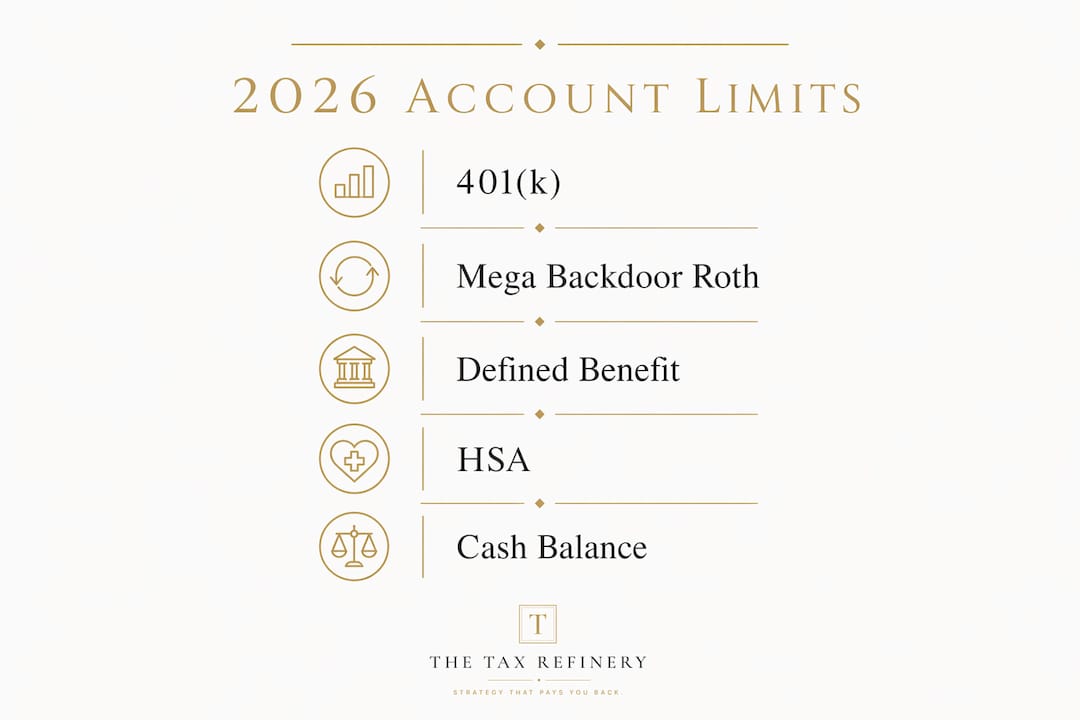
For business owners with consistent high income, a defined benefit or cash balance pension plan can shelter $100,000–$300,000+ per year depending on age and actuarial calculations. These plans work especially well for sole proprietors or S-Corp owners in their 50s who want to compress decades of retirement savings into a shorter window.
The HSA deserves special attention. Contributions are pre-tax, growth is tax-free, and qualified withdrawals are tax-free. That triple tax advantage makes the HSA the most tax-efficient account available. Pair it with a high-deductible health plan, invest the balance rather than spending it, and the account compounds into a significant tax-free medical reserve.
Pro Tip: If you own your business, work with a third-party administrator to design a 401(k) plan that permits mega backdoor Roth contributions. The plan design cost is typically a fraction of the annual tax savings.
How can income design reduce your tax burden?
Income design is the practice of controlling when income is recognized, what character it takes, and which legal entity receives it. It produces larger savings than deduction hunting alone.
The key levers are:
- Income timing: Defer bonuses or business income into lower-income years. Accelerate income into years when rates are lower, such as before a major liquidity event.
- Income characterization: Long-term capital gains rates top out at 20%, compared to 37% for ordinary income. Holding appreciated assets beyond 12 months before sale changes the character of that gain and cuts the rate nearly in half.
- S-Corporation election: An S-Corp lets a business owner split income between a reasonable W-2 salary and distributions. Distributions are not subject to FICA taxes. On $300,000 of net income with a $130,000 salary, S-Corp structuring saves approximately $13,000 in payroll taxes annually.
- Qualified Business Income (QBI) deduction: Pass-through business owners may deduct up to 20% of qualified business income under Section 199A, subject to income limits and W-2 wage tests. Entity structure directly affects eligibility.
- Nonqualified deferred compensation (NQDC): Executives at larger companies can defer significant compensation into future years, shifting income to a lower-bracket period.
AMT exposure requires its own timing discipline. Incentive stock option (ISO) exercises, large miscellaneous deductions, and certain depreciation methods can trigger AMT. Spreading ISO exercises across multiple tax years, or modeling the AMT impact before exercising, prevents a large unexpected liability.
Integrating multiple entities and income streams requires a tax strategist who can model payroll taxes, QBI deductions, and compliance risk together. Each decision affects the others.
What role do charitable giving, loss harvesting, and state taxes play?
These three strategies are often treated as optional add-ons. For high earners, they are core components of a complete plan.
Charitable giving
Donor-advised funds (DAFs) let you bunch multiple years of charitable contributions into a single tax year, pushing your itemized deductions above the standard deduction threshold. You get the full deduction in the contribution year, then distribute grants to charities over time. Donating appreciated stock to a DAF eliminates capital gains tax on the appreciation entirely while generating a full fair-market-value deduction. A client who donates $50,000 of stock with a $10,000 cost basis avoids $8,000–$10,000 in capital gains tax and receives the full $50,000 deduction. Use the charitable giving calculator at Thetaxrefinery to model the exact benefit for your situation.
Tax-loss harvesting and direct indexing
Tax-loss harvesting and direct indexing generate 1–2% of tax alpha per year on taxable portfolios. On a $2,000,000 taxable portfolio, that translates to $20,000–$40,000 in annual tax savings. Direct indexing takes this further by holding individual securities instead of a fund, creating harvesting opportunities at the individual stock level rather than the fund level.
State tax planning
State tax planning is often underutilized, particularly for business owners with multi-state income. Idaho has a flat income tax rate, which simplifies planning compared to states with graduated rates. However, business owners with operations or clients in multiple states face apportionment rules that can create unexpected tax exposure.
Pass-through entity tax (PTET) elections allow S-Corp and partnership owners to pay state income tax at the entity level, which is fully deductible federally. This effectively circumvents the $10,000 SALT cap for business income. The Idaho PTET election is one of the most underused tools available to Idaho business owners.
Pro Tip: If your S-Corp or partnership has not made a PTET election in Idaho, model the federal deduction benefit immediately. For owners paying $30,000 or more in Idaho state income tax, the savings are material.
Key Takeaways
Effective tax planning for high earners requires income design, entity structure, and year-round execution, not just deductions at filing time.
| Point | Details |
|---|---|
| Surtaxes compound quickly | NIIT and Additional Medicare Tax push effective rates well above the nominal bracket for earners above $250,000. |
| Max all tax-advantaged accounts | The 2026 total 401(k) limit of $72,000 and mega backdoor Roth create substantial annual tax reduction. |
| Income design beats deduction hunting | S-Corp structuring, income timing, and capital gains characterization produce larger savings than itemized deductions alone. |
| State taxes require a separate plan | Idaho PTET elections and multi-state apportionment can materially shift total tax liability for business owners. |
| Charitable giving is a tax tool | Donor-advised funds and appreciated stock donations eliminate capital gains while generating full deductions. |
What I have learned from working with high earners in Idaho
The most expensive mistake I see is treating tax planning as a once-a-year event. By the time a client sits down in february to file, most of the decisions that determine their tax bill were made months earlier. Income was recognized, bonuses were paid, stock was sold. The window to act had already closed.
Quarterly tax reviews change that entirely. When you track income, deductions, and estimated payments every 90 days, you catch problems while there is still time to fix them. You also catch opportunities, like a lower-income quarter that creates a perfect window for a Roth conversion or an ISO exercise.
The second mistake is focusing exclusively on deductions. Deductions are finite. Income design is not. An S-Corp election, a PTET election, and a shift from ordinary income to long-term capital gains can each save more than any single deduction. The clients who retain the most after-tax income are the ones who think about how income flows through their entities before it is ever earned.
High earners who engage comprehensive tax advisory services typically recoup professional fees five to ten times over through tax savings. A $5,000 advisory engagement that saves $40,000 is not an expense. It is the highest-return investment in your financial plan. That math holds whether you are an HVAC contractor in Nampa, a real estate investor in Eagle, or an executive in Boise.
— Melissa
How Thetaxrefinery helps high earners keep more of what they earn
High-income individuals and business owners in the Treasure Valley deserve more than a seasonal tax preparer. Thetaxrefinery, founded by Enrolled Agent Melissa Korber, provides year-round tax strategy and advisory services built specifically for business owners, real estate investors, and executives who want proactive planning.
Use the tax savings calculator to estimate your potential savings from S-Corp elections, retirement contributions, and PTET elections before your next quarterly review. For clients in Eagle and the surrounding Treasure Valley, local tax strategy services are available through a structured engagement model that delivers ongoing support, not a once-a-year conversation. Schedule a consultation to see exactly where your tax dollars are going and what can be redirected back to you.
FAQ
What income level requires advanced tax planning?
Household income above $250,000–$300,000 typically triggers compounded tax burdens including NIIT, Additional Medicare Tax, and AMT exposure, making proactive planning necessary rather than optional.
What is the mega backdoor Roth and who qualifies?
The mega backdoor Roth allows after-tax 401(k) contributions of up to $47,500 in 2026, converted to Roth. It requires a plan that permits after-tax contributions and in-service conversions, which business owners can build into their own plan design.
How does an S-Corp election reduce taxes for high earners?
An S-Corp splits business income between a W-2 salary and distributions. Only the salary portion is subject to FICA taxes, which saves a business owner approximately $13,000 annually on $300,000 of net income with a $130,000 salary.
What is a pass-through entity tax election and why does it matter in Idaho?
A PTET election allows S-Corp and partnership owners to pay Idaho state income tax at the entity level, making it fully deductible federally and effectively bypassing the $10,000 SALT deduction cap for business income.
How much can tax-loss harvesting save each year?
On a $2,000,000 taxable portfolio, systematic tax-loss harvesting and direct indexing generate $20,000–$40,000 in annual tax savings, representing roughly 1–2% of tax alpha per year.