
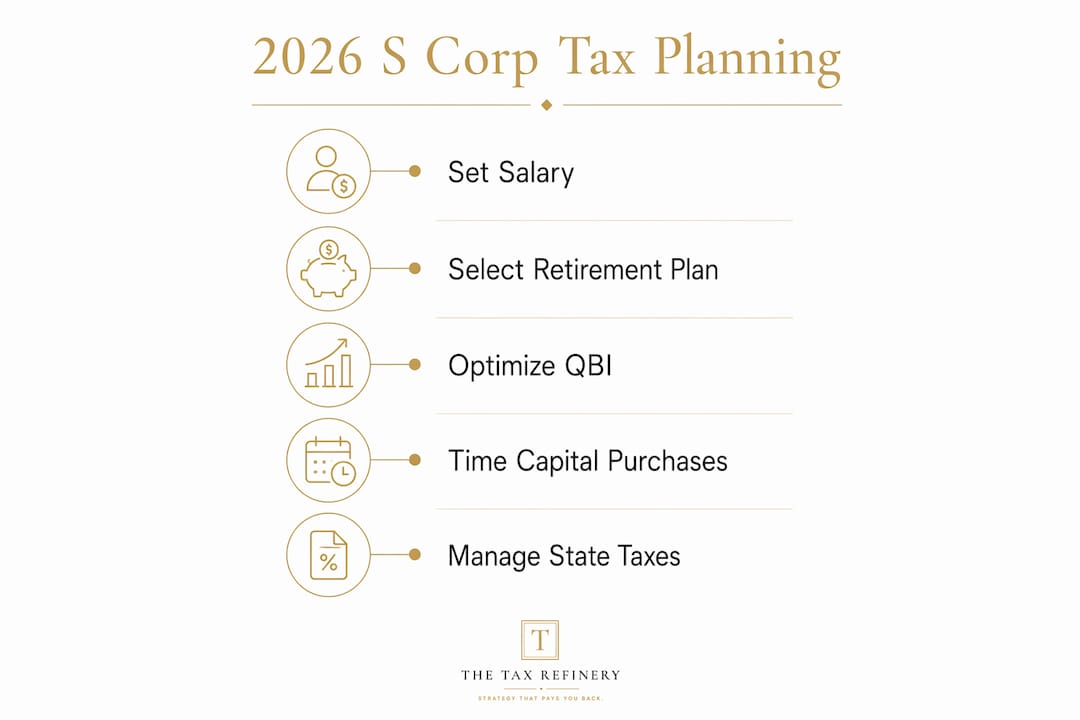
The five moves that produce the largest, most defensible tax savings for S corporation owners are: setting and documenting a reasonable salary, maximizing retirement plan contributions, preserving the Section 199A qualified business income (QBI) deduction, timing capital purchases around Section 179 and bonus depreciation, and evaluating state pass-through entity tax (PTET) elections. Implement all five this quarter and you build both a lower tax bill and an audit-ready paper trail.
Your immediate action checklist for this quarter:
- Set a defensible salary now. Pull Bureau of Labor Statistics (BLS) occupational wage data for your role, document it in board minutes, and run payroll at that rate. Next step: correct any prior-quarter underpayment before year end.
- Choose and fund a retirement plan. A solo 401(k) allows the highest combined deferral for owner-only businesses; a SEP-IRA is simpler but caps employer contributions at 25% of W-2 wages. Next step: confirm the plan is established before December 31 for 2026 contributions.
- Review your QBI eligibility. If your taxable income exceeds the phase-in thresholds, your W-2 wages paid through the S corp directly affect how much of the Section 199A deduction you can claim.
- Time large purchases before year end. Section 179 expensing produces an immediate deduction; confirm your state conforms before assuming the full federal benefit.
- Check your state's PTET election window. Oregon and many other states have specific deadlines for electing pass-through entity tax treatment, which can shift the deduction from the individual to the entity level.
- Confirm payroll deposit schedules. Monthly or semi-weekly deposit rules depend on your lookback period; a missed deposit triggers penalties that compound quickly.
- Verify e-file requirements. S corps filing 10 or more returns in a calendar year must e-file Form 1120-S for returns filed on or after January 1, 2024.
Thetaxrefinery works with S corp owners across Oregon and the broader region to implement exactly this sequence: starting with salary documentation and payroll setup, then layering in retirement and state elections.
Table of Contents
- What changed for S corp owners in 2025–2026
- S corp tax planning starts with salary: how to set and document reasonable compensation
- How to maximize retirement contributions through your S corp
- How to qualify for and protect the QBI deduction on S corp income
- When to use Section 179, bonus depreciation, and how to time capital purchases
- State tax issues and PTET elections: what to check for your state
- Filing, payroll, and estimated tax calendar for S corps
- Common S corp mistakes and IRS audit red flags
- When does S corp status actually make sense?
- Key Takeaways
- The part most S corp owners get wrong
- How Thetaxrefinery helps S corp owners get this right
- Authoritative sources and how to use them
What changed for S corp owners in 2025–2026
Two developments stand out for the current planning cycle.
The Section 199A deduction is now permanent. The One Big Beautiful Budget Act (OBBBA) made the 20% QBI deduction under Section 199A a permanent feature of the tax code rather than a provision set to expire after 2025. For S corp owners who qualify, that permanence changes how aggressively you should plan around it. Salary decisions, entity aggregation, and cost allocations all interact with QBI, and those decisions now carry long-term weight rather than a sunset-year deadline.
E-file thresholds tightened. Starting with returns filed on or after January 1, 2024, S corps that file 10 or more returns of any type in a calendar year must e-file Form 1120-S. This catches many small businesses that previously filed on paper.
Additional items to verify for 2026:
- Retirement plan contribution limits are adjusted annually by the IRS; confirm the current-year caps for solo 401(k) employee deferrals and employer contributions before year-end funding.
- Payroll deposit thresholds shifted for some employers; check whether your lookback period places you in the monthly or semi-weekly deposit schedule.
- State PTET expansions: several states added or modified PTET elections in recent years. Oregon's rules differ from federal treatment in important ways (covered in the state section below).
- Bonus depreciation phasing: the federal bonus depreciation percentage has been stepping down; confirm the current-year rate before making large capital purchase decisions.
The practical effect of these changes: salary timing, QBI eligibility, and capital spending decisions all need to be revisited with current-year rules in hand, not last year's assumptions.
S corp tax planning starts with salary: how to set and document reasonable compensation
Reasonable compensation is the IRS's primary area of scrutiny for S corporations. Owners who pay themselves too little in salary and take the rest as distributions reduce their payroll tax exposure, but they also create the single largest audit risk an S corp faces. The IRS can reclassify distributions as wages and assess back payroll taxes, interest, and penalties.

How to pick a defensible salary
The standard framework uses three inputs: market wage for the role, hours worked, and company profitability. Pull BLS occupational wage data for your specific job title and region, cross-reference with industry salary surveys or sites like the Economic Research Institute, and document the result in writing.
Worked example:
A commercial cleaning business owner in Oregon generates $280,000 in gross profit. After operating expenses, net income before owner compensation is $180,000. A BLS-benchmarked salary for a working owner-operator in that industry and region comes to $72,000. The owner pays $72,000 in W-2 wages and takes the remaining $108,000 as a distribution.
| Item | Amount |
|---|---|
| Net income before compensation | $180,000 |
| Reasonable salary (W-2) | $72,000 |
| Distribution (not subject to payroll tax) | $108,000 |
| Payroll tax avoided on distribution | ~$16,524 |
That $16,524 in avoided payroll tax is the core S corp benefit. It only holds if the salary is defensible.
Documentation checklist
A defensible reasonable compensation position requires a contemporaneous audit trail:
- Written job description listing specific duties and hours
- Time logs or timesheets showing hours worked in the business
- BLS wage printout or industry salary survey for the comparable role
- Board or shareholder minutes approving the salary amount and any changes
- Payroll records showing actual payments made each pay period
- Retain all of the above for at least four years from the return due date
Pro Tip: If you need to correct a historically low salary, document the rationale for the new rate, file amended payroll returns (Form 941-X) where necessary, and set aside cash for potential employer and employee payroll tax liabilities. Doing this proactively reduces penalty exposure significantly compared to waiting for an IRS inquiry.
How to maximize retirement contributions through your S corp
Retirement plans are one of the most direct tax deductions available to S corp owners, and plan selection matters more than most owners realize. The right plan depends on your W-2 salary, whether you have employees, and how much you want to contribute.
Recommended plan by owner profile
A solo 401(k) works best for owner-only S corps with no full-time employees other than a spouse. It allows both an employee deferral and an employer contribution, producing the highest possible combined contribution at a given salary level. A SEP-IRA is simpler to administer but limits contributions to the employer side only (25% of W-2 wages), which can be less efficient for high-income owners. A SIMPLE IRA fits businesses with employees but has lower contribution caps.
Retirement plan selection should be coordinated with salary decisions: a higher W-2 salary increases the absolute dollar amount available for both employee deferrals and employer contributions.
2026 contribution limits (confirm current IRS guidance before funding)
| Plan Type | Employee Deferral | Employer Contribution | Combined Limit | Catch-Up (Age 50+) |
|---|---|---|---|---|
| Solo 401(k) | — | Up to 25% of W-2 wages | — | — |
| SEP-IRA | None | Up to 25% of W-2 wages | — | None |
| SIMPLE IRA | — | 2–3% match or 2% non-elective | Lower overall | — |
Note: IRS adjusts these limits annually. Verify current-year caps at IRS.gov before making contributions.
Implementation steps
- Choose the plan type based on your salary level, employee count, and contribution goals before October 1 for a SIMPLE IRA (the setup deadline) or before December 31 for a solo 401(k).
- Establish the plan document with a financial institution or third-party administrator before the plan establishment deadline.
- Make employee deferrals from each payroll run; these must come from actual wages paid, not distributions.
- Make employer contributions by the tax return due date (including extensions) for most plan types.
- Keep records of contribution amounts, payroll periods, and plan documents in your audit file.
Cash flow note: employee deferrals reduce your take-home pay each period, so build the contribution schedule into your quarterly cash flow plan alongside estimated tax payments using the best budgeting app for freelancers.
How to qualify for and protect the QBI deduction on S corp income
The Section 199A deduction allows eligible S corp owners to deduct up to 20% of qualified business income (QBI) on their personal returns. With the deduction now permanent under the OBBBA, optimizing for it is a long-term planning priority, not a one-time calculation.
Who qualifies and where the limits kick in:
- Owners of non-specified service trades or businesses (non-SSTBs) generally qualify at any income level, subject to the W-2 wage and qualified property limitations above the phase-in thresholds.
- Owners of specified service trades or businesses (SSTBs, which include health, law, consulting, and financial services) face a phase-out of the deduction once taxable income exceeds the threshold range. For 2026, confirm the current phase-in range with IRS guidance.
- Above the phase-in thresholds, the deduction is limited to the greater of 50% of W-2 wages paid by the S corp, or 25% of W-2 wages plus 2.5% of the unadjusted basis of qualified property.
How salary decisions affect QBI:
Salary paid to the owner-shareholder reduces QBI dollar-for-dollar (it is a deduction at the entity level) but also increases the W-2 wage base used to calculate the QBI limitation. For high-income owners above the threshold, raising salary can actually increase the allowable QBI deduction even though it reduces the raw QBI amount. Running the numbers both ways before finalizing year-end salary is worth the effort.
Short example:
An Oregon HVAC contractor with $300,000 in S corp net income pays herself a $90,000 salary. QBI is $210,000. The W-2 wage limitation is 50% of $90,000 = $45,000. The tentative 20% deduction on $210,000 QBI would be $42,000, which is below the $45,000 W-2 cap, so the full $42,000 deduction is available. If she had paid only $40,000 in salary, the W-2 cap would be $20,000, potentially limiting the deduction significantly.
- Specified service business owners should model the phase-out before assuming they qualify.
- Non-SSTB owners above the threshold should confirm W-2 wages are sufficient to support the deduction.
- Aggregation of multiple pass-through entities can preserve or increase the deduction when ownership and business-line criteria are met; document the aggregation election in your tax workpapers each year.
Pro Tip: Aggregation under the 199A rules is a practical lever for owners with multiple S corps or pass-throughs. Properly aggregating eligible trades can pool W-2 wages and qualified property across entities. But aggregation requires meeting strict ownership and activity criteria and must be documented annually. An Enrolled Agent or CPA should review the election before it is filed.
When to use Section 179, bonus depreciation, and how to time capital purchases
The decision between Section 179 expensing, bonus depreciation, and standard depreciation comes down to one question: do you need the deduction now, or is deferring it more valuable?
The decision framework:
- Section 179 lets you expense qualifying property immediately, up to the applicable annual limit. Use it when you want a current-year deduction and your taxable income is sufficient to absorb it. Section 179 cannot create a loss; it is limited to taxable income from active business.
- Bonus depreciation applies to a percentage of the asset's cost in the year placed in service, with no taxable income limitation. The federal percentage has been phasing down; confirm the current-year rate before planning a large purchase around it.
- Standard MACRS depreciation spreads the deduction over the asset's recovery period. Use it when current-year income is low, when you want to preserve deductions for higher-income years, or when state conformity makes immediate expensing less valuable.
Timing considerations:
A piece of equipment purchased and placed in service by December 31 qualifies for the current tax year's depreciation treatment. A purchase made in January of the following year shifts the deduction by a full year. For S corp owners expecting higher income this year than next, pulling a planned purchase forward can produce a meaningful current-year tax reduction.
State conformity is a real variable. Section 179 and bonus depreciation treatment varies by state; Oregon, for example, has historically decoupled from certain federal bonus depreciation provisions. A deduction that is fully immediate at the federal level may need to be spread over multiple years on the Oregon return.
Practical considerations:
- Large Section 179 deductions reduce QBI, which can affect the 199A calculation for high-income owners.
- Keep purchase invoices, placed-in-service dates, and asset descriptions in your records; these are the first items requested in a depreciation audit.
- Safe-harbor elections for repairs and improvements (the IRS tangible property regulations) can allow expensing of certain building improvements without capitalizing them.
Pro Tip: Before making a year-end equipment purchase purely for the deduction, confirm the asset will actually be placed in service before December 31. "Ordered and paid for" is not the same as "placed in service" under IRS rules. A piece of equipment sitting in a warehouse on January 1 does not qualify for the prior year.
State tax issues and PTET elections: what to check for your state
State tax treatment of S corporations is not uniform, and Oregon owners face a specific set of rules that differ from the federal default.
Oregon specifics: Oregon imposes a $150 minimum excise tax on S corporations and taxes certain S corp income at the entity level in specific situations. Oregon also has a pass-through entity tax (PTET) election that allows the entity to pay state income tax on behalf of shareholders, potentially producing a federal deduction at the entity level that bypasses the $10,000 SALT cap for individual shareholders.
State-level checklist for S corp owners:
- Does your state allow a PTET election, and what is the election deadline? Oregon has specific filing windows; missing the deadline forecloses the option for that year.
- Does your state conform to federal Section 179 and bonus depreciation? Oregon has historically decoupled from federal bonus depreciation, meaning the state deduction schedule may differ from the federal one.
- What are your state's S corp filing and payment deadlines? Oregon's corporate return due dates generally follow the federal schedule but confirm annually with the Oregon Department of Revenue.
- Do you have nexus in other states? If your S corp has employees, property, or sales in multiple states, you may have filing obligations beyond Oregon.
- Are resident shareholders subject to different withholding rules? Some states require S corps to withhold on behalf of non-resident shareholders.
Evaluating the PTET election:
The PTET election makes sense when the owner's individual state tax rate is high enough that shifting the deduction to the entity level produces a net federal benefit exceeding the administrative cost of the election. Run the cash-flow math: the entity pays the state tax, which reduces federal taxable income, but the owner may need to adjust estimated tax payments to account for the credit received on the personal return. State PTET elections add administrative overhead; the benefit should be quantified before electing.
Filing, payroll, and estimated tax calendar for S corps
Staying compliant means knowing which form is due when, not just at year end.
Key dates and filings:
| Deadline | Filing or Action |
|---|---|
| January 15 | Q4 estimated tax payment due for shareholders |
| January 31 | Form 941 (Q4 payroll), annual FUTA filings |
| February 15 | Form 2553 deadline for S corp election effective current year (new corps: early filing recommended) |
| March 15 | Form 1120-S due (S corp annual return); Schedule K-1 to shareholders |
| March 15 | S corp extension deadline (extension forms extend deadline to mid-September) |
| April 15 | Shareholder individual return due; Q1 estimated tax payment |
| April 30 | Form 941 (Q1 payroll) |
| June 16 | Q2 estimated tax payment |
| July 31 | Form 941 (Q2 payroll) |
| September 15 | Extended Form 1120-S due; Q3 estimated tax payment |
| October 31 | Form 941 (Q3 payroll) |
| December 31 | Retirement plan establishment deadline (solo 401(k)); year-end capital purchase placed-in-service deadline |
Payroll deposit rules: The IRS assigns employers to monthly or semi-weekly deposit schedules based on the lookback period (total payroll taxes paid in the prior 12-month period ending June 30). Missing a deposit triggers a failure-to-deposit penalty that starts at 2% and scales up to 15% depending on how late the deposit is.
Compliance checklist:
- Set up payroll through a provider that handles federal and state deposits automatically.
- Reconcile payroll quarterly before filing Form 941; errors caught early are far cheaper to correct than those discovered at audit.
- Retain payroll records, W-2s, and 941s for at least four years.
- If you miss a deposit, correct it as quickly as possible; the penalty percentage increases with time.
- Use Thetaxrefinery's year-end checklist to confirm all filings and payments are current before December 31.
For payroll setup details and correction procedures, the firm's payroll compliance guide covers Form 941-X amendments and deposit correction steps.
Common S corp mistakes and IRS audit red flags
Most S corp audits are triggered by a handful of predictable patterns. Knowing them lets you correct course before the IRS does it for you.
Top audit red flags:
- Unreasonably low salary. This is the most scrutinized area for S corps. Owners who pay themselves $20,000 while taking $200,000 in distributions invite reclassification. The IRS compares owner compensation to what a third party would earn for the same services.
- Excessive distributions relative to cash flow. When distributions consistently exceed the business's net income, it signals that salary may be understated.
- Missing or incomplete payroll records. No W-2, no 941, no payroll register — these gaps suggest the owner is not running a legitimate payroll.
- Improper fringe benefit treatment. Health insurance premiums for 2%-or-more shareholders must be included in W-2 wages (Box 1) and then deducted on the shareholder's personal return. Running them through the business without W-2 inclusion is a common error.
- Basis reporting errors. Shareholders can only deduct S corp losses to the extent of their stock and debt basis. Deducting losses beyond basis is a frequent audit adjustment.
- Loans to shareholders treated as distributions. Informal transfers from the S corp to the owner that are not documented as loans will be treated as distributions or wages.
Remediation steps if you discover prior-year errors:
- Document the rationale for a corrected salary going forward.
- File amended payroll returns (Form 941-X) for affected quarters.
- Set aside cash to cover potential employer and employee payroll tax liabilities, including interest.
- Consult an Enrolled Agent or CPA before filing amendments; the sequence of corrections matters for penalty exposure.
Thetaxrefinery handles this type of remediation regularly, starting with a risk triage to identify the highest-exposure issues, then working through payroll corrections and penalty mitigation strategies. For complex situations, IRS representation is available as part of the firm's tax resolution services.
When does S corp status actually make sense?
S corp election is not the right move for every business. The typical break-even point where payroll tax savings exceed the added compliance costs falls in the $60,000–$85,000 net profit range, though the exact number depends on your state, your salary benchmark, and your payroll provider costs.
S corp vs. LLC taxed as sole prop/partnership:
- An S corp saves payroll taxes on the distribution portion of income; a sole prop or single-member LLC pays self-employment tax on all net profit.
- S corps add payroll compliance costs (quarterly 941s, state payroll filings, W-2s) that a sole prop avoids entirely.
- Below roughly $60,000 in net profit, the payroll tax savings often do not exceed the added compliance costs.
For a detailed side-by-side of entity tax outcomes, the firm's S-Corp vs LLC comparison and partnership vs. solo practice analysis walk through the math for different income levels.
S corp vs. C corp:
- C corps face two layers of tax: corporate income tax and dividend tax when profits are distributed. S corps avoid the corporate layer.
- C corps can offer more flexible stock classes and have no shareholder eligibility restrictions, making them better suited for venture-backed businesses or those planning to bring in foreign investors.
- S corps are limited to 100 shareholders, one class of stock, and U.S. citizen or resident shareholders only.
When not to elect S corp:
- Net profit is below $60,000 or highly variable year to year.
- You plan to bring in foreign shareholders or issue preferred stock.
- Your business has heavy fringe benefit needs (certain benefits are harder to administer for 2%-or-more shareholders).
- You are in a state with high entity-level taxes that offset the federal payroll tax savings.
The pass-through entity structure works best when the owner is actively working in the business, income is consistent, and the compliance overhead is manageable.
Key Takeaways
Effective S corp tax planning in 2026 requires a defensible reasonable salary, a funded retirement plan, active QBI monitoring, timed capital purchases, and state-level PTET due diligence — all documented before December 31.
| Point | Details |
|---|---|
| Reasonable salary is non-negotiable | Document salary using BLS benchmarks, board minutes, and payroll records to withstand IRS scrutiny. |
| Retirement plans reduce taxable income directly | A solo 401(k) offers the highest combined contribution for owner-only S corps; establish the plan before December 31. |
| QBI deduction is now permanent | Section 199A planning carries long-term weight; salary and aggregation decisions affect the deduction every year. |
| State rules differ significantly | Oregon's PTET election and bonus depreciation decoupling require separate analysis from the federal return. |
| Thetaxrefinery provides year-round S corp advisory | The firm handles salary documentation, payroll setup, retirement plan coordination, and audit defense for Oregon business owners. |
The part most S corp owners get wrong
S corp planning advice tends to focus on the payroll tax savings calculation, and that number is real. But the owners who run into trouble are not the ones who miscalculated the savings. They are the ones who set up the S corp, took distributions, and never built the documentation to support the salary they chose.
The IRS does not audit the math first. It audits the paper trail. A salary that is perfectly benchmarked but supported by nothing more than a QuickBooks entry is nearly as vulnerable as one that was never set at all. The audit-ready file — job description, time logs, BLS printout, board minutes, payroll records — is not a formality. It is the actual defense.
The second thing owners underestimate is the state layer. Federal planning that ignores Oregon's bonus depreciation decoupling or misses the PTET election window can produce a result that looks good on the federal return and creates a surprise on the Oregon return. State conformity is not automatic, and the PTET election is not a set-it-and-forget-it decision. It requires a cash-flow analysis each year.
The owners who get the most out of S corp status are the ones who treat it as an ongoing compliance and strategy discipline, not a one-time entity election. That means quarterly payroll reconciliation, annual salary reviews, retirement plan funding before deadlines, and a year-end planning session that accounts for both federal and state rules.
Solo and partnership practices build income. S corps help you keep more of it — but only if the structure is maintained.
How Thetaxrefinery helps S corp owners get this right
Most S corp owners know they should be doing more with their entity structure. The gap is usually not knowledge — it is implementation. Thetaxrefinery works with business owners in Oregon and beyond to close that gap through a structured advisory model that covers the full S corp compliance and strategy cycle.
The firm's S corp services include reasonable salary documentation and payroll setup, retirement plan selection and contribution coordination, QBI and Section 199A analysis, state PTET evaluation and election support, year-end capital purchase planning, and audit defense and IRS representation when needed. Engagements are structured as ongoing advisory relationships, not one-time return prep, so strategy decisions get reviewed before deadlines rather than after.
The starting point is a tax strategy assessment that identifies where your current structure is leaving money on the table and what corrections are highest priority. From there, the firm builds a payroll and compliance foundation, layers in retirement and QBI planning, and maintains an audit-ready file throughout the year. Use the firm's tax impact calculator to get an initial read on your potential savings, then book a strategy session to build the full plan.
Authoritative sources and how to use them
These primary sources belong in your audit file and should be your first stop when verifying rules for the current tax year.
- IRS S Corporations page: The authoritative source for filing requirements, pass-through mechanics, Form 1120-S instructions, and e-file rules. Bookmark this and check it annually for updates.
- IRS Form 2553: The election form for S corp status. Use this to confirm current filing deadlines and instructions; print a copy for your entity formation file.
- Oregon Department of Revenue — Corporation Excise and Income Tax: Oregon-specific rules for S corp filing, minimum excise tax, and PTET election details. Check this page annually; Oregon's conformity to federal rules changes.
- Thetaxrefinery — S Corp Reasonable Salary Guide: Practitioner-level walkthrough of how to calculate, document, and defend a reasonable salary. Save this to your planning folder and review before each annual salary decision.
- Thetaxrefinery — Payroll for S Corp Owner: Step-by-step payroll setup and Form 941-X correction procedures. Use this if you are setting up payroll for the first time or correcting prior-quarter errors.
- Thetaxrefinery — Year-End Tax Planning Checklist: A practical workflow covering retirement funding, capital purchases, payroll reconciliation, and state filings. Run through this checklist each November.
- 26 U.S.C. § 1361 — S corporation defined: The statutory definition of S corp eligibility requirements (shareholder limits, stock class restrictions, residency rules). Reference this when evaluating whether a proposed ownership change affects S corp status.
This article provides general tax information for educational purposes. Tax rules change, and individual circumstances vary. Confirm current rules with the IRS, the Oregon Department of Revenue, or a qualified Enrolled Agent or CPA before making decisions for your specific situation.