
A back taxes payment plan is a formal installment agreement with the IRS or a state tax authority that lets you pay overdue taxes over time instead of in one lump sum. For Oregon taxpayers in 2026, you have options at three levels: federal through the IRS, state through the Oregon Department of Revenue, and local through the City of Portland Revenue Division. The right path depends on what you owe, to whom, and how quickly you can pay.
Before you apply for any plan, complete these steps:
- Confirm all unfiled tax returns are submitted. The IRS requires full filing compliance before approving any installment agreement.
- Pull your IRS account transcript to verify the exact balance owed, including penalties and interest.
- Assess your monthly cash flow honestly. The IRS will base your payment amount on what you can realistically pay.
- Gather supporting documents: recent pay stubs or profit and loss statements, bank statements, and any prior IRS notices.
- Decide on your application method: online at IRS.gov (fastest), by phone, or in person at a Taxpayer Assistance Center.
For individuals owing $50,000 or less in combined tax, penalties, and interest, the IRS Simple Payment Plan is available online with no financial statement required. Short-term plans (180 days or less) carry a $0 setup fee. Long-term plans run up to 72 months, with setup fees ranging from $22 to $178 depending on how you apply and pay.
Which Oregon providers can help with a back taxes payment plan?
Oregon taxpayers can turn to government agencies or private consultants. Each serves a different need.
| Provider | Services Offered | Client Focus | Locality | Rating |
|---|---|---|---|---|
| Oregon Department of Revenue | State tax filing, payments, appeals, extensions | Oregon state taxpayers | Statewide, online and in-person | 1.9★ (283 reviews) |
| Internal Revenue Service (IRS) Taxpayer Assistance Center | Federal payment plan setup, transcripts, account info, return assistance | All federal taxpayers | Salem and other Oregon locations | 2.5★ (71 reviews) |
| City of Portland - Revenue Division | Arts Tax, personal and business income tax, employer withholding | Portland residents and businesses | Portland only | 2★ (37 reviews) |
| Hilltop Tax Service | Tax consulting and filing | Individuals in Oregon City area | Oregon City | 2.9★ (39 reviews) |
| In Or Out Tax Services | Tax prep, bookkeeping, payroll, audit assistance | Individuals and small businesses in Portland | Portland metro | 2.8★ (28 reviews) |
| Accountax of Oregon Inc | Tax and accounting consulting | Businesses needing local advisory | Tigard, Oregon | 3.7★ (18 reviews) |
| Oregon City Tax Service Inc | Tax prep, payroll, bookkeeping | Small business owners | Oregon City | 5★ (9 reviews) |
The Oregon Department of Revenue handles state income tax debt separately from the IRS. If you owe both, you need to address each agency independently. The Oregon Department of Revenue offers its own payment arrangements, and its online portal lets you file returns, make payments, and respond to notices without visiting an office.
The IRS Taxpayer Assistance Center in Salem handles federal tax issues directly, including payment plan setup and account reviews. Appointments are required, so call ahead.
Among private consultants, In Or Out Tax Services stands out for small business owners in Portland who need year-round support, transparent pricing, and help with payroll or bookkeeping alongside tax resolution. Accountax of Oregon Inc in Tigard focuses on businesses that want a local accounting partner for ongoing tax consulting. Oregon City Tax Service Inc covers tax prep, payroll, and bookkeeping for small business clients in Oregon City. Hilltop Tax Service offers individual tax consulting in the Oregon City area for those who prefer a local, personal approach.

How do you choose the right payment plan or provider?
The size of your debt and your ability to manage the process yourself are the two most important factors.
Evaluate your situation first:
- Owe $50,000 or less? You likely qualify for a self-service short-term or long-term plan online with no setup fee for plans of 180 days or less, or with low setup fees for long-term plans up to 72 months.
- Owe more than $50,000, or have complex business tax issues? A tax professional can negotiate terms and handle correspondence on your behalf.
- Dealing with both state and federal debt? Coordinate with the Oregon Department of Revenue and the IRS separately. A consultant who handles both saves time.
Red flags to avoid when selecting a provider:
- Any firm that guarantees an Offer in Compromise approval before reviewing your financials.
- Upfront fees that are not clearly itemized before you sign anything.
- Providers who discourage you from contacting the IRS directly or who claim to have special IRS relationships.
- Anyone who tells you to stop filing returns while a resolution is pending. Filing on time is required to keep any plan active.
Self-management vs. hiring a professional: Managing your own IRS installment agreement works well when the debt is straightforward and you are current on all filings. A tax professional adds real value when you face a large balance, business payroll tax issues, an audit, or an Offer in Compromise application. The cost of professional help often pays for itself in reduced penalties and better-negotiated terms.
Pro Tip: Set up direct debit payments for your installment agreement. The IRS requires direct debit for balances between $25,000 and $50,000, and it lowers your setup fee from $69 to $22 when applying online. It also eliminates the risk of a missed payment triggering default.
IRS installment agreements vs. Offer in Compromise: what's the difference?
These are two distinct tools for resolving federal tax debt, and choosing the wrong one wastes time and money.
IRS installment agreements require you to pay the full amount owed, plus accruing interest and penalties, over a set period. Short-term plans give you up to 180 days with no setup fee. Long-term plans run up to 72 months with setup fees from $22 to $178, depending on how you apply and whether you use direct debit. Businesses can access long-term plans for balances under $25,000, with up to 24 months to pay.
An Offer in Compromise (OIC) lets you settle your tax debt for less than the full amount if you can demonstrate genuine inability to pay. The IRS evaluates your income, expenses, asset equity, and future earning potential before deciding whether your offer represents the most it can reasonably collect. The application requires Form 656 and Form 433-A or 433-B, plus a $205 non-refundable application fee and an initial payment.
Key differences at a glance:
- Installment plans: pay full debt over time, easier to qualify, faster to set up.
- OIC: settle for less, requires detailed financial disclosure, selective approval, longer process.
- The IRS recommends exploring all payment options before submitting an OIC.
- Waiting on either option increases your total balance. Interest and penalties accrue daily, and the IRS can file a federal tax lien that affects your credit and ability to sell assets.
The so-called "Fresh Start Program" is not a separate application. It reflects a set of IRS policy expansions that broadened eligibility thresholds for installment agreements and OICs. You access those expanded terms through the standard application process, not a distinct program.
What does the payment plan process look like from start to finish?
The timeline from application to final payment follows a predictable sequence, though the length varies by plan type.
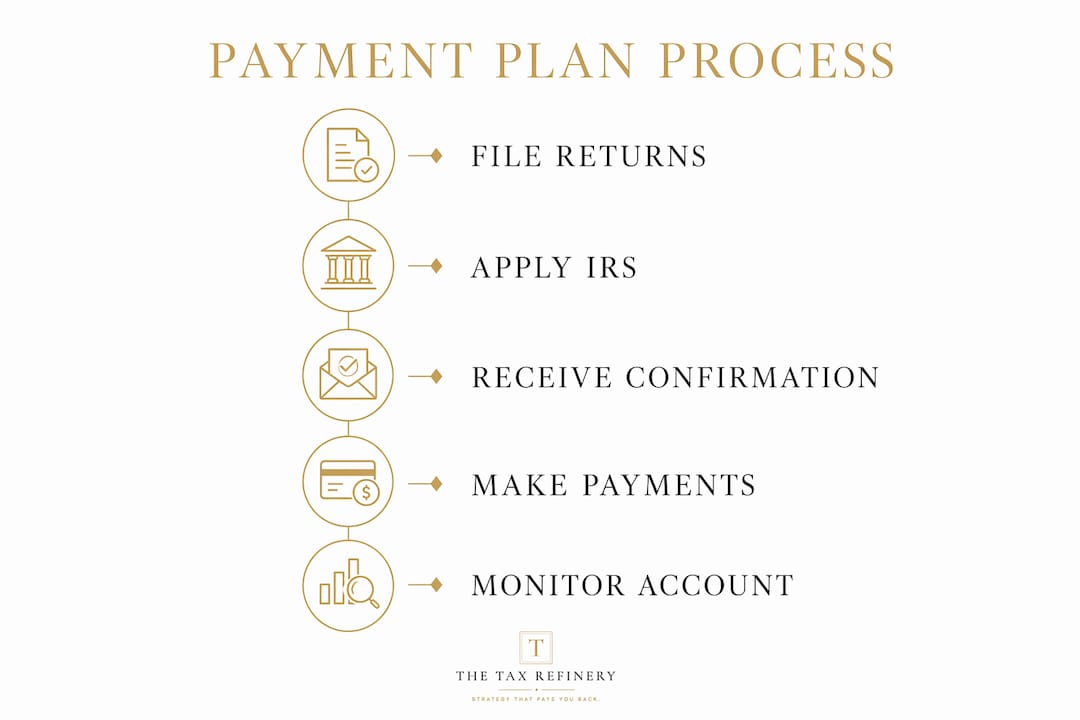
Week 1: File all missing returns and confirm your exact balance through your IRS Online Account. You cannot apply for a plan with unfiled returns outstanding.
Week 1–2: Apply online through the IRS Online Payment Agreement tool, by phone at 800-829-4933 (businesses), or in person at a Taxpayer Assistance Center. Online applicants receive immediate approval notification for qualifying plans.
Week 2–4: The IRS processes your agreement and sends written confirmation. Your first payment is due on the date you selected during setup.
Months 1–72: Make every scheduled payment on time. File all future returns on time and pay any new tax due in full. Your future refunds will automatically apply to your outstanding balance.
Throughout: Monitor your IRS Online Account for balance updates. You can revise payment dates, amounts, or bank information through the same portal. If your financial situation changes, contact the IRS before missing a payment.
How much will a payment plan actually cost you?
The total cost of a back taxes payment plan is always higher than the original tax debt. Interest and penalties continue to accrue until the balance reaches zero.
The IRS failure-to-pay penalty is 0.5% of the unpaid balance per month, capped at 25% of the original tax owed. Interest compounds daily at the federal short-term rate plus 3%. On a $20,000 balance paid over 60 months, the accumulated interest and penalties can add several thousand dollars to your total obligation.
Short-term plans minimize this cost because the repayment window is short. Long-term plans cost more overall but make monthly payments manageable. Choosing a shorter plan term, even if it stretches your budget, reduces the total amount you pay. For self-employed taxpayers or small business owners, a self-employed affordability calculator can help you model different monthly payment scenarios before committing to a term.
Setup fees add a one-time cost: $0 for short-term plans, $22–$29 for long-term direct debit plans applied online, and up to $178 for long-term plans applied by phone or mail without direct debit. Low-income taxpayers at or below 250% of the federal poverty level qualify for fee waivers on long-term plans.
What happens if your financial situation changes mid-plan?
Life changes. A job loss, a medical expense, or a slow business quarter can make your current payment amount unworkable. The IRS has a formal process for modifying an existing installment agreement.
Log into your IRS Online Account and navigate to the payment plan section. You can revise your payment date, payment amount, or bank account information directly. For more significant changes, such as reducing your monthly payment due to a documented hardship, call the IRS or visit a Taxpayer Assistance Center with updated financial documentation.
The revision fee is $6, which may be reimbursed for low-income taxpayers. If you miss a payment without contacting the IRS first, the plan can go into default, triggering a reinstatement fee and resuming collection actions. Contact the IRS before a payment is missed, not after. Oregon state plans through the Oregon Department of Revenue follow a similar modification process through their online portal or by phone.
Thetaxrefinery offers a distinct path for complex tax situations
If you're managing back taxes alongside ongoing business operations, real estate holdings, or multi-entity structures, the providers compared above handle resolution well. But resolution alone doesn't prevent the same problem from recurring next year.

Thetaxrefinery, founded by Enrolled Agent Melissa Korber, works with business owners and investors who need both resolution and a forward-looking tax strategy that keeps them out of debt with the IRS going forward. The firm handles IRS representation and audit defense alongside year-round advisory, so clients aren't left managing their tax position alone between filings. For Oregon business owners who've resolved a back taxes situation and want to make sure it doesn't happen again, Thetaxrefinery offers a structured engagement model built around that goal. You can book a consultation to discuss your specific situation directly with an Enrolled Agent.
Key Takeaways
An IRS installment agreement is the fastest and most accessible path for most Oregon taxpayers facing back taxes, with short-term plans carrying no setup fee and long-term plans available online for balances under $50,000.
| Point | Details |
|---|---|
| Short-term plan costs nothing to set up | Pay your balance in 180 days or less with a $0 setup fee and no financial statement required. |
| Long-term plans run up to 72 months | Individuals owing $50,000 or less qualify online; direct debit lowers the setup fee to $22. |
| OIC requires full financial disclosure | Form 656, Form 433-A or 433-B, and a $205 non-refundable fee are required; approval is selective. |
| Interest and penalties accrue daily | Shorter plan terms reduce total cost; waiting to apply increases the balance owed. |
| Thetaxrefinery for ongoing strategy | For business owners who want IRS representation plus proactive planning, Thetaxrefinery pairs resolution with year-round advisory. |