
If you earned income from Oregon while living somewhere else, Oregon almost certainly wants a return. Nonresidents owe Oregon tax on income sourced to the state, including wages for work performed there, business income earned there, and certain pass-through entity distributions. The typical next step is pulling your W-2 or 1099 to check Oregon wage allocations, then confirming whether Form OR-40-N, Form OR-OC, or Form OR-19-AF applies to your situation.
TL;DR:
- Nonresidents must file Oregon Form OR-40-N if they earned Oregon-source wages, business income, or PTE distributions during the year.
- Only Oregon-source income, such as wages for work performed in Oregon and lottery winnings over $600, is taxable to nonresidents.
- Employers are required to withhold Oregon tax on wages for work done in the state, but exceptions apply for low earnings or if a credit is available from the resident state.
- Pass-through entity owners can choose between composite returns or individual filings with Form OR-19-AF, affecting how withholding and payments are handled.
- Proper documentation, such as workday logs and correct wage allocations, prevents common audit triggers and simplifies the filing process.
Table of Contents
- Who Has to File an Oregon Nonresident Return?
- What Income Does Oregon Tax for Nonresidents?
- How Does Oregon Nonresident Withholding Work for Employers?
- Composite Returns vs. PTE Withholding: What Owners Need to Know
- Which Forms Do You Need and How Do You File?
- When Are Estimated Tax Payments Required?
- How Do Real Filers Handle These Rules in Practice?
- What Mistakes Trigger Oregon Audits for Nonresidents?
- An Enrolled Agent's Take on Oregon Nonresident Filings
- How Thetaxrefinery Helps With Oregon Nonresident Filings
- Sources
- FAQ
Who Has to File an Oregon Nonresident Return?
Oregon draws a hard line between three categories, and which one applies to you determines your entire filing path.
If you lived outside Oregon all year but earned Oregon-source income, you generally file Form OR-40-N. If you moved into or out of Oregon during the year, you file as a part-year resident on a different schedule, reporting Oregon income for the resident portion and Oregon-source income for the nonresident portion. A third, less obvious category exists too: the "special-case resident."
Oregon treats you as a nonresident, even if you technically meet residency tests, when you maintain a permanent home outside Oregon, keep no home in Oregon, and spend fewer than 31 days in the state during the year. This matters because it stops Oregon from taxing your entire worldwide income just because of a technical residency tie, such as an old driver's license or a family property.
Run through this before you file:
- Did you live in Oregon at any point during the tax year?
- Did you earn wages, business income, or PTE distributions tied to Oregon?
- Did you spend 31 days or more in Oregon without a permanent home elsewhere?
- Did you keep a permanent home in Oregon even while living out of state?
Answering these four questions tells you within minutes whether you're a nonresident, a part-year filer, or a special-case resident.
What Income Does Oregon Tax for Nonresidents?
Oregon only taxes income tied to an Oregon source. Everything else, in most cases, stays outside its reach.
Oregon-source income for nonresidents includes wages for services performed within the state, income from a trade or business conducted in Oregon, and lottery winnings over $600. If you're a remote worker who occasionally traveled to an Oregon office, only the days physically worked in Oregon typically count as Oregon-source wages. PTE distributive income also counts if the entity operates or sources income in Oregon, even if you never set foot in the state.
What's usually NOT taxable to a nonresident:
- Interest and dividend income, unless tied to an Oregon trade or business
- Wages earned entirely for work performed outside Oregon, even for an Oregon-headquartered employer
- Retirement income sourced from a prior Oregon job, in most cases, once you've established nonresident status
Pro Tip: Keep a day-by-day log of where you physically worked. If your employer withholds Oregon tax on 100% of your wages but you only worked 40% of your days in Oregon, that log is what gets you the correct allocation and, often, a refund.
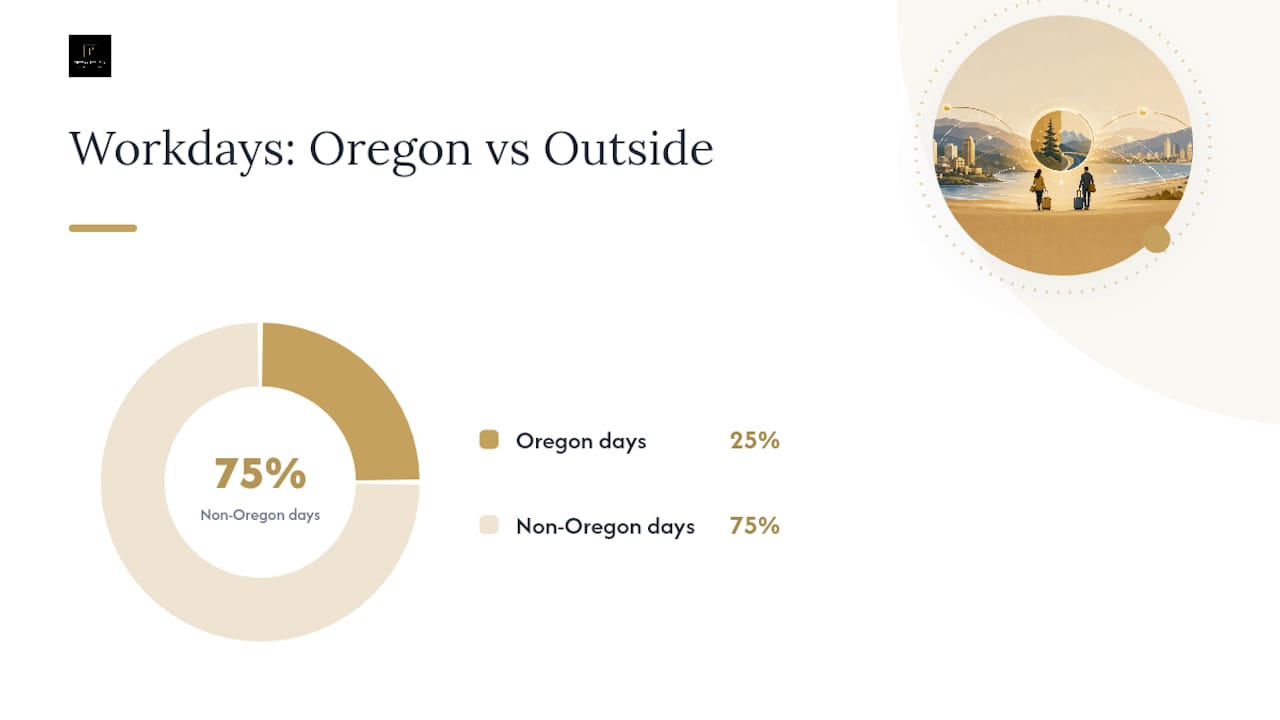
A consultant who splits time between Portland and Seattle, working 60 days in Oregon out of 240 total workdays, would allocate 25% of wages as Oregon-source. That fraction, not the total paycheck, is what belongs on Form OR-40-N.
How Does Oregon Nonresident Withholding Work for Employers?
Employers, including those headquartered entirely outside Oregon, generally have to withhold Oregon income tax on wages paid for services performed within the state. This obligation comes directly from OAR 150-316-0255, and it doesn't matter whether the company has a physical Oregon office. If an employee performs the work in Oregon, the withholding rule follows the work, not the employer's address.
There are a few situations where withholding isn't required:
- Low earnings exception. If a nonresident's total Oregon earnings for the year will fall below the standard deduction amount, withholding generally isn't required, though the department's guidance allows the employee to request it anyway.
- Department relief. Oregon can grant an employer relief from the withholding requirement in specific circumstances.
- Double-taxation credits. If your resident state also taxes the same income, you can typically claim a credit there for tax paid to Oregon, which prevents paying twice on identical dollars.
Check your W-2 for an Oregon wage figure in Box 16. If it doesn't match your actual Oregon workdays, that's a conversation to have with payroll before filing season, not after.
Composite Returns vs. PTE Withholding: What Owners Need to Know
Nonresident owners of Oregon pass-through entities face a choice most W-2 employees never have to make.
A pass-through entity with Oregon-source distributive income must withhold tax from nonresident owners who don't join a composite filing, unless the owner files Form OR-19-AF or qualifies for an exception. The composite return, Form OR-OC, lets nonresident owners bundle their Oregon-source PTE income into one filing handled by the entity, instead of each owner filing an individual OR-40-N.
Weigh these factors before choosing a path:
- Composite (OR-OC) pros: simpler for owners with no other Oregon income; one filing covers the group.
- Composite cons: often taxed at a flat rate that may not reflect your actual bracket, and it forfeits Oregon-specific deductions you might otherwise claim.
- Individual filing with OR-19-AF pros: better cash flow since the PTE skips withholding, and you control your own deductions and credits.
- Individual filing cons: more paperwork, and you're personally responsible for timely payment.
An exception also exists for owners with less than $1,000 in Oregon-source distributive income, which can skip withholding requirements entirely. Planning these elections annually matters, because your best option this year may not be your best option next year if the entity's Oregon revenue shifts. For multi-entity owners, our guide on Oregon PTE tax rules walks through the mechanics in more depth.
Pro Tip: Filing Form OR-19-AF often improves cash flow because you avoid PTE-level withholding upfront, but only if you're disciplined about setting aside estimated payments yourself.
Which Forms Do You Need and How Do You File?
Getting the paperwork right the first time saves weeks of processing delays.
- Confirm your form. Use Form OR-40-N if you had any Oregon-source wages, business income, or non-PTE income. Use Form OR-OC only if your sole connection to Oregon is PTE distributive income and you've elected composite treatment.
- Gather attachments. Include a copy of your federal return, all W-2s and 1099s showing Oregon wage or income allocations, and any K-1s reflecting Oregon-source PTE income.
- Reconcile PTE income separately. If you're a PTE owner who filed OR-19-AF, you'll still typically need OR-40-N to report and pay tax on that distributive share individually, since the affidavit only exempts you from entity-level withholding, not your own filing obligation.
- Choose a filing channel. Oregon accepts electronic filing through approved software or paper filing by mail, with payment vouchers available for anyone paying by check.
- Keep records. Retain copies of your filed return, attachments, and any OR-19-AF affidavit for at least three years in case of a later inquiry.
When Are Estimated Tax Payments Required?
Estimated payments apply to nonresidents whenever a chunk of Oregon income skips withholding entirely.
Estimated tax obligations kick in for income subject to Oregon withholding that wasn't actually withheld, income from a trade or business conducted in Oregon, and single-ticket lottery winnings above $600. PTE owners who filed OR-19-AF fall squarely into this group, since they've deliberately opted out of entity-level withholding.
- Oregon generally follows the standard quarterly schedule: mid-April, mid-June, mid-September, and mid-January.
- A safe-harbor approach, paying at least as much as last year's total Oregon tax liability, usually protects you from underpayment penalties even if your estimate runs a little light.
- Electronic payment through the Oregon DOR's online system is faster and gives you an immediate confirmation record, though paper vouchers remain an option.
If you're self-employed with Oregon clients, our breakdown of safe-harbor estimated tax rules covers how to compute a conservative quarterly figure without overpaying.
How Do Real Filers Handle These Rules in Practice?
Rules read cleanly on paper. Real situations rarely do.
Take a software engineer living in Vancouver, Washington, who works from home but flies into a Portland office 45 days a year. That engineer allocates wages based on Oregon workdays over total workdays, not total salary, and often finds their employer has over-withheld on the full amount, which means a refund is due on OR-40-N.
That owner needs to decide between composite treatment through OR-OC or filing OR-19-AF and paying estimated taxes individually, ideally before the entity's withholding deadline, not after.
Before filing anything, gather:
- W-2s and 1099s with Oregon wage boxes
- K-1s showing Oregon-source PTE income
- A day log of Oregon workdays, if your income requires allocation
- Any prior-year OR-19-AF filings
Pro Tip: Call an advisor before your PTE's fiscal year closes, not after. Composite elections and OR-19-AF affidavits are far easier to adjust proactively than to unwind once withholding has already happened.
What Mistakes Trigger Oregon Audits for Nonresidents?
Most nonresident audit flags trace back to the same handful of preventable errors.
Failing to file OR-40-N at all, assuming a small paycheck doesn't require it, is a close second. PTE owners who ignore their withholding options, neither joining composite nor filing OR-19-AF, often end up with mismatched 1099s and DOR inquiries.
- Keep day logs, employer emails about work location, and copies of any OR-19-AF filings on hand for at least three years.
- If you catch an error after filing, an amended Oregon return corrects it faster than waiting for a DOR notice.
- When in doubt about an allocation, contact the Oregon Department of Revenue directly or work with a tax professional before the original deadline, not after a penalty notice arrives.
An Enrolled Agent's Take on Oregon Nonresident Filings
Most surprises in this process come from PTE withholding elections and W-2 allocation errors that go unchecked until filing season. A short review each year, before your entity's fiscal close, catches both.
— Melissa
How Thetaxrefinery Helps With Oregon Nonresident Filings
A good tax advisory firm typically provides a proactive review of your Oregon exposure before withholding season locks in your options, rather than a rushed conversation near filing deadlines. For PTE owners weighing composite treatment against Form OR-19-AF, or remote employees with W-2 wage allocation issues, specialized advisory engagements can assist with proper allocation.

Our S-Corp Tax Strategy Accelerator helps multi-entity owners plan PTE elections before the withholding deadline hits, and our Monthly Tax Advisory and Quarterly Tax Strategy Sessions keep your Oregon filing strategy under review year-round instead of once a year. If you just need a return prepared, our fee schedule lists pricing for individual, self-employed, and investor returns. Book an initial consult through our site to walk through your specific Oregon numbers before your next quarterly deadline.
This article is general information, not a substitute for advice from a qualified financial advisor. Consult a qualified financial professional about your own circumstances before acting on anything here.
FAQ
How much is nonresident income tax in Oregon?
Oregon taxes nonresidents using the same graduated rate brackets as residents, but only on Oregon-source income; there's no separate nonresident rate schedule.
Do you pay Oregon state tax if you live in Washington?
Yes, if you earn Oregon-source income, such as wages for work performed in Oregon or Oregon business income, you owe Oregon tax regardless of your Washington residency, since Washington has no state income tax to offset it.
What are the filing requirements for Oregon nonresident individuals?
Nonresidents with wages above the standard deduction amount, or with Oregon business or PTE income, must generally file Form OR-40-N to report that Oregon-source income.
Do nonresidents have to file an Oregon tax return?
Yes, if you have Oregon-source income above the filing thresholds, whether from wages, a trade or business, PTE distributions, or lottery winnings over $600.
Can Thetaxrefinery help with an Oregon nonresident return?
Yes, Thetaxrefinery prepares nonresident and investor returns and offers ongoing advisory for PTE elections and withholding review, with pricing listed on its fee schedule.