
For most wage earners, moving from Oregon to Idaho lowers your state income tax bill in 2026, thanks to Idaho's new flat rate against Oregon's progressive brackets. Get the part-year filing and nexus questions right, and the numbers usually still favor Idaho.
TL;DR:
- Moving to Idaho from Oregon generally reduces state income tax bills in 2026 due to Idaho's flat tax rate, especially for higher earners making over $100,000.
- Proper documentation and careful timing of income, bonuses, and equity vesting are essential to avoid overpaying or incorrect state source allocations during the move.
- Both states offer tax credits for taxes paid to the other, but claimants must file specific forms and attach proof to prevent overlooking or over-claiming credits.
- Business nexus remains tied to operational presence and economic activity, so relocating your residence does not automatically shift your company's tax obligations to Idaho.
- Key steps include updating domicile evidence, re-calculating estimated taxes, and formally reviewing entity nexus to ensure compliance and optimal tax positioning.
Table of Contents
- Oregon to Idaho Taxes: The At-a-Glance Comparison
- How Do Idaho and Oregon Define Residency for Tax Purposes?
- Credits, Double Taxation, and Passthrough Entity Adjustments
- Business Owners: Why Moving Doesn't Automatically Move Your Tax Nexus
- Your Move Checklist: Forms, Timing, and Withholding
- Worked Examples: What the Net Savings Actually Look Like
- What Fifteen Years of Client Files Teach You About This Move
- How a tax advisory firm can help you get the Oregon to Idaho move right
- Sources
Oregon to Idaho Taxes: The At-a-Glance Comparison
Idaho's 2026 reform, enacted under SB 1223, moved the state to a flat individual income tax rate replacing its old bracket system. Oregon still runs a progressive structure with rates from 4.75% up to 9.9% for its highest earners, according to the Tax Foundation's analysis of Idaho's tax structure. That gap is the whole reason Idaho shows up in so many relocation searches.
The Trade-Off: Idaho charges a state sales tax for general goods (state rate applies). Oregon charges zero sales tax, period. A household that spends heavily on taxable goods in Idaho can give back $1,000 to $2,500 a year of its income tax savings, based on typical spending patterns cited in independent state tax comparison research.
A few other differences matter depending on your life stage:
- Idaho property tax rates run close to national averages; Oregon's vary widely by county and are shaped by Measure 50 assessment limits.
- Neither state currently imposes a separate state estate tax, so that consideration is mostly a wash.
- On $100,000 of wage income, Idaho's flat rate produces a noticeably smaller state tax bill than Oregon's top brackets would apply to the same earner, before sales tax is factored in.
How Do Idaho and Oregon Define Residency for Tax Purposes?
Idaho Code §63-3013 defines a resident as someone domiciled in Idaho or someone who maintains a home in the state and spends more than 270 days there during the tax year. Fall short of that and you may still owe Idaho tax as a part-year resident or nonresident with Idaho-source income.
Oregon takes a broader view: full-year residents owe Oregon tax on all income, wherever it's earned, and the state applies its own domicile and physical-presence tests to part-year filers. Community property issues can complicate things further for married couples who move mid-year, and Oregon's own guidance walks through several of those scenarios in detail.
The Idaho State Tax Commission's individual income tax guide spells out filing thresholds for residents, part-year residents, and nonresidents, along with how to report Idaho-source income if you're not yet domiciled there. Part-year filing is where most relocation returns go wrong, largely because people don't allocate wages, business income, and one-time capital events to the correct state based on the actual move date.
To protect yourself, hold onto:
- Your lease termination or home closing documents, dated
- Utility bills that show a service start date in the new state
- Updated driver's license and voter registration records
- A written record of the exact day you established your new domicile
Keep this paperwork for at least three years. Auditors in both states ask for it more often than movers expect.
Credits, Double Taxation, and Passthrough Entity Adjustments
If you earned income in Oregon before moving and Idaho also taxes that same income for the year, you're not stuck paying twice. Idaho and Oregon both offer credit mechanisms for taxes paid to another state, but they require paperwork most people skip.
- File Idaho Form 39R. This form calculates your credit for taxes paid to another state, and Idaho requires a separate Form 39R for each state involved, according to the Idaho tax form instructions.
- Attach a copy of the other state's return. Idaho won't process the credit without it.
- Check Oregon's own credit rules. Oregon's OR-40 and OR-17 publications explain how the state computes credit for mutually taxed income, including community property examples that affect married filers.
- Track passthrough entity (PTE) payments. If your S corp or partnership made a PTE-level tax payment in Oregon before your move, that payment often flows through to your personal return and can affect how much credit you're entitled to claim in Idaho.
Skip a step here, and you'll either overpay for months or trigger a notice asking you to substantiate a credit you can't currently prove.
Business Owners: Why Moving Doesn't Automatically Move Your Tax Nexus
Changing your home address doesn't change where your business owes tax. Nexus, the legal threshold that lets a state tax your business activity, gets triggered by employees, clients, property, or ongoing operations in that state, not by where you personally sleep at night. Oregon's own guidance on foreign corporations makes clear that a business can keep owing Oregon tax long after the owner relocates, if the underlying economic activity stays put.
Apportionment is the mechanism states use to divide your business income between where it's earned. If your clients, employees, or physical office remain in Oregon, Oregon will likely keep taxing a slice of that income no matter where you file your personal return. For S corp owners and multi-entity operators, that means payroll structuring, distribution timing, and accountable plan documentation all need a second look after a move, not a rubber stamp.
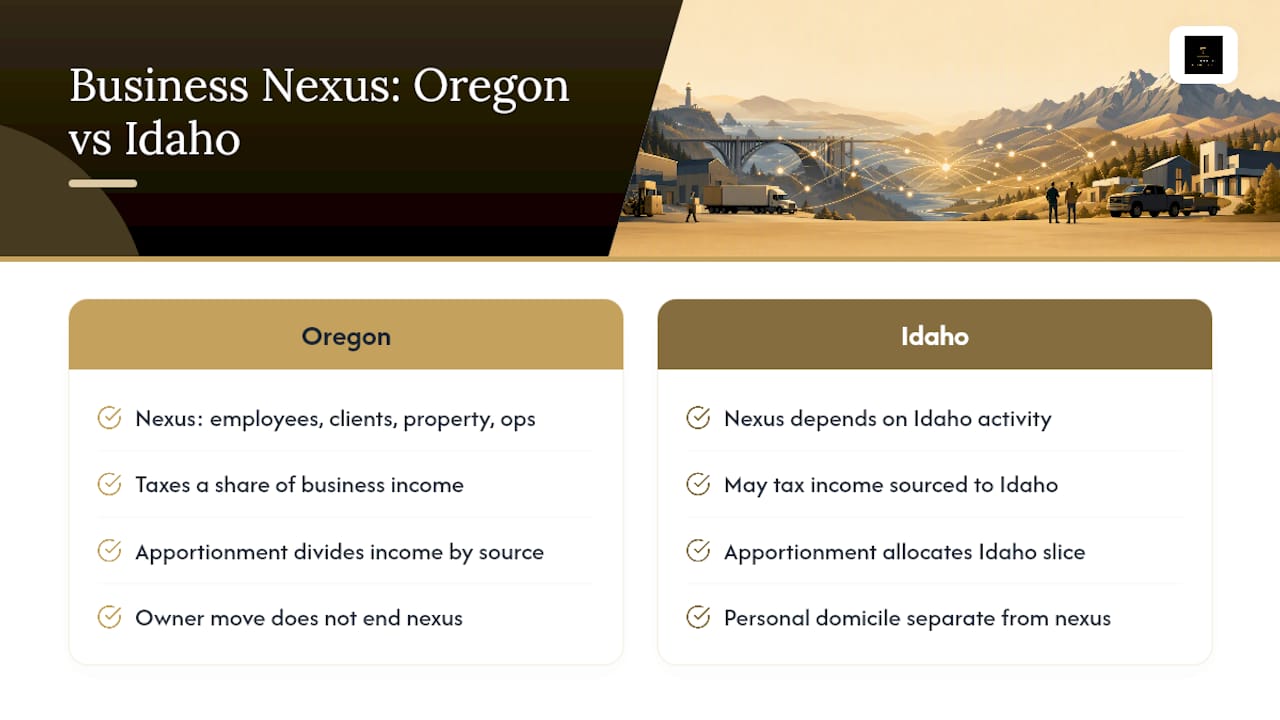
Pro Tip: Treat your personal domicile change and your entity's nexus status as two separate legal questions. Run a formal nexus review before you file your first Idaho return, not after you get a notice from Oregon.
Practical next steps: review where each entity has nexus, update state business registrations, and time any entity elections (like an S corp election or a change in tax year) around your actual move date rather than the calendar year.
Your Move Checklist: Forms, Timing, and Withholding
A clean move comes down to sequencing. Handle these in order and you avoid most of the headaches that turn a simple relocation into a multi-state audit.
- Before the move: Recalculate estimated tax payments, notify payroll of your new address and start date, and think carefully about the timing of bonuses or equity vesting.
- During the move window: Record your exact move date, keep every lease, closing, and utility document, and start a folder specifically for domicile evidence.
- After the move: File part-year returns in both states, claim your Idaho or Oregon credit where it applies, and update your employer's withholding immediately.
Beyond the paperwork tied directly to income tax, a handful of local administrative steps matter too:
- Update your driver's license and vehicle registration at the DMV.
- Re-register to vote in your new county.
- Check whether your new home qualifies for Idaho's homeowner property tax exemption.
- Confirm whether your old Oregon county still expects any local business or property filings.
Employers handling relocations also carry their own compliance obligations. A detailed HR guide on relocating staff covers the employer side of this timeline, useful if you're the one managing a team member's move rather than your own.
Worked Examples: What the Net Savings Actually Look Like
Add in Idaho's 6% sales tax on a typical spending pattern, and the household gives back roughly $1,000 to $2,500 of that savings annually, based on independent comparative tax research. The net result still favors Idaho for most households, just not by the full headline margin.
Example B: The business owner. A consultant who moves to Idaho but keeps Oregon clients and an Oregon-based employee will likely still apportion a share of business income to Oregon. That retained exposure can offset a meaningful chunk of the personal income tax savings the move was supposed to deliver.
- A late-year bonus paid after your move date is typically sourced to your new state.
- Equity that vests before your official move date usually stays taxable in Oregon.
What Fifteen Years of Client Files Teach You About This Move
The three mistakes I see most often: clients time a bonus or equity vesting event on the wrong side of their move date, they budget for Idaho's income tax savings without ever pricing in the sales tax on furniture, cars, or renovation costs, and they assume their LLC or S corp automatically follows them to Idaho when its clients and operations stay in Oregon.
The highest-impact moves clients make are almost always about timing and structure, not effort. Adjusting a move date by a few weeks, restructuring how an S corp pays its owner, or formally winding down Oregon nexus before it becomes a liability tends to matter more than any headline rate comparison. If your situation involves a business entity, real estate, or a six-figure income, this is exactly the kind of complexity worth a specialist's second look.
— Melissa
How a tax advisory firm can help you get the Oregon to Idaho move right
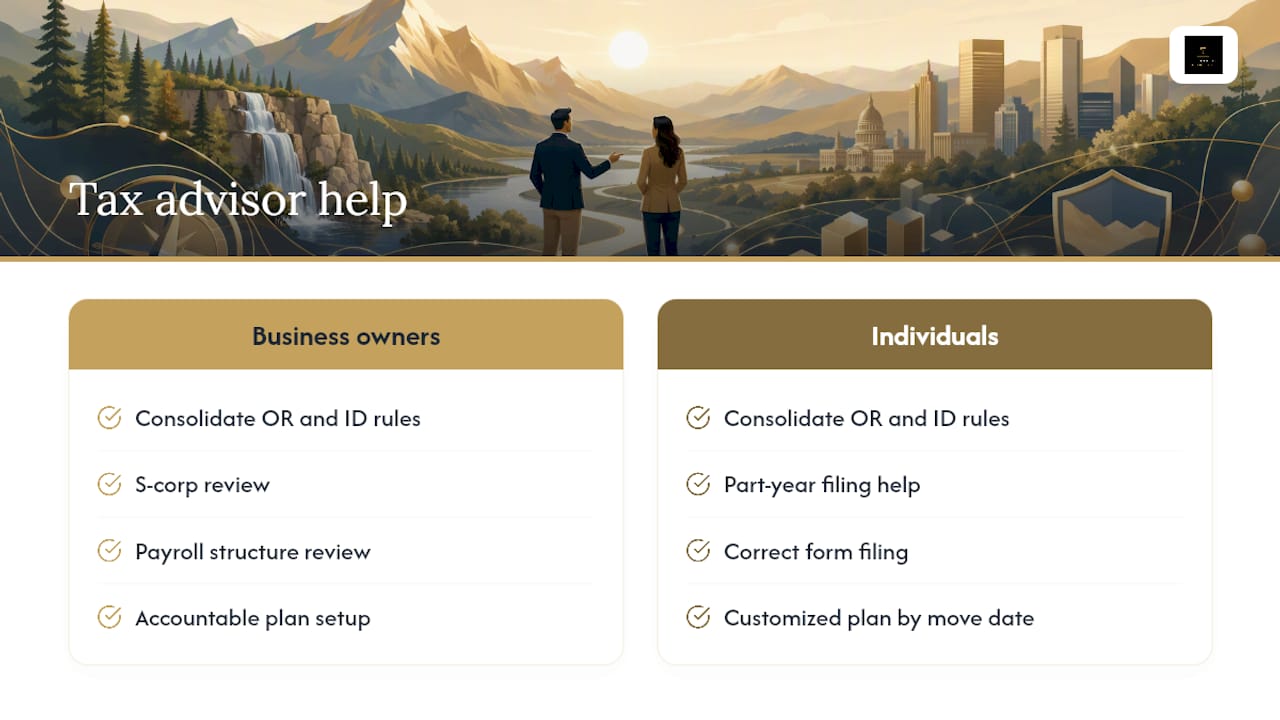
A specialized tax advisory service can consolidate Idaho and Oregon tax rules and provide assistance with part-year filing, nexus review, and entity planning in a single engagement.

Business owners can benefit from reviewing their S corp, payroll structure, and accountable plans proactively. Individuals benefit from correct filing of required forms and a customized plan based on their specific move date, income sources, and any business entities involved.
If you want a clearer picture of what your move could look like financially, run the numbers with our calculator before you file your first part-year return.
This article is general information, not a substitute for advice from a qualified financial advisor. Consult a qualified financial professional about your own circumstances before acting on anything here.
Sources
- Individual Income Tax Basics | Idaho State Tax Commission
- Idaho tax form instructions (includes credits and Form 39R guidance)
- Oregon DOR publication on filing and credits (OR-17/OR-40 guidance)
- Taxes in Idaho (Tax Foundation)