
You avoid an IRS underpayment penalty by paying the smaller of 90% of your current-year tax or 100% of last year's tax, bumped to 110% if your prior-year adjusted gross income topped $150,000 (or $75,000 if married filing separately). Meet one of these tests and the penalty simply does not apply, regardless of how much you ultimately owe on April 15.
Do this today:
- Pull last year's total tax and AGI off your return.
- Add up your withholding and estimated payments made so far this year.
- Check your next quarterly due date and calculate whether you need to send more before it hits.
The rest of this guide walks through annualizing uneven income with Schedule AI, choosing the right withholding and payment strategy, and what to do if you have already missed a payment.
Key Takeaways
Meeting one of the IRS safe-harbor tests, 90% of current-year tax, 100% of prior-year tax, or 110% for high-AGI filers, eliminates the underpayment penalty regardless of your final tax bill.
| Point | Details |
|---|---|
| Three safe-harbor tests | Pay 90% of current-year tax, 100% of prior-year tax, or 110% if prior-year AGI exceeded $150,000 ($75,000 MFS). |
| $1,000 exception | Owing under $1,000 after withholding and credits exempts you from the penalty entirely. |
| Penalties are period-based | The IRS calculates underpayment separately for each of the four quarterly periods, so a late lump sum won't fix an earlier shortfall. |
| Annualize uneven income | Use Schedule AI with Form 2210 when income arrives unevenly, like a Q4 capital gain or seasonal business revenue. |
| Get professional support | Thetaxrefinery offers year-round estimated tax planning and Form 2210 assistance for self-employed and high-earning clients. |
Table of Contents
- What Is the Safe Harbor for Estimated Taxes?
- Who Actually Has to Make Estimated Payments?
- When Should You Use the Annualized Income Installment Method?
- When Are Quarterly Estimated Payments Due?
- What's the Best Way to Avoid an Underpayment Penalty?
- Can You Get an Underpayment Penalty Waived?
- Your Safe Harbor Checklist for This Tax Year
- Let Thetaxrefinery Handle Your Safe Harbor Strategy
- Primary IRS Resources for Estimated Tax Planning
What Is the Safe Harbor for Estimated Taxes?
The IRS gives you three ways to hit safe harbor, and you only need to satisfy one.
- Pay 90% of your current-year tax liability. This requires a reasonably accurate forecast of what you will owe this year.
- Pay 100% of last year's total tax. This works regardless of how much your income grows this year, which makes it the most forgiving option for anyone expecting a big jump in earnings.
- Pay 110% of last year's total tax if your prior-year AGI exceeded $150,000 (or $75,000 for married filing separately).
Safe harbor thresholds at a glance: 90% current year, 100% prior year, 110% prior year for high-income filers, and a full exemption if you owe under $1,000 after withholding and refundable credits, according to the IRS.
That last exception matters more than people realize. If your total balance due, after subtracting withholding and credits, is under $1,000, no penalty applies no matter which safe harbor test you would have failed. IRS Publication 505 and Form 1040-ES are the two official resources for calculating exactly what you owe and how to remit it.
Who Actually Has to Make Estimated Payments?
If your income comes with taxes already withheld at the source, in most cases you are fine. Estimated payments become necessary when nobody is withholding on your behalf. That typically includes:
- Self-employment income, including 1099 contract work and sole proprietorships.
- Investment income, rental income, or capital gains without withholding.
- Partnership or S-corp distributions that exceed your reasonable salary.
- Any year where your W-2 withholding alone will not cover your total liability.
Publication 505 also covers special situations, including farmers, fishermen, household employers, and fiscal-year filers, each of which carries its own timing rule. And remember the small-balance exception: if your total shortfall after withholding and credits stays below a certain amount, you are exempt from the penalty entirely.
When Should You Use the Annualized Income Installment Method?

Standard safe-harbor math assumes your income arrives evenly across the year. It rarely does for self-employed people. A landscaping business that earns most of its revenue between May and September, or an investor who realizes a large capital gain in November, can end up penalized for "underpaying" in early quarters even though the income simply hadn't happened yet. That's where the Annualized Income Installment Method, computed on Schedule AI and attached to Form 2210, earns its keep.
Here's the general process:
- Total your actual income and deductions for each period: January through March, through May, through August, and through year-end.
- Apply the IRS annualization factors for each period. Investopedia notes the year-to-date figure through May 31 gets multiplied by 2.4, through August 31 by 1.5, and through year-end by 1.3.
- Use those annualized figures to calculate what each period's required installment should have been.
- Complete Schedule AI and file it with Form 2210.
Say you sell a business asset in November for a large gain. Under the standard method, your first three quarterly payments might look underpaid relative to your full-year tax. Annualizing lets you show the IRS that the income, and the tax on it, arrived in the fourth period, matching your required payment to when you actually earned the money rather than penalizing you for not predicting it in April.
- Keep detailed period-by-period income and expense records if you plan to annualize.
- The method requires real bookkeeping discipline. Guessing at quarterly splits defeats the purpose.
Pro Tip: If you use Schedule AI, attach it to Form 2210 and keep your period-by-period backup on file. Skip it, and the IRS will fall back on its own automatic penalty calculation, which assumes even income and won't give you credit for the annualization.
When Are Quarterly Estimated Payments Due?
The IRS treats your tax year as four separate payment periods, not one annual bucket, and each one is measured on its own.
| Payment Period | Due Date |
|---|---|
| January 1 to March 31 | April 15 |
| April 1 to May 31 | June 15 |
| June 1 to August 31 | September 15 |
| September 1 to December 31 | January 15 (following year) |
The IRS calculates underpayment penalties period by period, applying its published interest rate to whatever shortfall existed in each window.
This structure explains a mistake a lot of high earners make: assuming a large payment in December fixes everything. It doesn't. If you underpaid in the second quarter and overpaid heavily in the fourth, you still owe a penalty for that earlier shortfall, because the calculation looks backward through each period independently, not at your year-end total. In most cases, you never have to compute this yourself. The IRS runs the math automatically and sends a bill. Form 2210 only becomes necessary when you're requesting a waiver or using Schedule AI to annualize.
What's the Best Way to Avoid an Underpayment Penalty?
You have more flexibility here than most people assume, and the right mix depends on how predictable your income is.
- Increase W-2 withholding. If you or a spouse has wage income, bumping withholding on remaining paychecks can retroactively cover a shortfall, since withholding is treated as paid evenly across the year regardless of when it's actually deducted.
- Pay quarterly through Form 1040-ES. This is the standard route for self-employed income with no withholding at all.
- Use annualization if your income is genuinely uneven. Don't force this method onto steady income. It adds complexity without adding benefit.
- Make a catch-up payment if you're inside a current period. Late is better than never, though it won't erase a prior period's shortfall.
For actual payment, EFTPS and IRS Direct Pay are the two electronic channels the IRS recommends, both of which eliminate the mailing delays that can turn an on-time paper check into a late payment. The IRS Withholding Estimator is worth running at least twice a year if your income shifts.
Pro Tip: If your income is lumpy, combine tactics. Increase withholding on your later paychecks to cover the base, then use an annualized installment for the specific quarter where a large gain or bonus landed.
Can You Get an Underpayment Penalty Waived?
The IRS builds in real exceptions for circumstances beyond your control, and they're worth checking before you assume a penalty is final.
- Casualty, disaster, or other unusual circumstances.
- Retirement after age 62, if the underpayment was due to reasonable cause.
- Disability during the tax year in question.
- Other documented reasonable-cause situations.
In most cases, the IRS computes and bills the penalty automatically. To formally request a waiver, you need to file Part II of Form 2210 with supporting documentation. Publication 505 and the IRS reasonable-cause relief page both walk through what qualifies.
Your Safe Harbor Checklist for This Tax Year
Four steps, done in order, tell you exactly where you stand:
- Calculate last year's total tax and AGI.
- Add up withholding plus estimated payments made so far this year.
- Pick your safe-harbor test (90%, 100%, or 110%) and calculate what your next payment needs to be.
- Send it through EFTPS or Direct Pay, or adjust withholding if you have wage income to work with.
Keep copies of every payment confirmation and any Form 2210 or Schedule AI you file. If you work in farming, fishing, or operate on a fiscal year, different deadlines apply. Check Publication 505 before assuming the standard calendar fits your situation.
Why proactive planning matters for self-employed and high earners
Most penalty notices trace back to the same root cause: nobody looked at the numbers between January and April of the following year. Treating estimated taxes as a quarterly checkpoint, not an annual guess, turns a stressful bill into a predictable cash-flow line item. As an Enrolled Agent focused on tax strategy for business owners and real estate investors, I've found that the clients who avoid penalties are the ones who track income year-round, not the ones who forecast harder in December.
Let Thetaxrefinery Handle Your Safe Harbor Strategy
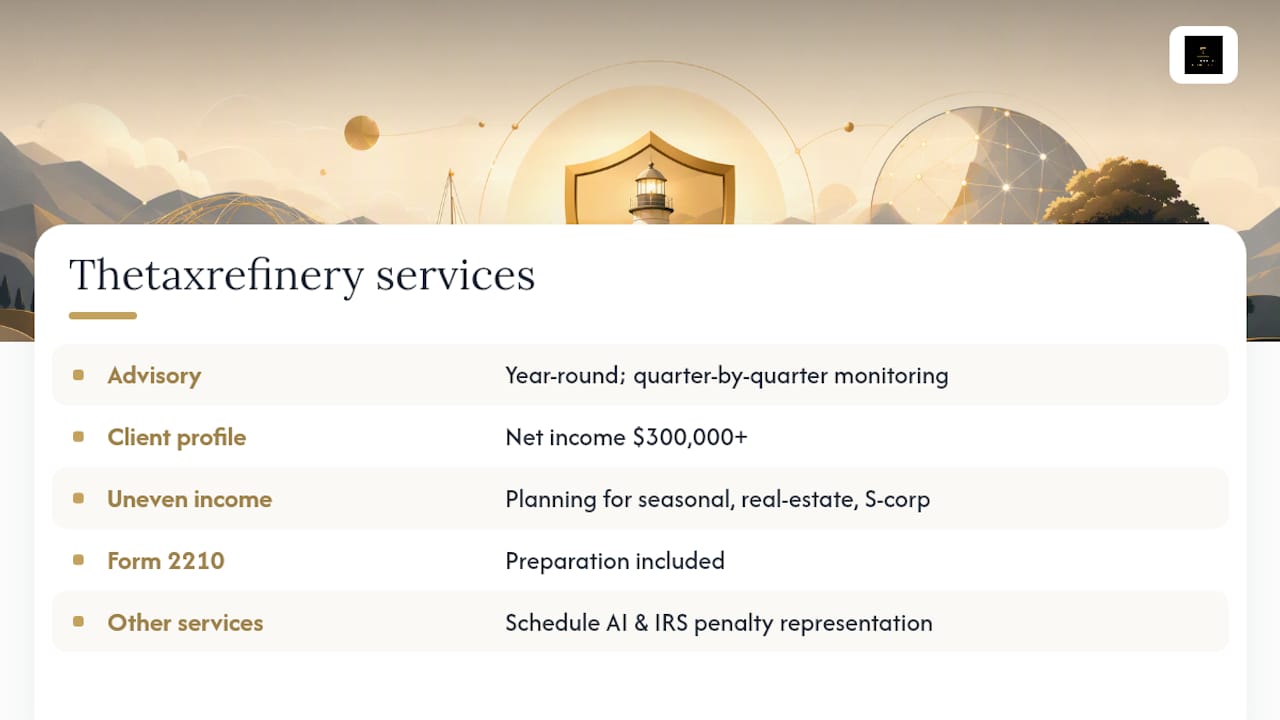
Thetaxrefinery gives self-employed owners and high-income professionals something a once-a-year tax preparer can't: a running, quarter-by-quarter view of where your estimated payments stand, built into a year-round advisory engagement instead of a single spring conversation.

If your income is uneven, whether from seasonal revenue, a real estate sale, or S-corp distributions that vary by quarter, figuring out which safe harbor test applies and whether annualizing makes sense is exactly the kind of planning we handle for clients netting $300,000 and up. That includes Form 2210 preparation, Schedule AI calculations when they genuinely help, and IRS representation if a penalty notice already landed in your mailbox. If you're weighing a bigger structural question, like whether an S-corp election changes your estimated tax picture, that's worth a conversation too.
Compare our planning packages on the tax strategy page, or go ahead and book a planning session to get your safe harbor numbers confirmed before your next due date.
Primary IRS Resources for Estimated Tax Planning
Start with Publication 505 for full safe-harbor rules, Form 1040-ES to calculate and pay quarterly, and Form 2210 with Schedule AI when annualizing or requesting a waiver. Use the IRS Withholding Estimator to check your W-4, and pay through EFTPS or Direct Pay for reliable timing. If you've fallen behind on filings entirely, streamlined filing support can help you get current before penalties compound. For planning help beyond the forms, visit Thetaxrefinery.
This article is general information, not a substitute for advice from a qualified financial advisor. Consult a qualified financial professional about your own circumstances before acting on anything here.