
Your wages are taxed where you physically perform the work, with one major exception: a handful of "convenience of the employer" states can tax you as if you never left the office. Employees should track their work-location days by state; employers should register for withholding wherever remote staff actually sit, not just where the company is based.
TL;DR:
- States that ignore physical presence, like New York and Pennsylvania, can tax wages based on remote work for the employer’s convenience, not actual work location.
- Employers must register for withholding and unemployment insurance in every state where remote employees perform work, often immediately upon hiring.
- Employees living in no-tax states such as Florida or Texas can still owe taxes if their employer is in a convenience-rule state like New York, unless documentation proves necessity.
- Tracking work days by state and maintaining thorough remote-work necessity records are crucial for compliance and defending against audit challenges.
- Partial-year or mid-move remote workers must carefully allocate wages and update payroll registrations for each state involved to avoid over- or under-withholding.
Table of Contents
- Remote Employees State Taxes: A Quick Compliance Checklist
- Where Your Income Gets Taxed: The Physical Presence Rule
- The Convenience of the Employer Rule Explained
- Reciprocity Agreements and Resident Credits
- What Multistate Registration Actually Requires
- Real-World Scenarios That Show the Rules in Action
- Guidance You Can Trust on Multistate Payroll
- Part-Year Remote Workers Face Different Rules Than Full-Timers
- Local Taxes Add Another Layer for Remote Employees
- Legislative Changes Reshaping Remote Work Taxation in 2026
- How Remote Work Creates Nexus Beyond Payroll Withholding
- Filing Across Multiple States as a Remote Employee
- The Rule Everyone Underestimates in 2026
- Get Multistate Payroll Compliance Handled Correctly
- Sources
- FAQ
Remote Employees State Taxes: A Quick Compliance Checklist
Most withholding problems trace back to a task nobody assigned. Use this checklist to close the gap fast.
For employees:
- Confirm your legal domicile and every state where you performed work this year.
- Keep a daily log of work location, especially if you split time between states.
- File a reciprocity or exemption certificate with your employer if your state has an agreement with your work state.
For employers:
- Register for withholding and state unemployment insurance in every state where a remote employee physically works.
- Collect signed exemption forms before running the first payroll for a new remote hire.
- Put employer necessity in writing, if you're in a convenience-rule state, before an audit forces the question.
When rules are ambiguous, some employers withhold for both the home and work state temporarily, and tell the employee plainly why, so nobody is surprised at filing season.
Where Your Income Gets Taxed: The Physical Presence Rule
The default rule is simple: states tax wages based on where you actually perform the work, not where your employer is headquartered. Many states levy a wage income tax, but several do not tax wages at all, including Alaska, Florida, Nevada, New Hampshire, South Dakota, Tennessee, Texas, Washington, and Wyoming.
Nine no-tax states: Alaska, Florida, Nevada, New Hampshire, South Dakota, Tennessee, Texas, Washington, Wyoming. If you live and work exclusively in one of these, wage income tax is a non-issue, though other state taxes may still apply.
Residency status changes the filing math even when the sourcing rule stays the same. Your domicile, the state you consider permanent home, generally taxes all your income regardless of where you earn it. Many states also apply a statutory residency test, commonly the 183-day rule, that can make you a taxable resident of a second state simply by spending too many days there, even if you never intended to move.
Day counts also govern withholding, not just residency. Some states apply de minimis thresholds that exempt short-term work from withholding entirely, while others start the clock on day one. Warp's breakdown of multistate payroll obligations confirms employers generally must withhold based on physical work location and register payroll accounts in every state where remote staff perform services, regardless of company headquarters. A single business trip or a two-week stint at a lake house can trigger withholding obligations depending on the state's specific threshold, so tracking days isn't optional busywork. It's the difference between clean payroll and an unpleasant notice eighteen months later.
The Convenience of the Employer Rule Explained
A small group of states ignores the physical presence rule entirely when remote work is your choice rather than your employer's requirement. Under the convenience of the employer doctrine, if you work from home for your own convenience rather than because your employer requires it, the state where your employer is located can tax your full wages, even though you never set foot there.
States enforcing some version of this rule include:
- New York — the most aggressive enforcer and the origin of most convenience-rule litigation
- Pennsylvania
- Delaware
- Nebraska
- Connecticut, with narrower applications appearing in a few other jurisdictions
New York's rule survived a significant legal test when the Zelinsky line of rulings, most recently affirmed in May 2025, upheld the doctrine against a remote worker's challenge. That outcome tells employers the rule isn't going away in 2026, and enforcement risk is rising, not falling.
The burden of proof sits with the employer, not the employee. Simply permitting someone to work from home rarely satisfies "necessity." Documentation that actually helps includes written remote-work policies specifying why the role must be remote, job descriptions referencing client-site or equipment requirements unavailable at the employee's location, and records showing the employer, not the worker, initiated the remote arrangement. Without that paper trail, a state auditor will default to taxing the wages as if the employee sat in a Manhattan office five days a week.
Reciprocity Agreements and Resident Credits
Two mechanisms exist to keep the same dollar of income from getting taxed twice, and both have real gaps.
- Reciprocity agreements let residents of one state work in a neighboring state without having the second state withhold tax, but the agreement only activates when the employee files the correct exemption certificate, such as Pennsylvania's REV-419. Skip the paperwork, and the employer must withhold for the work state by default, according to Experian's guidance on payroll taxes for out-of-state employees.
- Resident credits let your home state credit tax paid to another state against what you owe at home. The math works cleanly when both states have similar rates. It breaks down when the work state's rate is higher than your home state's rate, because the credit is capped at what your home state would have charged, leaving a gap you pay out of pocket, a point Tax Foundation's remote-worker analysis makes explicit.
- When both states withhold, the safer employer move is often to withhold for both temporarily and let the employee recover the overpayment through a nonresident return, shifting short-term cash flow risk to the employee while limiting the employer's audit exposure.
What Multistate Registration Actually Requires
Hiring one remote employee in a new state can trigger nexus, the legal threshold that obligates a business to register and pay tax there. That single hire commonly requires three separate registrations: a state withholding account, a state unemployment insurance (SUTA) account, and sometimes a general business registration or franchise tax filing.
- Register before the first paycheck. Payroll specialists consistently flag late registration, not the taxes themselves, as the top source of penalties and back interest.
- Treat SUTA and income tax as separate problems. SUTA localization uses its own "localization of work" test under federal guidelines, and it frequently applies in the employee's state even when income tax withholding is sourced elsewhere, per CPA Practice Advisor's breakdown of the two systems.
- Update payroll systems immediately, and collect exemption certificates before the first pay run rather than retrofitting them later.
Pro Tip: Register for withholding the same week you extend the offer letter, not the same week the employee starts. Hiring itself often establishes nexus, and payroll systems take longer to configure correctly than most HR teams expect.
Real-World Scenarios That Show the Rules in Action
- The hybrid worker. Splits three days at a home office and two in a downtown office. Wages typically get allocated by workday count between the two states, so a work-location log isn't optional paperwork, it's the source document for the allocation.
- The no-tax-state remote worker. Lives in Texas but works for a New York headquartered employer that applies the convenience rule. Expect New York withholding despite paying zero state income tax at home, with a refund claim as the only recovery path if the necessity test isn't met.
- The mid-year mover. Relocates from Ohio to Colorado in July. The employer must update registrations, potentially apply retroactive withholding for the new state, and the employee files a part-year resident return in both states.
Guidance You Can Trust on Multistate Payroll
Melissa Korber, an Enrolled Agent, built Thetaxrefinery around year-round advisory rather than once-a-year filing, with a focus on S-corp planning and multistate tax strategy for growing businesses. For remote payroll and nexus questions specifically, the firm reviews registration exposure, remediates withholding gaps, and helps employers document the necessity records convenience-rule states demand. Keep job descriptions, written remote-work policies, and dated hiring correspondence on file to back every sourcing position you take.
Part-Year Remote Workers Face Different Rules Than Full-Timers
A part-year remote employee, someone who moved mid-year, changed jobs, or shifted from office to remote status partway through 2026, files differently than someone remote the entire calendar year. Full-time remote workers generally file one resident return for their home state plus nonresident returns for any state where the convenience rule or physical presence created a tax obligation. The math, while tedious, stays consistent across twelve months.
Part-year situations split income by period. If you worked in Illinois from January through June, then Arizona from July through December, both states generally tax only the income earned while you were their resident or working within their border, not your full annual salary. That requires allocating wages, retirement contributions, and even certain deductions across the two periods, usually based on days worked or income actually earned during each stretch, depending on the state's specific allocation method.
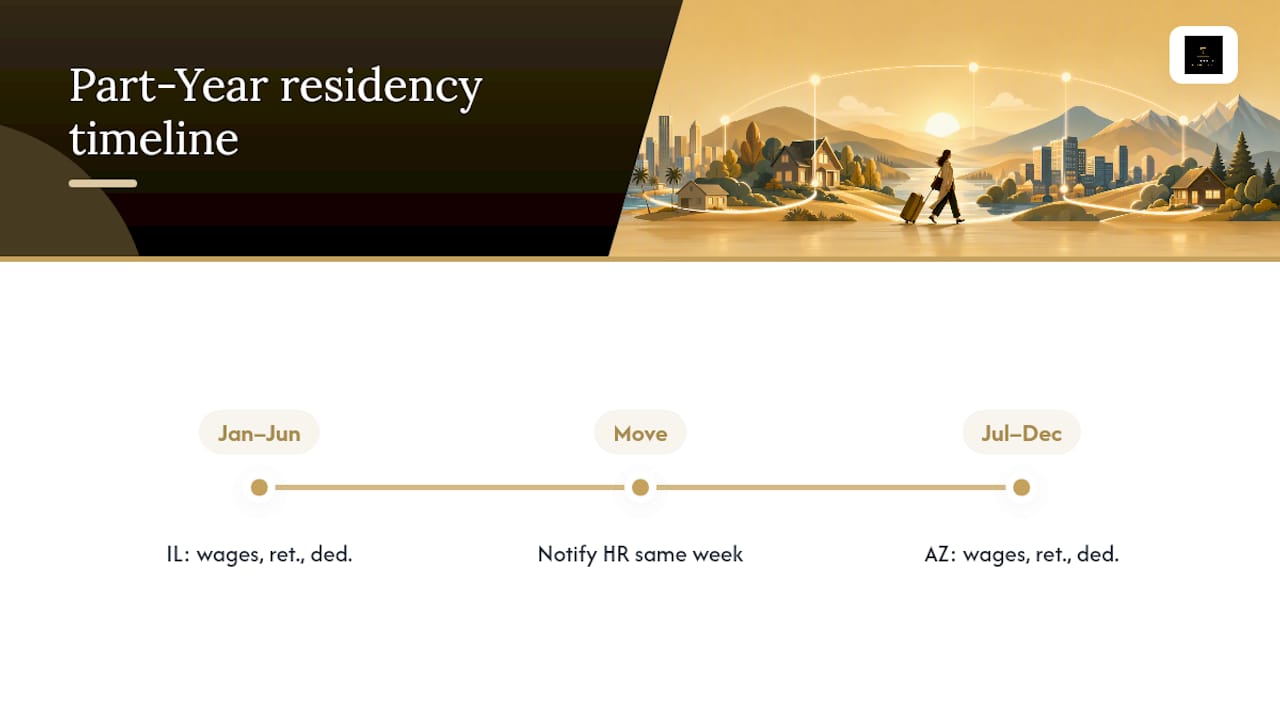
The practical risk is timing, not math complexity. Employers frequently continue withholding for the old state for weeks after an employee relocates, simply because HR wasn't notified quickly enough to update payroll. That creates an over-withholding situation in the old state and an under-withholding gap in the new one, which the employee then has to reconcile at filing time through amended withholding requests or a larger than expected balance due. If you move mid-year, notify HR the same week, not the same pay period, you sign a new lease.
Local Taxes Add Another Layer for Remote Employees
State income tax gets most of the attention, but city and county taxes complicate remote work in specific pockets of the country. Pennsylvania's local earned income tax applies in thousands of municipalities, each potentially with a different rate, and the general rule ties the tax to where you live, not necessarily where your employer sits. Ohio has a similar patchwork of municipal income taxes, and several of its cities adjusted remote-work sourcing rules after 2020 to address the flood of home-based filers.
New York City's local tax stacks on top of state liability for city residents, and it follows the same convenience-of-the-employer logic the state applies, meaning a Manhattan-based company's remote employee living in the city can owe both state and city tax on the same wages even while working from a home office in Brooklyn.
The practical challenge for employers is that local tax jurisdictions rarely publish clean, centralized guidance the way state departments of revenue do. A payroll system configured correctly for state withholding can still miss a municipal tax obligation entirely, especially in states where local taxes are optional for some municipalities and mandatory in others. Employers with remote staff in Pennsylvania, Ohio, or a handful of other states with aggressive local taxation should verify local withholding obligations separately from state registration, not as an afterthought bundled into the same setup.
Legislative Changes Reshaping Remote Work Taxation in 2026
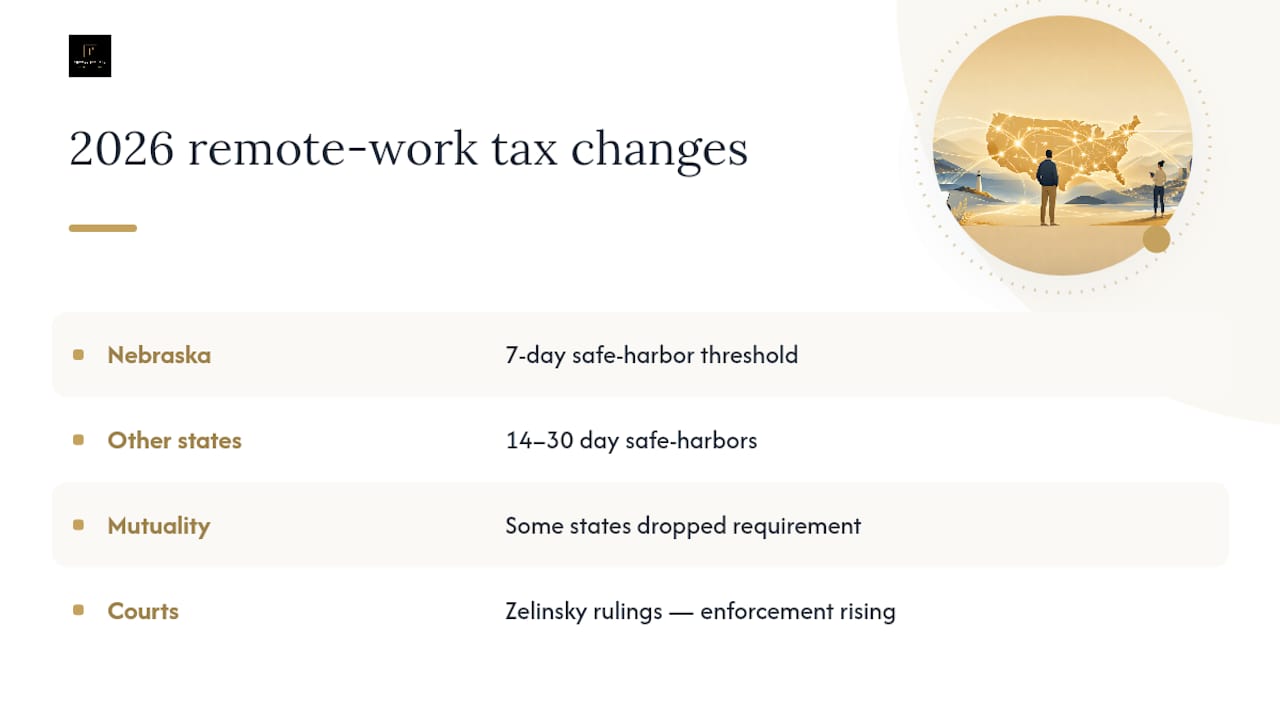
Several states adjusted safe-harbor day thresholds and de minimis rules heading into 2026, and the changes cut in different directions depending on the state. Nebraska applies a notably short 7-day threshold before nonresident withholding kicks in, while other states have moved toward 14 to 30 day windows that give employers more breathing room before an obligation triggers, according to Warp's 2026 guide to state income tax withholding for remote workers. Some states have also dropped mutuality requirements that previously limited when certain rules applied, widening the number of situations where withholding now kicks in.
The bigger signal for 2026 is judicial, not legislative. New York's Zelinsky line of rulings, upheld again in May 2025, tells every convenience-rule state that courts are willing to back aggressive enforcement rather than narrow it. Employers who assumed the doctrine might soften over time should assume the opposite: enforcement pressure is building, and audit activity in convenience-rule states has followed the same trend.
Watch state legislative sessions specifically for two things: changes to safe-harbor day counts, which directly affect when withholding starts, and any state considering adopting a convenience rule where one didn't exist before. A state without a convenience rule today isn't guaranteed to stay that way, particularly if a neighboring state's version generates the kind of revenue New York's has.
How Remote Work Creates Nexus Beyond Payroll Withholding
Withholding is the most visible remote-work tax issue, but it isn't the only one. A single remote employee working from their home in a new state can create corporate income tax nexus for the employer, meaning the business itself may owe state corporate or franchise tax in a state where it has no office, no inventory, and no clients, simply because one person logs in from there every day.
This matters most for growing companies that assume nexus requires a physical office or a sales presence. Many states define nexus broadly enough that a remote employee's home counts as a business location for tax purposes, which can trigger corporate income tax filing obligations, franchise tax assessments, and in some cases sales tax collection duties if the employee's role touches revenue generating activity in that state.
The practical consequence is that hiring decisions that look purely like an HR matter, "we found a great candidate in Colorado," actually carry a corporate tax footprint the finance team needs to evaluate before the offer goes out, not after the first quarterly filing deadline passes. Businesses that treat remote hiring as a payroll only decision often discover the corporate nexus question during their first multistate corporate tax filing, usually a year or more after the hire, when the retroactive exposure is already baked in. A pre-hire nexus review costs far less than a look back assessment.
Filing Across Multiple States as a Remote Employee
If you worked in more than one state during 2026, expect to file more than one state return. The general pattern is a resident return for your home state, reporting all income regardless of source, plus a nonresident return for each state where you earned income through physical presence or a convenience-rule employer relationship.
Order matters when you prepare these returns. Complete the nonresident return first, because the tax you owe there determines the resident credit you claim on your home state return. File them in reverse order, and you risk claiming a credit based on an incomplete or incorrect nonresident calculation.
Keep every W-2 and any state-specific withholding statements, since employers with remote staff across multiple states sometimes issue multiple state wage statements on a single W-2 form, split by box 15 through 17 state identifiers. If those boxes don't reconcile with the days you actually logged in each state, that's the first place to check before assuming your employer withheld correctly. Employees who moved mid-year should specifically confirm their employer updated the state withholding code by the date of the move, not the date HR happened to process the paperwork, since a lag of even a few pay periods creates a mismatch that shows up as a discrepancy on both returns.
The Rule Everyone Underestimates in 2026
Most guidance on remote work taxation treats the convenience of the employer rule as a footnote. It shouldn't be. It's the single biggest source of unexpected tax bills for remote employees, and the Zelinsky affirmation in 2025 makes clear it isn't fading. Employees living in no-tax states are the most exposed group, because they assume "no state income tax where I live" means zero state tax liability, full stop. It doesn't, if their employer sits in New York or Pennsylvania and can't document a real necessity for the remote arrangement.
The conventional advice, "just check if your states have reciprocity," undersells the actual risk. Reciprocity only helps with the physical presence rule. It does nothing against a convenience rule, and most employees don't learn the difference until they owe money on a state they never lived in or worked from.
What should change first: employers need contemporaneous documentation, not retroactive justification. Build the necessity record when you approve the remote arrangement, not when an auditor asks for it two years later. Employees should track work-location days the same way they'd track mileage for a deduction, because that log is often the only evidence that resolves a dispute in your favor.
— Melissa
Get Multistate Payroll Compliance Handled Correctly
We provide expert support to help you navigate multistate payroll by building documentation and registration structures that can withstand audits in convenience-rule states or corporate nexus reviews. For business owners, S-corp owners managing remote teams, and professionals with wages across state lines, there are real risks related to payroll registration, documentation, and resident credit issues that require careful planning before hiring decisions.

Our services include payroll registration and remediation, nexus reviews for expanding remote teams, correcting withholding errors from previous payrolls, and assistance with audit notices from states. If you're evaluating whether a remote hire changed your company's tax footprint, or you're the employee wondering why a state you've never visited is claiming your wages, book a consult through our tax strategy services and get a specific answer instead of a generic checklist.
Sources
- State nexus and payroll when hiring remote employees creates tax obligations › Warp
- Payroll taxes for out-of-state employees › Experian Employer Services
- How Are Remote and Hybrid Workers Taxed? › Tax Foundation
This article is general information, not a substitute for advice from a qualified financial advisor. Consult a qualified financial professional about your own circumstances before acting on anything here.
FAQ
How do taxes work if you work remotely in another state?
Your wages are generally taxed by the state where you physically perform the work, and your home state may also tax that income while giving you a credit for taxes paid elsewhere. Convenience-of-the-employer states are the main exception, taxing wages based on the employer's location instead.
Which state is best for remote workers in terms of taxes?
The nine states with no wage income tax, Alaska, Florida, Nevada, New Hampshire, South Dakota, Tennessee, Texas, Washington, and Wyoming, offer the clearest advantage, but that benefit disappears if your employer sits in a convenience-rule state like New York or Pennsylvania.
What are the payroll implications of having remote employees in multiple states?
Employers typically need a withholding account, a state unemployment insurance registration, and sometimes a business registration in every state where a remote employee performs work, and each hire can trigger those obligations immediately.
Do companies have to comply with state income tax if a remote employee moves out of state?
Yes. Employers need to update withholding registrations and payroll systems promptly when an employee relocates to avoid over-withholding or under-withholding issues that can lead to penalties. Professional assistance can help identify and correct these gaps in advance.