
The trust fund recovery penalty (TFRP) is a personal tax liability imposed on individuals who willfully fail to remit withheld employee payroll taxes to the IRS. Assessed under IRC §6672, the penalty equals 100% of the unpaid trust fund taxes, which include withheld income tax and the employee share of Social Security and Medicare. This is not a business penalty. It follows you personally, attaches to your personal assets, and survives business closure. Oregon business owners with payroll obligations need to understand exactly how this works before the IRS comes knocking.
What is the trust fund recovery penalty?
The TFRP equals 100% of unpaid trust fund taxes, covering withheld income tax plus the employee portions of FICA taxes. That typically represents 60–70% of total payroll tax liability. The employer's share of FICA is excluded from the penalty calculation, which is a distinction that matters when estimating your exposure.
The term "trust fund" refers to money withheld from employee paychecks. The IRS treats these funds as held in trust for the government. When a business fails to remit them, the IRS does not simply write it off as a business debt. It identifies the individuals responsible and holds them personally liable for the full amount.

The penalty survives bankruptcy and business dissolution. Even if your company closes, the IRS can pursue you individually for years. That fact alone separates the TFRP from most other tax penalties business owners encounter.
Who qualifies as a responsible person?
A responsible person is anyone with the authority and duty to collect, account for, and pay over trust fund taxes. The IRS does not rely on job titles. It looks at actual financial control.
The IRS examines a multi-factor test that includes:
- Authority to sign checks or approve payments
- Control over the company's bank accounts
- Power to hire or fire employees
- Responsibility for payroll decisions
- Ownership interest or corporate officer status
A 2026 Eastern District of Michigan ruling reaffirmed that officer titles matter less than actual financial control. A bookkeeper who signs checks can be a responsible person. A president who delegates all financial decisions may still qualify. The IRS gathers evidence from bank signature cards, canceled checks, corporate bylaws, and employment agreements.
Multiple responsible persons can each be assessed the full penalty amount under joint and several liability. The IRS can collect 100% from any one of them. This creates real risk for business partners, co-owners, and senior employees who share financial authority.
Pro Tip: If you have signature authority on a business bank account, you may qualify as a responsible person regardless of your formal title. Review your actual role, not just your job description.
How does the IRS assess and collect the penalty?
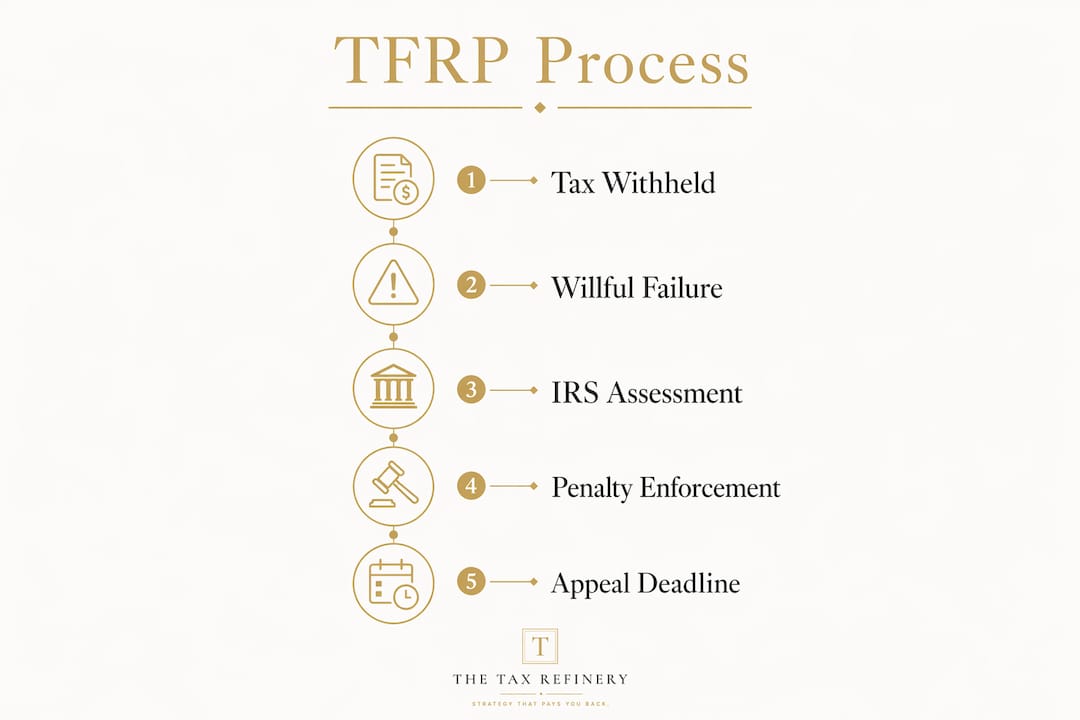
The IRS follows a defined process when pursuing the TFRP. Understanding each step gives you the best chance of responding effectively.
-
Form 4180 interview. An IRS revenue officer conducts a structured interview using Form 4180 to determine responsibility and willfulness. Statements made during this interview can be used as evidence in later assessments or litigation. Never attend this interview without professional representation.
-
Letter 1153. The IRS sends this letter proposing the penalty assessment. It triggers a strict 60-day deadline to file a written protest. Missing this deadline forfeits your administrative appeal rights entirely.
-
Form 2751. If you agree with the proposed assessment, you sign Form 2751. If you disagree and miss the 60-day window, the IRS assesses the penalty automatically.
-
Collection actions. Once assessed, the IRS may use liens, levies, wage garnishments, and bank account seizures against your personal assets. These tools mirror those used for any personal tax debt.
-
Post-assessment litigation. If you miss the appeal deadline, your only remaining option is to pay a portion of the penalty, file a refund claim, and sue in federal district court or the U.S. Court of Federal Claims. This path is expensive and uncertain.
Missing the 60-day deadline on Letter 1153 forfeits administrative appeal rights and triggers immediate collection. The IRS assessment is presumed correct once issued, placing the burden on you to prove otherwise.
What does willfulness mean under the TFRP?
Willfulness under the TFRP is a voluntary, conscious decision to pay other obligations instead of trust fund taxes. This is a lower standard than criminal willfulness. You do not need to intend to defraud the government.
Choosing to pay creditors or suppliers while trust fund taxes remain unpaid satisfies the willfulness standard, even if you did it to keep the business running. Courts have consistently held this position. The reasoning is straightforward: the withheld taxes were never yours to use for other purposes.
Willfulness is the most common trap for business owners. It often involves decisions to prioritize other creditors while knowing trust fund taxes are due. The IRS does not require proof of bad intent. Awareness of the obligation combined with a choice to pay something else is enough.
Common misconceptions business owners hold include:
- "I didn't know the taxes weren't being paid" (knowledge of the obligation is enough)
- "My accountant was handling it" (delegation does not eliminate responsibility)
- "We were just trying to survive" (financial distress does not negate willfulness)
- "I resigned before the taxes were due" (timing of resignation matters but rarely eliminates liability)
The delegation defense is effectively dead under current case law. Responsible persons cannot escape liability by pointing to someone else they trusted with payroll duties.
What defenses exist against the trust fund recovery penalty?
Two defenses can succeed against the TFRP: proving you were not a responsible person, or proving you did not act willfully. Every other defense faces a steep uphill battle.
Reasonable cause defenses that apply to other IRS penalties generally do not apply here. The IRS assessment is presumed correct, and the burden falls on you to disprove responsibility or willfulness by a preponderance of evidence.
Defenses that have succeeded include:
- Lack of authority. You had no actual control over financial decisions, no check-signing authority, and no role in payroll.
- Lack of knowledge. You genuinely did not know the taxes were unpaid and had no reason to know.
- Procedural errors. The IRS missed its own deadlines or made errors in the assessment process.
| Defense type | Strength | Key evidence needed |
|---|---|---|
| Not a responsible person | Strong if proven | No signature authority, no financial control, no payroll role |
| No willfulness | Moderate | Proof of no knowledge of unpaid taxes |
| Procedural IRS error | Situational | Documentation of IRS deadline or process failure |
| Reasonable cause | Weak | Rarely accepted; not a recognized TFRP defense |
Documentation is the foundation of any defense. Bank records, corporate minutes, employment agreements, and correspondence showing your actual role carry more weight than testimony alone. IRS revenue officers rely on documentary evidence rather than titles to establish who was truly responsible.
Pro Tip: Start gathering documentation the moment you receive any IRS notice about payroll taxes. Waiting until after the Form 4180 interview to organize records puts you at a serious disadvantage.
How can business owners manage the risk?
Prevention is far less costly than resolution. Oregon business owners with employees carry real exposure if payroll tax compliance is not actively monitored.
Practical steps to reduce your risk include:
- Monitor deposits directly. Verify that payroll tax deposits are made on time every pay period. Do not rely solely on a payroll provider or bookkeeper without checking.
- Maintain clear records. Keep documentation of who has financial authority, who approves payments, and how payroll decisions are made.
- Respond to IRS notices immediately. Any notice related to payroll taxes requires a prompt, documented response. Delays narrow your options.
- Understand delegation limits. Delegating payroll duties does not transfer your legal responsibility. You remain liable if you have the authority to ensure compliance.
- Consult a tax professional early. If your business is in financial distress and payroll taxes are at risk, get professional advice before missing a deposit. The cost of early advice is a fraction of the penalty.
If your business is already behind on payroll taxes, consider whether resignation from a financial role actually changes your liability. Timing matters, but resignation after the obligation arose rarely eliminates responsibility. Bankruptcy considerations are complex because the TFRP is typically nondischargeable and survives personal bankruptcy as a priority tax debt.
For business owners also managing S-corp payroll obligations, understanding S-corp payroll compliance is a related area where errors compound quickly.
Key Takeaways
The trust fund recovery penalty is a personal, 100% penalty assessed against individuals with financial authority who willfully fail to remit withheld employee taxes, and it survives business closure, bankruptcy, and delegation.
| Point | Details |
|---|---|
| TFRP is personal liability | The penalty attaches to individuals, not the business, and follows you after closure. |
| Responsible person is defined by control | Actual financial authority, not job title, determines who is liable. |
| Willfulness is a low bar | Paying other bills while knowing taxes are due satisfies the IRS standard. |
| 60-day deadline is critical | Missing the Letter 1153 protest window forfeits your administrative appeal rights. |
| Delegation is not a defense | Courts consistently reject the argument that assigning payroll duties removes liability. |
What I've learned from watching business owners face the TFRP
The business owners I see in the most trouble with the TFRP share one trait: they ignored early warning signs. A missed payroll tax deposit feels manageable in the moment. By the time the IRS sends Letter 1153, the penalty has grown, the options have narrowed, and the stress is significant.
The second pattern I see constantly is the delegation trap. A business owner hands payroll to a bookkeeper or office manager, assumes the problem is solved, and stops checking. Courts have made clear that this approach does not work. If you have the authority to ensure taxes are paid, you carry the liability whether or not you exercised that authority.
What actually helps is early documentation and early professional involvement. Clients who contact me before the Form 4180 interview have far more options than those who come in after the assessment is finalized. The interview itself is a legal proceeding in practical terms. Statements made there become evidence. Going in unprepared is a serious mistake.
For Oregon business owners, the financial stakes are real. The TFRP can equal tens of thousands of dollars in personal liability, collected from your personal bank accounts and property. The IRS does not distinguish between your business life and your personal finances once the penalty is assessed. Treat payroll tax compliance as a non-negotiable, not a cash flow management tool.
— Melissa
Thetaxrefinery can help you address payroll tax liability
Payroll tax issues require specific expertise, and the TFRP is one of the most serious personal tax liabilities a business owner can face. Thetaxrefinery works with business owners and responsible persons to assess their exposure, prepare for IRS interactions, and build a defense strategy when needed.

Melissa Korber, Enrolled Agent, brings deep knowledge of IRS procedures and tax strategy for founders to every client engagement. Whether you are facing a Form 4180 interview, responding to Letter 1153, or trying to prevent a problem before it starts, Thetaxrefinery provides year-round advisory support, not just seasonal filing. Use the tax liability calculator to estimate your exposure, or reach out directly to discuss your situation.
FAQ
What is the trust fund recovery penalty?
The trust fund recovery penalty is a personal liability equal to 100% of unpaid withheld employee taxes, assessed under IRC §6672 against individuals who willfully failed to remit those taxes to the IRS.
Can more than one person be held liable for the TFRP?
Yes. The IRS can assess the full penalty against multiple responsible persons under joint and several liability, meaning it can collect 100% of the unpaid amount from any one individual.
Does resigning from a company eliminate TFRP liability?
Resignation after the tax obligation arose generally does not eliminate liability. The IRS looks at whether you had authority during the period the taxes went unpaid.
What happens if I miss the 60-day deadline on Letter 1153?
Missing the deadline forfeits your administrative appeal rights. The IRS assesses the penalty automatically and begins collection, leaving federal court litigation as your only remaining option.
Does the TFRP go away if my business files for bankruptcy?
No. The TFRP is a priority tax debt that is typically nondischargeable in bankruptcy and continues to follow the individual personally after business dissolution or personal bankruptcy proceedings.
Recommended
- The Tax Refinery — Tax Strategy, Preparation & Resolution | Boise, ID
- The Augusta Rule: A Hidden Tax Strategy for Business Owners | The Tax Refinery
- Cleaning Business Taxes: A Practical Guide for Owners
- IRS Opens the Door for Crypto Staking Inside Trusts — But Only If You Follow the New Rules Exactly | The Tax Refinery