
The IRS Fresh Start Program refers to a collection of tax relief provisions that expand access to existing IRS debt resolution tools, making it easier for qualifying taxpayers to manage or reduce their federal tax debt. Formally introduced in 2011, the Fresh Start initiative is not a single program or application. It is an umbrella of policy changes covering installment agreements, Offers in Compromise, penalty abatement, and Currently Not Collectible status. The IRS and the Taxpayer Advocate Service both recognize these tools as the primary pathways for taxpayers who owe more than they can pay. Understanding how each option works puts you in a stronger position before you ever contact the IRS.
What relief options does the IRS Fresh Start Program include?
The Fresh Start initiative is not a unified program but an umbrella term for changes expanding access to existing relief tools like installment agreements and Offers in Compromise. Each tool serves a different financial situation, and knowing which one fits yours saves time and reduces the risk of rejection.
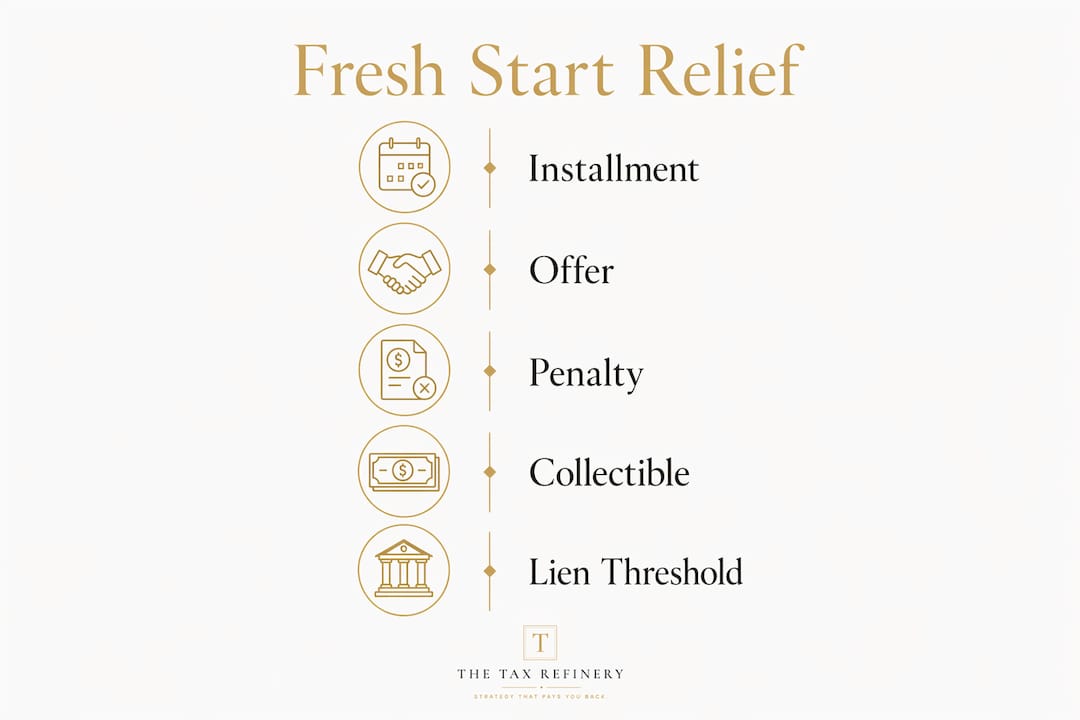
Streamlined Installment Agreements let taxpayers who owe $50,000 or less set up a monthly payment plan without submitting detailed financial disclosures. The IRS allows up to 72 months to pay, which makes this the most accessible option for most individuals and small business owners in Idaho.

Offers in Compromise (OIC) allow a taxpayer to settle a tax debt for less than the full amount owed. The IRS accepts an OIC only when the offered amount reflects what the agency can realistically collect, a figure called Reasonable Collection Potential. This is not a discount program. It is a formal settlement based on documented financial hardship.
First-Time Penalty Abatement removes penalties for taxpayers who have a clean compliance history for the three prior years. This applies to failure-to-file and failure-to-pay penalties and requires no financial documentation. It is one of the fastest forms of relief available and is frequently overlooked.
Currently Not Collectible (CNC) status temporarily suspends IRS collection activity when a taxpayer cannot meet basic living expenses and pay their tax debt. The IRS reviews CNC status periodically and can resume collection when financial circumstances improve.
The Fresh Start initiative also raised the federal tax lien filing threshold to $10,000 and created a path for lien withdrawal after a taxpayer enters a direct debit installment agreement.
| Relief Option | Purpose | Key Eligibility | IRS Form |
|---|---|---|---|
| Streamlined Installment Agreement | Monthly payment plan | Owe $50,000 or less | Form 9465 |
| Offer in Compromise | Settle for less than owed | Based on ability to pay | Form 656 |
| First-Time Penalty Abatement | Remove penalties | Clean 3-year filing history | Written request or call |
| Currently Not Collectible | Pause collections | Proven financial hardship | Form 433-F |
| Lien Withdrawal | Remove tax lien | Active direct debit agreement | Form 12277 |
Pro Tip: Interest and penalties continue to accrue even under installment agreements and CNC status. A payment plan stops collection action, but it does not freeze your balance. Factor this into your decision before choosing a longer repayment term.
Who qualifies for IRS Fresh Start relief?
Compliance is the gatekeeper. The IRS will not approve any relief application from a taxpayer who has unfiled returns or unpaid current-year obligations. This single requirement disqualifies more applicants than any financial threshold.
The core eligibility requirements include:
- Filed returns: You must have filed all required returns for the past six years. Missing returns must be filed before any application is submitted.
- Current estimated taxes: Self-employed individuals and business owners must be current on estimated tax payments for the current year.
- Federal tax deposits: Business owners with employees must be current on federal tax deposits for the current quarter and the two preceding quarters to qualify for an Offer in Compromise.
- No active bankruptcy: An open bankruptcy case disqualifies you from most IRS relief options until the case is resolved.
- Debt threshold: Streamlined installment agreements are available for balances of $50,000 or less, including tax, penalties, and interest combined.
The IRS evaluates Offer in Compromise applications using Reasonable Collection Potential, which accounts for your income, assets, and allowable living expenses. Meeting the debt threshold alone does not guarantee approval. The IRS calculates what it believes it can collect from you over time and compares that figure to your offer amount.
For Idaho business owners in trades like HVAC, landscaping, or commercial cleaning, the estimated tax and deposit requirements are especially critical. Missing a quarterly deposit while an OIC is pending will result in automatic rejection.
Pro Tip: Pull your IRS transcript at IRS.gov before applying. It shows every return the IRS expects from you and every balance on your account. Surprises during the application process cause delays and denials.
How to apply for IRS Fresh Start relief
There is no single Fresh Start application. Each relief tool requires its own form, its own documentation, and its own review process. Treating this as one application is the most common mistake taxpayers make.
Documents and steps to prepare before applying
- Gather the last two years of tax returns and confirm all prior returns are filed.
- Pull your IRS account transcript to verify balances and any existing liens or levies.
- Collect three months of bank statements, pay stubs, and documentation of monthly expenses.
- Complete Form 433-A (for individuals) or Form 433-B (for businesses) if applying for an OIC or CNC status. Streamlined installment agreements under $50,000 do not require these forms.
- Submit Form 9465 for an installment agreement or Form 656 for an Offer in Compromise.
The IRS offers three ways to set up a payment plan: online through the IRS Online Payment Agreement tool, by phone at the IRS collections line, or by mailing Form 9465. Online setup carries a lower setup fee, and low-income taxpayers may qualify for a fee waiver.
Collection activity generally pauses once a relief request is pending. The IRS will not levy bank accounts or wages while reviewing an installment agreement or OIC application, though this pause is not permanent and does not stop interest from accruing.
Processing times vary. Installment agreements set up online are often approved within minutes. Offers in Compromise take considerably longer, sometimes six months to a year, depending on the complexity of the case and IRS workload. Understanding structured payment options from a personal finance perspective can also help you manage cash flow while your IRS application is under review.
Common myths about the IRS Fresh Start Program
The phrase "Fresh Start" has been heavily marketed by third-party tax resolution companies, which has created widespread confusion about what the program actually does.
Myth 1: There is a single Fresh Start application that wipes out your debt. There is no such application. Each relief tool is separate, and none of them automatically forgive debt. The IRS approves relief based on individual financial circumstances, not program enrollment.
Myth 2: Third-party companies have exclusive access to Fresh Start relief. Tax resolution companies often imply they have special access or relationships with the IRS. They do not. Every relief option is available directly through the IRS website or by phone. Paying high upfront fees for access you already have is unnecessary.
Myth 3: A payment plan stops penalties and interest. Installment agreements and CNC status pause collection action, but interest and penalties keep accruing on the unpaid balance. Over a 72-month plan, this can add thousands of dollars to your total debt.
Myth 4: Applying guarantees approval. The IRS evaluates every application individually. Incomplete documentation, unfiled returns, or a financial picture that shows ability to pay in full will result in denial.
- Verify any tax resolution firm's credentials through the IRS Directory of Federal Tax Return Preparers.
- Contact the Taxpayer Advocate Service at 1-877-777-4778 if you face IRS hardship and need free guidance.
- File all missing returns before spending money on outside help.
Pro Tip: The Taxpayer Advocate Service is a free, independent resource within the IRS. Use it before paying a private firm thousands of dollars for access to programs you can apply to yourself.
Key Takeaways
Compliance with filing and payment requirements is the mandatory first step before any IRS Fresh Start relief option will be accepted or approved.
| Point | Details |
|---|---|
| Fresh Start is an umbrella | It covers installment agreements, Offers in Compromise, penalty abatement, and CNC status, not one program. |
| Compliance comes first | All required returns for the past six years must be filed before any relief application is accepted. |
| Interest keeps accruing | Payment plans and CNC status pause collections but do not stop penalties and interest from growing. |
| No exclusive access | Taxpayers apply directly through the IRS; third-party firms offer no special access to these programs. |
| Each tool has its own form | Form 9465 covers installment agreements; Form 656 covers Offers in Compromise; each requires separate documentation. |
What I've learned from working with taxpayers facing IRS debt
The biggest mistake I see is people waiting. They get a notice, feel the dread, and do nothing for months. By the time they come to me, the balance has grown, a lien has been filed, and their options have narrowed. The IRS rewards early engagement. Calling before a levy hits gives you far more negotiating room than calling after.
The second thing I want you to understand is that compliance is not a formality. It is the entire foundation. I have seen well-prepared OIC applications rejected because the taxpayer missed one quarterly estimated payment during the review period. The IRS does not make exceptions for this. Get your filings and payments current before you do anything else.
Realistic expectations matter too. Most taxpayers who enter installment agreements will pay their full balance plus interest over time. An OIC that settles for less is genuinely available, but it requires documented financial hardship and a thorough, honest financial disclosure. If your numbers show you can pay, the IRS will expect you to pay.
Professional help can improve your outcome, especially for complex cases involving business payroll taxes or multiple years of unfiled returns. But verify credentials, ask for a clear fee schedule upfront, and be skeptical of any firm that guarantees results before reviewing your financials. The IRS makes the final decision, not the firm you hire.
— Melissa
How Thetaxrefinery helps Idaho taxpayers navigate IRS relief
Thetaxrefinery works with individuals and business owners across the Treasure Valley who are facing IRS debt and need a clear path forward. Melissa Korber, an Enrolled Agent based in Boise, provides hands-on guidance through installment agreement setup, Offer in Compromise preparation, and compliance restoration for clients with unfiled returns or payroll tax issues.

Thetaxrefinery offers a transparent fee schedule so you know exactly what resolution support costs before committing. For business owners who want to understand their full tax picture, the tax resolution services page outlines how the firm approaches IRS communication and debt resolution. If you are ready to assess your options, the tax strategy comparison is a strong starting point.
FAQ
What is the IRS Fresh Start Program?
The IRS Fresh Start Program is an umbrella term for a set of policy changes introduced in 2011 that expanded taxpayer access to existing IRS relief tools, including installment agreements, Offers in Compromise, penalty abatement, and Currently Not Collectible status.
Who qualifies for IRS Fresh Start relief?
Taxpayers must have filed all required returns for the past six years, be current on estimated taxes, have no active bankruptcy, and generally owe $50,000 or less to qualify for streamlined options.
Does the Fresh Start Program forgive tax debt?
The Fresh Start initiative does not automatically forgive debt. An Offer in Compromise can reduce the total amount owed, but approval depends on the IRS's assessment of your Reasonable Collection Potential, not enrollment in any program.
Can I apply for IRS Fresh Start relief on my own?
Yes. Every relief option is available directly through the IRS website or by phone. Taxpayers have direct access to these programs without paying a third-party firm.
Does a payment plan stop penalties and interest?
No. Installment agreements and CNC status pause IRS collection action, but interest and penalties continue to accrue on the unpaid balance throughout the repayment period.