
The IRS offers several structured payment plan options for taxpayers who cannot pay their full balance at once. For business owners and real estate investors, choosing the right arrangement from the start can mean the difference between manageable monthly payments and a lien filing that disrupts financing or operations.
Here is a quick overview of the primary options:
- Short-term payment plan: Available to individuals owing less than $100,000 in combined tax, penalties, and interest. You get up to 180 days to pay. No setup fee applies.
- Simple Payment Plan (individual accounts): For balances up to $50,000. The Simple Payment Plan removes the previous requirement to use Direct Debit or Payroll Deduction, giving you more flexibility in how you pay.
- Streamlined Installment Agreement: Available for individuals with balances up to $50,000 under more restrictive payment method rules, or up to $100,000 for short-term plans, with specific criteria for higher balance tiers.
- In-Business Trust Fund Express (IBTF Express): For businesses with qualifying payroll tax balances, requiring payoff within a prescribed timeframe.
- Offer in Compromise (OIC): For taxpayers who genuinely cannot pay the full amount owed. Eligibility is assessed through the IRS OIC Pre-Qualifier tool.
- Temporary delay of collection: The IRS may pause collection if you can demonstrate financial hardship, though penalties and interest keep accruing.
Setup fees vary by payment method and application channel, with discounted fees available for low-income taxpayers. Revising an existing agreement involves a modest fee. All plans accrue penalties and interest until the balance is paid in full.
Table of Contents
- What are the IRS payment plan options for business owners?
- Common mistakes that can derail your IRS payment plan
- How Thetaxrefinery helps you get better outcomes from IRS payment plans
- How to set up an IRS payment plan step by step
- Thetaxrefinery: strategic IRS resolution for Idaho business owners
- Key Takeaways
What are the IRS payment plan options for business owners?
Business and individual accounts operate under different IRS rules, and conflating the two is one of the most common and costly mistakes business owners make.
Individual taxpayers — including sole proprietors and independent contractors — can apply for a payment plan online through the IRS Online Payment Agreement tool. Business entities cannot. If you operate as an S-corp, partnership, or corporation, you must contact the IRS by phone at 800-829-4933 or submit your request by mail.
The documentation requirements differ significantly as well. Business (BMF) accounts typically require financial statements and do not qualify for the Simple Payment Plan available to individual (IMF) accounts. The IRS uses these documents to assess your ability to pay and determine the appropriate agreement structure. Individual taxpayers under the streamlined criteria can often qualify without submitting detailed financial information, provided they meet the balance thresholds.
Before applying, business owners should have the following ready:
- Most recent profit and loss statement and balance sheet
- Bank statements for the past three months
- A list of business assets and their current values
- Documentation of current payroll tax deposit compliance
- All unfiled tax returns, filed and current
Pro Tip: If your business has employees, the IRS requires that all federal tax deposits (FTDs) are current before it will approve any installment agreement. Falling behind on payroll taxes while negotiating a payment plan for income taxes can derail the entire process.
For real estate investors with income spread across multiple entities or properties, the complexity increases. Each entity may carry its own tax liability, and the IRS treats each separately. Working with a tax resolution professional before contacting the IRS directly can help you present your financial picture accurately and avoid inadvertently triggering stricter collection procedures.

Common mistakes that can derail your IRS payment plan
A payment plan is not a resolution. It is a structured delay that keeps enforcement actions at bay while you pay down the balance — but penalties and interest continue to accrue throughout the agreement. Many business owners treat approval as the finish line. It is not.
The most frequent mistakes include:
- Assuming the plan stops the financial damage. Interest compounds daily on the unpaid balance. A $50,000 liability does not stay at $50,000 while you pay it down over 72 months.
- Missing a payment or filing a late return. Either can default your agreement. Once defaulted, the IRS can resume collection activity, including levies and lien filings.
- Waiting too long to contact the IRS. Proactive communication before a Notice of Federal Tax Lien is filed gives you far more options. After a lien is recorded, it becomes a public record that can affect your ability to refinance property or secure business credit.
- Applying as a business when you should apply as an individual. Sole proprietors and independent contractors apply as individuals, not as businesses. Applying under the wrong account type can delay or complicate your agreement.
- Ignoring penalty abatement opportunities. Many taxpayers pay penalties they could have had reduced or removed. The IRS offers first-time penalty abatement and reasonable cause relief, but you have to ask. The IRS's approach to automatic penalty waivers has specific conditions attached — they are not guaranteed without action on your part.
For business entities, the stakes are higher. The IRS applies stricter collection procedures to BMF accounts, and an IBTF Express agreement requires full payoff within 24 months. Missing that window can expose your business to aggressive collection action at a time when cash flow may already be strained.
How Thetaxrefinery helps you get better outcomes from IRS payment plans
Getting into a payment plan is one step. Getting out of it efficiently — with the least amount of money paid in penalties and interest — requires a deliberate strategy. Enrolled Agent Melissa Korber and the team at Thetaxrefinery work with business owners and real estate investors across Idaho to do exactly that.
The approach combines several tactics that most taxpayers overlook:
- Pursue penalty abatement before or during the plan. First-time abatement can eliminate a significant portion of assessed penalties. Reasonable cause arguments can address the rest. Thetaxrefinery evaluates abatement eligibility as part of every IRS tax resolution engagement.
- Make lump-sum payments when cash flow allows. Reducing the principal balance faster cuts the total interest paid. Even a single additional payment in a strong revenue month can meaningfully shorten the agreement term.
- Stay current on all future filings. A single unfiled return defaults most installment agreements. Thetaxrefinery's year-round advisory model keeps clients compliant so a payment plan never collapses due to a missed filing.
- Contact the IRS before enforcement begins. Proactive outreach — before a lien or levy notice arrives — preserves more options and typically results in more favorable agreement terms.
- Structure multi-entity situations carefully. Real estate investors with multiple LLCs or S-corps need to understand how liabilities across entities interact. Thetaxrefinery's multi-entity tax structuring experience is directly applicable here.
Pro Tip: If your financial situation changes during the plan — revenue drops, a property sells, or a major expense hits — you can request a modification. Do not simply stop paying, Contact the IRS or your tax resolution advisor immediately to renegotiate terms before the agreement defaults.
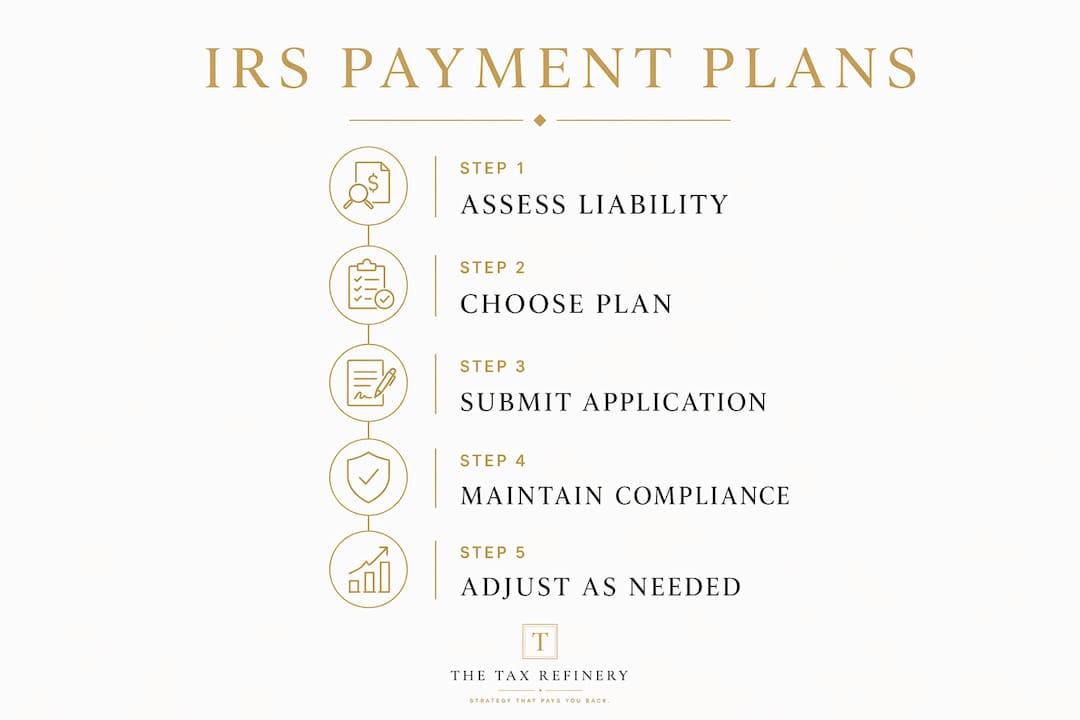
How to set up an IRS payment plan step by step
The process differs depending on whether you are an individual or a business entity.
For individuals and sole proprietors:
- Create an IRS Online Account at IRS.gov if you do not already have one. You will need a photo ID.
- Use the Online Payment Agreement tool to apply. You can apply for a short-term plan (180 days or less) or a long-term installment agreement.
- Select your payment method. Direct Debit carries a $29 setup fee; non-direct-debit monthly payments cost $69.
- Confirm your agreement terms and receive immediate notification of approval in most cases.
- Make all scheduled payments on time and file all future returns by their due dates.
For business entities:
- Call the IRS Business and Specialty Tax Line at 800-829-4933, or mail Form 9465 with your financial documentation.
- Prepare financial statements, bank records, and asset documentation before you call.
- Confirm that all payroll tax deposits are current — the IRS will not approve a business agreement otherwise.
- Negotiate the monthly payment amount and term. IBTF Express agreements must be paid within 24 months.
- Set up payments through EFTPS (Electronic Federal Tax Payment System) or Direct Debit to avoid missed payments.
For real estate investors with complex holdings:
- Identify which entities carry the liability and whether you are applying as an individual or a business.
- If you have an authorized representative, submit Form 2848 before applying for the plan.
- Monitor each entity's payment plan separately. The IRS tracks IMF and BMF accounts independently.
- Consider the impact of an active payment plan on property refinancing. A federal tax lien, if already filed, must typically be addressed before a lender will close.
Payment methods accepted include Direct Debit, EFTPS, check, money order, and debit or credit card (card payments carry processing fees). You can review your payment plan status, history, and upcoming payments through your IRS Individual Online Account or Business Tax Account.
Thetaxrefinery: strategic IRS resolution for Idaho business owners
Managing a tax liability while running a business or a real estate portfolio is not a task that benefits from a DIY approach. The cost of a misstep — a defaulted agreement, an unfiled return, a lien that blocks a refinance — often exceeds the cost of professional guidance many times over.

Thetaxrefinery, founded by Enrolled Agent Melissa Korber and based in the Treasure Valley, offers IRS representation and tax resolution services built specifically for business owners and real estate investors. The firm's subscription-based advisory model means you have a strategic partner throughout the life of your payment plan — not just someone who files paperwork and disappears. From penalty abatement to multi-entity structuring to proactive IRS communication, every engagement is designed to reduce what you owe and protect what you have built. If you are carrying a tax liability and want a clear plan for resolving it, review the firm's tax strategy and resolution services to see how Thetaxrefinery approaches your situation.
Key Takeaways
The most effective IRS payment plan strategy combines the right agreement type with proactive compliance, penalty abatement, and early payoff when cash flow allows.
| Point | Details |
|---|---|
| Business vs. individual accounts | Business (BMF) accounts cannot apply online and require financial statements; individuals can use the IRS Online Payment Agreement tool. |
| Simple Payment Plan eligibility | Individual accounts with balances up to $50,000 qualify; no Direct Debit requirement, unlike the prior streamlined rules. |
| Penalties and interest keep accruing | Every installment agreement continues to add interest and penalties until the full balance is paid — the plan stops enforcement, not the cost. |
| Penalty abatement reduces total owed | First-time abatement and reasonable cause relief can eliminate assessed penalties; you must request them proactively. |
| Thetaxrefinery's role | Thetaxrefinery provides IRS representation, penalty abatement strategy, and multi-entity planning for business owners and real estate investors in Idaho. |