
A deductible business meal needs five facts on record: the amount, the date, the place, who was there, and why you met. A receipt covers the first three. The last two are yours to write down, and they are where most meal deductions fall apart in an audit. For business owners, S-corp owners and high-earning professionals, the habit is simple: capture the receipt, add a short note the same day, and file it where your bookkeeper or tax advisor can find it. This guide shows exactly what to capture, how the rules work for reimbursed meals, and what changed for employer-provided meals in 2026.
TL;DR
- Keep a receipt showing the restaurant's name and location, the number of people served, the date and the amount. The IRS requires receipts for any expense of $75 or more.
- Write down who attended, their business relationship to you, and the business reason, at or near the time of the meal.
- Business meals are generally 50% deductible, and the cost includes tax and tip.
- If you reimburse yourself or staff, run it through an accountable plan so each meal is substantiated within set time windows.
- Keep the records for at least three years from the date you file the return that claims the deduction.
Table of Contents
- What makes a meal deductible in the first place
- The five elements every meal record needs
- What the receipt itself must show
- How to document purpose and attendees
- Meals while traveling
- Reimbursed meals and accountable plans
- What changed for employer-provided meals in 2026
- A simple system that holds up
- Where our clients' meal records tend to need work
- How we help
- Our perspective
- FAQ
- Sources
What makes a meal deductible in the first place
Documentation only helps if the meal qualifies. The IRS says you generally can't deduct a meal unless you or your employee is present when the food or drink is provided and the expense is not lavish or extravagant. Your documentation should be able to show both.
Two practical points:
- Presence. Buying lunch for a client you did not attend does not qualify. Your calendar entry or note should show you were at the table.
- Reasonableness. Publication 463 says a meal is not lavish if it is reasonable under the facts and circumstances, and it is not disallowed just because it costs more than some fixed amount or happens at an upscale restaurant. A $400 dinner with a referral partner can stand if the purpose and the setting make sense. A record that shows the purpose is what lets it stand.
The IRS also puts the burden on you. Its burden of proof guidance says taxpayers must substantiate certain elements of an expense, and that travel, entertainment, gifts and auto expenses need more than ordinary documentary evidence such as receipts, canceled checks or bills. Meals tied to a client or to travel fall into that stricter group.
The five elements every meal record needs
The IRS Travel and Entertainment guidance lists what records must show: the person you met and their connection to your business, the business purpose, the date, time and place, and the cost. In practice that becomes five fields.
| Element | What to record | Where it usually comes from |
|---|---|---|
| Amount | Total including tax and tip | Itemized receipt, card statement |
| Date | Date of the meal | Receipt |
| Place | Restaurant name and location | Receipt |
| Attendees | Names, titles or roles, and relationship to the business | Your note or calendar entry |
| Business purpose | What you discussed or what the meeting was for | Your note, written same day |
The cost of a meal for tax purposes includes food, beverages, taxes and tips, and the 50% limit is applied after you work out the amount that otherwise qualifies. So a $200 dinner with a $40 tip and $16 tax is a $256 meal, and $128 is the deductible portion.
What the receipt itself must show
Publication 463 says a restaurant receipt is enough when it shows the restaurant's name and location, the number of people served, the date and amount, and whether anything other than food and beverages was charged. Two habits make this work:
- Ask for the itemized receipt, not only the card slip. The slip shows a total. The itemized check shows the party size and any non-meal charges.
- Capture it the same day. Photograph it before it fades or gets lost in a wallet. Thermal paper receipts fade, and a clear image taken on the day is far stronger than a reconstruction months later.
The regulations require documentary evidence for any expenditure of $75 or more, and for any lodging while traveling. Under that amount a receipt is not strictly required, but the other elements still are. Most owners keep every receipt anyway, because one rule for everything is easier to follow than two.
How to document purpose and attendees
The note matters more than most owners expect. One top-ranked guide describes a short reason of a handful of words. That is enough when it is specific. Compare:
- Weak: "Client lunch."
- Strong: "Lunch with J. Alvarez, owner of Alvarez HVAC, to discuss 2027 service contract renewal."
The regulation at 26 CFR 1.274-5A generally requires a written statement of business purpose, but not when the purpose is evident from the surrounding circumstances, such as a business meal where the relationship of the people makes it clear. Do not lean on that exception. Writing one line costs you ten seconds.
For the business relationship, record the occupation or other information about the person, such as name, title or other designation. For a regular client, a name and company is enough. For a prospect, add where the lead came from.
Timing: record it while you remember it
The same regulation explains why timing matters: a record made at or near the time of the expense, backed by documentary evidence, carries a credibility that later statements do not, because recall fades. Publication 463 adds that confidential information need not sit in the main record, as long as it is recorded at or near the time and available elsewhere to substantiate that element. If a meeting involves a sensitive client or a medical or legal matter, you can keep the main record generic and the detail in a separate file.
If you have no receipt
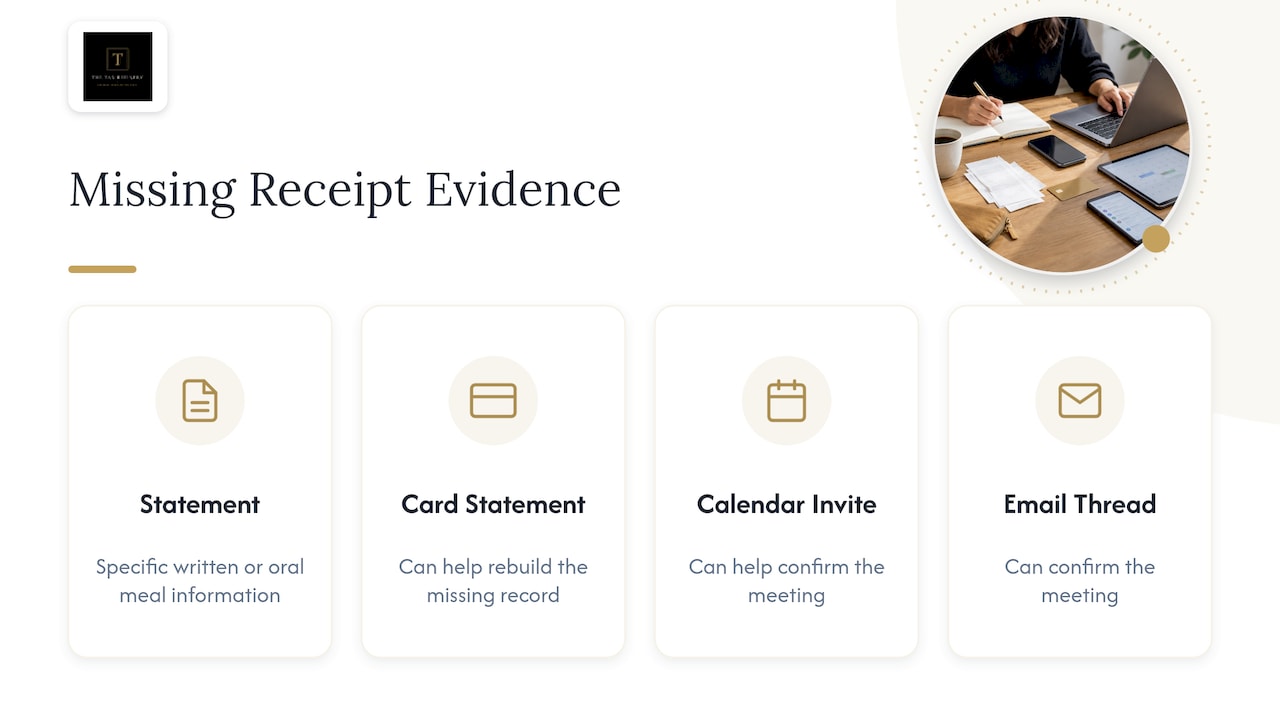
Lost receipts happen. Publication 463 says that without complete records you must prove each element with your own written or oral statement containing specific information, plus other supporting evidence. The regulations also allow circumstantial evidence for the business purpose and business relationship elements. A card statement, a calendar invite and an email thread confirming the meeting can together rebuild a missing record. It is a fallback, though, not a plan.
Meals while traveling
Overnight business travel adds a choice. You can deduct actual meal costs, or use the standard meal allowance, the federal meals and incidental expenses (M&IE) per diem rate. The Form 2106 instructions explain that the standard allowance replaces actual cost for daily meals and incidentals while you are away from your tax home overnight, and that the rates are published on GSA.gov/perdiem.
Two things carry over either way:
- You still need records proving the time, place and business purpose of the trip.
- The 50% limit still applies. Publication 463 says it covers both the actual cost method and the standard meal allowance.
For a nurse practitioner traveling to a conference or a business owner visiting a job site out of state, a trip log with dates, destination and purpose, plus the per diem table, is far lighter than a folder of receipts. If you want the reimbursement side of per diem explained, our guide on whether per diem is taxable walks through it.
Reimbursed meals and accountable plans
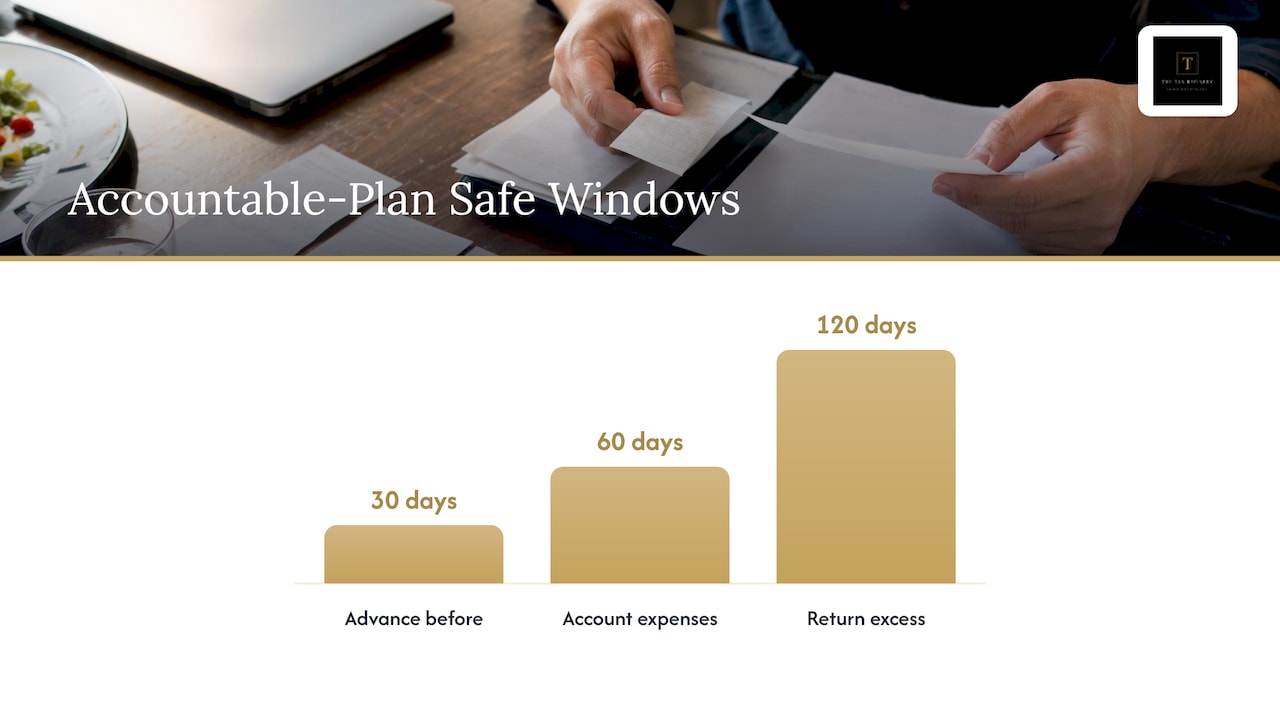
If your company reimburses you or your employees for meals, the paperwork has a second job: keeping the reimbursement non-taxable. That happens under an accountable plan. Publication 463 says a plan qualifies when expenses have a business connection, the employee adequately accounts within a reasonable period, and excess advances are returned within a reasonable period. The periods the IRS always treats as reasonable:
| Step | Safe window |
|---|---|
| Advance given no more than | 30 days before the expense |
| Employee accounts for expenses within | 60 days |
| Employee returns excess within | 120 days |
Adequate accounting means giving the employer an expense statement, account book, diary or similar record with each expense entered at or near the time it was incurred, plus documentary evidence such as receipts. The same standard is the one the IRS would apply if it questioned the deduction.
If you are an S-corp owner reimbursing yourself, treat yourself like an employee: submit the expense report, attach the receipt and note, and do it inside the 60-day window. Our breakdown of the three IRS tests for accountable plans shows how S-corp owners set this up.
If a contractor accounts to you for meals separately, Publication 463 says you, as the client, must keep records documenting each element and the 50% limit applies.
What changed for employer-provided meals in 2026
This section is separate from client meals, and it affects owners who feed their teams.
Publication 15-B (2026) states that for amounts paid or incurred after 2025, an employer can no longer deduct food and beverages provided through an eating facility that meets de minimis fringe requirements, or provided for the employer's convenience. The 50% deduction that applied through 2025 expired under a schedule set in the 2017 Tax Cuts and Jobs Act. The IRS's summary of the One Big Beautiful Bill Act (Public Law 119-21) notes limited exceptions, including food and beverages sold to customers under IRC 274(e)(8), certain vessels, oil and gas platforms, drilling rigs and support camps, and commercial fishing crews.
Employee recreation is different. Publication 15-B says food and drink for events such as holiday parties or annual picnics remain 100% deductible when made primarily for employees other than owners with a 10% or greater interest, officers or highly compensated employees.
The documentation takeaway: separate the categories in your books. Client meals, travel meals, team meals in the office and company-wide events are treated differently, and a single "Meals" account hides that. Our article on meals and entertainment deductions for 2026 covers how to recode these.
A simple system that holds up
Here is a routine that takes under a minute per meal.
- Pay with a dedicated business card. It creates a second record of date, place and amount.
- Photograph the itemized receipt before you leave the table.
- Add the note in the same moment. Names, titles, company and the topic. Use your bookkeeping app's memo field or the calendar entry.
- Tag the category. Client meal, travel meal, employee event or team meal.
- Reconcile monthly. Match receipts to the card statement and fill gaps while memories are fresh.
- Run reimbursements through the accountable plan inside the 60-day window.
For how long to hold on to it all: Publication 463 says keep records for as long as they may be needed to administer the tax code, which generally means 3 years from the date you file the return that claims the deduction. A return filed early is treated as filed on the due date. Store digital copies in a folder organized by tax year.
Where our clients' meal records tend to need work
The common weak points are predictable, and each is fixable:
- Receipts with no attendee names.
- A year of "business meal" entries with identical notes.
- Personal and business meals coded together.
- Owner reimbursements with no expense report.
- Team meals and client meals sitting in one account.
None of these is hard to correct going forward. The work is deciding on a standard and sticking with it, which is easier with a year-round advisor reviewing your books than with a once-a-year look in March.
How we help
For owners and high earners who want meal records and the wider tax picture handled together, we offer Monthly Tax Advisory at $11,997 per year and Quarterly Tax Strategy Sessions at $9,497 per year. Both are year-round engagements built around proactive planning, which includes setting up accountable plans so reimbursements are substantiated properly. If you are a self-employed filer who needs your return prepared, the fee schedule lists Self-Employed returns at $495, Investor or Rental Owner returns at $550, and Form 1065 and Form 1120-S returns at $1,800 each.
If you own an S corporation and want the structure, accountable plan and expense policies set up in one project, the S-Corp Tax Strategy Accelerator is $997.
Our perspective
Meal deductions are small next to entity structure or real estate depreciation, but they are the line items an examiner can test in an afternoon. A strong record turns a debatable deduction into a settled one.
We design our planning to be audit-proof, and that begins with ordinary habits: a note written the same day, a receipt with names attached, and a reimbursement that goes through an accountable plan on time. Owners who build those habits spend less time in March reconstructing the year and more time deciding what to do with the savings.
The 2026 change to employer-provided meals is a good reminder that rules move. A year-round advisor catches that shift when it happens, not at filing. That is the point of strategy that pays you back.
Melissa
FAQ
Do I need a receipt for every business meal?
The regulations require documentary evidence for any expense of $75 or more, and for all lodging while traveling. Below $75 you still must record the amount, date, place, attendees and purpose. Keeping every receipt is the simpler rule to follow.
Is a credit card statement enough to deduct a meal?
A statement shows the amount, date and merchant, but not the number of people served or whether non-meal items were charged. The IRS expects the restaurant receipt details and your own record of who attended and why. Use the statement as backup, not as the record.
How much of a business meal can I deduct?
Generally 50% of the unreimbursed cost, including tax and tip, whether you use actual costs or the standard meal allowance on a trip. Employer-provided office meals changed after 2025, as described above, so code them separately.
How long do I keep meal receipts?
Generally for 3 years from the date you file the return claiming the deduction, per Publication 463. Keep them in a digital folder by tax year so they are easy to produce.
Sources
- IRS Publication 463 (2025), Travel, Gift, and Car Expenses
- IRS Income & Expenses 2
- IRS Burden of proof
- IRS Travel & Entertainment Expenses FAQ
- 26 CFR 1.274-5, Substantiation requirements
- 26 CFR 1.274-5A, Substantiation requirements
- Instructions for Form 2106 (2025)
- IRS Publication 463 (2020), accountable plan rules
- IRS Publication 15-B (2026)
- IRS: Understanding the Working Families Tax Cuts, business tax provisions