
If you drive frequently for business in a modest, high-mileage vehicle, the standard mileage rate almost always produces the larger deduction with far less paperwork. If you own an expensive vehicle, had major repairs this year, or drive relatively few business miles, the actual expense method often wins. IRS Topic 510 recommends calculating both methods whenever you qualify for both, then claiming whichever yields the higher number.
The core difference is that the standard mileage rate combines typical vehicle operating costs into a single rate applied per business mile, whereas the actual expense method requires itemizing and deducting actual vehicle expenses proportionate to business use.
Pro Tip: The single most consequential decision you'll make is which method you elect in the first year you place a purchased vehicle in service. Use actual expenses in year one and you generally can't switch to the standard mileage rate for that vehicle later. Use the standard rate in year one and you retain the flexibility to switch. Before you file, photograph your odometer, gather every receipt, and run both calculations.
Key Takeaways
The standard mileage rate wins for high-mileage, lower-cost vehicles; actual expenses wins when vehicle costs are high relative to miles driven, and the first-year election for owned vehicles is permanent and cannot be undone.
| Point | Details |
|---|---|
| Standard mileage wins at high mileage | Multiply business miles by 72.5¢ (Jan–Jun) or 76.0¢ (Jul–Dec) per mile for 2026; no receipts required for operating costs. |
| Actual expenses wins for costly vehicles | Deduct real costs multiplied by business-use percentage; depreciation often makes this method superior for newer or expensive vehicles. |
| First-year election is binding | Using actual expenses in year one for an owned vehicle permanently forecloses the standard mileage rate for that vehicle. |
| Parking and tolls are always separate | Business parking and tolls are deductible on top of whichever primary method you use; track them as a distinct line item. |
| Thetaxrefinery runs both calculations | Thetaxrefinery analyzes both methods, handles depreciation elections, and sets up accountable plans for S-corp owners. |
Table of Contents
- How the standard mileage method works for your 2026 return
- What the actual expense method lets you deduct
- IRS switching rules and first-year election traps
- Mileage vs actual expenses: side-by-side comparison and decision checklist
- What records to keep and how long to keep them
- Special situations: reimbursements, commuting, rideshare, and parking
- Three worked examples: which method wins in real scenarios
- A step-by-step action plan for choosing your method this tax year
- What I actually see in practice as an Enrolled Agent
- How Thetaxrefinery helps you get the larger deduction and defend it
- Sources
How the standard mileage method works for your 2026 return
The standard mileage rate is a simplified deduction the IRS sets annually. Instead of tracking every fuel receipt and repair invoice, you multiply your total business miles by the published per-mile rate. That single figure covers gas, maintenance, repairs, insurance, and a built-in depreciation component. You cannot separately deduct those same costs for the same vehicle in the same year.
2026 IRS Standard Mileage Rates: 72.5¢ per mile (January 1–June 30, 2026) and 76.0¢ per mile (July 1–December 31, 2026), per the IRS standard mileage rates page.
Eligibility rules to know:
- You must own or lease the vehicle. The standard rate is available for owned cars and for leased vehicles, but if you use actual expenses for a leased vehicle in the first year of the lease, you cannot switch to standard mileage for that vehicle for the remainder of the lease.
- For owned vehicles, you must elect the standard rate in the first year the car is placed in service for business. If you used actual expenses in year one, the standard rate is off the table for that vehicle going forward.
- You cannot use the standard rate if you've previously claimed Section 179 expensing, bonus depreciation, or MACRS depreciation on that vehicle.
- The rate applies per vehicle. If you use multiple vehicles simultaneously for business, you must use the actual expense method for all of them.
Quick calculation example: A self-employed plumber drives 18,000 business miles in 2026, split evenly across the two rate periods (9,000 miles each half). The deduction is calculated by multiplying miles driven in each period by the respective IRS rate (72.5¢ or 76.0¢). No receipts for oil changes or insurance required.
For the full substantiation rules, see IRS Publication 463, which governs what records you must keep to support any vehicle deduction.
What the actual expense method lets you deduct
The actual expense method requires more recordkeeping, but it captures every real dollar you spend operating a vehicle for business. Under Publication 463, you total all qualifying vehicle costs for the year, then multiply by your business-use percentage (business miles driven ÷ total miles driven for the year) to arrive at the deductible amount.
Deductible costs to track:
- Gasoline and fuel
- Oil changes and routine maintenance
- Tires and repairs
- Insurance premiums
- Vehicle registration and license fees
- Lease payments (subject to an income inclusion amount for higher-value leased vehicles)
- Depreciation (for owned vehicles, subject to annual passenger automobile caps)
- Loan interest on a vehicle purchased for business use
- Garage rent or parking fees attributable to business use
Depreciation and Form 4562: Depreciation is often the largest single line item under this method, especially for newer or higher-value vehicles. The IRS caps annual depreciation for passenger automobiles, and those caps are reported on Form 4562. If you elect Section 179 or bonus depreciation in year one, the deduction can be substantial, but it locks you into the actual expense method permanently for that vehicle. For detailed depreciation schedules, Publication 946 is the authoritative IRS reference.
Deductible amount: $14,000 × 0.75 = $10,500.
IRS switching rules and first-year election traps
The method you choose in year one for a purchased vehicle is not just a preference. It's a binding election with long-term consequences.
The core switching rule: If you use the standard mileage rate in the first year a vehicle is placed in service, you may switch to actual expenses in a later year. The reverse is not true. Use actual expenses in year one for an owned vehicle and you generally cannot use the standard mileage rate for that vehicle in any future year, per IRS Topic 510.
How prior depreciation affects your options: If you've claimed accelerated depreciation (Section 179 or bonus depreciation) on a vehicle, the standard mileage rate is permanently unavailable for that vehicle. If you switch from standard mileage to actual expenses in a later year, you must use straight-line depreciation for the vehicle's remaining useful life, and you must account for the depreciation already embedded in the standard mileage rate.
Common compliance pitfalls:
- Mixing commuting with business miles. Commuting from home to your regular workplace is never deductible, regardless of method. Only trips to client sites, job locations, or temporary worksites qualify.
- Failing to document total annual miles. Both methods require a record of total miles driven for the year, not just business miles. Without it, the IRS cannot verify your business-use percentage.
- Claiming parking and tolls under the wrong category. Parking fees and tolls for business travel are deductible separately from your primary vehicle deduction, regardless of which method you use. Track them as a distinct line item.
- Using the standard rate for multiple simultaneous vehicles. If you operate more than one vehicle for business at the same time, you must use actual expenses for all of them.
Pro Tip: Advisors commonly run both calculations in year one for clients with high vehicle costs, then choose the method that preserves the most long-term tax value. A first-year Section 179 election on a $60,000 truck can produce a massive deduction upfront, but it permanently forecloses the standard mileage rate for that vehicle. Know the trade-off before you file.
Mileage vs actual expenses: side-by-side comparison and decision checklist
The right method depends on your vehicle profile, mileage volume, and tolerance for recordkeeping. This comparison covers the dimensions that matter most for small-business owners and self-employed taxpayers.
| Dimension | Standard Mileage Rate | Actual Expense Method |
|---|---|---|
| Best for | High-mileage drivers, older or lower-cost vehicles | Expensive vehicles, low-mileage owners, years with major repairs |
| Recordkeeping burden | Mileage log only (date, miles, purpose) | Receipts for every expense category plus mileage log for business-use % |
| What costs are included | Gas, repairs, insurance, depreciation — all bundled in the rate | Each operating cost deducted individually after business-use allocation |
| How to calculate | Business miles × IRS rate (72.5¢ or 76.0¢ per mile in 2026) | Total expenses × (business miles ÷ total miles) |
| Eligibility & switching | Must elect in year one for owned vehicles; can switch to actual later | If elected in year one for owned vehicle, cannot switch to standard mileage |
| Forms & reporting | Schedule C (Part II, Line 9) or applicable business return | Schedule C plus Form 4562 when depreciation is claimed |
| Audit/documentation risk | Lower; mileage log is the primary document | Higher; receipts, depreciation schedules, and mileage log all required |
| Potential dollar difference | See worked examples below | See worked examples below |
Decision checklist — answer these four questions:
- Did you place this vehicle in service for business this year? If yes, your year-one election is permanent for owned vehicles.
- How many business miles did you drive? High mileage (15,000+) generally favors the standard rate.
- What are your total annual vehicle costs? High costs relative to miles driven favor actual expenses.
- Did you claim Section 179 or bonus depreciation on this vehicle? If yes, actual expenses is your only option.
Pro Tip: Run both calculations every year you qualify for both. A year with a major engine repair or new tires can flip the winner from standard mileage to actual expenses. TurboTax and similar tax-prep tools include a vehicle deduction calculator that walks through both methods side by side.
What records to keep and how long to keep them
A deduction you can't substantiate is a deduction you'll lose under audit. Publication 463 requires contemporaneous records, meaning logs and receipts created at or near the time of each trip or expense, not reconstructed from memory at year-end.
Records required for both methods:
- A mileage log with: date of each trip, odometer reading at start and end (or miles driven), business purpose, and destination or client name
- Total annual odometer reading (January 1 and December 31)
- Title or lease agreement for the vehicle
- Documentation of the date the vehicle was first placed in service for business
Additional records for actual expenses:
- Receipts or statements for every deductible cost (fuel, insurance, repairs, registration, lease payments)
- Depreciation schedule and Form 4562 from prior years
- Loan statements showing interest paid, if applicable
Retention timeline: Keep vehicle-related tax records for at least three years from the date you file the return on which the deduction appears. If you claim depreciation, retain records for as long as the vehicle is in service plus three years after the final return that includes a depreciation deduction for it.
Sample mileage log fields to use today:
| Field | What to record |
|---|---|
| Date | MM/DD/YYYY |
| Start odometer | Reading at trip start |
| End odometer | Reading at trip end |
| Miles driven | End minus start |
| Business purpose | Brief description (e.g., "client site visit — ABC Plumbing") |
| Destination | City or address |
Apps like MileIQ, Everlance, and Prism Wallet can automate trip logging and expense capture, which reduces the administrative burden and produces audit-ready exports. Photo receipts stored in a dedicated folder (Google Drive, Dropbox, or your tax software's document vault) work well alongside a digital mileage log.
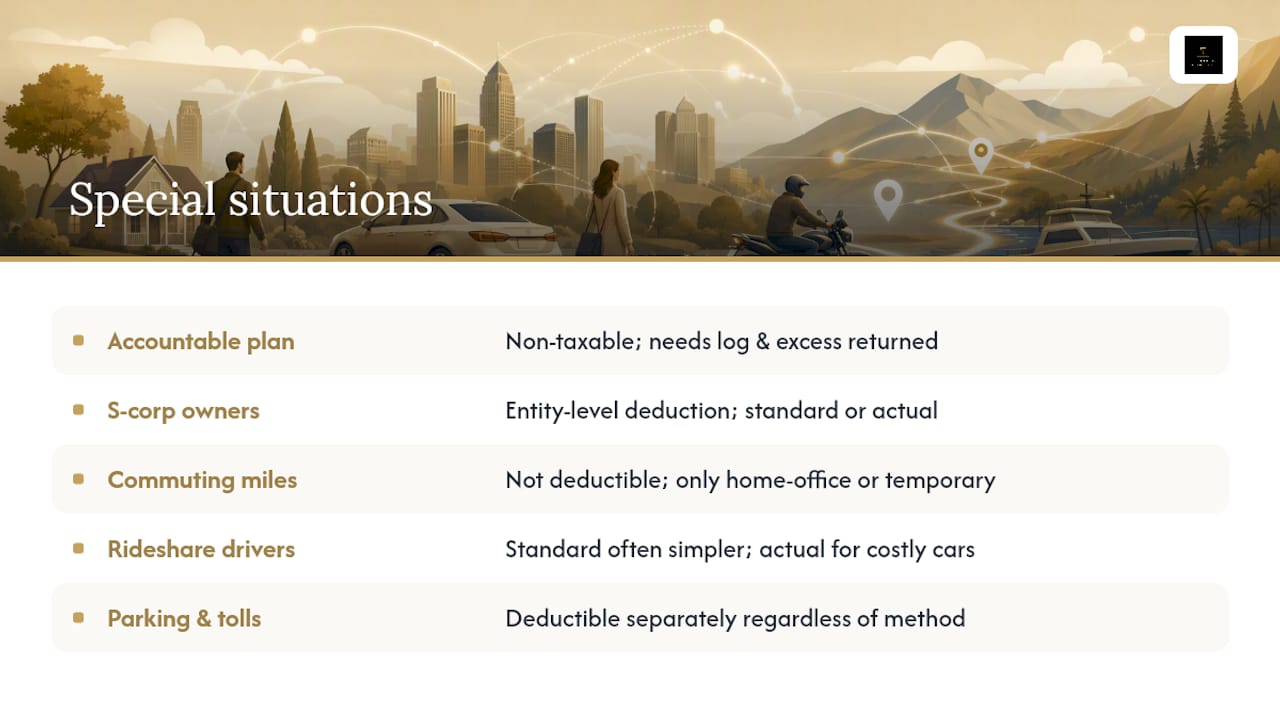
Special situations: reimbursements, commuting, rideshare, and parking
Employer reimbursements and accountable plans
When an employer reimburses an employee for business vehicle use under an accountable plan, the reimbursement is not taxable income to the employee and the employer deducts the expense. An accountable plan requires a business connection, adequate substantiation (mileage log and receipts), and return of any excess reimbursement within a reasonable time. Reimbursements that don't meet accountable-plan rules are treated as taxable wages. For S-corp owners, a properly structured accountable plan can reimburse vehicle expenses at the standard mileage rate or actual costs, keeping the deduction at the entity level rather than on the owner's personal return.
Commuting miles
Miles driven from your home to your regular, fixed place of business are commuting miles. They are never deductible, regardless of method. The exception applies when your home is your principal place of business (a qualifying home office) or when you travel to a temporary worksite. A landscaper who drives from home directly to client properties each morning is driving business miles. An office worker who drives to the same downtown location every day is commuting.
Rideshare and driver-for-hire
For rideshare drivers (Uber, Lyft, DoorDash), the standard mileage rate is often the simpler and more favorable choice because mileage volume is high and vehicle costs per mile tend to be moderate. Actual expenses can pay off for rideshare operators who drive a newer, higher-cost vehicle or who have significant repair and maintenance costs. The same first-year election rules apply.
Parking and tolls
Business-related parking fees and tolls are deductible separately from your primary vehicle deduction, regardless of whether you use the standard mileage rate or actual expenses. Track them as a distinct line item on Schedule C. A $40 parking fee at a client's building is fully deductible on top of your mileage or actual-expense deduction for that trip.
Three worked examples: which method wins in real scenarios
The following examples use 2026 IRS rates and realistic cost assumptions. All business-use percentages are based on business miles ÷ total miles.
Example 1 detail: 20,000 business miles split evenly across rate periods: (10,000 × $0.725) + (10,000 × $0.760) = $7,250 + $7,600 = $14,850 (rounded to $14,825 after minor rounding on the split). Standard mileage wins by roughly $8,874.
Example 2 detail: 7,200 business miles: (3,600 × $0.725) + (3,600 × $0.760) = $2,610 + $2,736 = $5,346. Actual expenses include $8,000 in depreciation (subject to passenger automobile caps per Form 4562), $4,200 in fuel and maintenance, $3,800 in insurance and registration, and $6,000 in loan interest, totaling $22,000 × 60% = $13,200. Actual expenses wins by $7,854.
Example 3 detail: The leased RAV4 has annual lease payments of $6,000, fuel of $2,400, insurance of $1,800, and maintenance of $1,200, totaling $11,400. Standard mileage: (6,750 × $0.725) + (6,750 × $0.760) = $4,894 + $5,130 = $10,024 (approximately $10,013 after rounding). Standard mileage wins here, but note: if actual expenses were used in the first year of this lease, the standard mileage rate would not be available for the remainder of the lease.
A step-by-step action plan for choosing your method this tax year
- Gather your odometer records. Pull your January 1 and December 31 odometer readings. If you don't have them, use your most recent service records as a proxy and note the gap.
- Separate business miles from personal and commuting miles. Review your calendar, GPS history, or appointment records to reconstruct business trips if your mileage log isn't complete.
- Total all vehicle expenses. Collect receipts or statements for fuel, insurance, repairs, registration, lease payments, and loan interest for the full year.
- Calculate the standard mileage deduction. Multiply business miles in each half of 2026 by the applicable rate (72.5¢ or 76.0¢).
- Calculate the actual expense deduction. Divide business miles by total miles to get your business-use percentage, then multiply total expenses by that percentage. Add depreciation if applicable, using the caps from Form 4562 instructions.
- Check your first-year election status. If this is the first year you've used the vehicle for business, confirm which method you're electing and understand the switching rules before you file.
- Choose the method with the larger deduction. Document your choice in your tax preparation notes or workpapers.
- Set up a recordkeeping system for next year. A contemporaneous mileage log and a dedicated expense folder (digital or physical) will protect your deduction under audit. See the mileage reimbursement compliance guide for additional state-level considerations.
- Consult a tax professional if depreciation or multi-entity questions arise. Section 179 elections, bonus depreciation, and vehicles used across multiple entities add complexity that benefits from professional review. For year-round planning support, proactive tax planning can help you document recurring vehicle expenses as part of a broader strategy.
What I actually see in practice as an Enrolled Agent
Most of the clients who come to The Tax Refinery with vehicle deduction questions fall into two camps, and the right answer is almost never the same for both.
The first group drives constantly. HVAC technicians, commercial cleaners, landscapers, real estate agents showing properties six days a week. For these clients, the standard mileage rate is usually the right call. The per-mile rate is generous, the recordkeeping is manageable, and the deduction compounds quickly at high mileage volumes. A service-business owner logging 25,000 business miles in 2026 can claim over $18,000 without touching a single fuel receipt.

The second group drives less but owns a newer, more expensive vehicle, or had a significant repair event during the year. For them, actual expenses frequently produce a meaningfully larger deduction, especially when depreciation is factored in. A real estate investor who purchased a $55,000 SUV and drove it 8,000 business miles will almost always come out ahead with actual expenses, particularly in the first few years when depreciation is highest.
The piece most business owners miss is the long-term consequence of the first-year election. Choosing actual expenses in year one to capture a large depreciation deduction is sometimes the right move, but it permanently forecloses the standard mileage rate for that vehicle. When clients are weighing a Section 179 election on a vehicle, I always model both the current-year deduction and the multi-year impact before recommending a path. That kind of multi-year view is exactly what separates proactive tax strategy from annual return prep.
If your situation involves multiple vehicles, an S-corp accountable plan, or real estate activity with significant vehicle use, the interaction between methods and entity structures adds enough complexity that a one-time calculation isn't sufficient. Year-round advisory support tends to pay for itself quickly in these cases.
How Thetaxrefinery helps you get the larger deduction and defend it
Running both calculations once is straightforward. Running them correctly across multiple vehicles, entity structures, and depreciation elections, year after year, is where most business owners leave money on the table or create audit exposure.

Thetaxrefinery offers specific services built around exactly this problem: mileage vs actual expense analysis, depreciation review and Form 4562 preparation, accountable-plan setup for S-corp owners, multi-entity vehicle coordination, and audit support if the IRS questions your documentation. Melissa Korber, Enrolled Agent, works with business owners netting $300,000 to $1,000,000+ annually who want a tax partner, not a seasonal filer.
Engagements are available as subscription-based advisory (year-round strategy and compliance support) or project-based packages for one-time planning needs. If you want to know which method produces the larger deduction for your specific vehicle and mileage profile, and how to document that choice so it holds up under scrutiny, review the tax strategy options or book a consultation directly.
Sources
- IRS standard mileage rates
- Instructions for Form 4562
- Standard mileage vs. actual expenses: Getting the biggest tax deduction (TurboTax)
This article provides general tax information, not professional tax advice. Tax rules change and individual circumstances vary. Confirm current rates and rules with the IRS or a qualified tax professional before filing.
This article is general information, not a substitute for advice from a qualified financial advisor. Consult a qualified financial professional about your own circumstances before acting on anything here.