
The de minimis safe harbor under Treas. Reg. § 1.263(a)-1(f) lets you immediately expense qualifying tangible property purchases instead of capitalizing and depreciating them. The threshold is a specified dollar amount per item or invoice that is higher for taxpayers with an Applicable Financial Statement (AFS) and lower for those without. To claim it, you attach a statement titled "Section 1.263(a)-1(f) de minimis safe harbor election" to your timely-filed original federal return, including extensions, for each year you want the election to apply.
Before you proceed, confirm these three things:
- Threshold check: Your invoice or item cost falls at or below $5,000 (AFS) or $2,500 (non-AFS), including any delivery or installation charges on the same invoice.
- Book treatment: You have expensed the item on your books and records in the same year.
- Election statement: You will attach the required statement to your original return filed on time.
One important boundary: this is an administrative convenience, not a blanket permission to expense anything small. Land, inventory, and certain rotable or standby spare parts are explicitly excluded, regardless of cost.
Table of Contents
- What the de minimis safe harbor is and why the IRS created it
- Who qualifies and how the $5,000 vs. $2,500 thresholds work
- How to make the annual election, step by step
- What you can expense and what the safe harbor excludes
- How the safe harbor interacts with repairs rules and capitalization analysis
- Documentation you must keep and a sample written accounting policy
- Common mistakes and audit red flags to avoid
- Worked examples for Schedule C filers, real estate investors, and corporations
- Key Takeaways
- Why the de minimis safe harbor deserves a place in your tax strategy
- How Thetaxrefinery helps you implement and maintain the safe harbor
- Useful sources for deeper reading
What the de minimis safe harbor is and why the IRS created it
The legal foundation is Treas. Reg. § 1.263(a)-1(f), part of the IRS's final tangible property regulations. Before these rules took effect, every business owner faced a subjective, time-consuming analysis whenever they bought a piece of equipment or made a repair: capitalize it and depreciate it over years, or deduct it now? That determination required examining whether the expenditure improved, adapted, or restored a unit of property, and the line was often unclear for small-dollar items.

The safe harbor eliminates that analysis for qualifying purchases. If your item meets the threshold and you have treated it as an expense on your books, you can deduct it immediately without documenting why it does not rise to the level of a capital improvement. That reduction in compliance burden is the entire point.
The threshold for non-AFS taxpayers was originally set at $500 when the final regulations were issued. IRS Notice 2015-82 raised it to $2,500, effective for tax years beginning on or after January 1, 2016, in response to practitioner feedback that $500 was too low to provide meaningful relief for most small businesses. The $5,000 threshold for AFS holders has remained in place since the regulations were finalized. The IRS justifies the higher AFS threshold because audited financial statements provide independent assurance that a capitalization policy does not materially distort income.
Who qualifies and how the $5,000 vs. $2,500 thresholds work
Any taxpayer, including individuals, corporations, partnerships, and S-corps, can use the safe harbor as long as three conditions are met at the time of the expenditure:
- You have an accounting procedure in place at the beginning of the tax year that requires expensing amounts below a set dollar threshold.
- You expense the item on your books and records in the year of purchase.
- The cost per item or per invoice falls at or below your applicable threshold.
If you have an AFS, that accounting procedure must be in writing. Without an AFS, a written policy is still strongly advisable, but the regulation does not require it in writing for non-AFS taxpayers.
Threshold comparison

| Taxpayer type | Threshold | Basis |
|---|---|---|
| With AFS (audited financials, SEC-filed statements, or financials required by a federal/state agency) | $5,000 per item or invoice | Written accounting procedure required |
| Without AFS (most sole proprietors, small LLCs, Schedule C filers) | $2,500 per item or invoice | Accounting procedure required; writing strongly recommended |
What counts as an AFS? The three most common examples are: financial statements filed with the SEC, audited financial statements accompanied by a CPA's opinion, and financial statements required by a federal or state government agency. Most small businesses and individual rental property owners do not have an AFS, so the $2,500 threshold applies to them.
"Per item or invoice" explained. The threshold applies to the amount paid for each item as substantiated by the invoice, or to the total invoice if it covers a single item. Critically, delivery and installation charges on the same invoice count toward the threshold. A $2,200 piece of equipment with a $400 installation charge on the same invoice totals $2,600, which exceeds the non-AFS limit and disqualifies the entire invoice.
Three quick scenarios
Schedule C sole proprietor (no AFS). A freelance graphic designer buys a $1,800 monitor. The invoice shows only the monitor price and a $50 shipping charge, totaling $1,850. She has a written accounting policy expensing items under $2,500 and records the purchase as an expense in her general ledger. She qualifies. She attaches the election statement to her Schedule C return.
Rental property investor (no AFS). A landlord replaces a water heater for $2,100, with a $250 installation charge on the same invoice, totaling $2,350. That falls under $2,500. He expenses it on his books and attaches the election to his Form 1040 with Schedule E. The deduction is immediate rather than depreciated over 27.5 years.
Corporation with audited financials (AFS). A commercial cleaning company with a CPA-audited annual statement buys a floor-scrubbing machine for $4,500, with a $300 delivery charge on the same invoice, totaling $4,800. Under the $5,000 AFS threshold, the full invoice qualifies. The company's written capitalization policy states that items under $5,000 are expensed, and the GL reflects that treatment.
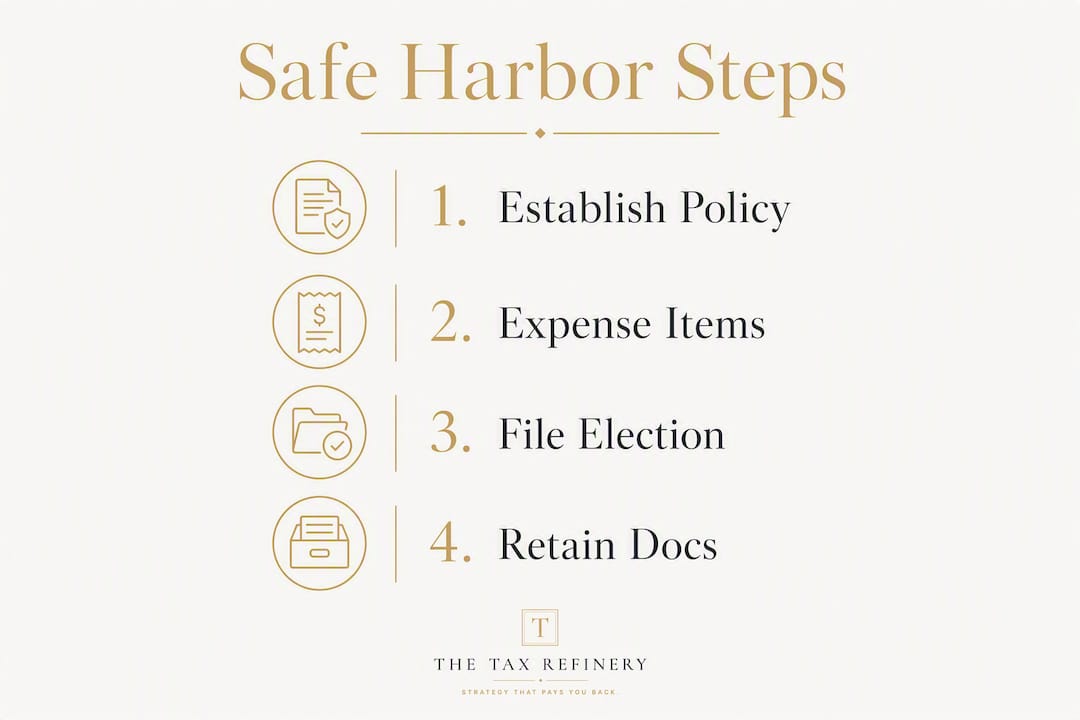
How to make the annual election, step by step
The election is not automatic. You must affirmatively make it each year by attaching a statement to your timely-filed original federal return. Missing the attachment for a given year means you cannot go back and claim it retroactively for that year.
Step 1: Establish your accounting procedure before the first day of the tax year
Your policy must exist at the start of the year in which you want to use the safe harbor. If you are setting one up for the first time, do it before January 1. If you already have one, confirm it is still in place and that the threshold has not changed.
Step 2: Expense qualifying items on your books
When you purchase a qualifying item during the year, record it as an expense in your general ledger, not as a fixed asset. This book treatment is a prerequisite, not a formality. The IRS will look at your GL entries if the election is questioned.
Step 3: Prepare and attach the election statement to your original return
The statement must be titled exactly: "Section 1.263(a)-1(f) de minimis safe harbor election." It should include your name, address, and taxpayer identification number, a statement that you are making the election under Reg. § 1.263(a)-1(f), and the tax year to which the election applies.
Sample statement text:
Step 4: Retain supporting invoices and itemized documentation
Keep every invoice for items you expense under the safe harbor. The invoice should be itemized so the cost per item is clear. If delivery or installation appears on the same invoice, confirm the total still falls within your threshold.
Filing software notes. Most professional tax software, including platforms used for Schedule C and business returns, can generate the election statement as a PDF attachment. TaxSlayer's support guidance confirms that the statement must be attached to the timely-filed return and walks through the process for Schedule C filers. If you are paper-filing, print the statement and include it with your return. For amended returns, the election cannot be added retroactively; the original return must carry the statement.
What you can expense and what the safe harbor excludes
The safe harbor covers amounts paid to acquire or produce units of tangible property and incidental materials and supplies that meet the threshold and book-treatment requirements. That covers a wide range of ordinary business purchases: office equipment, tools, small appliances, replacement fixtures, and similar items.
The regulations explicitly exclude the following from the safe harbor:
- Land (never depreciable, never eligible)
- Inventory held for sale to customers
- Rotable, temporary, and standby spare parts that the taxpayer elects to capitalize under Reg. § 1.162-3(d)
- Property produced by the taxpayer for sale
Eligible vs. excluded: a quick reference
| Eligible (if threshold and book treatment met) | Excluded (regardless of cost) |
|---|---|
| Office furniture under threshold | Land |
| Small tools and equipment | Inventory for resale |
| Replacement fixtures and hardware | Rotable spare parts (if capitalized under § 1.162-3(d)) |
| Printer cartridges and incidental supplies | Intangible property (patents, licenses) |
| Low-cost appliances for rental units | Property produced for sale |
| Computer peripherals | Major structural components (usually exceed threshold anyway) |
The all-or-nothing rule on invoices. If a single invoice combines multiple items and the total exceeds the threshold, the entire invoice is ineligible. You cannot cherry-pick individual line items from a qualifying invoice once the total crosses the limit. However, if the invoice is itemized and each line item is separately substantiated, each item is evaluated on its own cost. Keeping invoices itemized is not just good practice; it can be the difference between expensing and capitalizing.
A practical illustration: a landlord orders a replacement faucet ($180) and a bathroom vanity ($2,400) on the same invoice, totaling $2,580. That total exceeds the $2,500 non-AFS threshold, so neither item qualifies under the safe harbor from that invoice. Had the landlord placed two separate orders with two separate invoices, both items would have qualified individually.
How the safe harbor interacts with repairs rules and capitalization analysis
The de minimis safe harbor is one of three administrative safe harbors in the tangible property regulations. Understanding where it ends and where the others begin prevents both missed deductions and improper ones.
The de minimis safe harbor applies to small-cost acquisitions and productions of tangible property. The routine maintenance safe harbor covers recurring activities that keep a unit of property in its ordinarily efficient operating condition, such as periodic HVAC servicing, regular equipment lubrication, or scheduled inspections. These are different jobs. A $900 replacement part for a piece of equipment might qualify under de minimis. The annual service contract for that same equipment might qualify under routine maintenance. A full system upgrade qualifies under neither and must be capitalized.
One procedural difference matters: the de minimis election is made annually on your return. The routine maintenance safe harbor, by contrast, is generally adopted as an accounting method, which means that a first-time adoption may require filing Form 3115 (Application for Change in Accounting Method) to formalize the change. If you have been capitalizing routine maintenance costs and want to switch, Form 3115 is typically the vehicle.
Three scenarios side by side:
- Small replacement part, $400: Falls under the $2,500 non-AFS threshold, expensed on books, election attached. De minimis safe harbor applies. No depreciation schedule needed.
- Annual HVAC preventive maintenance contract, $1,800: Recurring activity that keeps the system in operating condition. Routine maintenance safe harbor likely applies. No capitalization required, but the analysis is different from de minimis.
- Full HVAC system replacement, $14,000: Exceeds both thresholds. Must be analyzed under the UNICAP and improvement rules. Likely capitalized and depreciated, though a cost segregation study might accelerate some components.
When an item is expensed under any safe harbor rather than capitalized, it has no depreciable basis. That means no depreciation deductions in future years, but also no recapture on sale. For high-value items near the threshold, the choice between immediate expensing and multi-year depreciation (potentially accelerated under Section 179 or bonus depreciation) deserves a quick calculation before you default to the safe harbor. For proactive tax planning that integrates depreciation strategy with entity structure, the interaction between these rules is worth reviewing annually.
Documentation you must keep and a sample written accounting policy
To qualify for the safe harbor, you must have an accounting procedure in place at the start of the tax year and expense the item on your books. For AFS taxpayers, that procedure must be in writing. For non-AFS taxpayers, a written policy is still the safest approach because it demonstrates consistency and intent if the IRS ever questions your treatment.
Sample written accounting policy
Effective Date: January 1, [Year] Entity Name: [Your Business Name] TIN: [EIN or SSN]
This entity maintains an accounting procedure under which amounts paid for tangible property with a cost of $[2,500 / 5,000] or less per item, as substantiated by the invoice, are expensed in the period of acquisition. This threshold includes all amounts on the same invoice, including delivery and installation charges. Items meeting this threshold are recorded as expenses in the general ledger and are not capitalized as fixed assets. This policy is in effect at the beginning of each tax year for which the de minimis safe harbor election is made.
Authorized Signature: _________________________ Date: _____________
Adapt the threshold to your situation ($2,500 for non-AFS, $5,000 for AFS), date it before January 1 of the applicable year, and keep a signed copy in your records.
Recordkeeping checklist
- Itemized invoices for every item expensed under the safe harbor
- General ledger entries showing the item was recorded as an expense (not a fixed asset)
- A copy of your written accounting policy, dated and signed before the start of the tax year
- The election statement as filed with your return (keep a copy of the full return)
- Supporting memos for any item with partial business use, showing the business-use percentage and allocation method
- Retention period: the IRS generally has three years from the filing date to audit a return, but six years if income is substantially understated; keep records for at least six years
Pro Tip: For mixed-use items, such as a laptop used 70% for business and 30% personally, apply the safe harbor only to the business-use portion. Document the allocation in a contemporaneous memo or usage log. The invoice total still governs threshold eligibility, but only the business-use percentage is deductible.
Common mistakes and audit red flags to avoid
The four most common audit triggers related to the de minimis safe harbor are: a missing written policy when one is required (AFS taxpayers), inconsistent book treatment, combining multiple items on one invoice without itemization, and treating excluded property as eligible.
Missing or backdated policy. The accounting procedure must exist at the beginning of the tax year. A policy signed in November and backdated to January 1 is not compliant. If you are setting up a policy for the first time mid-year, it applies to the following year, not the current one.
Inconsistent book treatment. If you expense some items under the safe harbor but capitalize similar items of the same cost, the IRS may question whether you have a consistent accounting procedure. Your GL should reflect the policy uniformly.
Improper invoice aggregation. Combining multiple items on one invoice and then trying to apply the threshold to individual line items only works if the invoice itself itemizes each item separately. A lump-sum invoice for "office supplies and equipment, $3,000" does not allow you to break it into qualifying pieces after the fact.
Retroactive elections. You cannot attach the election statement to an amended return. If you filed your original return without the statement, the election is unavailable for that year. The only path forward is to treat the expenditure under the general capitalization rules or, in some cases, file Form 3115 to change your accounting method prospectively.
Remediation steps. If you discover you used the safe harbor incorrectly in a prior year, the correction depends on the error. For a year where you failed to attach the statement, you generally must capitalize the item and begin depreciating it. If you improperly expensed a large item that should have been capitalized, you may need to file Form 3115 to change your accounting method and adjust the tax treatment going forward. Consulting an Enrolled Agent or CPA before filing any correction is advisable, particularly if the amounts are material. Thetaxrefinery provides IRS representation and audit defense for exactly these situations.
One caution worth stating plainly: do not invent a threshold or create an ad-hoc policy during an audit. Examiners are trained to spot policies that appear to have been written to justify a specific deduction rather than to govern a consistent practice. Your documentation must be contemporaneous, not reconstructed.
Worked examples for Schedule C filers, real estate investors, and corporations
Three short examples show how the safe harbor plays out in practice, including how delivery charges can change the result.
Example 1: Schedule C sole proprietor (no AFS)
A self-employed consultant buys a standing desk for $1,950 and a monitor arm for $320, each on separate invoices. Both fall under the $2,500 non-AFS threshold. She has a written accounting policy expensing items under $2,500 and records both as office expenses in her GL.
- Tax result: Both items are fully deductible in the current year. No depreciation schedule.
- Documents to keep: Two itemized invoices, GL entries showing "office expense," copy of written accounting policy, election statement as filed.
Example 2: Rental property investor (no AFS)
A landlord replaces a dishwasher in a rental unit. The appliance costs $1,800, and the installer charges $350 on the same invoice, bringing the total to $2,150. That is under $2,500. He expenses it on his books and attaches the election to his Form 1040 with Schedule E.
Now consider a variation: the same landlord orders a refrigerator for $2,100 with a $450 installation charge on the same invoice, totaling $2,550. That exceeds the $2,500 threshold. The entire invoice is ineligible. The refrigerator must be capitalized and depreciated as residential rental property, or the landlord can explore whether Section 179 applies.
- Documents to keep: Itemized invoice showing appliance and installation separately, GL entry, written policy, election statement.
Example 3: Corporation with AFS
A commercial cleaning company with audited financial statements purchases a commercial vacuum for $3,800, with a $400 delivery charge on the same invoice, totaling $4,200. Under the $5,000 AFS threshold, this qualifies. The company's written capitalization policy covers items under $5,000, and the GL records the purchase as an operating expense.
- Tax result: Full $4,200 deducted in the current year. No depreciation schedule.
- Documents to keep: Itemized invoice showing equipment and delivery, GL entry as expense (not fixed asset), signed written accounting policy, election statement attached to the corporate return.
These examples illustrate a consistent pattern: the threshold analysis, the book treatment, and the election statement are all required. Any one of the three missing and the safe harbor does not apply.
Key Takeaways
The de minimis safe harbor is an annual election that lets qualifying taxpayers immediately expense tangible property purchases up to a specified dollar threshold depending on AFS status, provided the item is expensed on the books and the election statement is attached to the original return.
| Point | Details |
|---|---|
| Two thresholds apply | Different thresholds apply per item or invoice depending on whether the taxpayer has an AFS, and the total includes delivery and installation on the same invoice. |
| Policy must precede the year | Your accounting procedure must be in place before January 1 of the tax year you want to elect. |
| Election is annual, not permanent | Attach the "Section 1.263(a)-1(f) de minimis safe harbor election" statement to every original return; it cannot be added to an amended return. |
| Key exclusions | Land, inventory, and rotable spare parts elected to be capitalized are not eligible, regardless of cost. |
Why the de minimis safe harbor deserves a place in your tax strategy
Most articles treat the de minimis safe harbor as a compliance checkbox. That undersells it. For owner-operators running businesses that regularly purchase tools, equipment, and supplies, a properly maintained safe harbor policy can shift dozens of small purchases from multi-year depreciation schedules to immediate deductions, year after year.
What gets overlooked is the compounding effect of consistency. A business owner who establishes a clear written policy, trains their bookkeeper to code qualifying purchases as expenses, and attaches the election every year builds a clean, defensible record. That record does not just reduce current-year tax liability; it reduces audit risk by eliminating the subjective repair-versus-capitalization question for every item under the threshold.
There is also a strategic pairing that practitioners rarely discuss: the de minimis policy works best when it is coordinated with your depreciation strategy. Items just above the threshold might be better candidates for Section 179 expensing or bonus depreciation, while items well below it are cleanly handled by the safe harbor. Treating these as separate decisions, rather than as part of an integrated annual review, leaves money on the table.
For real estate investors specifically, the interaction between de minimis expensing, the routine maintenance safe harbor, and cost segregation is where the real planning value lives. A landlord who expenses a $2,200 appliance under the safe harbor and simultaneously runs a cost segregation study on a new acquisition is doing both correctly, but only if the two strategies are coordinated so that no item is counted twice and no election is missed.
The safe harbor also complements entity structuring. An S-corp owner who has an accountable plan, a clear capitalization policy, and a coordinated depreciation strategy is operating with the kind of documented, consistent tax position that holds up under scrutiny. These tools reinforce each other. None of them works as well in isolation.
How Thetaxrefinery helps you implement and maintain the safe harbor
Getting the de minimis safe harbor right is not complicated, but it does require three things to happen in the right order: a written policy before year-start, consistent book treatment throughout the year, and the election statement attached to the original return. Missing any one of those steps costs you the deduction for that year.
Thetaxrefinery drafts written accounting policies tailored to your entity type and AFS status, reviews your general ledger entries to confirm book treatment is consistent, and prepares the required annual election statement as part of your tax filing. For business owners who want year-round support, the firm's subscription advisory model keeps the policy current, flags purchases that approach the threshold, and coordinates the safe harbor with your broader tax strategy, including depreciation planning, S-corp structuring, and accountable plans.
If you have never adopted a written capitalization policy, or if you are not sure whether your current policy satisfies the IRS requirements, that is the right place to start. Thetaxrefinery also provides audit representation if the safe harbor election is ever questioned by an examiner. Schedule a strategy consultation at thetaxrefinery.com to review your current policy and confirm your election is in order before the next filing deadline.
Useful sources for deeper reading
The following authoritative sources support the claims in this article and are worth bookmarking for audit-ready reference.
-
IRS Tangible Property Final Regulations: The primary regulatory source for the de minimis safe harbor, covering thresholds, eligibility, election mechanics, and exclusions under Treas. Reg. § 1.263(a)-1(f). Save this page and print the relevant sections as part of your audit file.
-
IRS Notice 2015-82 (IRB 2015-50): The official IRS notice that raised the non-AFS threshold from $500 to $2,500, effective January 1, 2016. Useful for understanding why the two thresholds differ and for documenting the regulatory basis of your policy.
-
The Tax Adviser: "The De Minimis and Routine Maintenance Safe Harbors": An AICPA practitioner article covering both safe harbors in depth, including the invoice-total rule, interaction with capitalization analysis, and practical compliance guidance. One of the most thorough practitioner treatments available.
-
TaxSlayer Support: "How Can I Claim the De Minimis Safe Harbor Election for Schedule C Expenses?": Practical step-by-step guidance for Schedule C filers on attaching the election statement within tax software. Useful if you are self-preparing your return.
-
A note on "de minimis" in customs law: The term "de minimis" also appears in U.S. customs rules governing low-value imports. That is a separate legal framework administered by U.S. Customs and Border Protection under 19 U.S.C. § 1321, not the IRS. The two rules have no connection. If you have encountered news about changes to the $800 import exemption, that does not affect the IRS capitalization safe harbor discussed in this article.
This article provides general tax information, not professional tax advice. Tax rules change, and individual circumstances vary. Confirm current thresholds and requirements with the IRS guidance above or a qualified tax professional before filing.
Recommended
- Proactive Tax Planning for Small Business Owners
- The Augusta Rule: A Hidden Tax Strategy for Business Owners | The Tax Refinery
- Hiring your Children in Your Business: A Smart Tax Strategy with a Family Twist | The Tax Refinery
- IRS Opens the Door for Crypto Staking Inside Trusts — But Only If You Follow the New Rules Exactly | The Tax Refinery