
An accountable plan lets an employer reimburse business expenses tax-free, but only when the arrangement satisfies three IRS requirements: business connection, substantiation, and return of excess. Meet all three and the reimbursement skips the employee's W-2 and the employer's payroll tax bill entirely. Miss even one, and the IRS treats the payment as wages, with income tax withholding and FICA exposure attached.
TL;DR:
- Meeting all three IRS tests—business connection, substantiation, and return of excess—is essential for a reimbursement plan to remain tax-free; failing any turns payments into wages subject to payroll taxes.
- Proper documentation for expenses like home office costs, mileage, and travel must be detailed and timely; delayed or vague reports risk disqualification and reclassification as taxable wages.
- Substantiation deadlines for expense reports are strict, requiring monthly or quarterly submissions with receipts, mileage logs, and business purpose statements to avoid IRS penalties.
- A well-designed plan must be adopted in writing before reimbursements occur, with clear expense categories and routine review to ensure ongoing compliance and audit readiness.
- Incorrect or retroactive plan setups, vague descriptions, or mixing reimbursements with regular payroll increase audit risk and lead to losing the tax advantages entirely.
Table of Contents
- What Accountable Plan Rules Actually Require Under IRS Law
- The Three Tests Every Accountable Plan Must Pass
- Which Business Expenses Qualify for Tax-Free Reimbursement
- How to Document Expenses and Meet Substantiation Deadlines
- What Happens When an Accountable Plan Fails IRS Requirements
- How to Set Up an Accountable Plan Step by Step
- The Audit Traps Most Business Owners Never See Coming
- When an Accountable Plan Becomes a Real Tax Strategy
- How Thetaxrefinery Helps You Build a Compliant Accountable Plan
- Where to Verify the Official Accountable Plan Rules
- Sources
What Accountable Plan Rules Actually Require Under IRS Law
The legal foundation sits in IRC §62(c) and its companion regulation, Treasury Regulation 26 C.F.R. §1.62-2. Together they draw the line between a reimbursement arrangement that stays off an employee's taxable income and one that doesn't. When a plan qualifies, the employee excludes the reimbursement from gross income, and the employer still deducts the underlying business expense. Neither side pays tax on money that never should have been treated as personal income in the first place.
That distinction explains why so many S corporation owners build one of these plans into their compensation structure. An S-corp owner who fronts money for a home office, a vehicle, or a cell phone plan has two options: eat the cost personally with no deduction, or get reimbursed by the company through a plan that meets the federal standard. The second option, done correctly, moves real dollars out of taxable wages without triggering additional payroll tax on either side.
The Three Tests Every Accountable Plan Must Pass
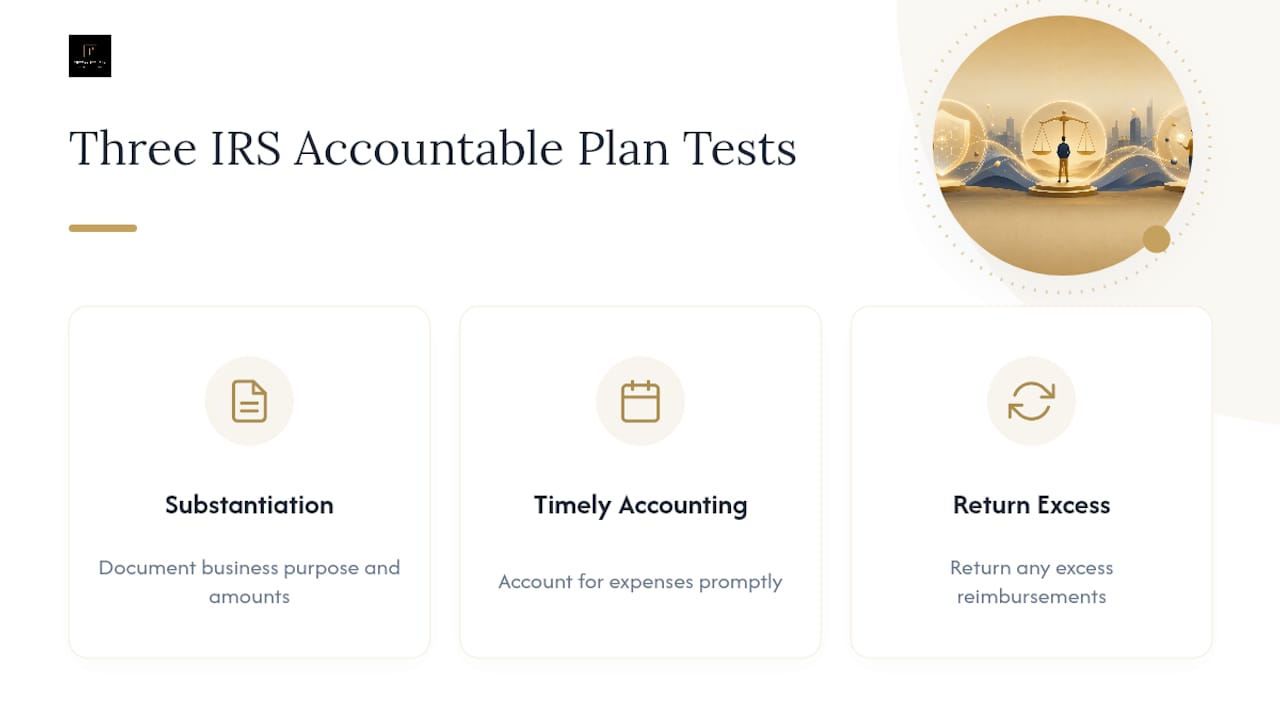
Every accountable plan lives or dies on three tests, and the IRS doesn't grade on a curve. Fail one, and the whole reimbursement becomes wages, even if the expense itself was completely legitimate.
- Business connection: The expense must arise directly from the employee's job duties. Mixed-use items, like a car used for both client visits and grocery runs, only qualify for the business-use percentage, not the whole cost.
- Substantiation: The employee has to document the amount, date, location, and business purpose of each expense, and submit that documentation within a reasonable period. The IRS considers a reasonably prompt period for substantiation to be within about two months of the expense date.
- Return of excess: If an employer advances more than the employee actually spent, the employee must return the unused portion. Returning any excess reimbursement within roughly four months after the expense is generally regarded as reasonable under the safe harbor framework.
These aren't suggestions layered on top of good bookkeeping. They're the actual statutory test, and Treasury Regulation §1.62-2 spells out that failing any single one reclassifies the payment as taxable wages, not just the portion tied to the failed test.
Which Business Expenses Qualify for Tax-Free Reimbursement
Most employers reimburse a predictable set of categories, but each one carries its own documentation quirks that trip up otherwise careful business owners.
- Home office: Reimbursement has to be based on actual expenses (rent, utilities, insurance, depreciation prorated to the office square footage) tied to a space used regularly and exclusively for business. The simplified $5-per-square-foot method that works for a Schedule C home office deduction has no place in an accountable plan reimbursement; it isn't tied to actual costs the way the regulation requires.
- Mileage: Employees need a log with dates, miles driven, and business purpose for each trip. Employers can reimburse using the standard mileage rate or actual vehicle expenses, but not both for the same vehicle in the same year.
- Travel, meals, and per diem: These fall under the stricter substantiation rules of §274(d), and IRS Publication 463 walks through the documentation IRS agents look for on audit. Per diem allowances that exceed the federal rate get treated as nonaccountable for the excess portion, which means that slice becomes taxable wages even inside an otherwise compliant plan.
- Cell phone, internet, and professional dues: These typically require a reasonable allocation between business and personal use, documented with enough specificity to survive a reviewer's second look.
Pro Tip: A cell phone bill with no business-use percentage attached is one of the fastest ways to turn a clean reimbursement into a wage dispute. Write the allocation down every time, not just once when the plan starts.
How to Document Expenses and Meet Substantiation Deadlines
Good documentation isn't complicated, but it has to be consistent. Here's what a defensible file looks like month to month:
- Itemized receipts for every reimbursed expense, showing vendor, date, and amount, not just a credit card statement line.
- Mileage logs with trip dates, starting and ending odometer readings, and a one-line business purpose for each entry.
- Business-purpose statements attached to travel and meal expenses, since IRS Publication 463 treats these categories under §274(d)'s tougher documentation standard.
- Home-office square-footage calculations, updated whenever the space or usage changes.
Submit these monthly or quarterly, not once a year. A single December catch-up submission covering twelve months of expenses doesn't come close to the 60-day substantiation window or the 120-day return-of-excess safe harbor, and it's one of the clearest signals to an examiner that the plan exists on paper only.
On the receipt question specifically: many employers assume there's a blanket $75 threshold below which no receipt is needed. That guidance applies narrowly, and §274(d) expenses like meals and travel carry their own stricter documentation rules that override the general exception. When in doubt, keep the receipt.
What Happens When an Accountable Plan Fails IRS Requirements
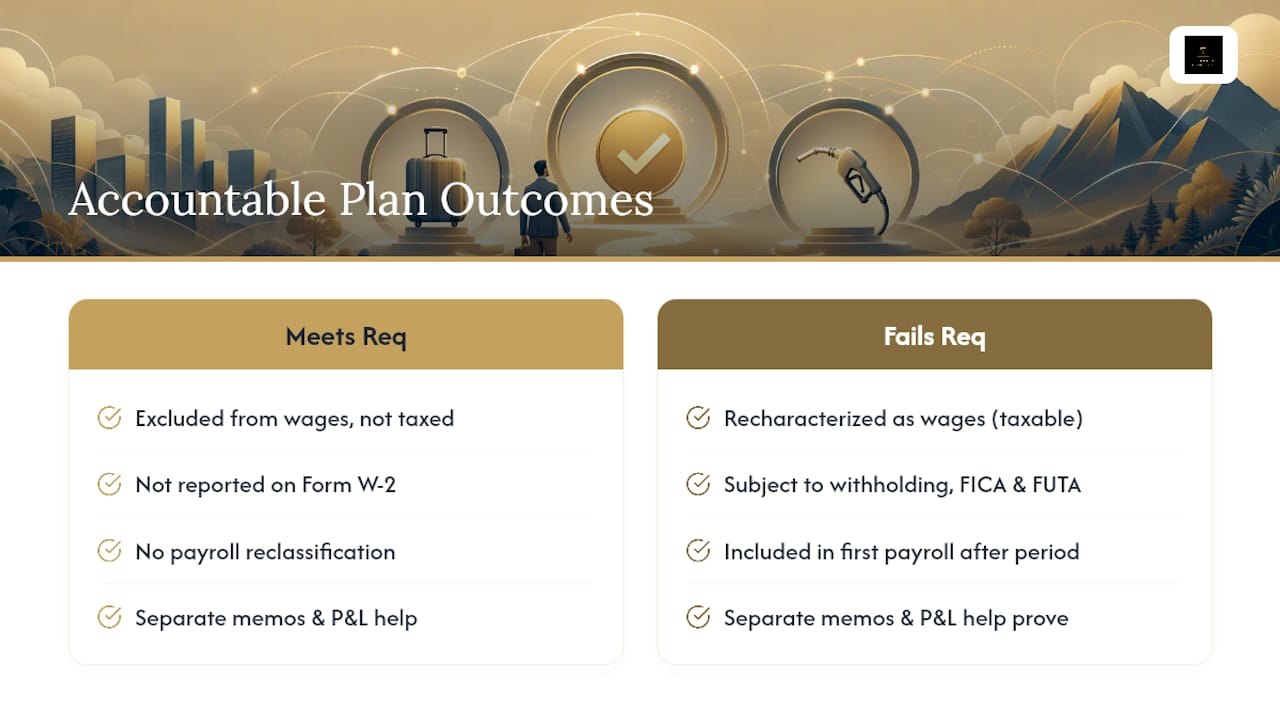
A failed accountable plan doesn't just lose its tax-free status quietly. The reimbursed amount gets recharacterized as wages, subject to federal income tax withholding, Social Security and Medicare tax under FICA, and FUTA. Kent State University's tax office confirms that reimbursements meeting the requirements are excluded from wages and never show up on Form W-2. When they don't meet the requirements, that exclusion disappears.
Timing matters here too. The IRS generally requires the reclassified amount to be included as wages in the first payroll period after the "reasonable period" for substantiation or return of excess has run out, not backdated to when the expense occurred. Keeping reimbursement transactions separate from regular payroll deposits, with distinct memo lines and dedicated P&L coding, makes it far easier to prove which payments were reimbursements and which were compensation, especially relevant for S-corp owners tracking fringe benefits alongside reimbursement activity.
How to Set Up an Accountable Plan Step by Step
A defensible accountable plan doesn't require outside consultants to draft, just discipline in how it's built and run.
- Adopt a written plan, even a one-page document, before any reimbursement flows. A board resolution or owner's signed adoption memo creates a paper trail showing the plan predates the reimbursements, not the other way around.
- Define eligible expense categories up front (home office, mileage, travel, phone) and pick a standard substantiation form for each.
- Set a monthly cadence for expense report submission. Monthly gives enough buffer to comfortably clear the 60-day substantiation and 120-day return-of-excess windows without a scramble.
- Process reimbursements as separate transactions, not folded into a paycheck deposit, with clear memo lines and dedicated bookkeeping codes.
- Review periodically, spot-checking a sample of expense reports each quarter the way an IRS examiner would.
Pro Tip: Treat your accountable plan the same way you treat year-end tax planning: build the cadence into your calendar now, not in the scramble before December 31.
The Audit Traps Most Business Owners Never See Coming
The same red flags show up again and again on review: plans adopted retroactively after reimbursements already happened, a single catch-up expense report filed in December, reimbursements deposited in the same transaction as regular payroll, and business-purpose descriptions vague enough to mean nothing ("miscellaneous business expense").
A defensible monthly expense report should include the vendor, date, amount, business purpose in a full sentence, and a receipt image, with mileage entries carrying odometer readings and destination. That's the file an examiner wants to see, and it's the file Thetaxrefinery helps clients build, from drafting the written plan itself to setting the bookkeeping controls that keep reimbursements separate and defensible year-round.
When an Accountable Plan Becomes a Real Tax Strategy
The biggest misconception I run into is that accountable plans are a compliance checkbox, something you set up once and forget. For an S-corp owner with meaningful home-office and mileage costs, a well-run plan is closer to a recurring tax-savings mechanism than paperwork. It moves real expenses out of personal after-tax dollars and into a category the company deducts and the owner never reports as income.
The owners who get the most out of this aren't running it themselves reactively at tax time. They're treating it as one piece of ongoing advisory, alongside entity structure and depreciation strategy. If you're not sure where you stand, run a one-month pilot: adopt the plan, submit one clean expense report, and see how it feels before scaling it up.
— Melissa
How Thetaxrefinery Helps You Build a Compliant Accountable Plan
Getting the paperwork right on your own is possible, but most business owners underestimate how much ongoing attention an accountable plan actually needs once it's running. Thetaxrefinery drafts the written plan itself, sets up the bookkeeping coding that keeps reimbursements separate from payroll, and builds the monthly cadence that keeps your substantiation inside the IRS safe harbors instead of scrambling every December.
Clients working with Thetaxrefinery get a written plan template built around their actual expense categories, hands-on stewardship of the monthly reporting cadence, and a documentation file ready to hand an examiner if the question ever comes up. For S-corp owners layering an accountable plan into a broader entity strategy, that same advisory relationship extends to structuring decisions like the ones covered in The Augusta Rule. If you're ready to stop treating your reimbursements as a year-end afterthought, compare Thetaxrefinery's tax strategy services and see what a properly run accountable plan could put back in your pocket this year.
Where to Verify the Official Accountable Plan Rules
For the rule text and IRS guidance directly, these are the primary sources worth bookmarking:
- Treasury Regulation §1.62-2, the governing regulation for the three-part accountable plan test.
- IRS Publication 463, for travel, meal, and vehicle expense documentation rules.
- Practical operational context from TrueMeasure Accounting on accountable plan reimbursements, covering common small-business setup questions.
Complex situations, multi-entity structures, mixed-use assets, high mileage volume, generally warrant a conversation with a tax professional before you finalize the plan.
This article is general information, not a substitute for advice from a qualified financial advisor. Consult a qualified financial professional about your own circumstances before acting on anything here.
Sources
- Cornell Law School — Treasury Regulation 26 C.F.R. §1.62-2
- IRS Publication 463, Travel, Gift, and Car Expenses (PDF)
- Kent State University — Expense Reimbursement: Accountable vs. Non-accountable Plan