
Passive losses generally cannot offset your salary, business income, or other nonpassive earnings this year, unless you qualify for the $25,000 active-participation allowance or meet the real estate professional test. Outside those exceptions, disallowed losses carry forward until you have passive income to absorb them or you sell the activity outright.
Before you read further, do three things:
- Check whether you materially participate in the activity, or whether it defaults to passive rental treatment.
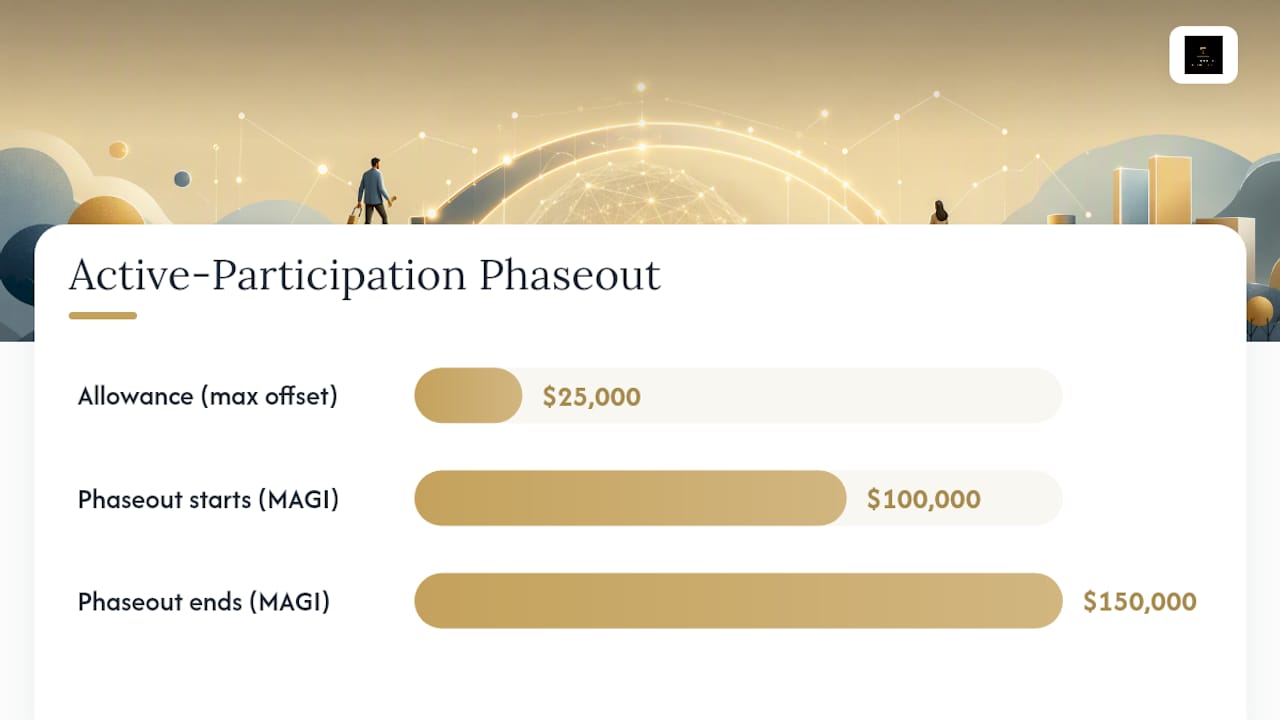
- Calculate your modified adjusted gross income (MAGI) to see where you land on the $100,000 to $150,000 phaseout range.
- Pull together your records and start (or finish) Form 8582.
The full rules live in IRC §469, IRS Topic 425, and Publication 925. What follows breaks those sources down into the sequence you actually need to follow.
Key Takeaways
Passive losses only offset nonpassive income this year through material participation, the $25,000 active-participation allowance, or real estate professional status, and every other dollar carries forward.
| Point | Details |
|---|---|
| Verdict on this year's losses | Passive losses generally can't offset wages or business income unless an exception applies. |
| Material participation escape hatch | Meeting any one of the seven IRS tests removes an activity from passive treatment. |
| $25,000 allowance phases out | The allowance drops to zero once MAGI reaches $150,000, losing 50 cents per dollar after $100,000. |
| Correct order of limits | Apply basis, then at-risk (Form 6198), then passive rules (Form 8582), then excess business loss. |
| Work with Thetaxrefinery | Melissa Korber's firm handles Form 8582/6198 preparation, real estate professional review, and disposition planning. |
This article is general information, not a substitute for advice from a qualified financial advisor. Consult a qualified financial professional about your own circumstances before acting on anything here.
Table of Contents
- Passive Activity Loss Rules: The Statutory Baseline
- Material Participation Tests: When an Activity Isn't Passive
- Rental Real Estate Rules: The $25,000 Allowance and Real Estate Professional Status
- Forms and the Order You Apply Loss Limits
- Practitioner Notes on Sequencing and Common Mistakes
- When Suspended Losses Finally Become Deductible
- What Records to Keep and For How Long
- Why Timing and Structure Decide Whether Your Losses Actually Help You
- How Thetaxrefinery Turns Passive Loss Rules Into a Real Plan
- Sources
Passive Activity Loss Rules: The Statutory Baseline
A passive activity loss is the excess of your total losses from passive activities over your total passive income for the year, as defined under IRC §469. Passive activities are trades or businesses you don't materially participate in, plus almost all rental activity, regardless of how many hours you personally put in.
The general rule is disallowance. If your passive losses exceed your passive income, you can't use the excess to reduce your W-2 wages, your S-corp distributions, or your interest and dividend income this year.
That doesn't mean the deduction disappears. Publication 925 confirms disallowed losses carry forward indefinitely to future tax years and become deductible once you have enough passive income to offset, or when you dispose of the entire activity.
- Passive activity loss = passive deductions minus passive income for the year
- Disallowed amounts carry forward with no expiration date
- Full deduction is generally available in the year you completely dispose of the activity
For the complete statutory language and every exception, IRC §469, IRS Topic 425, and Publication 925 are your primary references.
Material Participation Tests: When an Activity Isn't Passive
The IRS gives you seven ways to prove material participation under 26 CFR § 1.469-5T. Meet any one of them and the activity escapes passive treatment.
- You participate more than 500 hours during the year
- Your participation is substantially all the participation in the activity
- You work more than 100 hours and nobody else works more than you
- The activity is a "significant participation activity" and your combined significant participation activities total more than 500 hours
- You materially participated in the activity for any 5 of the prior 10 tax years
- The activity is a personal service activity and you materially participated in any 3 prior years
- You participate on a regular, continuous, and substantial basis based on facts and circumstances
Rental real estate is passive by default even if you clock hundreds of hours managing it yourself. The only way around that default is the real estate professional exception, covered next.
Consider two landlords: one owns a duplex, handles a few calls a year, and hires a property manager for everything else. The other self-manages fifteen units, screens every tenant, and handles every repair call personally. Only the second scenario has a real shot at nonpassive treatment, and even then, only through the real estate professional test.
Pro Tip: Keep a contemporaneous log of hours, not a reconstructed one built at tax time. Corroborate it with calendar entries, texts with tenants, invoices you approved, and signed contracts. Reconstructed logs are one of the first things an examiner discounts.
Rental Real Estate Rules: The $25,000 Allowance and Real Estate Professional Status
If you actively participate in rental real estate, you can offset up to $25,000 of nonpassive income with rental losses, even without meeting a material participation test. Active participation is a lower bar than material participation.
That $25,000 allowance phases out fast. Form 8582 instructions reduce it by 50 cents for every dollar your MAGI exceeds $100,000, eliminating it entirely at $150,000.
Here's the phaseout in practice:
- MAGI of $100,000 or less: full $25,000 allowance available
- MAGI of $120,000: allowance drops to $15,000 (reduced by 50% of the $20,000 excess)
- MAGI of $140,000: allowance drops to $5,000
- MAGI of $150,000 or more: allowance is fully eliminated
Real estate professional status is a different, tougher standard, requiring a substantial time commitment focused on real property trades or businesses, according to IRS Topic 425. Married couples cannot combine hours to meet this threshold. A real estate professional election can convert rental losses to nonpassive, but only one spouse's hours count toward the test.
Watch for two traps: spouses can't pool hours for the active-participation test either, and paying a family member for duties that don't reflect genuine, customary work has been challenged under the anti-abuse provisions in the regulations.
Forms and the Order You Apply Loss Limits
Four separate limitation systems can restrict a loss, and they apply in a fixed order. Skip a step and you'll misstate what's actually deductible.
- Basis limitations first: you can't deduct a loss that exceeds your basis in the activity.
- At-risk rules next, using Form 6198 when required: amounts not at risk are disallowed before the passive rules even come into play.
- Passive activity rules third, computed on Form 8582: this is where material participation and the $25,000 allowance matter.
- Excess business loss limitation last, for losses that survive the first three tests.
Publication 925 is explicit that a loss disallowed under the at-risk rules isn't a passive activity deduction for that year at all. That distinction changes how you allocate carryforwards, and mixing up the sequence is one of the most common errors on returns with multiple rental properties or K-1 losses. Form 8582 walks through allocation and carryforward mechanics across its later parts once the at-risk step is settled, and results flow to Schedule E, C, or F depending on the activity type.
Practitioner Notes on Sequencing and Common Mistakes
A few patterns show up again and again in returns with unused passive losses.
- Apply basis and at-risk limits before touching the passive rules. Skipping this step overstates what Form 8582 should even be calculating.
- Document participation hours as you go, not in April.
- Group related activities consistently year to year. Reclassifying an activity's grouping to chase a better tax result invites scrutiny.
- Treat publicly traded partnership losses separately. They can't offset other passive income under general netting rules.
- Save the excess business loss calculation for last, after basis, at-risk, and passive limits are resolved.
Before meeting an advisor, gather your K-1s, prior-year Form 8582 carryforwards, and a summary of hours spent on each activity. Suspended losses only become deductible on a full, taxable sale to someone outside your family or controlled group, so that documentation trail matters well before you list the property. Ordering mistakes here mirror issues that show up in other loss-limitation stacking situations, where sequencing errors quietly cost taxpayers real deductions.
When Suspended Losses Finally Become Deductible
Suspended passive losses aren't gone. They're waiting for a trigger event, and the cleanest trigger is a complete disposition.
To release the full carryforward in one year, the transaction has to check three boxes:
- You dispose of your entire interest in the activity, not a partial stake
- The sale is fully taxable, meaning it's not a like-kind exchange, installment sale to a related party, or gift
- The buyer is unrelated to you
Meet all three and IRC §469(g) generally allows the full suspended loss to become deductible in the year of sale, confirmed in Publication 925. Practitioners flag this as documentation heavy rather than automatic. You need clean records proving the interest was entirely disposed of and that the buyer wasn't related. Credits behave differently than losses here. Suspended passive credits generally don't get the same automatic release on disposition that losses do.
What Records to Keep and For How Long
Eight documents form the backbone of an audit-ready passive loss file:
- Contemporaneous time logs for each activity
- Calendar entries corroborating hours worked
- Invoices from contractors or vendors you approved personally
- Signed lease agreements
- Property management contracts, if any
- Form 1099s issued to contractors
- Copies of filed Forms 8582 and 6198 for every year
- Closing documents and sale agreements when you dispose of an activity
Keep standard-year records for at least 3 to 7 years, matching the IRS's general audit window. Hold disposition documents longer, until every dollar of suspended loss tied to that sale has been used or the statute of limitations closes on that return. A single digital folder organized by tax year, handed to your preparer each January, saves hours during both routine filing and an audit.
Why Timing and Structure Decide Whether Your Losses Actually Help You
Most taxpayers treat passive activity loss rules as something to sort out in April. That's backwards. Whether a loss helps you this year or sits suspended for a decade is usually decided by decisions made in March, June, and October: how an entity is structured, when income and expenses land, and whether hours were tracked as they happened rather than reconstructed later.
I've seen the difference between a taxpayer who tracked material participation hours from day one and one who tried to rebuild them at filing time. One has usable losses. The other has an argument with an examiner. If you're projecting suspended losses above $25,000, sitting near the MAGI phaseout window, or planning to sell a passive interest in the next year or two, that's the point to bring in a strategist rather than wait for the return.

How Thetaxrefinery Turns Passive Loss Rules Into a Real Plan
Thetaxrefinery is the alternative to reworking these calculations alone every April. Melissa Korber, an Enrolled Agent and founder of Thetaxrefinery, works year-round with real estate investors and multi-entity business owners on exactly the sequencing and documentation questions this article covers.

Instead of a once-a-year filing conversation, the firm builds ongoing strategy around your specific mix of activities:
- Passive loss analysis and preparation of Form 8582 and Form 6198 in the correct order
- Real estate professional evaluation, including hour-tracking systems built to hold up under review
- Disposition planning that positions a sale to actually release suspended losses in the year you need them
If your MAGI is drifting into the phaseout range, or you're weighing whether a sale this year finally frees up losses you've carried for years, compare Thetaxrefinery's tax strategy and advisory services and book a planning conversation before the decisions that matter most have already been made.
Sources
- Topic no. 425, Passive activities – Losses and credits | Internal Revenue Service
- Instructions for Form 8582 (2025) | Internal Revenue Service
- 26 CFR § 1.469-5T - Material participation (temporary) | govinfo
- 26 U.S.C. § 469 - Passive activity losses and credits limited