
If you're running a low-risk, low-revenue side hustle with minimal personal assets on the line, a sole proprietorship is a perfectly reasonable starting point. If you have meaningful assets to protect, client contracts, employees, or any real exposure to lawsuits, form an LLC. And if your net profit is consistently strong, an S-corp election on top of that LLC is where the real tax savings begin.
TL;DR
- Testing a side hustle with minimal risk? Stay a sole proprietor for now. Zero paperwork, zero cost.
- Growing a profitable practice with contracts or employees? Form a single-member LLC. Personal asset protection is worth the filing fee.
- Netting strong profits consistently? Talk to a tax advisor about an S-corp election. The self-employment tax savings can be substantial once you cross the right threshold.
- Already have multiple income streams or real estate? Multi-entity planning likely applies to your situation.
The LLC protects your assets. The S-corp election can reduce your self-employment tax burden. But the LLC alone does not lower your taxes — that distinction matters more than most solo owners realize.
Table of Contents
- How does a sole proprietor vs LLC comparison actually break down?
- What is a sole proprietorship, and is it right for you?
- What is a single-member LLC, and what does it actually protect?
- How do sole proprietorship vs LLC taxes actually differ?
- When does advanced tax planning actually pay off for solo owners?
- What does it cost to run a sole proprietorship vs an LLC?
- When should you switch from sole proprietor to LLC?
- How to form an LLC or formalize your sole proprietorship
- Key Takeaways
How does a sole proprietor vs LLC comparison actually break down?
The table below covers the seven dimensions that matter most when choosing between these two structures. Short explanations follow for the rows that need context.
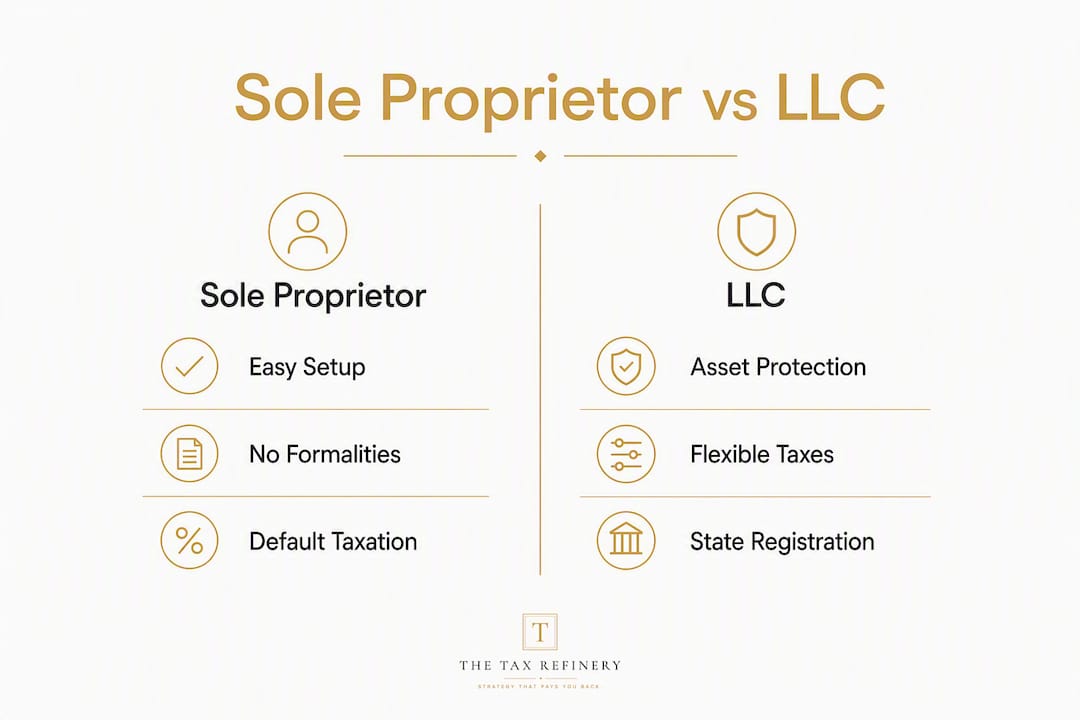
| Dimension | Sole Proprietor | Single-Member LLC |
|---|---|---|
| Legal status / liability | No legal separation; personal assets fully exposed | Separate legal entity; personal assets protected in most cases |
| Federal taxes | Schedule C; self-employment tax on net profit | Disregarded entity by default; same Schedule C treatment unless S-corp elected |
| Payroll options | No payroll required | Payroll required if S-corp election is made |
| Setup steps | Automatic; DBA and local licenses only | Articles of Organization, registered agent, operating agreement, EIN |
| Upfront costs | Near zero | State filing fees vary by state; registered agent fees typically apply annually |
| Ongoing compliance | Minimal; no state reporting in most cases | Annual reports, franchise taxes, and registered-agent fees vary by state |
| Best for | Early-stage, low-risk, low-revenue ventures | Any business with real liability exposure, contracts, or scaling plans |
| Credit / banking credibility | Harder to separate personal and business credit | Cleaner path to business banking, credit lines, and lender credibility |
A few nuances worth noting:
- Both structures use Schedule C by default. The LLC's tax advantage only appears after you file Form 2553 to elect S-corp treatment.
- The S-corp election is available only to LLCs (or corporations), not to sole proprietors.
- State fees vary considerably. Delaware and Wyoming are popular for low fees and flexible statutes; California charges an $800 annual franchise tax minimum regardless of revenue.
State differences matter. Formation fees range from under $50 in some states to several hundred dollars in others. Annual report fees, franchise taxes, and registered-agent requirements add to the ongoing cost. Always check your specific state's Secretary of State website before forming.
Pro Tip: Even if you stay a sole proprietor, open a dedicated business checking account from day one. It keeps your bookkeeping clean and preserves your options if you decide to convert to an LLC later.
What is a sole proprietorship, and is it right for you?
A sole proprietorship is an unincorporated business owned and operated by one person. You become one automatically the moment you start conducting business activities without registering a separate legal entity. No state filing required. No formation fee. No operating agreement.

That simplicity is genuinely useful at the right stage. For a freelancer testing a new service, a craftsperson selling at a weekend market, or a consultant taking on a first client, the sole proprietorship removes every barrier between idea and action.
Pros of operating as a sole proprietor
- Zero formation cost and no state registration in most cases
- No annual reports, franchise taxes, or registered-agent fees
- Simple tax filing: all income and expenses flow through Schedule C on your personal return
- Full control with no governance formalities
- Easy to dissolve or pivot without legal paperwork
Cons you need to understand before you commit
- No path to S-corp election — Tax planning options are limited without first forming an LLC or corporation.
How sole proprietorship taxes work
All net profit flows to your personal return and is subject to self-employment tax at 15.3% on top of your ordinary income tax rate. At certain net profit levels, self-employment tax amounts to a significant portion before income tax applies. The deduction for half of SE tax softens the blow slightly, but the exposure is real.
First-week setup checklist for a sole proprietor
- Decide whether you need a DBA (doing business as) name and file it with your county or state if so.
- Obtain any required local business licenses or permits for your industry.
- Apply for an EIN from the IRS if you plan to hire or want to avoid using your Social Security number on client forms.
- Open a dedicated business checking account.
- Set up a basic bookkeeping system (QuickBooks, Wave, or a simple spreadsheet) to track income and expenses from the start.
Pro Tip: Keeping a separate bank account and clean books from day one costs nothing but saves hours when tax season arrives, and it makes converting to an LLC far smoother if you choose to later.
What is a single-member LLC, and what does it actually protect?
A single-member LLC (SMLLC) is a state-registered legal entity with one owner. Unlike a sole proprietorship, it creates a legal separation between you and your business. That separation is the core reason most growing solo owners make the switch.

When someone sues your business or a creditor comes after unpaid debts, the LLC structure generally shields your personal bank accounts, home, and other assets from that exposure. The U.S. Small Business Administration describes LLCs as a common choice for medium- and higher-risk businesses precisely because of this protection.
What you get with an LLC
- Path to S-corp election — Once formed, an LLC can file Form 2553 to elect S-corp tax treatment, opening the door to meaningful self-employment tax savings.
What an LLC costs you
- Formation fees and recurring state compliance obligations
- Annual reports and, in some states, franchise taxes
- Registered-agent fees if you use a third-party service
- Greater bookkeeping discipline to maintain the legal separation
Default tax treatment and the S-corp option
By default, the IRS treats a single-member LLC as a disregarded entity. That means federal taxes work exactly like a sole proprietorship: Schedule C, self-employment tax on all net profit. The LLC itself files no separate federal return unless you elect otherwise.
To change that treatment, you file Form 2553 to elect S-corp status. That election requires you to pay yourself a reasonable salary (subject to payroll taxes) and take remaining profit as distributions, which are not subject to self-employment tax. The mechanics of that election are covered in detail in the next section.
Typical LLC formation steps
| Step | What's involved | Typical timeline |
|---|---|---|
| Name check | Verify availability with your state's Secretary of State | Same day |
| File Articles of Organization | Submit to state; pay filing fee ($50 depending on state) | 1–5 business days |
| Create operating agreement | Internal document defining ownership and management | 1–3 days |
| Obtain EIN | Apply free at IRS.gov; issued immediately online | Same day |
| Open business bank account | Requires EIN and Articles of Organization | 1–3 days |
| Appoint registered agent | Can be yourself or a third-party service | Same day |
Pro Tip: Draft your operating agreement even as a single-member LLC. Banks often require it to open a business account, and it documents your intent to maintain the legal separation that protects your personal assets.
How do sole proprietorship vs LLC taxes actually differ?
Here is where most solo owners get confused: a single-member LLC and a sole proprietorship are taxed identically by default. Both report income on Schedule C. Both pay self-employment tax on all net profit at 15.3%. The LLC structure alone changes nothing about your federal tax bill.
The difference appears only when an LLC elects S-corp treatment.
How the S-corp election changes the math
Under S-corp treatment, you split your business income into two buckets:
- Reasonable salary: — Subject to payroll taxes (Social Security and Medicare, the same 15.3% split between employer and employee portions).
- Distributions: — Profit above the salary, paid to you as the owner, not subject to self-employment tax.
At high net profit levels, an S-corp owner who pays themselves a reasonable salary pays payroll taxes on that salary portion only, while distributions may avoid SE tax entirely, leading to potential significant SE tax savings, before accounting for payroll service costs.
When the S-corp election makes sense
- Pros: Meaningful SE tax reduction at higher profit levels; opens the door to advanced S-corp tax planning, accountable plans, and retirement contributions.
- Net benefit: — The election generally makes financial sense once net profit is consistently above a threshold where SE tax savings exceed those added administrative costs. Many tax advisors provide a net profit range as a general guideline, though the exact threshold depends on your state, your salary, and your existing accounting setup.
Pro Tip: The IRS scrutinizes S-corp owners who pay themselves an unreasonably low salary to maximize distributions. Document your reasonable salary using industry compensation data, your hours worked, and the services you provide to the business. This is not optional paperwork — it's audit protection.
When does advanced tax planning actually pay off for solo owners?
Proactive tax advisors consistently note that high-earning professionals outgrow simple structures faster than they expect. Once profitability is consistent, the focus shifts from structure selection to tax structuring: S-corp elections, accountable plans, retirement contributions, and sometimes multi-entity arrangements.
Practical thresholds worth knowing
Forming an LLC makes sense as soon as you have meaningful personal assets, client contracts, or any real liability exposure, regardless of revenue. The S-corp election conversation typically starts when net profit is strong enough that SE tax savings exceed the added payroll and accounting costs. The exact crossover depends on your state and your existing professional fees, but it's a calculation worth running annually once your business is profitable.
Multi-entity planning, where an owner uses separate LLCs or a holding structure to isolate liabilities and optimize tax treatment across different income streams, becomes relevant for owners with real estate, multiple business lines, or significant passive income. This is not a DIY project; it requires a tax advisor who understands both the legal and tax dimensions of the structure.
Common mistakes that cost solo owners money
- Assuming the LLC lowers taxes automatically — It does not. A single-member LLC is a disregarded entity by default; the tax treatment is identical to a sole proprietorship until you elect otherwise.
- Underpaying yourself as an S-corp owner — The IRS requires a reasonable salary. Paying yourself $1 to maximize distributions is a red flag that invites an audit and potential penalties.
Thetaxrefinery works with business owners netting $300,000 to $1,000,000+ annually, and the firm's approach centers on proactive tax planning rather than year-end scrambles. For solo owners approaching or past the S-corp threshold, the questions to bring to your first advisor meeting include: What is a defensible reasonable salary for my role? What payroll service will you use? What are my state's annual LLC obligations? And what is the net savings after all-in costs?
Pro Tip: Ask your tax advisor to model the S-corp election with and without payroll service costs before you commit. The savings are real, but so are the added obligations. You want the net number, not the gross.
What does it cost to run a sole proprietorship vs an LLC?
Cost comparisons between these two structures often focus on formation fees and miss the full picture. The table below covers both formation and ongoing costs so you can compare total cost of ownership.
| Cost category | Sole proprietor | Single-member LLC | Notes |
|---|---|---|---|
| State formation fee | — | Varies significantly by state | Varies significantly by state |
| Registered agent | — | $100/year | Required in most states |
| Annual report / franchise tax | — | —–$800+/year | California charges $800 minimum; many states charge $50 |
| Payroll service (if S-corp) | — | — | Required if S-corp election is made |
| Bookkeeping / accounting | — | — | Increases with S-corp complexity |
| Business liability insurance | — | — | Recommended for both structures |
Timeline expectations
- Sole proprietorship: — Operational immediately. DBA filing, if needed, takes one to two weeks in most counties.
- S-corp election: — Form 2553 must generally be filed within 75 days of the start of the tax year for which the election applies. Payroll setup adds two to four weeks depending on your payroll provider.
Pro Tip: Liability insurance is not a substitute for an LLC, but it works alongside it. A general liability policy for a service business often costs less per year than a single hour of litigation. Carry both the LLC structure and the insurance — they protect you in different ways.
When should you switch from sole proprietor to LLC?
The decision to convert is rarely about a single trigger. More often, it's a combination of factors that collectively tip the scale. Use the checklist below as a diagnostic.
Decision checklist: is it time to form an LLC?
Ask yourself these questions:
- Do you have personal assets (home, savings, retirement accounts) worth protecting?
- Are you signing client contracts that could expose you to liability claims?
- Do you sell a physical product that could cause harm?
- Are you hiring employees or independent contractors?
- Is your annual net profit approaching a level where S-corp planning would produce meaningful savings?
- Are you applying for business loans or lines of credit?
- Do clients or partners expect to see a registered business entity?
If you answered yes to two or more of these, the case for forming an LLC is strong.
Red-flag situations that warrant immediate action
Some scenarios should prompt LLC formation regardless of revenue or stage:
- You are hiring your first employee.
- You are selling a product with any physical harm risk (supplements, equipment, food).
- You are entering a high-value contract where a dispute could result in significant damages.
- A client or lender has specifically requested proof of a registered entity.
On reversibility and conversion
Converting from a sole proprietorship to an LLC is straightforward. You file the LLC formation documents through your state's normal process, obtain a new EIN, open new business bank accounts under the LLC, and transfer operations. There is no penalty for waiting, but there is also no retroactive protection. An LLC formed after a lawsuit is filed does not shield you from that claim.
Pro Tip: If you are on the fence, form the LLC now. The formation cost is a one-time expense. The liability exposure of staying a sole proprietor is open-ended.
How to form an LLC or formalize your sole proprietorship
Forming a single-member LLC: step by step
- Obtain an EIN — Apply free at IRS.gov. Issued immediately online.
- File Form 2553 if electing S-corp — Do this within 75 days of the tax year start. Set up payroll before your first paycheck.
Formalizing a sole proprietorship: what to do now
- File a DBA (assumed name) with your county or state if operating under a name other than your legal name.
- Obtain required local business licenses and permits.
- Apply for an EIN if you plan to hire or want to avoid using your SSN on 1099 forms.
- Open a dedicated business checking account.
- Set up bookkeeping software (QuickBooks Self-Employed, Wave, or FreshBooks work well for sole proprietors).
- Review your insurance coverage and add a general liability policy if you work with clients in person or deliver a product.
When to bring in a tax advisor
Before you elect S-corp treatment, consult a tax professional. Bring these items to that first meeting:
- Your last two years of Schedule C net profit figures
- A list of your current business expenses and any anticipated changes
- Your state of formation and any states where you operate
- Questions about payroll service options and reasonable salary documentation
For owners approaching the S-corp threshold, Thetaxrefinery's S-corp vs LLC comparison is a useful starting point before that conversation.
Pro Tip: The IRS EIN application at IRS.gov is free and takes under ten minutes. Never pay a third-party service to obtain one for you.
Key Takeaways
A sole proprietorship is the right starting point for low-risk ventures, but any meaningful asset exposure, client contracts, or consistent profitability makes forming a single-member LLC the stronger choice, with an S-corp election worth evaluating once net profit is strong enough to offset the added payroll costs.
| Point | Details |
|---|---|
| Default tax treatment is identical | Both sole proprietors and single-member LLCs file Schedule C and pay 15.3% self-employment tax by default. |
| LLC protects personal assets | A registered LLC creates legal separation; a sole proprietorship leaves personal assets fully exposed to business claims. |
| S-corp election drives tax savings | The self-employment tax savings can be substantial once you cross the right threshold, but payroll costs offset part of that benefit. |
| Ongoing LLC costs are real | Annual reports, registered-agent fees, and state franchise taxes add $200–$1,000+ per year depending on your state. |
| Thetaxrefinery specializes in this decision | Thetaxrefinery helps high-earning solo owners evaluate S-corp elections, structure entities, and implement year-round tax strategy. |
What a tax advisor actually sees in practice
Most solo owners who come to Thetaxrefinery have already formed an LLC. The structure is right. What's missing is the election, the payroll setup, and the year-round planning that turns a legal entity into a tax asset. The single most common mistake is treating entity formation as the finish line when it is really just the starting point.
As an Enrolled Agent and founder of Thetaxrefinery, Melissa Korber works with business owners who are past the testing phase and ready to build a tax strategy that reflects what they actually earn. The firm's subscription-based model means clients get ongoing guidance, not a once-a-year conversation. For a solo owner netting $300,000 or more, the difference between reactive filing and proactive structuring is not marginal. It is often tens of thousands of dollars per year.
Solo and partnership practices build income. S-corps help you keep more of it.
Thetaxrefinery: tax strategy for solo owners who are ready to plan ahead

Thetaxrefinery is built for business owners who have moved past the "just file my taxes" stage. If you are a solo operator netting strong profits and still paying self-employment tax on every dollar, the gap between your current structure and an optimized one is worth calculating. The firm offers S-corp election analysis, entity formation strategy, payroll compliance setup, accountable plan implementation, and year-round advisory, all structured so you have a tax partner, not just a preparer.
The next step is straightforward: review your tax strategy options and book a strategy session to see what your current structure is costing you.
Authoritative sources and official links
| Source | What you'll find there |
|---|---|
| IRS: Limited Liability Company (LLC) | Official IRS guidance on LLC tax classification, Form 2553, and EIN applications |
| IRS: Sole Proprietorships | IRS definition, Schedule C filing requirements, and self-employment tax basics |
| IRS: Self-Employed Individuals Tax Center | Comprehensive hub for SE tax rates, estimated payments, and deductions |
| U.S. Small Business Administration: Choose a Business Structure | Plain-language overview of all major business structures including LLC and sole proprietorship |
| U.S. Chamber of Commerce: Sole Proprietorship vs LLC | Practical comparison of liability, costs, and compliance for small business owners |
| Investopedia: Sole Proprietorship or LLC | Covers conversion steps, banking implications, and credibility differences |
| Wolters Kluwer: Single-Member LLC vs Sole Proprietorship | Detailed legal and tax comparison from a compliance-focused perspective |
| Price & Accountants: Limited Liability Company | Accessible explainer on LLC structure and how limited liability works in practice |
| Thetaxrefinery: Tax Strategy Comparison | Overview of tax strategy, S-corp planning, and advisory services for high-earning business owners |
This article provides general information about business structures and tax concepts. It is not legal or tax advice. Consult a qualified tax professional or attorney to evaluate your specific situation and confirm current rules with the IRS or your state's filing authority.
Recommended
- S-Corp vs LLC: Which is Right for Your Business? | The Tax Refinery
- Partnership vs. Solo Practice: The Tax Mathematics (with S Corp Option) | The Tax Refinery
- Solo 401(k) for S-Corp Owners: Maximize Your 2026 Contributions
- When to Transition from Employee to Private Practice Owner: Tax Implications of the Switch | The Tax Refinery