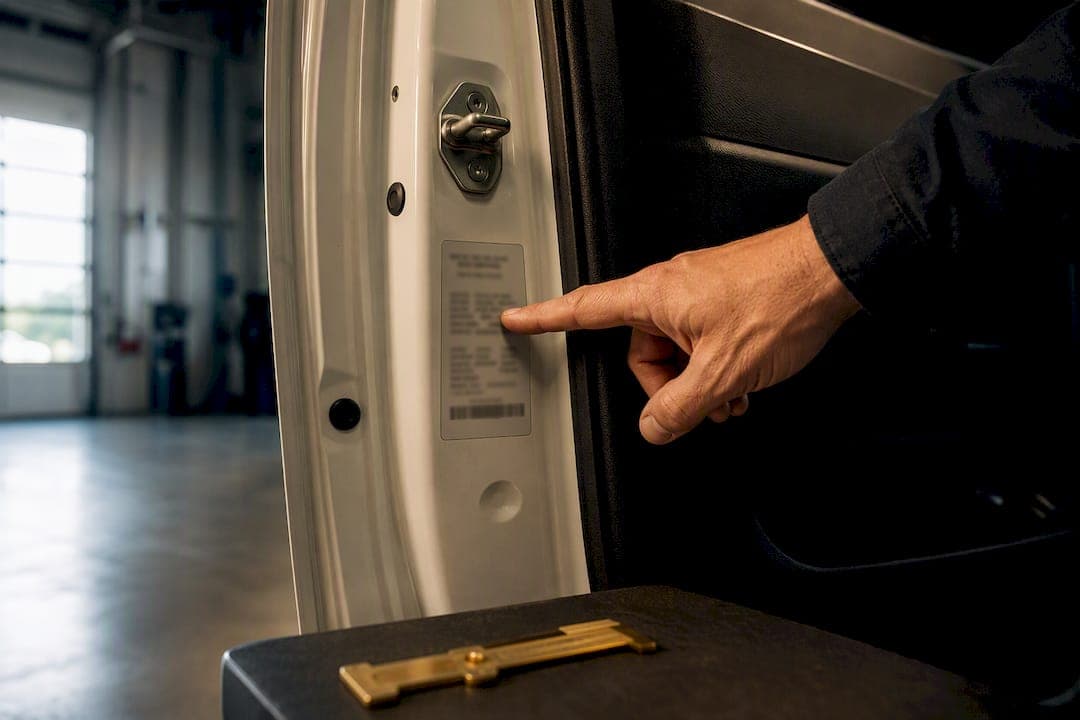
Yes, most vehicles bought and used for business qualify for Section 179 expensing in the purchase year, but the deduction amount depends entirely on the vehicle's manufacturer Gross Vehicle Weight Rating (GVWR) and your documented business-use percentage. Before you sign anything, check the door-jamb sticker for the exact GVWR and decide honestly what share of the miles will be business miles. Vehicles placed in service after January 19, 2025 may also qualify for 100% bonus depreciation, which can cover costs Section 179 caps leave behind.
TL;DR:
- Vehicles exceeding 6,000 pounds GVWR, especially full-size SUVs and heavy-duty trucks, typically qualify for higher first-year deductions, including Section 179 and bonus depreciation.
- Confirming the exact GVWR from the manufacturer’s door-jamb sticker is crucial, as relying on verbal claims or marketing specs can lead to disqualification or recapture risks.
- The deductibility and deduction amount depend on the vehicle's category, business-use percentage, and purchase basis, with heavy SUVs capped around $32,000 under Section 179, regardless of purchase price.
- Bonus depreciation applies automatically for vehicles placed in service after January 19, 2025, and can cover costs beyond Section 179 caps, but it may generate net operating losses if overused.
- Proper business-use documentation, especially detailed mileage logs, is essential to withstand IRS scrutiny and prevent deduction recovery or penalties.
Table of Contents
- Quick Eligibility Checklist Before You Buy or Order a Vehicle
- GVWR, Not Curb Weight, Decides Your Vehicle's Category
- The Heavy SUV Cap and Passenger-Vehicle Limits, in Real Numbers
- Section 179 vs Bonus Depreciation in 2026: Which One First?
- What an Examiner Wants to See: Business-Use Documentation
- Calculating the Deduction: A Worked Example and Form 4562
- State Tax Traps After the Federal Math Is Done
- A Practitioner's Pre-Purchase Checklist
- Ready to Structure Your Vehicle Purchase for Maximum Benefit?
- Editorial Take: Stop Treating Section 179 Vehicles as a Simple Checkbox
- Sources
- FAQ
Quick Eligibility Checklist Before You Buy or Order a Vehicle
Dealerships are not tax advisors, and the finance office will not warn you that the crossover you love has a GVWR just under the line that separates a $32,000 cap from full expensing. Run through this checklist before you sign a purchase order or place a lease.
- Find the manufacturer GVWR. It is printed on a sticker inside the driver's door jamb, not the window sticker or the brochure. Write down the exact number.
- Set a business-use target. You need more than 50% business use to qualify at all, and your deduction is prorated to whatever percentage you actually use and document.
- Confirm the vehicle is "new to you." Section 179 and bonus depreciation both allow used vehicles, as long as you did not own or use the vehicle before acquiring it and the purchase was not from a related party.
- Tally the full eligible basis. That means the purchase price, sales tax, freight, and any installed equipment (a plow, a lift gate, a wrap) that's placed in service with the vehicle.
- Sort the vehicle into a category. Passenger car, SUV, or heavy commercial vehicle. Each category has a different cap, and the difference between a heavy SUV and a light crossover can be tens of thousands of dollars in year-one deductions.
Pro Tip: Ask the dealer for the vehicle's certified GVWR in writing on the invoice or window sticker printout before you finalize the deal. If the GVWR isn't listed, look it up by VIN through the manufacturer's fleet or specifications portal. A verbal "it's over 6,000 pounds" from a salesperson is not something you want to rely on if the IRS ever asks.
GVWR, Not Curb Weight, Decides Your Vehicle's Category
The 6,000-pound threshold that determines whether a vehicle escapes passenger-car depreciation limits is based on GVWR, the maximum loaded weight the manufacturer certifies the vehicle to safely carry, including passengers, cargo, and fuel. It is not the same as curb weight, which is how much the vehicle weighs empty. A truck that weighs 5,400 pounds empty might carry a GVWR of 6,800 pounds once you factor in its rated payload capacity.
You find the real number on a small sticker inside the driver's door jamb, usually labeled "Gross Vehicle Weight Rating" alongside tire and loading information. That label reflects the manufacturer's certification and is the figure IRC §179 and the IRS rely on, not the number a salesperson quotes from memory or a spec sheet pulled off a marketing site.
Where common vehicle types typically land:
- Full-size pickups (half-ton and larger) usually clear 6,000 pounds GVWR, often by a wide margin once you factor in higher trims and 4x4 configurations.
- Full-size and heavy-duty SUVs (large three-row SUVs and full-size body-on-frame models) frequently exceed 6,000 pounds, though trim level and drivetrain can push a model above or below the line.
- Compact and midsize SUVs and crossovers typically fall under 6,000 pounds, which puts them squarely into the more restrictive passenger-vehicle depreciation limits.
- Cargo vans and commercial vans vary widely by configuration, but many work vans exceed 6,000 pounds, especially extended or high-roof versions.
- Vehicles over 14,000 pounds GVWR, along with certain vehicles built for specific commercial uses (some cargo vans, box trucks, and vehicles with no seating behind the driver), escape the SUV cap entirely and fall under different rules with no passenger-style dollar limitation.
Edge cases deserve extra caution. A heavy-duty pickup with a specialty conversion, a work van retrofitted for cargo use, or a recreational vehicle modified for business hauling can shift GVWR from the factory rating. If you're buying a converted or modified vehicle, get a VIN-based GVWR confirmation from the manufacturer or a certified weigh station rather than trusting the aftermarket builder's paperwork. A few hundred pounds in either direction changes which set of rules applies to your deduction.
The Heavy SUV Cap and Passenger-Vehicle Limits, in Real Numbers
Sport utility vehicles with a GVWR between 6,000 and 14,000 pounds face a Section 179 dollar cap that top practitioner guidance places around $32,000 in the current year, a figure adjusted periodically through IRS guidance and Revenue Procedure updates tied to inflation. That's the ceiling regardless of what the SUV actually costs. Buy a $75,000 heavy SUV for business and you can still only take the capped amount under Section 179 in year one, though bonus depreciation can often absorb the remainder.
Statistic Callout: Under IRC §179, Congress wrote a specific limitation targeting sport utility vehicles precisely because lawmakers were concerned about business owners buying luxury SUVs primarily to capture an outsized first-year write-off. The statute treats heavy SUVs differently from heavy pickups and vans specifically to close that gap.
Passenger vehicles under 6,000 pounds GVWR face a separate and far more restrictive limitation under IRC §280F, sometimes called the "luxury auto" depreciation limits, even though the caps apply to ordinary sedans and small crossovers, not just luxury models. These limits cap total depreciation (Section 179, bonus depreciation, and regular MACRS combined) in the first year at a much lower dollar figure than the SUV cap allows, which is why a $45,000 sedan and a $45,000 heavy pickup can produce dramatically different first-year deductions for the same purchase price.
Partial business use complicates both caps further. If you use a heavy SUV more than 50% for business, you prorate the deduction amounts to your actual business-use percentage. An examiner reviewing a Section 179 vehicle claim will recalculate this ratio first, because it's the single most common place round-number estimates fall apart under scrutiny.
Section 179 vs Bonus Depreciation in 2026: Which One First?
Notice 2026-11 confirms that qualifying property acquired and placed in service after January 19, 2025 is eligible for 100% bonus depreciation, restored under the One Big Beautiful Bill Act after years of a scheduled phase down. That single change reshapes vehicle tax planning for 2026, because it gives business owners a second, larger tool that works differently than Section 179.
The two deductions solve different problems, and understanding the distinction matters more than picking a "better" one.
- Section 179 has a dollar cap and an income limitation. You can't deduct more than your business's net taxable income for the year, and the overall Section 179 election has an annual ceiling that phases out once total equipment purchases cross a threshold.
- Bonus depreciation has no business-income cap. You can use it to create or deepen a net operating loss, which Section 179 cannot do.
- Section 179 is elective and selective. You choose which assets and how much of each asset's cost to expense, asset by asset.
- Bonus depreciation applies automatically to qualifying property unless you formally elect out of it for an entire class of property in a given year.
- Related-party acquisitions can disqualify bonus depreciation even when the same purchase would otherwise qualify for Section 179.
For most small business owners with modest, predictable taxable income, the practical order is to apply Section 179 first, up to the SUV or passenger-vehicle cap, and let bonus depreciation cover whatever basis remains. If your business had a rough year and you don't want a vehicle purchase to manufacture a large net operating loss you can't use efficiently, that's a signal to elect out of bonus depreciation for that vehicle class and rely on regular MACRS depreciation instead, spreading the deduction over several years.
State conformity adds another layer. Some states don't follow federal bonus depreciation rules at all, which means a purchase that fully offsets your federal income can still leave you with a state tax bill you didn't plan for.
Pro Tip: Think of Section 179 as a scalpel and bonus depreciation as a much bigger blade. Use Section 179 to hit a precise taxable-income target, then let bonus depreciation absorb the rest only if a larger deduction (or even a loss) genuinely helps your tax position this year. Deducting the maximum possible amount isn't always the smartest move if it wastes deductions you could have used more effectively next year.
What an Examiner Wants to See: Business-Use Documentation
The single most common reason a Section 179 vehicle deduction gets adjusted on audit isn't a GVWR dispute. 510 sets as the threshold for qualifying at all. Fall below that line and you don't just lose part of the deduction. You can trigger recapture of amounts already claimed in prior years, plus interest and potentially penalties.
A contemporaneous mileage log is your primary defense, and "contemporaneous" is the operative word. Reconstructing a year's worth of mileage from memory in April doesn't hold up the way a log built trip by trip does.
- Date of each trip, recorded the day it happens or within a few days, not months later.
- Odometer readings at the start and end of the trip, or total trip miles if you use a tracking app that captures this automatically.
- Business purpose, stated specifically ("site visit, Client X" beats "business").
- Client, job, or location name tied to each business trip.
- Running totals separating business miles from personal and commuting miles for the year.
Beyond the mileage log, keep the purchase invoice and financing or lease agreement, vehicle registration, proof of the placement-in-service date (the date the vehicle was actually available and ready for business use, not just purchased), and any internal usage policy or fleet assignment records if multiple people drive the vehicle.
The mistakes that sink an otherwise legitimate claim are predictable: logs reconstructed after the fact, suspiciously round mileage numbers every single week, and personal errands folded into business trips with no way to separate them. A mileage tracking method built around clear documentation habits from day one avoids nearly all of it.
Pro Tip: If you drive the vehicle for both business and personal use, log every trip, not just the business ones. A log that only shows business miles with unexplained gaps looks incomplete to an examiner, even if it's accurate.
Calculating the Deduction: A Worked Example and Form 4562
The calculation flows in a specific order. Start with eligible basis, which is the purchase price plus tax, freight, and any equipment installed before the vehicle is placed in service. Apply your business-use percentage to that basis first. Then apply Section 179 up to the applicable cap (SUV or passenger-vehicle) and up to your business's taxable income limit. Whatever basis remains after Section 179 becomes eligible for bonus depreciation. Anything left after both is depreciated under standard MACRS schedules over the vehicle's useful life.

Here's how that plays out for two different purchases in the same year.
Heavy SUV example: A business buys a heavy SUV with a GVWR of 6,900 pounds for $68,000, used 80% for business. Eligible business-use basis is $54,400. Section 179 can absorb up to the SUV cap, roughly $32,000 based on current guidance, leaving about $22,400 in remaining basis. Bonus depreciation at 100% covers that remaining amount, bringing the total first-year deduction close to the full $54,400 business-use basis.
Business-use basis is $30,400, but the IRC §280F passenger-vehicle depreciation limits cap total first-year depreciation, combining Section 179, bonus depreciation, and MACRS, at a fraction of that amount. The remaining basis carries forward and depreciates over subsequent years instead of disappearing in year one.
Statistic Callout: The gap between those two outcomes, on vehicles of similar price, illustrates why GVWR classification is the single highest-leverage decision in vehicle tax planning. The SUV crosses 6,000 pounds and gets to use nearly its full business-use basis in year one. The sedan, priced lower, is capped at a much smaller first-year number purely because of its weight classification.
Claiming either deduction requires Form 4562, filed with your business return. Part I covers the Section 179 election and dollar limitations. Part II covers special depreciation allowance, which is where bonus depreciation gets reported. Part V, if applicable, addresses listed property rules that can apply to vehicles depending on ownership structure. Publication 946 walks through basis calculations and depreciation mechanics in more detail, and it's worth reading before you file if this is your first year claiming a heavy vehicle.
Timing matters here too. The deduction is tied to the date the vehicle was "placed in service," meaning ready and available for business use, not necessarily the date you signed the purchase agreement. A vehicle bought in December but not actually usable until January belongs on next year's return, which is a detail that trips up more year-end vehicle purchases than most owners expect.
State Tax Traps After the Federal Math Is Done
A federal deduction doesn't guarantee the same benefit at the state level. Several states don't fully conform to federal bonus depreciation rules or apply their own Section 179 limits, which means you can owe a state addback even after fully expensing a vehicle federally. That addback often defers rather than eliminates the deduction, spreading it over future state returns instead of letting you use it all at once. Check your state's specific conformity rules before you count on a vehicle purchase to offset state taxable income the same way it offsets federal.
Related-party acquisitions create a separate trap. Buying a used vehicle from a spouse, a business partner, or a related entity can disqualify it from bonus depreciation even though an identical purchase from a stranger would qualify without issue.
Vehicle design also matters more than most buyers realize. The IRS applies seating and cargo-area rules that can pull a vehicle out of the SUV category entirely, regardless of its GVWR, if it doesn't meet certain interior configuration standards. A vehicle marketed as an SUV that fails those design tests may actually fall under passenger-vehicle limits instead of the higher SUV cap, which is one more reason to verify classification with documentation rather than assumption.
A Practitioner's Pre-Purchase Checklist
Before any client signs for a vehicle, I walk through six things: the door-jamb GVWR, a realistic business-use percentage (not an aspirational one), every dollar that belongs in eligible basis, whether the home state conforms to federal bonus depreciation, a placement-in-service date that lines up with the intended tax year, and a mileage-log system that's already running before the vehicle leaves the lot.
The scenarios repeat constantly. An S-corp owner buying a heavy SUV needs the SUV cap explained clearly, because the difference between a 6,100-pound and a 5,900-pound GVWR on two similar-looking vehicles can mean a five-figure swing in year-one deductions. A tradesperson buying cargo vans for a crew usually clears both the weight threshold and the business-use test easily, but often misses equipment and upfit costs that belong in basis.
If you're bringing a vehicle purchase to an advisor, bring the invoice, the GVWR documentation, and a real estimate of business-use percentage. Thetaxrefinery works through this exact decision with clients before the purchase happens, when the choices about basis, timing, and election strategy still matter, and helps build the documentation that holds up if the IRS asks questions later.
Ready to Structure Your Vehicle Purchase for Maximum Benefit?
The rules around Section 179 vehicles reward planning and punish improvisation. A GVWR checked before you buy, a business-use percentage you can actually document, and a decision about Section 179 versus bonus depreciation made with your full tax picture in mind, not just the vehicle in isolation, are what separate a clean deduction from an adjusted one. If you're weighing a vehicle purchase against your broader tax strategy this year, Thetaxrefinery's tax strategy services can model both the Section 179 and bonus depreciation scenarios against your actual income before you sign anything, and help you build the documentation that protects the deduction after you do.
Editorial Take: Stop Treating Section 179 Vehicles as a Simple Checkbox
Most advice on Section 179 vehicles treats the 6,000-pound line as the whole story, and that's where the conventional wisdom falls short.
The bigger mistake I see isn't misjudging GVWR. It's business owners who take the maximum deduction available without asking whether that's actually the right move for their income this year. Bonus depreciation with no income cap sounds appealing until it creates a net operating loss you can't use efficiently, while a smaller, deliberate Section 179 election might have hit your taxable income target with room to spare next year.
Prioritize the business-use documentation before the purchase, not after. A perfectly classified heavy SUV with a sloppy mileage log is a liability waiting to surface, and no amount of GVWR precision fixes that gap once an examiner starts asking questions.
— Melissa
This article is general information, not a substitute for advice from a qualified financial advisor. Consult a qualified financial professional about your own circumstances before acting on anything here.
FAQ
Can I write off a 6,000-pound vehicle in 2026?
Yes. Vehicles with a GVWR of 6,000 pounds or more generally escape the restrictive passenger-vehicle depreciation limits under IRC §280F, though SUVs in that weight class still face a separate dollar cap (roughly $32,000 based on current guidance) while heavier pickups and vans without that classification often qualify for full expensing.
What luxury vehicles are over 6,000 pounds GVWR?
Several full-size and heavy-duty SUVs and large luxury crossovers exceed 6,000 pounds GVWR, but the exact rating varies by trim, drivetrain, and model year, so you must check the door-jamb sticker for the specific vehicle rather than relying on the model name or marketing materials.
What vehicles qualify for the Section 179 deduction?
Passenger cars, SUVs, pickup trucks, and cargo vans can all qualify, but the deduction amount depends on GVWR classification: passenger vehicles under 6,000 pounds face tighter caps under IRC §280F, SUVs between 6,000 and 14,000 pounds face a separate SUV cap, and heavier trucks and vans above 6,000 pounds (excluded from the SUV category by design) often qualify for full first-year expensing.
Does leasing a vehicle affect Section 179 eligibility?
Section 179 and bonus depreciation generally apply to vehicles you own, so a standard operating lease typically doesn't qualify for either deduction, while a vehicle financed through a purchase-style lease that transfers ownership can qualify depending on how the lease is structured.