
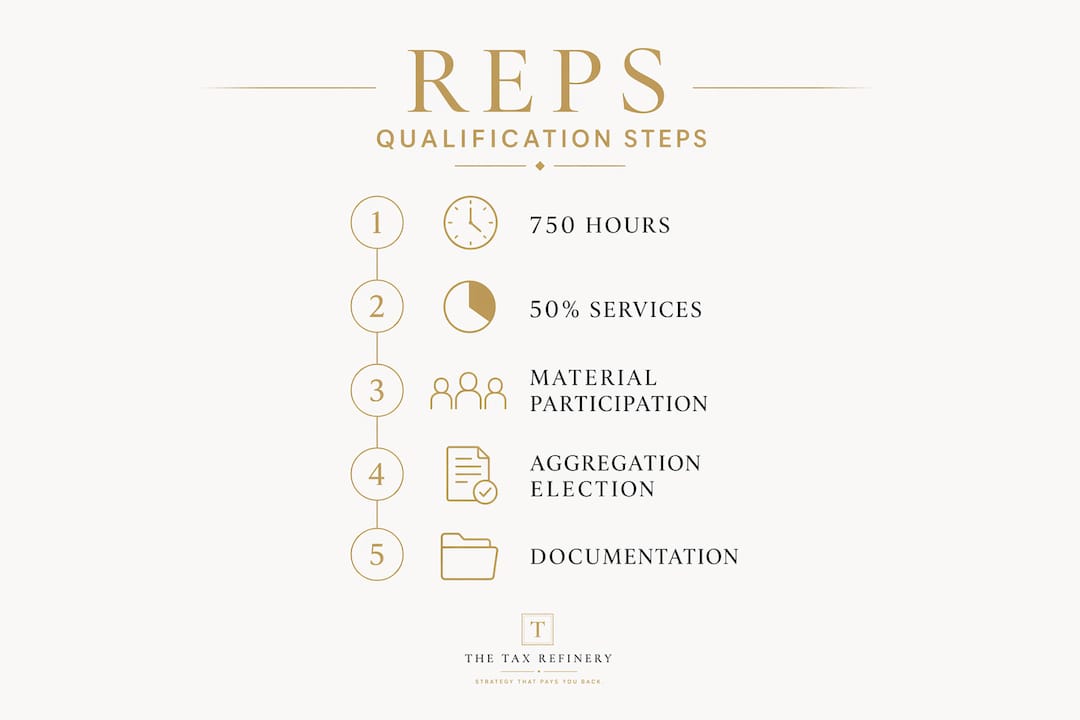
You qualify as a real estate professional for federal tax purposes only when you meet both the IRS 750-hour test and the more-than-50% personal-services test in the same tax year. Meeting one without the other leaves your rental losses passive,, meaning they can only offset other passive income, not your W-2 salary or business earnings.
Here is why that distinction matters: once you satisfy both tests and demonstrate material participation in your rental activities, those losses convert from passive to non-passive. They flow directly to Form 1040 and reduce your ordinary income dollar for dollar. For a high-earning investor in the Treasure Valley, that can translate into a meaningful reduction in federal tax owed in the year the losses are generated.
Key facts at a glance:
- Both tests apply every tax year. Qualifying in 2025 does not carry over to 2026.
- Material participation must still be established for each rental property unless you file an aggregation election.
- Idaho generally conforms to federal passive activity loss rules, but you should verify current conformity with the Idaho State Tax Commission before relying on federal positions for your state return. Idaho-specific filing notes are covered in the Idaho section below.
Table of Contents
- What real estate professional status is and when it applies
- The two IRS tests you must pass every year
- How material participation works and why the aggregation election matters
- What the IRS expects you to document
- How qualifying changes your tax picture
- A practical one-year plan to pursue REPS
- Common pitfalls and audit triggers to avoid
- Idaho-specific considerations for REPS filers
- Key Takeaways
- Why REPS planning is more nuanced than most guides admit
- Thetaxrefinery helps Idaho investors qualify and defend REPS
- Useful sources and official references
What real estate professional status is and when it applies
Real estate professional status (REPS) is a federal tax classification defined under IRC §469(c)(7). It is not a license, a designation, or a credential issued by any industry body. The IRS created it to carve out an exception to the general rule that rental activities are passive by default.
Under the default passive activity rules, rental losses can only offset passive income. REPS removes that restriction for taxpayers who spend the majority of their working time in real property trades or businesses. IRS Publication 925 is the primary reference document for these rules and covers qualifying activities, the grouping election, and how Schedule E interacts with Form 8582.
What the IRS counts as a real property trade or business includes development, redevelopment, construction, reconstruction, acquisition, conversion, rental, operation, management, leasing, and brokerage. If your day-to-day work involves any of these activities with respect to real property, those hours are potentially countable toward the statutory thresholds.
What does not count: holding a REALTOR® designation, a CCIM, a CPM, or any other industry credential; those reflect education and professional standing, not tax qualification. A licensed broker who spends most of her time on W-2 employment in an unrelated field still fails the REPS tests regardless of her designations. The IRS measures hours and participation, not credentials.
The two IRS tests you must pass every year
To claim real estate professional status, you must satisfy two conjunctive requirements in the same tax year:
- A minimum threshold of personal services hours in real property trades or businesses in which you materially participate.
- More than half of your total personal services across all trades and businesses must be in those same real property activities.
Both tests must be met. Passing only the 750-hour threshold while spending more time in a separate career leaves you outside REPS.
Worked example: the W-2 conflict

Consider a physician in Boise who earns $500,000 from her medical practice and owns four rental properties. She logs 800 hours managing those properties during the year. She passes the 750-hour test. But her medical practice consumes 2,200 hours annually. Her real estate hours represent roughly 27% of her total personal services, well below the 50% threshold. She does not qualify.
Now consider her spouse, who left a part-time job mid-year and now works exclusively on the couple's real estate portfolio. He logs 820 hours in property management, leasing, and maintenance coordination. His only other personal services total 300 hours. Real estate represents 73% of his personal services. He passes both tests. On a joint return, one qualifying spouse is sufficient, but hours cannot be pooled between spouses. He must independently satisfy both tests.
Activities that count toward the 750 hours
The IRS recognizes hours spent on:
- Development and redevelopment of real property
- Construction and reconstruction
- Acquisition of real property interests
- Conversion of property to different use
- Rental operations and day-to-day management
- Leasing activities (showing units, negotiating leases, renewals)
- Brokerage services
- Maintenance coordination and vendor oversight
- Financial management specific to the properties (reviewing statements, planning capital expenditures)
Time spent commuting to properties, attending general investment seminars, or managing a stock portfolio does not count.
Pro Tip: The 50%-of-personal-services test is often the harder hurdle for W-2 employees. As CPA Amanda Han has noted, real estate hours must exceed every other hour of personal services combined. If you hold a full-time job, that bar is nearly impossible to clear without a spouse strategy or a genuine career transition.
How material participation works and why the aggregation election matters
Passing the two REPS tests is necessary but not sufficient. You must also establish material participation in each rental activity. Under Treas. Reg. §1.469-5T, the IRS provides seven tests for material participation, and meeting any one of them for a given activity satisfies the requirement for that activity.
The seven material participation tests:
- Participation exceeding a substantial number of hours during the year.
- Participation constituting substantially all of the activity by all individuals.
- Participation in excess of others involved.
- Aggregate significant participation exceeding certain hours across activities.
- Material participation in multiple prior tax years.
- Material participation in prior years recognized as a personal service activity.
- Regular, continuous, and substantial participation based on facts and circumstances.
The default rule and why it creates a problem for portfolios
By default, each rental interest is treated as a separate activity. If you own six rental properties and a third-party manager handles most of the work on four of them, you may materially participate in only two. The other four remain passive even if you qualify as a real estate professional overall. Losses from those four properties stay trapped.
The aggregation election
The solution is the grouping election, which combines all your rental interests into a single activity. Material participation is then measured across the combined portfolio. If you spend 600 hours total across all six properties, you clear the 500-hour test for the aggregated activity.
The election must be attached to your original return for the year you first make it. Revenue Procedure 2011-34 provides guidance on late-election relief, but that relief is narrow and not guaranteed. Once made, the election is binding in subsequent years unless you obtain IRS consent to revoke it. Filing it correctly the first time is far less costly than seeking relief later.
What the IRS expects you to document
The IRS does not issue a REPS certificate. You claim the status on your return and defend it with records if audited. Tax Court cases consistently show that taxpayers lose REPS disputes when they cannot produce contemporaneous logs. Post-hoc reconstructions, even when plausible, carry little weight.
Contemporaneous records to maintain:
- Daily or weekly time logs with specific dates, activities performed, time spent, and the property involved
- Calendars (digital or paper) showing appointments, site visits, and contractor meetings
- Emails and text messages with tenants, vendors, and contractors
- Work orders, maintenance invoices, and vendor agreements
- Lease agreements, renewal negotiations, and tenant correspondence
- Property management reports if you use a manager (to document your oversight hours)
- Bank and credit card statements showing property-related expenditures
Suggested time-log fields: Date | Property address | Activity description | Start time | End time | Total hours | Supporting document reference
Pro Tip: Use a dedicated time-tracking app or a shared Google Sheet updated at least weekly. A log that shows entries made in real time, with consistent formatting and cross-references to emails or invoices, is far more credible than a spreadsheet reconstructed in March. Several real estate tools also include built-in time-logging features worth evaluating.
Third-party corroboration strengthens your position considerably. Vendor invoices dated on the days you logged hours, tenant emails timestamped to match your calendar entries, and contractor agreements that show your direct involvement all support the claim that your hours were real and contemporaneous.
How qualifying changes your tax picture
The core benefit of REPS is straightforward: rental real estate losses from activities in which you materially participate are treated as non-passive and deductible against ordinary income on Form 1040. Without REPS, those same losses sit on Form 8582 as suspended passive losses, waiting for passive income or a disposition event to release them.
The practical impact is largest when accelerated depreciation is in play. Under current bonus depreciation rules, a qualifying investor can take a substantial paper loss in the year a property is placed in service. If that loss is non-passive, it offsets W-2 income, business income, or other active earnings directly.
Worked example: before and after REPS
| Scenario | Gross Income | Rental Paper Loss | Taxable Income | Estimated Federal Tax |
|---|---|---|---|---|
| With REPS (loss treated as non-passive) | — | ($200,000) | — | — |
The $200,000 paper loss in this example reflects accelerated depreciation on a newly acquired property, consistent with high-earner scenarios where bonus depreciation creates large first-year deductions. The estimated tax figures above are illustrative and use a simplified flat-rate calculation; actual liability depends on filing status, deductions, and other income items.
Form 8582 and suspended losses
Form 8582 tracks passive activity losses that cannot be deducted in the current year. When you qualify as a real estate professional and materially participate, the losses from those activities bypass Form 8582 entirely. Previously suspended losses from years when you did not qualify remain suspended until you generate passive income from those activities or dispose of the property in a fully taxable transaction.
REPS does not affect self-employment tax. Rental income is generally not subject to self-employment tax regardless of REPS status, though net investment income tax (NIIT) treatment may shift depending on material participation. Consult a qualified tax professional for your specific situation.
For a broader view of how REPS fits into a high-earner tax strategy, the interaction with depreciation recapture, installment sales, and entity structure all deserve attention.
A practical one-year plan to pursue REPS
Qualifying is not something you plan in April. The hours must accumulate throughout the calendar year, and the decisions you make in January affect what you can claim in December.
Before January 1: Set up a time-tracking system. Decide whether to aggregate rental activities and confirm with your CPA or Enrolled Agent whether the aggregation election should be filed on your upcoming return. Review your prior-year hours to understand your baseline. If you use a property manager, identify which oversight and management tasks you will personally handle to build your hour count.
Q1 (January through March): Begin logging immediately. Track every qualifying hour: tenant calls, site visits, lease reviews, vendor coordination, financial reviews. Confirm your time-tracking system is generating dated, exportable records. If you are married and using a spouse strategy, confirm the qualifying spouse is the one logging hours and that no pooling of hours is occurring.

Q2 and Q3 (April through September): Run a mid-year hour check. If you are on pace for 750 hours and the 50% threshold looks achievable, continue. If you are falling short, assess whether delegation decisions need to change. Avoid delegating tasks to a third-party manager that you could handle yourself if those hours are critical to qualification.
Q4 and year-end (October through December): Finalize your hour count and compile supporting documentation. Work with your CPA or EA to confirm the aggregation election language and attach it to the return. Review your year-end tax planning checklist to coordinate REPS with depreciation elections, entity distributions, and any disposition planning.
Engage a CPA or Enrolled Agent early, particularly if you are dealing with complex entity structures, multiple LLCs, or prior-year audited positions. The aggregation election, once filed, is binding, and the cost of getting it wrong exceeds the cost of professional guidance upfront.
Common pitfalls and audit triggers to avoid
REPS is one of the more frequently audited positions on a high-income return. The IRS knows the pattern, and examiners look for specific weaknesses.
Red flags that invite scrutiny:
- Claiming REPS while holding a full-time W-2 job with no plausible path to the 50% test
- Failing to file the aggregation election and then claiming material participation across a portfolio
- Relying on a third-party property manager for most day-to-day work while logging hours for "oversight"
- Inconsistent year-to-year claims (qualifying some years, not others, with no change in circumstances)
- Hour logs that appear reconstructed, lack specificity, or show suspiciously round numbers
Misconceptions worth correcting:
- A real estate license does not establish REPS. Licensure is a state-law credential; REPS is a federal tax test.
- Prior-year suspended passive losses do not automatically release when you first qualify. They remain suspended until passive income or a disposition event triggers release.
- Spousal hours cannot be combined. Each qualifying spouse must independently meet both tests.
Audit-prep checklist for your CPA:
- Organized time logs with cross-references to supporting documents
- Calendar exports for the full tax year
- Vendor invoices and contractor agreements dated within the year
- Lease agreements and tenant correspondence
- Aggregation election statement attached to the original return
- Prior-year returns showing consistent treatment
Idaho-specific considerations for REPS filers
Idaho generally conforms to the federal Internal Revenue Code for purposes of passive activity loss treatment, which means the federal REPS framework carries over to your Idaho state return in most respects. However, Idaho conformity is not automatic or permanent. The Idaho legislature periodically updates its conformity date, and any year in which Idaho has not adopted a federal change creates a potential divergence between your federal and state tax positions.
What Idaho filers should do:
- Verify the current conformity date and any passive-loss-specific deviations directly with the Idaho State Tax Commission before filing.
- Confirm whether Idaho requires any separate state-level election or disclosure when claiming REPS-based deductions.
- Maintain the same contemporaneous documentation for Idaho audit purposes as you would for a federal examination. Idaho auditors can and do examine passive activity positions independently.
- If your REPS position produces a large state-level deduction, consider whether Idaho's audit selection criteria make a proactive disclosure or protective filing advisable.
Idaho does not have a separate state-level REPS statute. The state's treatment flows from federal conformity, so the federal qualification rules described throughout this article govern the Idaho position as well, subject to any conformity gaps in effect for the tax year in question.
Advisory: Conformity status can change between the time you file and the time an audit occurs. Involve an Idaho-licensed CPA or Enrolled Agent when the state implications are material to your overall tax position. The Idaho State Tax Commission's website at tax.idaho.gov is the authoritative source for current conformity guidance.
Key Takeaways
Qualifying as a real estate professional requires meeting both the 750-hour test and the more-than-50% personal-services test every year, with material participation established for each rental activity or through a timely aggregation election.
| Point | Details |
|---|---|
| Both IRS tests are annual | You must satisfy the 750-hour and 50%-of-services tests every tax year; prior-year qualification does not carry forward. |
| Aggregation election is critical | File the grouping election on your original return to measure material participation across your entire portfolio, not property by property. |
| Contemporaneous logs are your defense | Time logs, calendars, and third-party corroboration are what sustain REPS in a Tax Court examination; post-hoc estimates rarely hold up. |
| Idaho conformity requires annual verification | Check the Idaho State Tax Commission each year for the current conformity date before relying on federal REPS positions on your state return. |
| Thetaxrefinery provides year-round REPS support | From initial qualification assessment through aggregation election filing and audit defense, Thetaxrefinery offers structured advisory for Idaho real estate investors. |
Why REPS planning is more nuanced than most guides admit
The conventional framing of real estate professional status treats it as a binary: you either qualify or you don't, and if you do, the losses flow through. That framing misses the most consequential layer of the analysis.
The aggregation election is where most REPS strategies succeed or fail in practice. A taxpayer who qualifies on the hour tests but never files the election is left proving material participation property by property, which is often impossible when a manager handles day-to-day operations. The election is not a technicality. It is the mechanism that makes the strategy work for anyone with more than one or two properties.
There is also a timing problem that rarely gets discussed. The 50%-of-personal-services test is evaluated at year-end, but the decisions that determine whether you pass it are made throughout the year. A physician who reduces her clinical hours in July to pursue real estate may pass the test for that year, but if she returns to full-time practice in January, she fails the following year. REPS is not a status you acquire once. It requires active management of your time allocation every year you want to claim it.
For Idaho investors specifically, the conformity question adds a layer that out-of-state guides simply ignore. A federal REPS position that produces a $200,000 deduction is worth confirming at the state level before you build your cash-flow projections around it. The Idaho State Tax Commission is the right starting point, and an Idaho-licensed advisor is the right person to interpret what you find there.
The investors who get the most out of REPS are not the ones who qualify by the narrowest margin. They are the ones who plan the qualification deliberately, document it rigorously, and file the elections correctly the first time.
Thetaxrefinery helps Idaho investors qualify and defend REPS
Real estate professional status is one of the highest-value tax positions available to Idaho investors, and it is also one of the most audit-sensitive. Thetaxrefinery, founded by Enrolled Agent Melissa Korber in the Treasure Valley, works with real estate investors year-round to assess qualification, set up time-tracking protocols, file aggregation elections correctly, and prepare audit-ready documentation packages.

The firm's REPS engagements include an initial qualification assessment to determine whether the two IRS tests are achievable given your current income mix, a documentation framework built around your specific property portfolio, mid-year hour-count checkpoints, and aggregation election drafting attached to your original return. For investors who have already claimed REPS and face an IRS inquiry, Thetaxrefinery provides audit defense and IRS representation.
This is not a once-a-year conversation. Qualifying for REPS requires decisions made in January, not April. If you want to evaluate whether REPS is the right position for your 2026 return, start with a tax strategy consultation or use the tax calculator to get an initial read on your situation.
This article is general educational information, not personalized tax advice. Confirm current rules with the IRS, the Idaho State Tax Commission, or a qualified tax professional for your specific circumstances.
Useful sources and official references
The following sources are primary authority or practitioner guidance for REPS research and filing:
- IRS Publication 925, Passive Activity and At-Risk Rules — Primary IRS authority on passive activity rules, REPS qualification, and the grouping election. Start here for any REPS research and bring it to audit discussions.
- Form 8582 and its instructions — The form that tracks passive activity losses and suspensions. Available at irs.gov; the instructions explain how REPS affects the form's calculations.
- Treas. Reg. §1.469-5T — The Treasury regulation that defines the seven material participation tests. This is the governing rule for proving participation at the activity level.
- Revenue Procedure 2011-34 — IRS guidance on late aggregation election relief. Narrow in scope; read it before assuming late relief is available for a missed election.
- Idaho State Tax Commission (tax.idaho.gov) — The authoritative source for Idaho conformity dates and any state-specific passive loss guidance. Check this annually, not just at filing time.
- IRC §469(c)(7) — The statutory provision that creates the REPS exception. Useful to cite in correspondence with the IRS or in a Tax Court proceeding.
For planning conversations, bring Publication 925 and your time logs. For audit defense, add the aggregation election statement, Form 8582 from the relevant year, and any prior IRS correspondence. An Idaho-licensed CPA or Enrolled Agent can help you interpret how these sources apply to your specific facts.