
What are the official 2026 mileage reimbursement rates for Idaho employers?
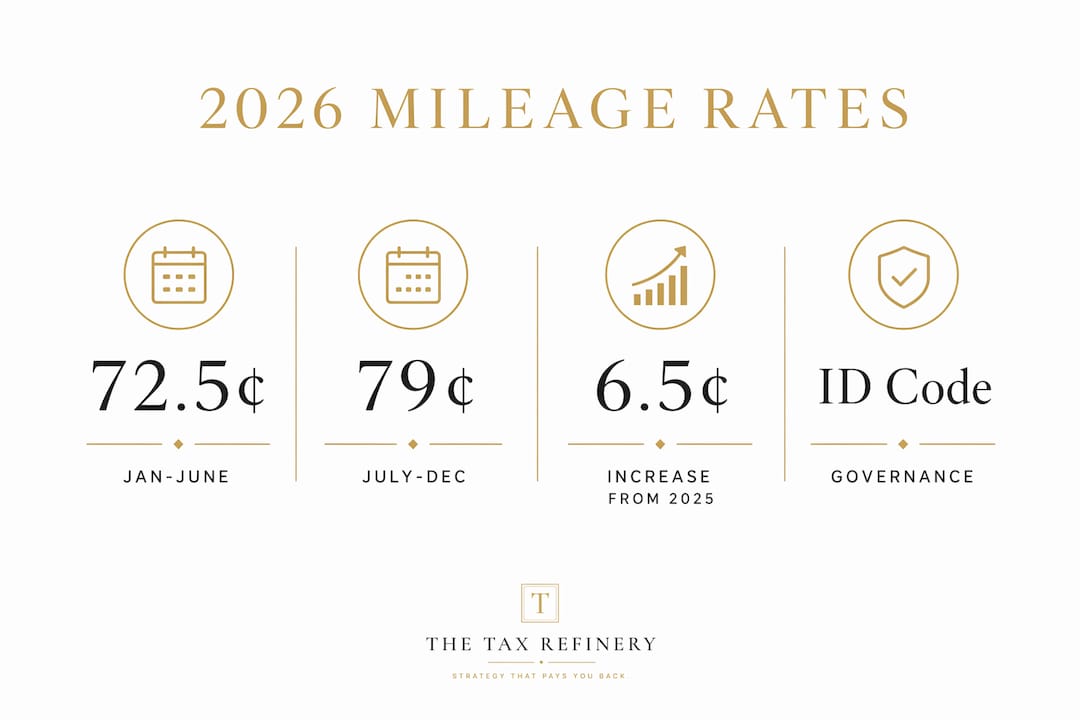
The IRS standard mileage rate 2026 for business use changed mid-year, reflecting updated fuel costs, as described in Announcement 2026-11. That mid-year adjustment reflects rising fuel costs and modifies the original Notice 2026-10. For Idaho employers, these are the rates to build your reimbursement policy around.
Idaho state employees fall under Idaho Code Section 67-2004, which directs the Idaho Board of Examiners to set reimbursement rates for state travel. Private employers are not bound by that statute, but the IRS rates serve as the practical standard for tax-free treatment under any accountable plan.
| Purpose | Jan 1 – June 30, 2026 | July 1 – Dec 31, 2026 | 2025 Rate |
|---|---|---|---|
| Business use | 72.5¢ per mile | 76¢ per mile | — |
| Medical / moving (qualifying) | IRS standard mileage rate for first half of 2026 | IRS adjusted mileage rate for second half of 2026 | Prior year rate |
| Charitable use | 14¢ per mile | 14¢ per mile | 14¢ per mile |
| Statute reference | Notice 2026-10 | Announcement 2026-11 | Notice 2025-5 |

The business rate has climbed 6.5 cents since 2025, a meaningful shift for any Idaho employer with field crews, service technicians, or sales staff logging regular miles. Charitable mileage stays fixed by statute at 14 cents and does not adjust with fuel prices.
What Idaho laws govern employer mileage reimbursement obligations?
Idaho does not mandate that private employers reimburse employee mileage. The obligation to reimburse arises from contract, policy, or the need to preserve tax-free treatment under IRS accountable plan rules. That said, several Idaho statutes create real compliance exposure if you get reimbursement wrong.
- Idaho Code Section 67-2004 governs mileage reimbursement for state employees and sets the framework the Idaho Board of Examiners uses to adopt official rates. Private employers are not directly subject to it, but state-contracted work may trigger its requirements.
- Idaho Code Sections 72-432 and 72-433 (Workers' Compensation) require employers to cover reasonable travel expenses when employees travel for medical treatment related to a work injury. Mileage to and from authorized medical providers must be reimbursed at the applicable rate.
- Title 44-1502 (Idaho Minimum Wage Law) creates indirect exposure: if unreimbursed vehicle expenses push an employee's effective hourly rate below minimum wage, the employer faces a wage violation. This is a real risk for hourly workers in delivery, landscaping, or field service roles.
- Reimbursements paid above the IRS standard rate without proper documentation are treated as taxable wages, must appear on the employee's W-2, and trigger payroll tax obligations for the employer.
- Employers who pay a flat car allowance instead of a per-mile rate face the same taxable income risk unless the allowance is structured as a qualified FAVR (Fixed and Variable Rate) plan meeting IRS requirements.
- Updating employees in writing when rates change, especially after the July 1, 2026 mid-year adjustment, protects against disputes and demonstrates good-faith compliance.
How do you calculate mileage reimbursement using IRS methods?
Two IRS-recognized methods exist for calculating the business mileage deduction: the standard mileage rate method and the actual expense method. Each has distinct rules, and choosing the wrong one for a given vehicle can cost you deductions or create compliance problems.
Standard mileage rate method
- Multiply total business miles by the applicable IRS rate (72.5¢ for miles driven January 1 through June 30; 76¢ for miles driven July 1 through December 31, 2026).
- Simpler to administer because it requires no receipt tracking for fuel, oil, repairs, or insurance.
- The standard mileage rate already incorporates all vehicle operating costs, including gas, insurance, repairs, and depreciation. Reimbursing gas separately on top of the per-mile rate creates a double reimbursement that the IRS treats as taxable income.
- If you elect the standard mileage method for a vehicle in its first year of business use, that election is binding for the life of that vehicle in your business. Switching to actual expenses in a later year is allowed only under specific IRS conditions.
Actual expense method
- Deduct the actual costs of gas, repairs, insurance, registration, and depreciation, prorated by the percentage of business use.
- Yields a larger deduction for high-mileage vehicles with significant operating costs, but requires meticulous receipt tracking throughout the year.
- Employers who use this method for company-owned vehicles must track every expense category separately and calculate the business-use percentage accurately.
Pro Tip: Write your reimbursement policy to say "employees will be reimbursed at the current IRS standard mileage rate" rather than naming a fixed dollar amount. That single phrase automatically absorbs mid-year IRS adjustments, like the July 1, 2026 increase to 76 cents, without requiring a policy amendment or board approval.
A common mistake Idaho employers make is setting a generous flat rate, say 80 cents per mile, without tying it to IRS documentation requirements. Any amount above the IRS standard rate that is not substantiated under an accountable plan becomes taxable compensation, adding payroll tax costs on both sides.

What does the IRS require in a mileage log?
Proper mileage logs are the single most important protection an employer has in an IRS audit of travel reimbursements. Without them, even a correctly calculated reimbursement loses its tax-free status.
- Date of each trip: the log must record when the trip occurred, not just a weekly or monthly summary.
- Destination: city or location driven to, not just "client visit."
- Business purpose: a brief description of the business reason for the trip (e.g., "delivery to commercial cleaning client, Nampa").
- Miles driven: odometer start and end readings, or total miles for the specific trip.
- Time of travel: while not always required, time-stamped entries significantly strengthen audit defensibility, especially for digital logs.
Digital mileage tracking apps that auto-generate time-stamped logs are preferable to paper logs because they are harder to reconstruct after the fact and easier to export for review. Paper logs are accepted by the IRS if they are contemporaneous, meaning recorded at or near the time of travel, not reconstructed at year-end.
A practical year-round habit: photograph your odometer on january 1 and december 31. That creates a clear record of total annual mileage against which business miles can be verified. Employers should also establish a submission deadline, such as the 5th of each month, so mileage reports are reviewed while the trips are still fresh.
Insufficient documentation does not just risk an audit finding. It converts a tax-free reimbursement into taxable wages retroactively, creating amended W-2 obligations and potential penalties.
Expert guidance from Thetaxrefinery: building a compliant mileage policy in Idaho
Melissa Korber, Enrolled Agent and founder of Thetaxrefinery in the Treasure Valley, works with Idaho business owners across trades, real estate, and recurring-service industries to structure mileage reimbursement programs that hold up under IRS scrutiny and actually reduce tax liability.
The foundation of any compliant program is the IRS accountable plan. To qualify, a reimbursement arrangement must meet three conditions: the expense must have a business connection, the employee must adequately account for it with documentation, and any excess reimbursement must be returned to the employer. When all three conditions are met, reimbursements are excluded from the employee's gross income and are not subject to payroll taxes.
Common pitfalls Thetaxrefinery sees with Idaho employers:
- Paying above the IRS rate without documentation. Excess reimbursements above the IRS standard rate that are not returned become taxable wages, reported on the employee's W-2 and subject to FICA taxes for both parties.
- Combining gas reimbursements with per-mile payments. Because the standard mileage rate already covers fuel, adding a separate gas payment creates a taxable double reimbursement.
- Using a fixed rate that never updates. A policy locked at a specific cent-per-mile figure can fall out of compliance when the IRS adjusts rates mid-year, as it did effective July 1, 2026.
- Skipping employee communication. When the IRS raises rates, employees should receive written notice of the updated rate and the effective date. This prevents underpayment disputes and documents the employer's good-faith compliance.
- Treating all vehicle use as business use. Commuting miles from home to a regular office are not reimbursable business miles under IRS rules. Mixing commuting and business miles in a log is one of the most common audit triggers.
For Idaho employers who want to review whether their current policy creates any taxable income exposure, Thetaxrefinery's tax strategy comparison outlines how accountable plan structuring fits into a broader tax reduction approach. You can also explore tax deductions high earners miss for context on how vehicle expense elections interact with other business deductions.

Idaho business owners who want a policy review or help structuring an accountable plan can book a consultation with Thetaxrefinery directly.
How does mileage reimbursement interact with other employee reimbursements in Idaho?
Mileage reimbursement rarely exists in isolation. Idaho employers who reimburse employees for travel often also cover lodging, meals, tools, uniforms, or phone expenses. How these interact under an accountable plan determines whether the full package stays tax-free.
All reimbursements under a single accountable plan must meet the same three-part IRS test: business connection, adequate accounting, and return of excess. If mileage reimbursements qualify but meal reimbursements lack receipts, only the documented expenses retain tax-free status. The undocumented portion becomes taxable income regardless of what the mileage portion looks like.
For Idaho employers with workers' compensation claims, mileage reimbursement under Idaho Code Sections 72-432 and 72-433 operates separately from the standard business travel policy. Workers' comp mileage covers travel to authorized medical providers and is governed by the workers' comp insurer's rate schedule, not the employer's general travel policy. Employers should maintain separate logs for workers' comp travel to avoid mixing the two.
Per diem allowances for meals and lodging, when used alongside mileage reimbursement, must follow IRS Publication 463 guidelines. Paying both a per diem and actual meal receipts for the same trip creates an excess reimbursement that must be returned or reported as income. Idaho employers with field crews who travel overnight should establish a clear written policy distinguishing mileage, per diem, and any other allowances to prevent unintentional taxable income.
Key Takeaways
The 2026 IRS standard mileage rate is 72.5 cents per mile for business use from January 1 to June 30, and increases to 76 cents per mile from July 1 to December 31, as set in Announcement 2026-11.
| Point | Details |
|---|---|
| 2026 business mileage rates | 72.5¢ per mile (jan 1–june 30) and 76¢ per mile (july 1–dec 31) as set in Announcement 2026-11. |
| Idaho private employer obligation | No state mandate to reimburse mileage; IRS accountable plan rules govern tax-free treatment. |
| Mileage log requirements | Logs must record date, destination, business purpose, and miles driven for each trip. |
| Over-reimbursement risk | Any amount above the IRS rate without proper documentation becomes taxable wages on the employee's W-2. |
| Policy language best practice | Write policies to reference "the current IRS standard mileage rate" to absorb mid-year adjustments automatically. |