
A 1031 exchange lets you defer federal capital gains tax when you sell U.S. investment real estate and reinvest the proceeds into like-kind property under IRC §1031. For Idaho investors sitting on appreciated rental properties, commercial buildings, or vacant land, that deferral can preserve substantial equity that would otherwise go to the IRS in the year of sale.
Three rules determine whether your exchange succeeds or fails before you ever close on a replacement property:
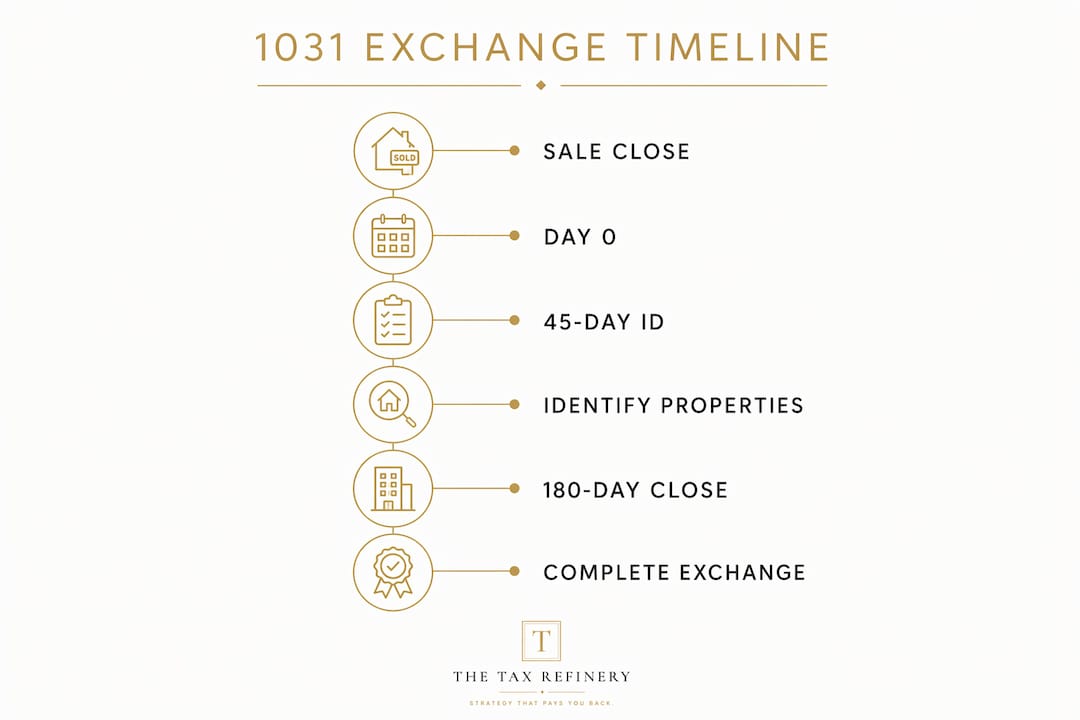
- 45-calendar-day identification rule. From the day you close on the sale of your relinquished property, you have exactly 45 calendar days to identify replacement properties in writing. Weekends and holidays count.
- 180-calendar-day closing rule. You must close on the replacement property within 180 calendar days of the relinquished property sale. This deadline cannot be extended except in presidentially declared disasters.
- Qualified Intermediary (QI) requirement. An independent QI must hold your sale proceeds between transactions. If you receive or control those funds at any point, the exchange is disqualified immediately.
One more point before anything else: a 1031 exchange defers tax, it does not erase it. The deferred gain follows the new property's basis until you eventually sell without exchanging. Engage a QI and a CPA or Enrolled Agent before you list the property, not after.
Table of Contents
- What a 1031 exchange actually does for your tax position
- Who can use a 1031 and which exchange structures fit your situation
- Which properties qualify and which ones do not
- The deadlines and identification rules you cannot afford to miss
- The QI's role and your step-by-step exchange checklist
- Tax consequences: boot, depreciation recapture, and basis rollover
- Idaho-specific considerations for your exchange
- Benefits, downsides, and the mistakes that disqualify an exchange
- How to choose the right QI and tax advisor
- Key Takeaways
- The case for treating a 1031 exchange as a strategic tool, not a transaction
- Thetaxrefinery helps Idaho investors plan and execute 1031 exchanges
- Authoritative resources for further reading
What a 1031 exchange actually does for your tax position
The core purpose is tax deferral through basis rollover. When you sell appreciated investment real estate and complete a valid exchange, you do not recognize the capital gain in that tax year. Instead, your adjusted basis in the relinquished property carries forward into the replacement property, and the deferred gain stays embedded in that new asset.

Since January 1, 2018, exchanges are limited to real property. The Tax Cuts and Jobs Act eliminated 1031 treatment for personal property, machinery, equipment, artwork, and intangibles. Only U.S. real estate held for investment or business use qualifies today.
Common investor scenarios where this matters:
- Trading a single-family rental in Meridian for a small commercial building in Boise
- Consolidating three small rental properties into one larger multifamily asset
- Swapping vacant land for an apartment complex
The most powerful long-term application is sometimes called "swap-til-you-drop." Investors continue exchanging into larger properties over decades, compounding equity without triggering tax. When the property passes to heirs, those heirs may receive a stepped-up basis, effectively eliminating the deferred tax burden for beneficiaries. That estate planning angle makes 1031s relevant well beyond a single transaction.
Pro Tip: Deferral preserves compounding equity, but it never permanently eliminates the tax unless a step-up in basis occurs at death. Model both scenarios with your CPA before deciding whether to exchange or cash out.
Who can use a 1031 and which exchange structures fit your situation
Eligible taxpayers
Individuals, C corporations, S corporations, partnerships (general and limited), LLCs, and trusts may all use a 1031 exchange for investment or business real estate. One critical constraint: the same taxpayer who sells the relinquished property must acquire the replacement property. If a property is held in your personal name, the replacement must also be acquired in your personal name. Mismatched entity names are one of the most common disqualifying errors.
Exchange structures compared
| Structure | How it works | Best for |
|---|---|---|
| Simultaneous swap | Both properties close on the same day | Rare; requires a willing counterparty |
| Deferred exchange | QI holds proceeds; replacement closes within 180 days | Most common structure for Idaho investors |
| Reverse exchange | Replacement property acquired first via an Exchange Accommodation Titleholder; relinquished property sold within 180 days | Competitive markets where you must buy before selling |
| Improvement/construction exchange | QI holds funds; improvements are made to replacement property before title transfers | Investors who want to build equity into a replacement |

DST and TIC as replacement options
Two passive replacement structures are worth knowing. A Delaware Statutory Trust (DST) is a professionally managed real estate trust that qualifies as like-kind replacement property. Investors receive a fractional beneficial interest, which means no landlord responsibilities. DSTs are commonly used as backup replacement options when the 45-day deadline is approaching and no direct replacement has been secured.
Tenants in Common (TIC) ownership gives investors a direct, undivided fractional interest in a property alongside other co-owners. TIC arrangements qualify as like-kind replacement property and offer more direct ownership than a DST, though they come with co-ownership coordination considerations. Both structures are worth discussing with your advisor if you want passive exposure or need a quick-closing backup.
Which properties qualify and which ones do not
Qualifying property is U.S. real estate held for investment or productive use in a trade or business. The like-kind standard for real estate is broad: almost any investment real estate qualifies as like-kind to other investment real estate, regardless of property type or quality.
Allowed swaps include:
- Single-family rental → commercial office building
- Vacant land → apartment complex
- Improved property → unimproved land (within the U.S.)
- Rental house → industrial warehouse
Property that does not qualify:
- Primary residences (unless converted to investment use and meeting additional rules)
- Property held primarily for sale, such as fix-and-flip inventory
- Stocks, bonds, notes, and other securities
- Partnership interests
- Most personal property (machinery, equipment, vehicles) after 2017
- Certificates of trust
Two geographic limits matter for Idaho investors with multi-state portfolios. U.S. property is not like-kind to foreign property, so you cannot exchange an Idaho rental for a property in Canada or Mexico. Improvements conveyed without land also have limits under IRS rules.
Warning: If you are converting a personal residence to a rental to set up a future exchange, the property must be genuinely held for investment use for a reasonable period before the sale. The IRS scrutinizes short conversion windows.
The deadlines and identification rules you cannot afford to miss
Both timelines begin the day the relinquished property closes. Miss either one and the entire gain becomes taxable in the year of sale.
| Rule | Requirement | Notes |
|---|---|---|
| 45-day identification | Identify replacement properties in writing within 45 calendar days | Signed by taxpayer; delivered to QI or seller of replacement |
| 180-day closing | Close on replacement property within 180 calendar days | Runs concurrently with 45-day window |
| 3-property rule | Identify up to 3 properties regardless of value | Most common method |
| 200% rule | Identify any number of properties if total fair market value ≤ 200% of relinquished property value | Useful when targeting multiple smaller replacements |
| — | Identify any number of properties at any value if you acquire at least 100% of the total identified value | Rarely used; high execution risk |
Per IRS identification regulations, the written identification must be signed by you and delivered to the QI or another qualified party involved in the exchange. A legal description, street address, or distinguishable name all satisfy the requirement. Telling your real estate agent or attorney does not count.
A practical calendar tip: count backward from day 180 to set your target closing date, then count backward from day 45 to set your identification deadline. Build in a buffer of several days for title and escrow processing. Presidentially declared disasters are the only recognized exception to these deadlines.
Pro Tip: Prepare a shortlist of at least two or three replacement properties, including a DST as a backup, before you close on the relinquished property. Waiting until after closing to start your search compresses an already tight timeline.
The QI's role and your step-by-step exchange checklist
A Qualified Intermediary is not optional. The QI is an independent third party who holds your sale proceeds, prepares the exchange agreement, and facilitates the transfer of both properties. If you receive, control, or have constructive receipt of the sale funds at any point, the exchange fails and the full gain becomes taxable immediately.
Even a misdirected escrow check that briefly passes through your hands constitutes constructive receipt. Escrow and title instructions must explicitly route all funds to the QI, not to you.
Step-by-step exchange checklist
- Pre-sale planning. Engage a QI and a CPA or Enrolled Agent before listing the property. Review depreciation schedules, calculate estimated gain, and confirm entity names match.
- Engage the QI formally. Sign the exchange agreement before the relinquished property closes. Confirm the QI's escrow protections, insurance or bonding, and fund custody arrangements.
- Close on the relinquished property. Sale proceeds go directly to the QI. You receive no funds.
- Identify replacement properties within 45 days. Submit a signed, written identification to the QI. Use address, legal description, or distinguishable name. Identify backups.
- Close on the replacement property within 180 days. The QI releases funds to complete the purchase. Confirm the acquiring entity matches the selling entity.
- Report the exchange on Form 8824. File with your federal return for the tax year of the exchange. Your CPA or EA handles the basis calculations and any recognized gain from boot.
Questions to ask a QI before you hire one
- How many 1031 exchanges have you facilitated, and do you have experience with Idaho transactions?
- Where are exchange funds held, and are they segregated from operating accounts?
- Are you bonded or insured, and for what amount?
- Can you provide a sample exchange agreement before I sign?
- What are your fees, and are there any additional charges for reverse or improvement exchanges?
Pro Tip: Engage the QI before you list the property, not after you accept an offer. Confirm that escrow instructions explicitly name the QI as the recipient of sale proceeds. This single step prevents the most common and most costly exchange failure.
Tax consequences: boot, depreciation recapture, and basis rollover
A completed 1031 exchange defers recognition of gain, but it does not reset your tax obligation to zero. Two situations trigger taxable income in the exchange year even when an exchange is otherwise valid.
Boot is any cash or non-like-kind property you receive in the transaction. Per IRS guidance on like-kind exchanges, you must recognize gain equal to the lesser of your realized gain or the boot received. Debt relief also counts as boot: if the replacement property carries less mortgage than the relinquished property, the difference is treated as cash boot.
Depreciation recapture is a separate issue. Depreciation you claimed on the relinquished property reduces your adjusted basis and may be recaptured as ordinary income under Section 1250 rules when gain is eventually recognized. Your CPA needs to model this separately from capital gains.
Illustrative example (not tax advice):
Suppose you sell a rental property for $500,000 with an adjusted basis of $200,000, giving you a realized gain of $300,000. You purchase a replacement property for $480,000. The $20,000 shortfall is cash boot. You would recognize $20,000 of gain in the exchange year; the remaining $280,000 is deferred. Your basis in the replacement property is $200,000 (carried forward from the relinquished property), adjusted for the partial recognition.
Basis rollover means your new property starts with a lower basis than its purchase price. That affects future depreciation deductions and the gain calculation when you eventually sell. Coordinate with your CPA to model the full outcome, including depreciation recapture exposure.
Idaho-specific considerations for your exchange
A 1031 exchange is a federal provision under IRC §1031, but Idaho investors need to verify state treatment separately. Idaho generally conforms to federal treatment for like-kind exchanges, meaning the deferred gain is not recognized at the state level in the year of exchange. However, you should confirm the current rules with the Idaho State Tax Commission for your specific situation, since state conformity can change and filing requirements vary.
Several Idaho-specific points are worth raising with your advisor:
- Real estate withholding. Idaho imposes withholding requirements on certain real estate sales. Confirm whether your transaction triggers withholding obligations and whether the exchange structure affects that requirement.
- State return disclosures. Ask your CPA whether Idaho requires any additional disclosures or schedules when reporting a like-kind exchange on your state return.
- Multi-state dispositions. If you own property in multiple states and are selling an out-of-state property as part of an Idaho-based exchange, nexus and apportionment rules may affect your state tax exposure. This is a common oversight for investors who have expanded beyond Idaho.
Pro Tip: Ask your advisor specifically about Idaho real estate withholding at closing, how the exchange affects your Idaho state basis, and whether any multi-state filing obligations apply. These details are easy to overlook and expensive to correct after the fact.
Benefits, downsides, and the mistakes that disqualify an exchange
Benefits
- Tax deferral. Capital gains tax is deferred, preserving equity for reinvestment.
- Compounding equity. Deferred tax dollars stay invested and continue to grow.
- Portfolio consolidation. Multiple smaller properties can be exchanged into one larger asset.
- Estate planning. The swap-til-you-drop strategy, combined with a potential step-up in basis at death, can eliminate deferred tax for heirs.
Downsides
- Complexity and cost. QI fees, legal coordination, and CPA time add real transaction costs.
- Tight timelines. The 45/180-day structure leaves little room for error in competitive markets.
- Deferred liability. The tax does not disappear. It follows the replacement property and may grow if the asset appreciates further.
- Restricted flexibility. You must reinvest in like-kind real estate, which limits your ability to diversify into other asset classes.
Common mistakes that disqualify an exchange
- Missing the 45-day identification deadline by even one day
- Taking receipt of sale proceeds, even briefly
- Identifying replacement properties with vague descriptions (no address, no legal description)
- Mismatched taxpayer names between the relinquished and replacement property
- Underestimating closing timelines on the replacement side and running out of the 180-day window
- Failing to account for boot when trading down in value or reducing mortgage debt
For a broader look at transaction errors in real estate that affect both agents and investors, the pattern is consistent: procedural missteps in time-sensitive transactions are the most common and most preventable source of loss.
Is a 1031 a good fit for you?
A 1031 tends to make sense when you plan to stay in real estate, your gain is substantial, and you have a clear replacement target. It may not be the right move if you need liquidity, want to exit real estate entirely, or if the transaction costs and complexity outweigh the deferred tax benefit on a smaller gain.
How to choose the right QI and tax advisor
Choose advisors with documented 1031 experience, clear custody protections for exchange funds, and transparent fees. Your CPA or Enrolled Agent should be comfortable preparing Form 8824 and familiar with Idaho state filing requirements.
Questions to ask before hiring:
- How many 1031 exchanges have you completed, and can you provide references?
- Are exchange funds held in segregated, FDIC-insured accounts?
- Are you bonded or insured, and what is the coverage amount?
- Can I review a sample exchange agreement before signing?
- Do you have experience with reverse or improvement exchanges?
- Are you familiar with Idaho real estate withholding rules and state conformity?
Credentials to look for:
- Certified Public Accountant (CPA) or Enrolled Agent (EA) for tax reporting and strategy
- Licensed real estate counsel for exchange agreement review
- A QI with membership in the Federation of Exchange Accommodators (FEA) and verifiable bonding
Red flags:
- A QI who commingles exchange funds with operating accounts
- Advisors who are vague about timelines or unwilling to provide a sample agreement
- Anyone who suggests you can briefly "hold" proceeds and still qualify
Strategic tax planning for high earners often includes 1031 exchanges as one tool among several. Thetaxrefinery, based in the Treasure Valley, provides coordinated 1031 planning, Form 8824 preparation, and introductions to vetted QIs for Idaho investors who want a single point of contact for the full exchange process.
Key Takeaways
A valid 1031 exchange requires a QI, written identification within 45 calendar days, and a replacement property closing within 180 calendar days, with all deferred gain remaining embedded in the new property's carried-forward basis.
| Point | Details |
|---|---|
| Two non-negotiable deadlines | Identify replacement property within 45 days and close within 180 days; both start at relinquished property closing. |
| QI is mandatory | A Qualified Intermediary must hold all sale proceeds; any constructive receipt by the taxpayer voids the exchange. |
| Deferral, not elimination | Deferred gain and depreciation recapture follow the replacement property's basis until you sell, exchange again, or pass the asset to heirs. |
| Idaho state rules apply separately | Idaho generally conforms to federal 1031 treatment, but confirm withholding obligations and state disclosures with the Idaho State Tax Commission. |
| Thetaxrefinery for local coordination | Thetaxrefinery provides 1031 planning, Form 8824 preparation, and multi-entity structuring for Idaho real estate investors. |
The case for treating a 1031 exchange as a strategic tool, not a transaction
Most investors approach a 1031 exchange as a one-time tax maneuver. That framing undersells what the tool actually does. When used as part of a longer-term plan, a series of exchanges can compound equity across decades, reshape a portfolio from fragmented small rentals into a single well-managed asset, and set up a meaningful estate transfer for heirs.
The part that often gets missed is the integration with entity structure. An investor holding properties in multiple LLCs or an S-corp structure faces the same-taxpayer rule in a way that can create real friction. The entity that sells must be the entity that buys. If your portfolio has evolved organically across different ownership structures, that mismatch can disqualify an otherwise clean exchange. Sorting out entity alignment before you list is not a formality. It is the difference between a successful deferral and a surprise tax bill.
Depreciation recapture is the other underestimated variable. Investors who have held properties for many years and claimed substantial depreciation may find that recapture exposure is larger than the capital gains exposure. A 1031 defers both, but the recapture clock keeps running on the new property. Modeling that number before the exchange, not after, changes the calculus on whether to exchange, sell outright, or consider a different structure entirely.
The swap-til-you-drop strategy works best when it is deliberate. Investors who build wealth through strategic tax planning treat each exchange as one move in a longer sequence, not a standalone event. That perspective shifts the conversation from "how do I avoid tax this year" to "how do I structure my portfolio so the tax event, when it comes, is on my terms."
Thetaxrefinery helps Idaho investors plan and execute 1031 exchanges
Real estate investors in Idaho who are approaching a property sale have a narrow window to get the right team in place. Thetaxrefinery, founded by Enrolled Agent Melissa Korber in the Treasure Valley, provides the proactive tax strategy that makes that window manageable.

The firm's services relevant to a 1031 exchange include proactive tax strategy, 1031 planning coordination, Form 8824 preparation, multi-entity structuring, and direct liaison with Qualified Intermediaries. For investors with S-corp structures or multi-entity portfolios, Thetaxrefinery also handles the entity alignment review that prevents same-taxpayer disqualifications before they happen.
When you come in for a consultation, bring your property closing statements, current depreciation schedules, entity formation documents, and an initial list of potential replacement properties. That preparation lets the first conversation focus on strategy, not paperwork.
To see how Thetaxrefinery's tax strategy services apply to your situation, schedule a consultation with the firm directly. The earlier in the sale process you engage, the more options you have.
Authoritative resources for further reading
| Resource | What you will find |
|---|---|
| IRC §1031, Cornell Law School | The primary statutory text governing like-kind exchanges; use this to verify any legal scope question. |
| IRS — Like-Kind Exchanges: Real Estate Tax Tips | Plain-language IRS guidance on qualifying property, boot, and the deferral mechanics. |
| IRS Form 8824 Instructions | Step-by-step instructions for reporting a like-kind exchange on your federal return; essential for your CPA. |
| IRS — Tax Reform Changes | Confirms the post-2017 limitation of 1031 exchanges to real property only. |
| TD 8346 — Like-Kind Exchange Regulations | Treasury regulations codifying identification rules, QI requirements, and constructive receipt rules. |
| Investopedia — Section 1031 | Accessible overview of the exchange process, Form 8824 reporting, and common structures. |
| Fidelity — What Is a 1031 Exchange? | Practical industry guidance on professional coordination and common execution errors. |
| Baker 1031 — Basics for First-Time Investors | Beginner-focused checklist covering pre-sale steps, DST backups, and documentation best practices. |
| Idaho State Tax Commission | Starting point for confirming Idaho's current conformity, withholding rules, and state filing requirements. |
This article is general information, not legal or tax advice. Confirm current rules with the IRS, the Idaho State Tax Commission, or a qualified CPA or Enrolled Agent for your specific situation.