
Oregon's Corporate Activity Tax is a gross-receipts tax under ORS Chapter 317A, not an income tax. You must register once Oregon commercial activity hits the registration threshold, and you owe money once it crosses the filing and payment threshold. If you expect to owe a significant tax amount for the year, quarterly estimated payments are required.
TL;DR:
- Businesses must register within 30 days of exceeding $750,000 in Oregon commercial activity to avoid penalties, regardless of profit or loss.
- The calculation involves subtracting the larger of cost inputs or labor costs from gross receipts, then applying the rate to the remaining amount after a $1 million threshold.
- Out-of-state companies with Oregon-sourced activity above the threshold must comply with registration, sourcing, and documentation rules just like Oregon-based firms.
- Claiming exclusions requires thorough documentation, and misclassification or poor recordkeeping can lead to audits and penalties.
- Proactively tracking revenue, forecasting liability, and maintaining detailed records can prevent costly last-minute compliance issues.
Table of Contents
- Where the CAT Came From and What Counts as Commercial Activity
- Who Has to Register and File the Oregon CAT
- How the Oregon CAT Formula Actually Works
- Registration Deadlines, Filing Cadence, and Estimated Payments
- What Receipts the CAT Does Not Tax
- Nexus and Sourcing: Figuring Out What Counts as Oregon Activity
- Where CAT Compliance Breaks Down
- Practical Recordkeeping That Prevents CAT Surprises
- Which Forms You Need and Where to File
- Compliance Discipline Beats Last-Minute Scrambling
- How Thetaxrefinery Helps With Oregon CAT Readiness
- Sources
- FAQ
Where the CAT Came From and What Counts as Commercial Activity
The 2019 Oregon Legislature created the CAT to fund public K through 12 education through the Fund for Student Success, and the tax has applied to tax years starting January 1, 2020. That funding purpose is not a footnote. It explains why the Oregon Department of Revenue enforces registration deadlines aggressively, even against businesses that lose money in a given year.
Commercial activity means the total amount a business realizes from transactions and activity in the regular course of business, measured using the same accounting method the business already uses for federal tax purposes. The definition is intentionally broad. It sweeps in sales of goods, services, and other business receipts, with specific carve outs the statute lists separately.
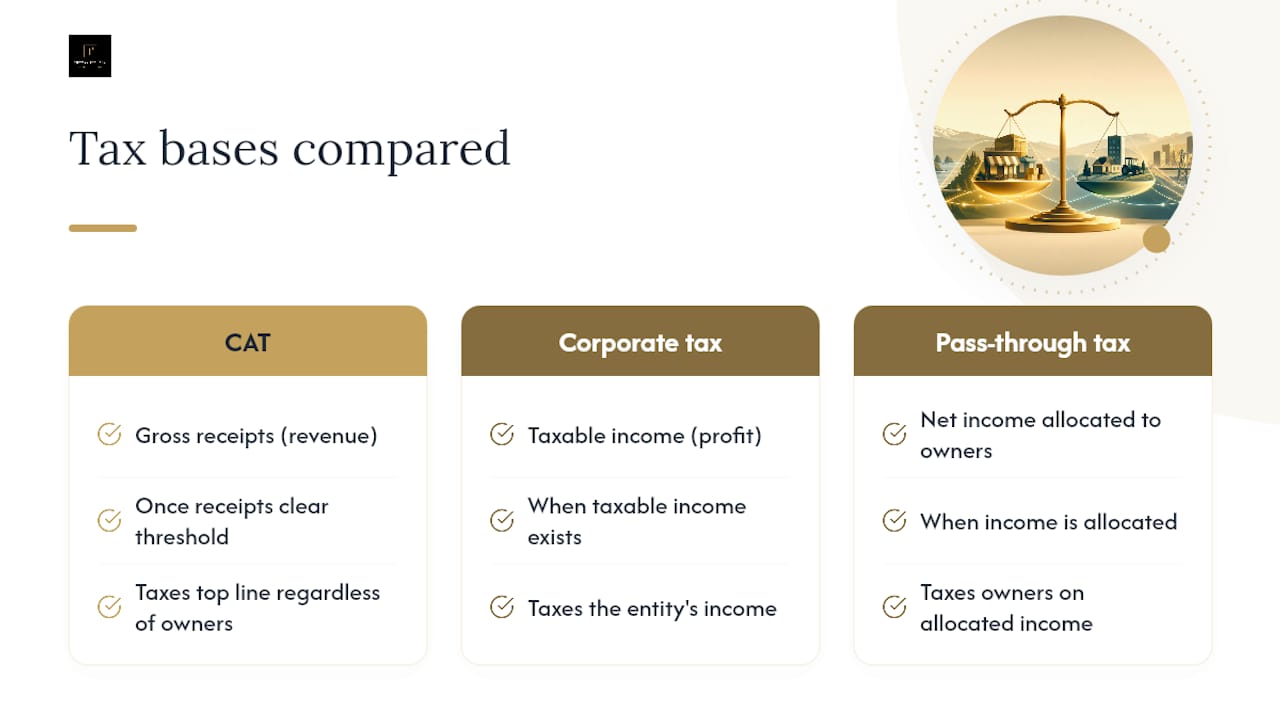
Here is the distinction that trips up new registrants: the CAT taxes revenue, not profit. A construction company with $3 million in gross receipts and a slim 4% margin owes CAT on the receipts, not the thin profit left over. A software company burning cash while it scales still owes CAT once its Oregon commercial activity clears the threshold. This makes the CAT fundamentally different from Oregon's corporate income tax, which only bites once there is taxable income to tax. It is also different from sales tax, since Oregon does not have one and the CAT is not passed to the customer as a line-item charge.
For businesses operating as S corporations or partnerships, this gross-receipts structure interacts with other filing obligations in ways owners do not always anticipate. If your entity already deals with Oregon's pass-through entity tax, the CAT sits alongside it as a separate, unrelated obligation, calculated on a different base entirely. One taxes net income allocated to owners. The other taxes the top line of the business itself, regardless of who owns it or how profit ultimately flows through.
Who Has to Register and File the Oregon CAT
The CAT applies broadly across entity types. C corporations, S corporations, partnerships, LLCs, and sole proprietors are all potentially subject once their Oregon commercial activity crosses the thresholds. Unitary groups of related businesses file as a single taxpayer, with one designated reporting member handling registration and filing on behalf of the group.
The threshold structure works in three bands:
- Below $750,000 in Oregon commercial activity: no registration or filing obligation.
- $750,000 to $1,000,000: registration is required, but no tax is owed yet.
- Above $1,000,000: both registration and tax payment apply, using the $250 plus 0.57% formula.
Timing matters as much as the dollar figures. A business must register within 30 days of exceeding $750,000 in Oregon commercial activity for the calendar year. Miss that window and the Department of Revenue can assess a failure-to-register penalty of $100 per month, capped at $1,000. That penalty applies even if you eventually file correctly. It is a registration penalty, separate from any late-filing or late-payment penalty that follows.
Out-of-state businesses are not exempt just because they lack a physical Oregon office. If a company's Oregon-sourced commercial activity exceeds the thresholds, whether through remote sales, shipped goods, or services delivered to Oregon customers, it is subject to the same registration and filing rules as an Oregon-based company. This catches e-commerce sellers and remote service providers off guard more often than any other CAT rule.
How the Oregon CAT Formula Actually Works
The calculation runs through three steps, and the order matters because each step changes the base for the next one.
- Start with total Oregon commercial activity as reported on Form OR-CAT, then subtract any statutory exclusions (more on those below) to arrive at gross taxable commercial activity.
- Apply the 35% subtraction. Businesses subtract 35% of whichever is greater: cost inputs (generally cost of goods sold) or labor costs. Labor costs are capped at $500,000 per employee, so a business with a handful of highly paid employees cannot inflate the subtraction past that per-person ceiling. Multi-state businesses apply their apportionment percentage before or alongside this step, depending on how income is sourced.
- Subtract the $1,000,000 threshold, then apply the rate. Tax equals $250 plus 0.57% of whatever remains.
Pro Tip: Run the subtraction calculation both ways, once using cost inputs and once using labor costs, every single year. The larger figure changes as your cost structure shifts, and defaulting to whichever method you used last year can leave real money on the table.
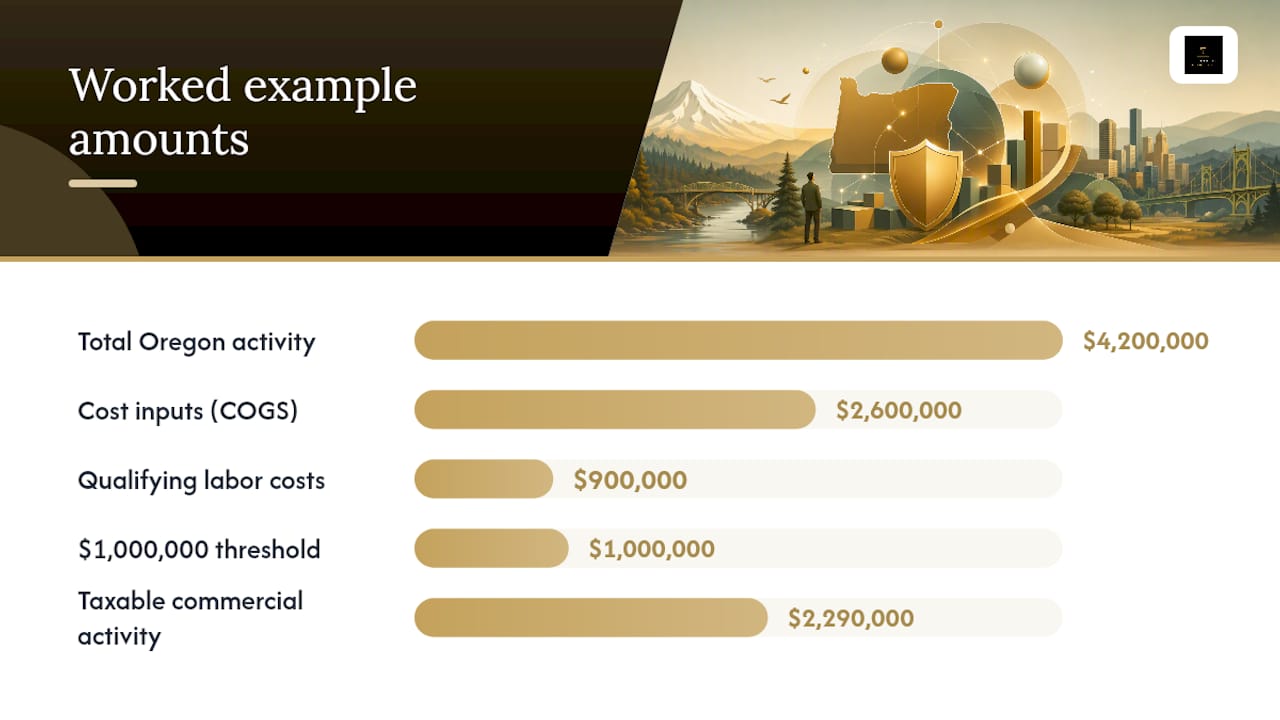
Here's a worked example. Say a distribution business reports $4,200,000 in Oregon commercial activity for the year, with $2,600,000 in cost of goods sold and $900,000 in qualifying labor costs. That leaves taxable commercial activity of $3,290,000. Subtract the $1,000,000 threshold, leaving $2,290,000. Total CAT liability: $13,303.
Figures on Form OR-CAT are reported in whole dollars, with standard rounding applied line by line. Businesses with complex multi-entity structures or unusual revenue patterns can request an alternative apportionment method if the standard formula distorts their Oregon-sourced activity, and a substitute method exists for certain industries where the standard cost-input calculation does not reflect how the business actually operates.
Registration Deadlines, Filing Cadence, and Estimated Payments
Registration happens through Revenue Online, Oregon's electronic filing portal, and the clock starts the moment your year-to-date Oregon commercial activity crosses $750,000. You have 30 days from that point to register, not 30 days from the end of the quarter or the year.
The annual CAT return is due April 15 for calendar-year filers. But most CAT taxpayers do not wait until April to pay. If you expect your annual CAT liability to reach $5,000 or more, quarterly estimated payments are required, due in April, July, October, and January.
A short compliance checklist keeps this manageable:
- Track year-to-date Oregon commercial activity monthly, not just at quarter end.
- Forecast full-year liability by mid-year so estimated payments do not come as a surprise.
- Set calendar reminders for the 30-day registration window as soon as receipts approach $700,000.
- Reconcile actual quarterly activity against your original forecast, and adjust the next estimated payment if revenue is running hot or cold.
Underpayment of estimated CAT carries interest and penalty exposure similar to other Oregon estimated tax regimes. If your business has irregular revenue, seasonal spikes, or a large one-time contract, the estimated tax mechanics that apply to S corp owners offer a useful parallel for building a forecasting habit, even though the CAT calculation itself is entirely separate from S corp income tax.
What Receipts the CAT Does Not Tax
Not every dollar that moves through your books counts as Oregon commercial activity. The statute lists specific exclusions, and claiming them correctly requires documentation, not just a good-faith assumption.
Common exclusions include:
- Receipts from groceries sold for home consumption.
- Motor fuel sales, which are taxed separately under Oregon's fuel tax structure.
- Sales delivered to customers outside Oregon, since the CAT only reaches Oregon-sourced activity.
- Certain transactions between members of a cooperative.
- Receipts passed between members of a unitary group, which are eliminated to avoid double counting.
- Distributive income received by a partner or shareholder from a pass-through entity, since that income was already captured at the entity level.
Claiming a resale or wholesale exclusion is not automatic. A grocery distributor selling to retailers for resale needs a resale certificate on file and a recordkeeping system that ties each sale to that certificate. An exporter claiming out-of-state delivery exclusions needs shipping records showing destination, not just an invoice address. The Department of Revenue's audit approach leans heavily on documentation quality, so treat every exclusion as a claim you may someday need to defend with paper.
Entity-level exemptions apply too. Nonprofits, government entities, and certain regulated health providers have specific exemption rules, but the unrelated business income caveat matters here: a nonprofit running a commercial side activity unrelated to its exempt purpose can still owe CAT on that slice of revenue, even while its core mission-related activity stays exempt.
Nexus and Sourcing: Figuring Out What Counts as Oregon Activity
The Department of Revenue applies a significant economic presence standard for CAT nexus, and there is no bright-line dollar test separate from the $750,000 registration threshold itself. If your Oregon commercial activity crosses that number, you have nexus, regardless of whether you have a warehouse, an office, or a single remote employee in the state.
Sourcing determines whether a given receipt counts as Oregon activity in the first place. For goods, Oregon generally applies a destination test: a product shipped from a Portland warehouse to a buyer in Idaho is not Oregon commercial activity, even though the shipment originated in Oregon. For services, sourcing follows where the benefit of the service is received, which gets complicated fast for remote consulting, software, and professional services delivered to clients across multiple states.
Multi-state businesses apportion their subtraction and, in some cases, their overall base using Oregon-specific formulas. When the standard apportionment method produces a result that clearly misrepresents where your business activity actually happens, an alternative apportionment request under ORS Chapter 317A is the formal path to correct it, though it requires a documented petition rather than a unilateral adjustment on your return.
Where CAT Compliance Breaks Down
Most CAT problems trace back to three failures: missing the registration deadline, poor separation of Oregon receipts from total company receipts, and thin documentation for claimed exclusions.
- Missed registration deadline. The $100-per-month penalty (capped at $1,000) applies even when the eventual return is accurate, so late registration is pure cost with no offsetting benefit.
- Blended revenue tracking. Businesses that don't tag transactions by destination state at the point of sale end up reconstructing Oregon-sourced revenue from scratch at tax time, often under deadline pressure.
- Thin exclusion files. Claiming a resale exclusion or out-of-state delivery exclusion without contemporaneous records is one of the fastest ways to lose that exclusion in an audit.
Pro Tip: Build Oregon-sourcing fields directly into your invoicing or point-of-sale system rather than reconstructing them later. A destination field captured at the time of sale is worth far more in an audit than a spreadsheet assembled months afterward.
Audits tend to focus on the same handful of areas: how sourcing was determined for multi-state sales, whether exclusions have supporting documentation, and whether the COGS or labor-cost subtraction was calculated and applied correctly. Interest accrues on any late payment in addition to the underlying penalty, so a small registration delay can compound quickly if it also pushes back your first estimated payment.
Practical Recordkeeping That Prevents CAT Surprises
Good CAT compliance starts in the bookkeeping system, not on the tax return. Add a destination or customer-location field to every invoice and point-of-sale transaction, so Oregon-sourced revenue can be isolated without a manual reconstruction project at year-end. Tag exclusion-eligible transactions, resale sales, exports, intra-group receipts, as they happen, with the supporting document attached or referenced.
A business with seasonal labor swings or a shifting COGS ratio can see the more favorable method change year to year, and running the comparison mid-year gives you time to adjust pricing or staffing before it affects cashflow. This matters most for businesses with high receipts and narrow margins, where a CAT bill calculated on gross activity can land harder than expected relative to actual profit.
For multi-entity operators, confirm which entity is the designated reporting member for your unitary group, and make sure that entity's bookkeeping captures consolidated Oregon activity accurately. Structural changes, adding an entity, changing ownership percentages, or shifting which entity invoices customers, can change who bears registration responsibility.
Before any CAT readiness review or audit response, gather these documents:
- Prior-year Form OR-CAT filings and supporting schedules.
- Sourcing documentation for the largest 20 to 30 transactions of the year.
- Resale certificates and export shipping records for any claimed exclusions.
- Payroll summaries and COGS workpapers supporting the subtraction calculation.
| Planning area | What to track | Why it matters |
|---|---|---|
| Revenue tagging | Destination state, customer location | Makes exclusions and sourcing defensible in an audit |
| Subtraction method | COGS and labor costs, calculated both ways | Larger figure changes annually; locks in the better outcome |
| Entity structure | Designated reporting member, ownership changes | Determines who registers and files for the group |
| Cashflow modeling | Quarterly liability forecast vs. actual | Prevents underpayment penalties on estimated payments |
Which Forms You Need and Where to File
Form OR-CAT is the annual return every registered taxpayer files, and the accompanying OR-CAT instructions walk through each line, from gross commercial activity through the final tax calculation. A handful of supporting forms handle specific situations:
- OR-EXC-CAT documents claimed exclusions from commercial activity.
- OR-ES-CAT is used for estimated quarterly payments.
- OR-QUP-CAT applies to unitary groups reporting combined activity.
- OR-EXT-CAT requests a filing extension when needed.
Calendar-year filers use the standard April 15 due date; fiscal-year filers align their due date to their own tax year end. All registration and filing happens through Revenue Online, and the Department of Revenue's training materials plus the statutory text in ORS Chapter 317A remain the authoritative references when a specific situation isn't clearly covered by the instructions.
Compliance Discipline Beats Last-Minute Scrambling
Most CAT problems I see aren't calculation errors. They're timing failures, a business crosses $750,000 in June and doesn't register until the following spring because nobody was watching year-to-date Oregon receipts in real time. Proactive bookkeeping, tagging revenue by destination as it happens, running the subtraction both ways annually, forecasting liability before the estimated payment deadline hits, turns the CAT from a April surprise into a predictable line item. Early engagement with an advisor pays for itself the first time it prevents a $1,000 registration penalty.
— Melissa
How Thetaxrefinery Helps With Oregon CAT Readiness
Professional tax advisory services are available as an alternative to handling Form OR-CAT alone every spring.

Relevant services can include registration timing review, quarterly payment modeling tied to revenue forecasts, apportionment guidance for multi-state or multi-entity operators, and representation for Department of Revenue inquiries. If your business is approaching the $750,000 threshold or already filing and want a second look at your subtraction calculation and exclusion documentation, a tax strategy review is the place to start, or run preliminary numbers yourself using the tax calculator before booking a conversation.
This article is general information, not a substitute for advice from a qualified financial advisor. Consult a qualified financial professional about your own circumstances before acting on anything here.
Sources
FAQ
Who Is Required to File an Oregon CAT Return?
Any business, corporation, partnership, LLC, or sole proprietor, with Oregon commercial activity above the tax payment threshold must file and pay. Registration alone is required starting when commercial activity crosses the registration threshold, even before a filing obligation kicks in.
How Do I Calculate My Oregon CAT Tax?
A tax calculator can help model this before you file.
Which State Has No Corporate Income Tax?
Several states, including Nevada, South Dakota, Washington, and Wyoming, do not impose a traditional corporate income tax, though some of these states, Washington included, levy their own gross-receipts style tax similar in concept to Oregon's CAT.
Why Is Oregon's Tax Rate So High?
Oregon has no general sales tax, which shifts more revenue pressure onto income and business taxes, including the CAT, whose proceeds are earmarked specifically for K through 12 education funding rather than the general fund.
Do I Owe CAT if My Business Lost Money This Year?
Yes. The CAT is based on gross commercial activity, not net income, so a business can owe CAT even while reporting a net loss for the year.