
Yes, a nurse practitioner can elect S-corp status if her practice operates as an eligible entity, like an LLC, PLLC, or PC. It typically becomes worthwhile once net profit clears roughly $50,000, with the savings getting harder to ignore between $80,000 and $125,000. The tradeoff is real: you take on payroll, a compensation study, and an annual Form 1120-S filing in exchange for lower self-employment tax.
TL;DR:
- An S-corp election for nurse practitioners is most beneficial when net profits reach around $80,000 to $125,000, after accounting for payroll and compliance costs.
- Setting a reasonable W-2 salary based on market rates is crucial to avoid IRS penalties and maximize tax savings through distributions.
- Proper formation of the entity at the state level, timely filing of Form 2553, and disciplined payroll processes are essential to maintain S-corp compliance and avoid re-election issues.
- The election does not alter malpractice liability or professional liability coverage but can improve tax efficiency and retirement planning opportunities.
- State practice authority rules can impact ownership and payroll setup, especially in restricted states, requiring careful planning before electing S-corp status.
Table of Contents
- What Is an S Corp for a Nurse Practitioner Practice?
- Why NPs Use S-Corp Status: Mechanics, Benefits, and Limits
- How to Set Up S-Corp Status for Your NP Practice
- State Practice-Authority Rules That Affect S-Corp Ownership
- When Does an S-Corp Election Pay Off for an NP?
- Ongoing Compliance Costs and Common S-Corp Mistakes
- Does S-Corp Status Affect Malpractice Insurance or Liability?
- Tax Benefits and Drawbacks Specific to Nurse Practitioner S-Corps
- How Might Recent Tax Law Changes Affect NP S-Corps?
- Do State Supervision Requirements Change How S-Corp Works for NPs?
- S Corp vs. Sole Proprietorship vs. LLC for Nurse Practitioners
- Salary vs. Distributions: Getting the Split Right
- How Thetaxrefinery Approaches S-Corp Planning for NPs
- Ready to Model Your Own S-Corp Break-Even?
- Where to Go for Official S-Corp Guidance
- Sources
- FAQ
What Is an S Corp for a Nurse Practitioner Practice?
An S corporation is not a business entity you form at your state's Secretary of State office. It is a federal tax election under Subchapter S, and the IRS lays out the eligibility rules plainly: the underlying business must be a domestic corporation or an eligible LLC, it can only issue one class of stock, and it cannot exceed 100 shareholders.
For a nurse practitioner, that means the S-corp election sits on top of whatever entity you already formed, usually a PLLC or PC, since most states require licensed healthcare providers to use a professional entity rather than a plain LLC. That distinction matters because your state's professional-entity rules determine who can legally own shares in your practice before the IRS election even enters the picture. Getting the entity right at the state level, then layering the S-corp status on afterward, is the order that actually works.

Why NPs Use S-Corp Status: Mechanics, Benefits, and Limits
The core mechanic is simple to describe and easy to misuse. As an S-corp owner, you pay yourself a W-2 salary subject to payroll taxes, then take any remaining profit as a distribution. Distributions are not subject to Social Security and Medicare tax, which is the entire reason this election saves money. A sole proprietor or single-member LLC owner pays self-employment tax on every dollar of net income; an S-corp owner pays payroll tax only on the salary portion.
Beyond the headline savings, the structure carries a few secondary perks worth knowing:
- Pass-through taxation still applies, so profits are taxed once on your personal return, not at the corporate level.
- Running payroll opens the door to certain retirement plan contributions tied to W-2 wages, which can shift more money into tax-deferred savings.
- Some payers, landlords, and banks treat a formally structured corporation as more established than a sole proprietorship.
The limits are just as important. You are capped at one class of stock, shareholder eligibility rules restrict who can co-own the practice, and several states layer on a franchise tax or minimum fee that eats into the federal savings before you see a dime of it.
How to Set Up S-Corp Status for Your NP Practice
Getting from "sole proprietor" to "properly elected S-corp" is a sequence, not a single form. Skip a step and you either lose the election for the year or create a payroll mess that costs more than it saves.
- Form the right state entity first. Confirm with your state board of nursing and Secretary of State whether you need a PLLC or PC. Most states require one for licensed providers, and NP-focused entity guides confirm this is where many practices stumble before they even reach the tax question.
- Get an EIN from the IRS for the new entity, separate from your Social Security number.
- File Form 2553. The IRS instructions for Form 2553 require the election within two months and 15 days after the start of the tax year you want it to apply to, and every shareholder must sign.
- Set up payroll through a payroll provider so you can issue yourself a W-2, withhold the right taxes, and file Forms 941 and 940 on schedule.
- Plan for Form 1120-S, the annual S-corp tax return, which is due earlier in the year than a personal return.
Pro Tip: File Form 2553 as soon as your entity is formed rather than waiting until tax season. Missing the deadline usually means you lose the election for the entire current year, not just a few months of it.
State Practice-Authority Rules That Affect S-Corp Ownership
Not every state lets a nurse practitioner own a practice outright, and that gates the S-corp question before it even starts. Full practice authority states let NPs diagnose, treat, and prescribe without a physician's oversight, which generally makes solo ownership straightforward. Restricted or reduced practice states often require a collaboration or supervision agreement with a physician, and that requirement can complicate who is allowed to hold ownership shares in the practice at all.
A few things to confirm before you file anything:
- Whether your state board of nursing classifies your practice authority as full, reduced, or restricted, since that classification shapes what kind of entity you are even permitted to own.
- Whether your state requires a PLLC or PC specifically for licensed providers, since NP business structure guidance notes this affects payer enrollment, bank account setup, and credentialing timelines.
- Whether a collaboration agreement changes anything about shareholder eligibility under the one-class-of-stock rule.
Check your state board and Secretary of State guidance before you form an entity or file Form 2553. Entity formation happens at the state level and the tax election happens at the federal level, and getting the order backward can force you to unwind and refile.
When Does an S-Corp Election Pay Off for an NP?
The break-even math is not abstract. It comes down to whether the self-employment tax you save exceeds what you spend running payroll and filing an extra return.
As a rule of thumb, S-corp status is worth evaluating once your practice nets around $50,000 consistently, and the savings usually become clear enough to act on between $80,000 and $125,000. An illustrative scenario for a nurse practitioner practice netting $125,000 annually puts a real number on it: after paying a reasonable W-2 salary, covering employer payroll taxes, and accounting for CPA and payroll fees, the net federal tax savings often amount to a few thousand dollars a year.
That number depends entirely on defending your salary figure. Reasonable-salary support generally includes:
- Market comparables for what an NP with similar hours and duties earns as an employee in your region.
- Documented hours worked and job duties, kept current as your practice grows.
- Written minutes or a compensation memo showing how the board (even a board of one) arrived at the number.
Below the $50,000 range, the math usually runs the other way. For a deeper look at how this compares against staying a solo LLC, see S corp reasonable salary compliance.
Ongoing Compliance Costs and Common S-Corp Mistakes
The savings above are net, not gross, and that "net" is doing a lot of work. Illustrative modeling puts typical annual payroll and administrative costs for a solo NP using a CPA plus a payroll provider typically fall within a moderate range consistent with industry estimates, which is exactly why the break-even point sits where it does rather than lower.
Staying compliant means keeping a few processes running on autopilot rather than scrambling each quarter:
- Regular payroll runs on a fixed schedule, not sporadic owner "draws" relabeled as salary after the fact.
- Quarterly payroll filings (Forms 941 and 940) plus annual W-2 issuance for yourself as an employee.
- Filing Form 1120-S every year, separate from your personal Form 1040.
- Maintaining minutes or a short compensation memo that documents how your salary was set.
The most common mistake is setting a token salary, say $20,000 on a $125,000 net practice, hoping to shovel nearly everything into distributions. That is precisely the pattern the IRS looks for when scrutinizing reasonable compensation. The second most common mistake is skipping payroll discipline altogether: sporadic, inconsistent runs create the kind of paper trail that undermines the election if it is ever questioned.
Pro Tip: Treat your S-corp payroll like a hospital shift schedule, not a suggestion. Set it, automate it through your payroll provider, and revisit the salary figure once a year rather than whenever cash feels tight.
Does S-Corp Status Affect Malpractice Insurance or Liability?
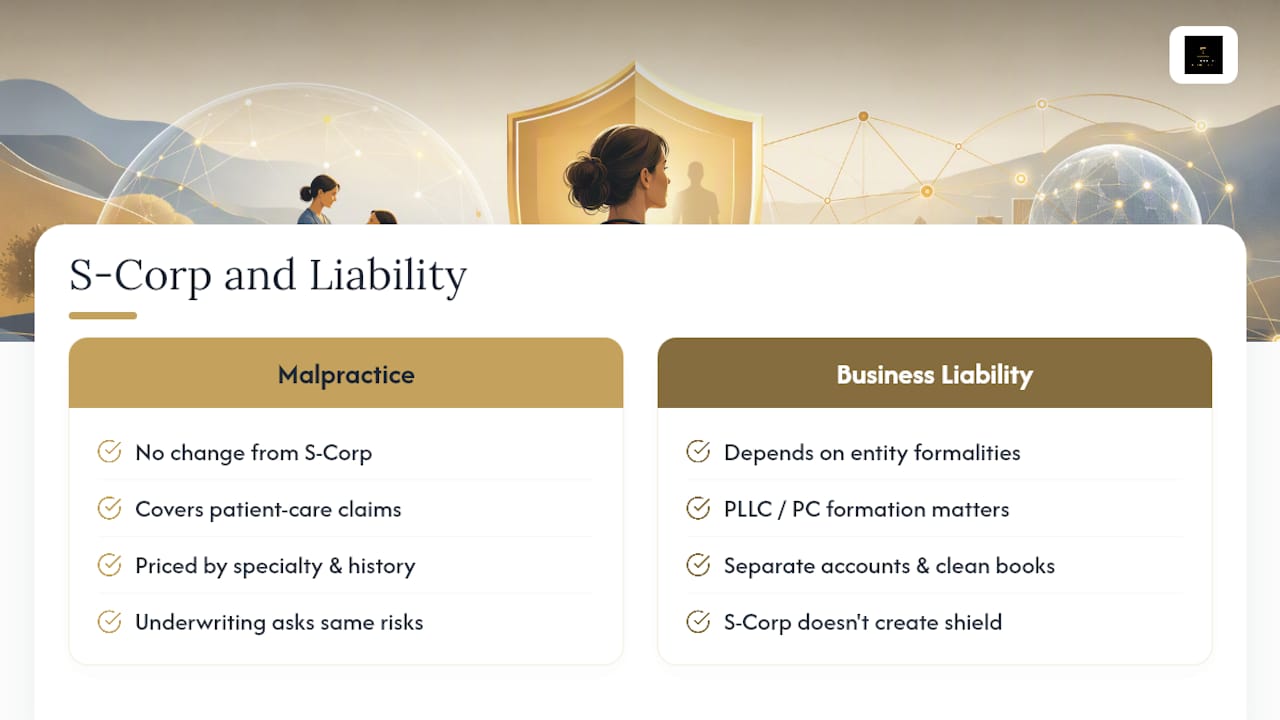
Electing S-corp status does not change your professional liability exposure as a clinician. Your malpractice coverage protects you against claims arising from patient care, and that risk exists whether you are a sole proprietor, an LLC member, or an S-corp shareholder-employee. The tax election has no bearing on the standard of care you owe patients or on what a malpractice carrier underwrites.
Where it does matter is on the business liability side, and this is a distinction NPs frequently blur. Forming a PLLC or PC and maintaining it properly, keeping separate bank accounts, filing annual reports, and not commingling personal and business funds, is what gives you a liability shield against business debts and certain claims unrelated to patient care. The S-corp election rides on top of that entity but does not create the shield itself. If you skip the state-entity formalities and operate loosely, electing S-corp status will not retroactively protect you.
Malpractice premiums themselves are typically priced on your specialty, claims history, practice setting, and coverage limits, not on your tax structure. Carriers underwriting a solo NP practice generally ask about the same risk factors regardless of whether the practice files as a disregarded entity or an S-corp. That said, having a formally structured PLLC or PC in place, with proper payroll and clean books, tends to make underwriting conversations smoother because it signals an organized, established practice rather than a side hustle.
The practical takeaway: keep your malpractice coverage and your tax election as two separate decisions. Review your coverage limits annually regardless of entity structure, and do not assume that becoming an S-corp adds a layer of protection it was never designed to provide.
Tax Benefits and Drawbacks Specific to Nurse Practitioner S-Corps
The benefits for an NP practice mirror the general S-corp case but land differently because of how clinical income tends to be structured. Most NPs bill fee-for-service or receive a percentage of collections, which produces the kind of steady, provable net income that makes a reasonable-salary defense easier than it is for businesses with lumpy revenue. That steadiness is an advantage most NPs do not realize they have.
The benefits worth weighing:
- Lower self-employment tax exposure on the distribution portion of profit, as detailed above.
- A cleaner path to retirement plan contributions tied to W-2 wages, since CPA perspectives on NP S-corp planning note that solo 401(k) or SEP contributions calculate differently once you are running payroll.
- Easier tracking of deductible practice expenses once bookkeeping is formalized around a corporate structure. A related resource on nurse practitioner deductions covers what typically qualifies.
The drawbacks are equally specific to this profession. Many NPs work part-time, moonlight at a second W-2 job, or run a practice alongside per diem shifts, and that mixed-income picture complicates the reasonable-salary calculation. If you are already earning wages elsewhere, your S-corp salary needs to be justified on its own terms rather than blended with outside income. Health insurance is another wrinkle: self-employed health insurance deductions work differently once you are a greater-than-2% S-corp shareholder, requiring the premium to run through payroll as W-2 wages to be deductible. Get that wrong and you lose a deduction you were entitled to under a simpler structure.
How Might Recent Tax Law Changes Affect NP S-Corps?
Two provisions matter most for NP practices weighing this election, and both connect back to the same theme: how you split salary versus distributions changes what you can claim.
Salary is wages, not qualified business income, so it does not count toward the 199A deduction. Distributions, by contrast, generally do qualify. That creates a mild pull toward keeping salary reasonable but not inflated, since every dollar shifted to salary is a dollar that stops counting toward a deduction that could otherwise reduce your taxable income further. This is one more reason the "just pay yourself everything as distributions" instinct is the wrong one and a properly documented reasonable salary matters twice over.
Payroll tax thresholds and Social Security wage base limits adjust most years, which shifts the exact break-even math slightly without changing the underlying logic. A practice sitting right at the $80,000 to $125,000 range should revisit its salary-versus-distribution split annually rather than setting it once and forgetting it, since wage base changes and QBI phase-out thresholds move the calculation each tax year. None of this changes the core verdict: the election still turns on the same salary defensibility and break-even math described above, just recalculated with updated numbers each season.
Do State Supervision Requirements Change How S-Corp Works for NPs?
Aside from determining what entity type you can even own, state supervision and collaboration requirements ripple into a few other operational areas that affect how smoothly an S-corp runs day to day.
In restricted or reduced practice states, a required collaboration agreement with a physician can affect how payers view your billing structure, and by extension how predictable your net income is for salary-setting purposes. If your collaborating physician bills under their own NPI for certain services, your practice's net profit calculation, and therefore your reasonable-salary defense, needs to reflect that split cleanly.
Credentialing timelines also vary meaningfully by state and payer mix. NP private practice startup guidance points to a typical three to six month credentialing window before a new practice sees steady reimbursement. That lag matters for S-corp timing: electing the status before your practice has predictable revenue to support a W-2 salary can leave you underpaying yourself relative to the reasonable-salary standard, or worse, unable to make payroll on schedule during the ramp-up period.
Full practice authority states remove the collaboration agreement variable entirely, which generally makes the ownership and salary picture cleaner from day one. If you practice in a restricted state, budget extra time with your CPA or EA to model how the collaboration arrangement interacts with your S-corp payroll before you file Form 2553, not after.
S Corp vs. Sole Proprietorship vs. LLC for Nurse Practitioners
Every NP practice starts somewhere on this spectrum, and understanding what changes at each stage clarifies why the S-corp election is a step-up rather than a starting point.
| Structure | Self-employment tax | Liability protection | Admin burden | Best fit |
|---|---|---|---|---|
| Sole proprietorship | Full SE tax on all net income | None; personal assets exposed | Lowest | Testing a side practice before committing |
| LLC/PLLC (no election) | Full SE tax on all net income | Shields personal assets from business debts | Low; state filings only | Early-stage practice building revenue |
| S-corp election on PLLC/PC | SE tax only on salary portion | Same liability shield as the underlying entity | Higher; payroll, 1120-S, compensation study | Established practice above the break-even range |
A sole proprietorship is the default for a new NP moonlighting on the side, and it carries no formal liability protection at all. An LLC or PLLC without the S-corp election adds that liability shield but does not touch your self-employment tax, since profit still flows through and gets taxed the same way it would for a sole proprietor. The S-corp election is what actually changes the tax math, and it only makes sense once the entity and liability question is already settled.
The practical sequencing for most NPs looks like: sole proprietor while testing the waters, PLLC or PC once patient volume is real and liability protection matters, then the S-corp election once net income clears the range where the payroll and compliance costs pay for themselves. Jumping straight to S-corp before your practice has steady revenue usually creates more administrative drag than benefit.
Salary vs. Distributions: Getting the Split Right
The single decision that determines whether your S-corp election saves money or creates an audit target is how you split salary from distributions, and it deserves more thought than a one-time setup step.
Start with what the job actually requires. If you are seeing patients 30 hours a week and handling all the administrative work of running the practice, your salary needs to reflect what it would cost to hire an NP plus a part-time practice manager to do both jobs, not a discounted number chosen to minimize payroll tax. Comparable W-2 salary data for NPs in your specialty and region is the anchor point, and it is worth revisiting yearly rather than setting once and ignoring.
Once the salary is set defensibly, distributions absorb the rest of the profit, and that is where the tax savings actually live. But distributions are not automatic; they depend on the practice having actual cash available after covering payroll, overhead, and reserves. NPs who take distributions before confirming cash flow can cover them sometimes end up owing back taxes or shorting quarterly estimated payments elsewhere.
A few habits keep this clean: run payroll on a consistent biweekly or semimonthly schedule regardless of how busy the practice is that month, reconcile distributions against actual bank cash rather than projected income, and revisit the salary figure each year against updated market data rather than inflating it arbitrarily to "look safer." For a closer look at how distribution timing interacts with your personal tax bracket, S corp distribution rules covers the mechanics in more depth.
How Thetaxrefinery Approaches S-Corp Planning for NPs
Most of the risk in this election lives in two places: an indefensible salary number and inconsistent payroll discipline. Scenario models can be used to pressure-test a proposed salary against market comparables before an election is filed, rather than after an audit letter arrives.
Consult an EA or CPA rather than handling this alone once your practice approaches that $80,000 to $125,000 break-even range, once state supervision rules complicate ownership, or once you know payroll and bookkeeping discipline is not your strength. An engagement typically includes salary modeling, a payroll setup checklist, and implementation support through the first year of filings.
— Melissa
Ready to Model Your Own S-Corp Break-Even?
Generic tax software gives you a form to fill out, not a defensible salary number or a plan for the years after you file. Thetaxrefinery is the alternative to guessing your way through Form 2553: every engagement starts with scenario modeling built around your actual net income, hours worked, and state rules, not a template borrowed from a different profession.
The S-Corp Tax Strategy Accelerator is built for exactly the moment this article describes: a practice approaching or past the break-even point that needs a documented compensation analysis and a clean implementation plan, priced at $997 one-off. If your practice already has steady revenue and you want strategy support that continues past the election, the Monthly Tax Advisory or Quarterly Tax Strategy Sessions packages, at $11,997 and $9,497 per year respectively, keep your salary figure and filings current as tax rules shift each year. This approach is suited for established NP practices at or above the break-even range who seek a strategy partner rather than just annual filing assistance. Book a consultation to find out where your practice actually stands.
Where to Go for Official S-Corp Guidance
Start with the IRS S corporations page and the Form 2553 instructions for the primary rules on eligibility and election timing.
This article is general information, not a substitute for advice from a qualified financial advisor. Consult a qualified financial professional about your own circumstances before acting on anything here.
Sources
- S Corporations | Internal Revenue Service
- About Form 2553, Election by a Small Business Corporation | Internal Revenue Service
- Evaluating S-Corp election for nurse practitioner practice netting $125,000 annually
- Module 04 — Business Entity - NP Private Practice Guide
FAQ
Can I own my own practice as a nurse practitioner?
Yes, in most states, though full practice authority states make solo ownership simpler than restricted or reduced practice states that require a collaboration agreement. Check your state board of nursing and entity requirements before forming an entity, since ownership rules vary significantly by state.
What is the break-even point for S-corp election as an NP?
A common rule of thumb treats $50,000 in consistent net profit as the point worth evaluating, with savings becoming clearer between $80,000 and $125,000. An illustrative scenario for a $125,000 net practice shows roughly $2,500 to $3,000 in net federal tax savings after payroll and CPA fees.
How to make $200,000 as a nurse practitioner?
Reaching that income level generally comes from a combination of full-time clinical hours, a specialty or setting with higher reimbursement, and often ownership of a practice rather than pure employment. At that income level, the self-employment tax savings from an S-corp election become substantial enough that most NPs at this range benefit from formal salary and distribution planning.
What is the 5-year rule for S corporations?
The most common "5-year rule" refers to the restriction on revoking an S-corp election and then re-electing it. Once you terminate or revoke S-corp status, the IRS generally does not allow you to re-elect for five years without special permission, so the decision deserves careful modeling before you file.
Are nurse practitioners becoming oversaturated?
Growth in NP program graduates has increased competition in some markets and specialties, though demand still varies widely by region and practice setting. This trend makes practice ownership, and the tax efficiency that comes with structuring it correctly, more relevant for NPs looking to differentiate their income beyond a standard employment role.