
S-Corp owners can claim a deduction up to 20% of qualified business income, but the amount affecting your outcome depends on your taxable income relative to the phase-in thresholds. The single highest-leverage decision is how you set reasonable compensation, because salary is excluded from QBI yet it also builds the W-2 wage base that can rescue the deduction for high earners. Run a projection now, before year-end payroll decisions lock in.
TL;DR:
- The QBI deduction for S-Corp owners depends heavily on taxable income thresholds, with phase-in ranges affecting limitations and eligibility.
- Raising W-2 wages can be necessary above the threshold to unlock the full deduction, but doing so may reduce the deductible QBI base.
- Proper classification of SSTB status and careful aggregation of multiple businesses are critical to avoid losing the deduction or triggering IRS audits.
- Strategic retirement contributions and timing of income recognition can help keep taxable income within favorable thresholds for QBI.
- State tax treatment of the QBI deduction varies and may not mirror federal rules, requiring separate modeling to prevent surprises.
Table of Contents
- What Is QBI for S Corp Owners Under §199A?
- What Are the 2026 QBI Income Thresholds?
- Should S Corp Owners Raise or Lower Their Salary for QBI?
- How Does the W-2 Wage and UBIA Limitation Work?
- Why Do SSTBs Lose the QBI Deduction Above the Threshold?
- Can Aggregating Multiple Businesses Preserve the QBI Deduction?
- What Retirement and Timing Strategies Reduce Taxable Income for QBI?
- What Do Real QBI Scenarios Look Like for S-Corp Owners?
- A Practitioner Checklist Before You File
- Does Your State Tax the QBI Deduction Differently?
- What Mistakes Do S-Corp Owners Make Claiming QBI?
- How Does QBI Interact With Other Deductions and Credits?
- What Recent Legislative Changes Affect QBI Going Forward?
- What Triggers an IRS Audit of an S-Corp's QBI Deduction?
- What Should S-Corp Owners Actually Prioritize for QBI in 2026?
- How Thetaxrefinery Helps S-Corp Owners Model the QBI Decision
- Sources
What Is QBI for S Corp Owners Under §199A?
Qualified business income is the net amount of qualified items of income, gain, deduction, and loss from a trade or business, calculated at the shareholder level under 26 USC §199A. For S-Corp owners, that means your K-1 ordinary business income counts, but several items never make it into the QBI calculation.
- Excluded from QBI: W-2 wages paid to you as a shareholder-employee, capital gains, dividends, and interest income not properly allocable to the business.
- K-1 reporting: Form 1120-S Schedule K-1 Box 17 carries the codes for your allocable share of QBI, W-2 wages, and unadjusted basis immediately after acquisition (UBIA), which your preparer needs to compute the deduction.
- Shareholder-level computation: Even though the S-Corp files an informational return, the §199A deduction itself is calculated on your personal Form 1040, not the corporate return.
- Form choice: Below the taxable income threshold, you use the simpler Form 8995. Above it, or if you're an SSTB owner in the phase-in range, you need Form 8995-A, which handles the wage and UBIA limitations.
The mechanics sound simple until your taxable income crosses into the range where limitations start applying, and that's where most S-Corp owners get surprised.
What Are the 2026 QBI Income Thresholds?
The phase-in ranges for 2026 determine whether the wage and UBIA limitation, or the SSTB phase-out, applies to your deduction at all.
2026 taxable income thresholds (before the QBI deduction):
- Below the threshold: full 20% deduction without wage/UBIA tests or SSTB restrictions
- Within the phase-in range: partial limitations apply, gradually scaling based on income
- Above the top of the phase-in range: full wage/UBIA limitation applies to all businesses, and SSTB owners lose the deduction entirely according to IRS guidance.
The Instructions for Form 8995-A lay out the exact phase-in ranges for single and married-filing-jointly filers, and those ranges expanded under the permanent rules that took effect after the One Big Beautiful Bill Act. One change worth flagging for smaller operations: taxpayers with at least $1,000 of QBI from an active trade or business now qualify for a $400 minimum deduction, even if the wage/UBIA math would otherwise produce less.
Pro Tip: Don't assume you're safely below the threshold just because your S-Corp distributions feel modest. Combine your K-1 income with your spouse's W-2 wages, your rental income, and any capital gains before you decide which regime applies.
Once you're within or above the phase-in range, everything downstream, salary decisions, retirement contributions, aggregation elections get calculated against these numbers.
Should S Corp Owners Raise or Lower Their Salary for QBI?
Reasonable compensation is the lever with the widest range of outcomes, and it cuts in opposite directions depending on where you sit relative to the thresholds. Every dollar you pay yourself as W-2 wages gets excluded from QBI, so it shrinks the deduction's base. But that same wage dollar builds the W-2 wage pool the limitation formula uses, so for high earners it can be the only thing standing between a full deduction and a gutted one.
- Below the threshold: minimize salary within reasonable-compensation limits. There's no wage/UBIA test yet, so every dollar kept as distribution rather than salary avoids payroll tax without costing you QBI.
- Within the phase-in range: this is where the trade-off gets genuinely close. Adding salary reduces QBI dollar for dollar but also raises the wage limit ceiling, so the net effect depends on your specific numbers.
- Above the phase-in range, non-SSTB: here, insufficient W-2 wages can zero out your deduction even though your business easily qualifies. Raising salary to create wage basis is often the only way to unlock a deduction at all.
A salary-model payoff analysis needs three inputs: projected taxable income, projected S-Corp net profit, and current W-2 wages paid. The output should show the QBI deduction at two or three salary levels, plus the payroll tax cost of each increase, so you can see the break-even point in dollars, not theory.
Reasonable compensation still has to satisfy IRS standards independent of QBI strategy. You can't set salary at zero to preserve QBI if your role clearly warrants a market wage, and you can't inflate salary purely to manufacture wage basis if it no longer reflects the work performed.

How Does the W-2 Wage and UBIA Limitation Work?
Once you're above the phase-in range, the deduction for each trade or business is capped at the greater of two calculations:
- 50% of the W-2 wages paid by that business, allocated to you as the shareholder, or
- 25% of W-2 wages plus 2.5% of UBIA (unadjusted basis immediately after acquisition of qualified property).
Service and labor-heavy S-Corps, consulting firms, agencies, professional practices, tend to hit the 50%-of-wages prong because they don't carry much depreciable property. Capital-intensive operations, equipment-heavy contractors, real estate holding entities, manufacturing, often do better under the 25%-wages-plus-UBIA prong because their property basis does real work in the formula.
Timing capital expenditures to raise UBIA only helps if you're already leaning on that second prong, and it only makes sense if the equipment purchase serves a real operational need. Buying equipment purely to goose a tax deduction is rarely cost-effective once you account for the actual cash outlay versus the marginal QBI benefit.
Why Do SSTBs Lose the QBI Deduction Above the Threshold?
Specified service trades or businesses, health, law, accounting, consulting, financial services, and similar fields, face a much harder cliff than other businesses once taxable income exceeds the top of the phase-in range.
- Below the threshold: SSTB status doesn't matter at all; the deduction works exactly the same as any other business.
- Within the phase-in range: the deduction phases out gradually as taxable income climbs.
- Above the top of the phase-in range: the SSTB phase-out eliminates the deduction entirely, regardless of how much W-2 wages or UBIA the business has.
That last point catches people off guard. A physician or attorney with strong W-2 wages in their S-Corp gets zero relief from that wage base once they're fully phased out, because SSTB status overrides the wage/UBIA test rather than working alongside it. Mitigation options exist, retirement deferrals, timing income recognition, splitting non-SSTB activities into a separate entity where legitimately warranted, but none of them eliminate the underlying cliff. Realistic expectations matter here: if you're well above the phase-in ceiling, you may simply be planning around a QBI deduction of zero.
Can Aggregating Multiple Businesses Preserve the QBI Deduction?
If you operate more than one S-Corp, or an S-Corp alongside a rental property or partnership, aggregation lets you combine QBI, W-2 wages, and UBIA across commonly controlled businesses that meet ownership and operational tests.
- Aggregation typically helps when one entity is wage-rich and another is wage-poor but profitable, since pooling smooths out the limitation.
- It also helps when UBIA is concentrated in one entity while income sits in another.
- The election must be disclosed on Schedule B of Form 8995-A every year, and it's effectively binding once made.
Pro Tip: Treat aggregation conservatively. Failing to disclose consistently can trigger IRS-forced disaggregation, which can produce an immediate QBI shortfall if you were counting on pooled wages to clear the limitation.
What Retirement and Timing Strategies Reduce Taxable Income for QBI?
Pushing taxable income back below a threshold, or deeper into a more favorable phase-in position, is often more achievable than people assume late in the year.
- Solo 401(k) contributions let a single-owner S-Corp defer a meaningful chunk of both employee and employer contributions before the tax-filing deadline.
- SEP-IRA contributions work similarly but with less flexibility on the employee-deferral side.
- Defined benefit plans let owners closer to retirement age push far more income out of the current year than either option above, sometimes enough to shift an entire filing from "within phase-in" to "below threshold."
- Capital expenditures that raise UBIA can help, but only where the purchase already made business sense on its own.
Sequence these correctly: payroll and retirement plan decisions generally need to be locked in before December 31, while some contributions can still be made up until the filing deadline. Check plan-specific deadlines with your advisor before assuming flexibility that may not exist.
What Do Real QBI Scenarios Look Like for S-Corp Owners?
- Scenario A, below threshold: a solo consultant nets $140,000. Minimizing salary to a reasonable-but-modest level saves payroll tax and costs nothing on QBI, since no wage/UBIA test applies yet.
- Scenario B, within phase-in: an agency owner nets $380,000. Adding $40,000 in Solo 401(k) deferrals and adjusting salary shifts the outcome meaningfully; the exact deduction depends on the sliding-scale calculation.
- Scenario C, above phase-in, non-SSTB: a contractor nets $650,000. Without sufficient W-2 wages, the deduction could be zero; raising salary to build wage basis becomes the only lever that works.
Build your own spreadsheet with these inputs: projected 1040 taxable income, S-Corp net profit, current and proposed salary, W-2 wages paid, UBIA, and retirement contributions. Output fields should show QBI deduction at each salary level, payroll tax delta, and the net after-tax result.
A Practitioner Checklist Before You File
Run a taxable-income projection first, then check whether current payroll supports or undermines the QBI outcome you want. Review K-1 Box 17 codes for accuracy before assuming the numbers are right, and size any retirement contribution against both the QBI threshold and the plan's own limits. Escalate for deeper review if you see SSTB income mixed with non-SSTB income in one entity, wildly inconsistent aggregation reporting year to year, or a salary set suspiciously low relative to industry norms purely to preserve QBI. For deeper modeling on any of these levers, see S-Corp tax planning strategies and Solo 401(k) contribution limits.
Does Your State Tax the QBI Deduction Differently?
The §199A deduction is a federal creation, and most states that impose an income tax don't recognize it at all on the state return. That distinction trips up a lot of S-Corp owners who assume their state liability shrinks the same way their federal bill does.
States that use federal taxable income as their starting point but decouple from §199A effectively add the QBI deduction back before calculating state tax, which means your state bill can look disproportionately high compared to what the federal savings suggested. Other states, mostly those without a broad income tax, make the question moot for that particular income stream, though S-Corp owners in those states still deal with franchise taxes, gross receipts taxes, or entity-level fees that have nothing to do with QBI.
There's a second layer worth understanding: states that impose their own franchise tax or entity-level tax on S-Corps calculate that liability independently of the federal QBI mechanics entirely. A state-level pass-through entity tax election, common in states responding to the federal SALT cap, changes your federal itemized deduction picture but doesn't touch QBI eligibility one way or the other.
If you operate in Idaho or Oregon, or any state with its own conformity rules, don't assume your state return will mirror your federal QBI outcome. Check your state's specific treatment before finalizing any salary or retirement strategy built around federal thresholds, because a plan that looks efficient federally can produce an unpleasant state surprise if you didn't model both returns together.
What Mistakes Do S-Corp Owners Make Claiming QBI?
The most common error is treating W-2 wages as part of QBI. They aren't, ever, for the shareholder-employee receiving them, and that misunderstanding alone causes more overstated deductions than any other single mistake.
A close second is setting reasonable compensation purely to optimize QBI rather than to reflect actual market value for the work performed. The IRS evaluates reasonable compensation independently of any tax strategy attached to it, so a salary set too low to inflate distributions, or one manipulated upward purely to manufacture wage basis, can unravel under scrutiny regardless of the QBI math behind it.
Other frequent errors:
- Forgetting to check SSTB status carefully. Some businesses sit in gray areas, and misclassifying an SSTB as a qualifying trade can overstate the deduction significantly once taxable income clears the phase-in range.
- Using the wrong form. Filing Form 8995 when your taxable income actually requires Form 8995-A skips the wage/UBIA limitation entirely, which either understates or overstates the deduction depending on your numbers.
- Aggregating inconsistently year to year without proper Schedule B disclosure, risking forced disaggregation.
- Overlooking UBIA entirely for asset-heavy businesses, which leaves real deduction value on the table for owners who qualify under the second limitation prong.
- Failing to update K-1 QBI figures when prior-year loss carryforwards exist. Negative QBI from a prior year has to offset current-year QBI before the deduction is calculated, and that carryforward is easy to lose track of.
How Does QBI Interact With Other Deductions and Credits?
QBI doesn't exist in isolation on your return, and several other items shift depending on how you calculate it.
The deduction is calculated after most above-the-line adjustments but doesn't reduce your adjusted gross income, it applies as a separate deduction from taxable income, which means it doesn't help you qualify for AGI-based phaseouts elsewhere. It also can't create or increase a net operating loss on its own.
That's usually a net benefit, since the health insurance deduction itself is worth more than the marginal QBI it displaces. Retirement contributions work the same way: they reduce taxable income first, potentially shifting you into a better phase-in position, and only then does the QBI math run on the resulting number.
The deduction interacts less directly with credits. A credit like the R&D credit reduces tax owed dollar for dollar and doesn't touch QBI eligibility at all, since credits apply after the deduction stack is finalized. Where things get genuinely complicated is with the qualified small business stock exclusion or capital gains from a business sale, since those gains are explicitly excluded from QBI even when they originate from the same operating business generating your K-1 income.
What Recent Legislative Changes Affect QBI Going Forward?
The most consequential recent development is that §199A, originally set to expire after 2025, became permanent under the One Big Beautiful Bill Act, removing the sunset that had planners scrambling for years. That permanence changes the calculus for multi-year planning entities and aggregation elections that only made sense if the deduction was going to survive past a single tax year.
Alongside permanence, the phase-in ranges themselves expanded for 2026, giving more owners room before the wage/UBIA limitation or SSTB phase-out kicks in fully. The new $400 minimum deduction for taxpayers with at least $1,000 of QBI is a smaller but genuinely helpful change for owners of modest, actively-run businesses who might otherwise see a limitation formula produce a near-zero result.
Watch for state-level responses to federal permanence. Several states have signaled they'll revisit their own decoupling rules now that §199A isn't a temporary provision, which could change the state-tax picture described earlier in ways that haven't fully settled yet. Anyone doing multi-year entity structuring should treat the current phase-in ranges as durable enough to plan around, but should still check annually for state conformity updates.
What Triggers an IRS Audit of an S-Corp's QBI Deduction?
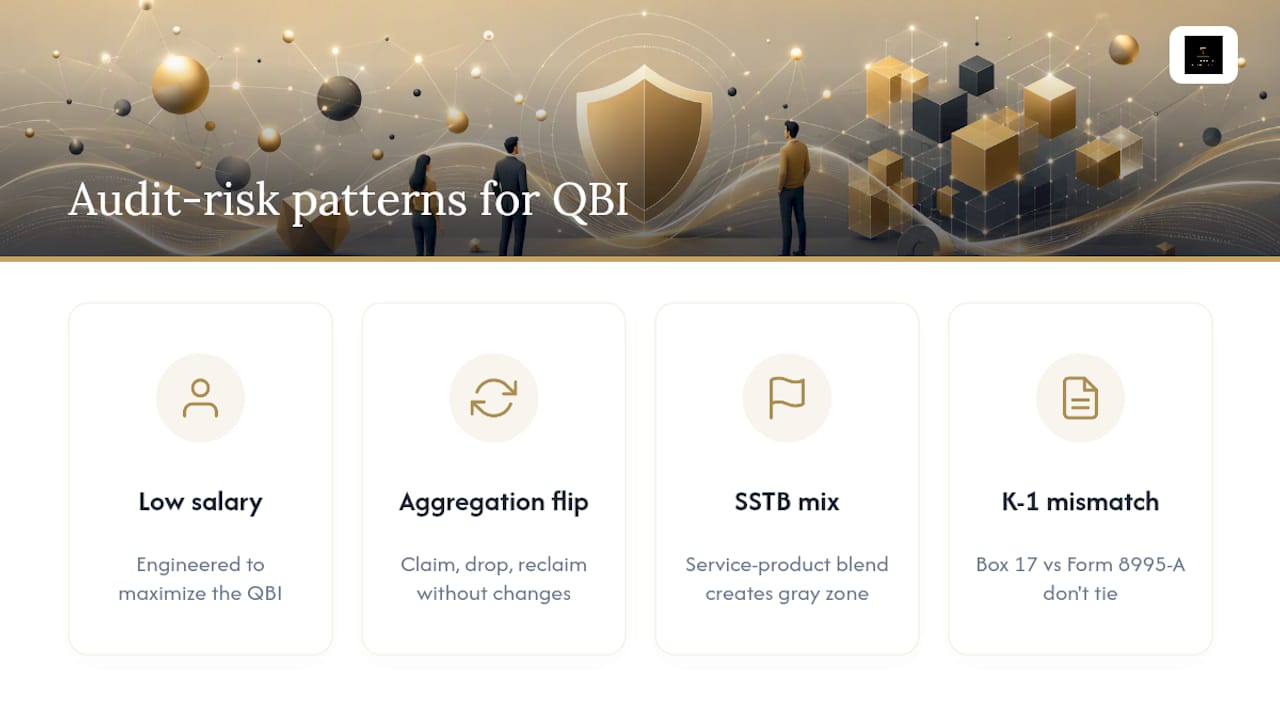
A handful of patterns draw disproportionate scrutiny. Unreasonably low salary relative to the work performed is the single most common trigger, especially when it coincides with a QBI deduction that looks optimized to the dollar. The IRS has pursued reasonable-compensation cases against S-Corp shareholders for years independent of QBI, and a salary that seems engineered to maximize the deduction rather than reflect market value invites exactly that kind of review.
Inconsistent aggregation reporting is another flag. Claiming aggregated QBI one year, dropping it the next, then reclaiming it without a documented change in ownership or operations looks like opportunistic form-shopping rather than a genuine business decision.
SSTB misclassification draws attention too, particularly for businesses that blend consulting or advisory services with a product or non-service revenue stream. Claiming the deduction in full while sitting in a gray zone between SSTB and non-SSTB status is a common audit flashpoint once income clears the phase-in range.
Finally, mismatches between the K-1 Box 17 codes and the amounts claimed on Form 8995-A raise a simple red flag: the numbers on the personal return should tie directly back to what the S-Corp reported, and any gap between the two is one of the easiest things for an examiner to spot.
What Should S-Corp Owners Actually Prioritize for QBI in 2026?
Most advice on this topic treats QBI like a static eligibility question: are you in, or are you out? That framing misses the point for S-Corp owners specifically, because you have a lever nobody else in the pass-through world has quite the same access to: the ability to convert profit into wages and back again, deliberately, every single year.
The conventional wisdom says minimize salary to save payroll tax, full stop. That's right below the threshold and dangerously wrong above it. I've seen owners cling to a low salary well past the point where it started costing them the entire deduction, simply because nobody re-ran the numbers once income grew.
What gets underweighted is timing. Retirement plan design, especially defined benefit plans for owners in their fifties or older, does more to protect a marginal QBI position than almost any other single move, and it's usually the last thing anyone considers until it's too late in the year to act on it.
Prioritize the projection first, every time. Salary decisions, retirement contributions, and aggregation elections all flow from where your taxable income actually lands, not where you assume it will.
— Melissa
How Thetaxrefinery Helps S-Corp Owners Model the QBI Decision
Some tax advisory firms build salary-versus-QBI models that most S-Corp owners never get from a once-a-year filing relationship, because the numbers above only work if someone runs them before December, not after.
 A first tax advisory engagement typically starts with a taxable-income projection, a payroll review against your current reasonable-compensation position, and a look at your K-1 history to see whether aggregation or a retirement plan change would move your deduction meaningfully. From there, specific levers such as Solo 401(k) versus defined benefit plans, salary adjustment thresholds, and aggregation election timing can be sized against your actual numbers rather than a generic rule of thumb. If you want to see where you land before committing to an engagement, start with the tax strategy comparison for founders to map your options against your current structure.
This article is general information, not a substitute for advice from a qualified financial advisor. Consult a qualified financial professional about your own circumstances before acting on anything here.