
Whether you can claim business deductions comes down almost entirely to one question: are you a W-2 employee, a 1099 contractor, or a practice owner? Self-employed and practice-owner NPs get broad access to Schedule C deductions for the ordinary and necessary costs of running their work. W-2 employees, by contrast, lost the federal deduction for unreimbursed job expenses under current law, with narrow exceptions in a few states.
If you fall into the 1099 or practice-owner category, prioritize these first: continuing education and licensing fees, malpractice insurance, mileage for business driving, a home office if you meet the exclusive-use test, equipment and supplies (expensed or depreciated), and retirement plan contributions. High earners should also look at the Qualified Business Income deduction, which can shave a meaningful chunk off taxable income if you qualify.
Before you file anything, get these five things in order:
- A contemporaneous mileage log with date, miles, and business purpose for every trip
- A dedicated folder (digital or physical) for CE certificates, licensing renewals, and malpractice premium statements
- Measurements and photos of your home office space, if you claim one
- Entity paperwork (LLC filing, S-Corp election, EIN) if you've formed a business structure
- A separate business bank account and credit card so expenses aren't tangled with personal spending
Key Takeaways
Nurse practitioner deductions depend first on employment classification, and self-employed or practice-owner NPs have access to substantially more write-offs than W-2 employees.
| Point | Details |
|---|---|
| Classification decides eligibility | 1099 and practice-owner NPs can deduct ordinary business expenses; most W-2 NPs cannot at the federal level. |
| Documentation protects every deduction | Keep contemporaneous mileage logs, tagged receipts, and CE certificates for at least three years. |
| Retirement contributions cut taxable income | SEP IRA, Solo 401(k), and SIMPLE IRA options directly lower current-year tax liability for self-employed NPs. |
| S-Corp conversion has a break-even point | Payroll-tax savings only outweigh added admin costs once practice income reaches a meaningful threshold. |
| Thetaxrefinery models the decision | Thetaxrefinery offers S-Corp modeling and year-round advisory tailored to an NP's actual classification and income. |
Where to Read the Official Rules Yourself
For primary guidance, review the IRS pages on self-employment tax basics, home office deduction rules, and education tax benefits in Publication 970. For NP-specific examples, see NPBusiness's deduction guide and LegalClarity's breakdown.
This article is general information, not a substitute for advice from a qualified financial advisor. Consult a qualified financial professional about your own circumstances before acting on anything here.
Table of Contents
- How Employment Classification Changes Your Nurse Practitioner Deductions
- What Nurse Practitioner Business Expenses Qualify for Write-Offs
- Which Retirement Plans Lower Taxable Income for Self-Employed NPs
- Recordkeeping That Survives an IRS Audit
- Filing Mechanics: Schedule C, Schedule SE, and the QBI Deduction
- Sole Proprietor, LLC, or S-Corp: What Fits a Growing NP Practice
- Timing Equipment Purchases and Depreciation the Right Way
- Signs It's Time to Bring in a Tax Advisor
- How Thetaxrefinery Helps Nurse Practitioners Keep More of What They Earn
- Sources
How Employment Classification Changes Your Nurse Practitioner Deductions
Your tax form tells the real story. W-2 employees receive a wage statement and have taxes withheld automatically. 1099 contractors receive a 1099-NEC and report income and expenses on Schedule C. Practice owners file through Schedule C (sole proprietor), a partnership return, or an S-Corp return, depending on how the business is structured.
The deduction gap between these groups is substantial. Since the Tax Cuts and Jobs Act suspended miscellaneous itemized deductions through 2025, W-2 nurse practitioners generally cannot deduct unreimbursed job expenses like scrubs, CE courses, or mileage at the federal level, according to LegalClarity's breakdown of NP tax rules. A handful of states still allow it, but the federal door is closed for most employees.
1099 and practice-owner NPs operate under a different rulebook. Schedule C lets you deduct ordinary and necessary business expenses directly against income, which is why contractor status often produces a lower effective tax bill even though the hourly pay structure looks similar to W-2 work, as NP Schools notes in its comparison of NP employment types. The tradeoff: self-employed NPs owe self-employment tax on net earnings, covering both the employee and employer shares of Social Security and Medicare. Half of that self-employment tax is deductible on Form 1040, which softens the blow but doesn't eliminate it.
- W-2: limited federal deductions, taxes withheld, no self-employment tax
- 1099: full Schedule C access, self-employment tax applies, quarterly estimates required
- Practice owner: same Schedule C access (or entity-level filing), plus decisions about payroll and reasonable salary if structured as an S-Corp
Pro Tip: If you're W-2 but your clinic doesn't reimburse CE, licensing, or mileage, ask about a formal accountable plan. Under an accountable plan, the employer reimburses you tax-free for documented business expenses, which sidesteps the deduction limitation entirely without changing your employment status.
What Nurse Practitioner Business Expenses Qualify for Write-Offs
If you're self-employed or run your own practice, the list of deductible expenses is long, but every item needs a paper trail. Here's what typically qualifies, organized by category.
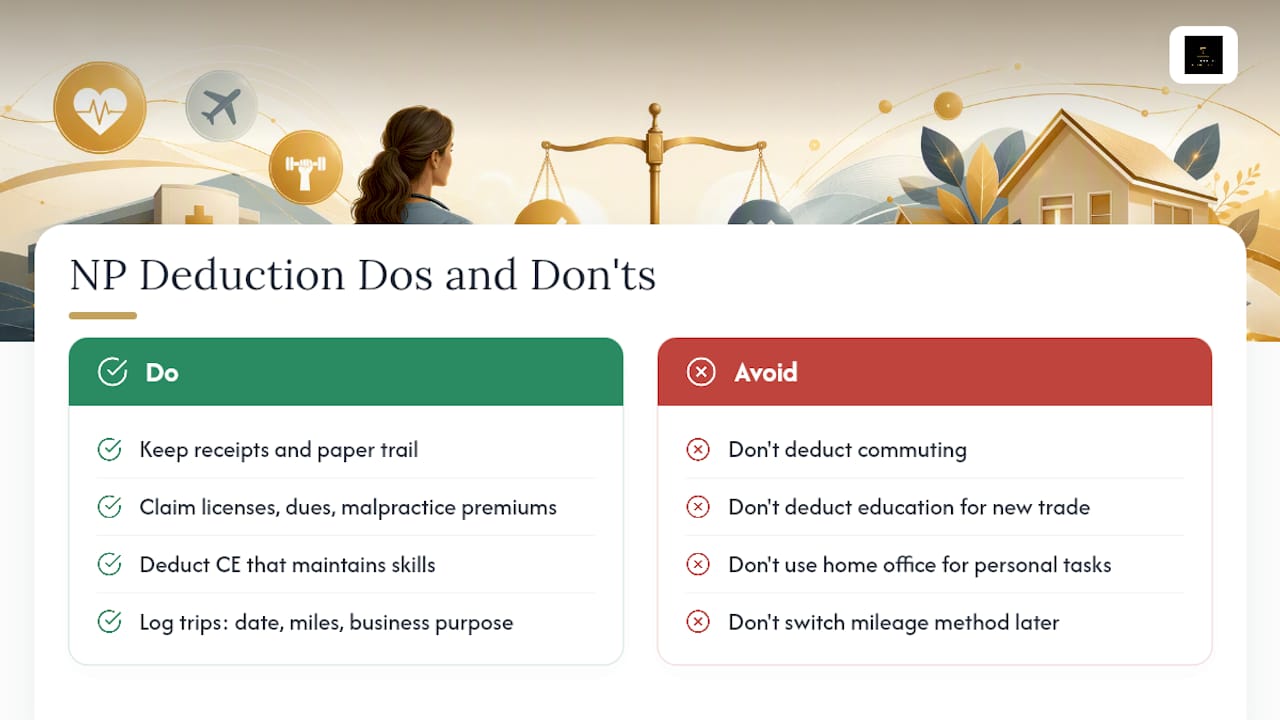
Licensing, credentialing, and professional costs. State license renewals, DEA registration, board certification fees, and specialty credentialing all count as ordinary and necessary business expenses under the standard the IRS applies to self-employed filers, a rule ThriveAP highlights in its guidance for NPs. Malpractice insurance premiums fall in the same bucket, and if you're a practice owner rather than an employee covered under someone else's policy, that premium is fully deductible against business income. Professional association dues and journal subscriptions also qualify.

Continuing education, with one catch. CE and CME that maintain or improve skills in your current role as a nurse practitioner are deductible. But IRS Publication 970 draws a hard line: education that qualifies you for a new trade or profession, like a doctoral program that shifts your scope of practice entirely, is generally not deductible. This distinction trips up more NPs than almost any other rule, because the line between "improving your skills" and "training for a new role" isn't always obvious on the surface.
Uniforms, supplies, and small equipment. Scrubs and required specialized clothing (not everyday wear) are deductible for self-employed NPs. Stethoscopes, diagnostic tools, and small medical supplies used in your practice count too.
Office and technology costs. Rent, utilities, telehealth platform subscriptions, EHR software, and the business-use portion of your internet and phone bill are all deductible. If you work from a dedicated space at home, you may qualify for the home office deduction, but IRS Topic 509 requires exclusive and regular use of that space for business. A home office you also use for personal tasks after hours generally doesn't survive scrutiny; the kitchen table almost never qualifies.
Vehicle and mileage. Commuting from home to your primary workplace isn't deductible, but driving between clinic locations, to patient homes, to CME conferences, or for locum tenens assignments is. You choose between the standard mileage rate or actual costs (gas, insurance, depreciation, repairs), and once you pick a method for a vehicle, switching later gets complicated. Every trip log needs the date, miles driven, and business purpose.

Equipment: expense now or depreciate later. Smaller purchases usually get expensed in the year you buy them. Larger equipment, think ultrasound units or exam tables for practice owners, can be expensed immediately under Section 179 up to annual limits, or depreciated over several years under bonus depreciation rules. The right choice depends on your income this year versus next.
Meals and travel. Business meals during CME travel or client meetings are 50% deductible, not 100%. If your employer reimburses travel or per diem for locum work, you can't also deduct those same costs. Double-dipping is one of the fastest ways to draw IRS attention.
Here's an example for a self-employed NP's taxable income after common deductions such as continuing education, licensing fees, malpractice insurance, and mileage. Such deductions can significantly reduce taxable income before considering retirement contributions or QBI benefits.
Pro Tip: Audit-proof documentation means more than a shoebox of receipts. Name your files by category and date ("CE_AANP_Conference_2026.pdf," "Mileage_Log_Q1_2026.xlsx") and store them for at least three years, longer if you claim depreciation on equipment. A receipt with no noted business purpose is nearly worthless if the IRS asks.
Which Retirement Plans Lower Taxable Income for Self-Employed NPs
Self-employed and practice-owner NPs have retirement options that W-2 employees usually don't, and the contribution limits scale with income. A SEP IRA lets you contribute up to 25% of net self-employment income with minimal paperwork, a good fit for solo NPs who want simplicity. A Solo 401(k) allows both employee and employer contributions, often letting high earners defer more than a SEP IRA at the same income level. A SIMPLE IRA suits practices with a few employees and lower administrative overhead than a full 401(k).
Every dollar contributed reduces current taxable income dollar for dollar. If you're still W-2 somewhere, you can generally keep contributing to that employer's plan while also funding a SEP or Solo 401(k) for 1099 side income, though coordination matters. Set up the plan before December 31 for most options, and keep contribution confirmations with your tax records since they need to match what you claim on Schedule C or Form 1040.
Recordkeeping That Survives an IRS Audit
Documentation is what separates a deduction you can defend from one you'll lose in an audit. Keep these current, not reconstructed after the fact:
- Contemporaneous mileage logs with date, odometer or trip miles, and purpose
- Receipts tagged with the business reason, not just the amount
- CE certificates paired with the course agenda showing relevance to your current NP role
- A home office worksheet with square footage, photos, and the exclusive-use confirmation
- Bank and credit card statements with business expenses flagged or run through a separate account
Keep records for at least three years, and up to seven if you're claiming depreciation on equipment or a home office under the actual-expense method. Store everything digitally in a system you back up, not a shoebox you'll dig through in April.
Pro Tip: Apps like MileIQ or Everlance automate mileage tracking, and receipt-scanning tools like Expensify cut down on lost paper. If you'd rather keep it simple, a shared spreadsheet updated weekly beats a perfect app you stop using by March.
Filing Mechanics: Schedule C, Schedule SE, and the QBI Deduction
Self-employed and practice-owner NPs report business income and expenses on Schedule C, then calculate self-employment tax on Schedule SE. That SE tax, roughly 15.3% of net earnings covering both the employer and employee shares of Social Security and Medicare, flows to Form 1040, where half of it becomes a deduction. If you claim actual home office expenses rather than the simplified method, Form 8829 calculates that deduction separately.
Because no employer withholds taxes for you, you'll owe estimated quarterly payments, typically due in April, June, September, and January. Missing these triggers underpayment penalties even if you pay the full balance by the filing deadline.
The Qualified Business Income deduction under Section 199A can shelter up to 20% of qualified business income for eligible filers, but nurse practitioners often fall under the "specified service trade or business" category, which phases out the benefit above certain income thresholds. LegalClarity's guide covers the SSTB phaseout mechanics in more detail, and it's worth modeling with a tax professional rather than assuming or ruling out.
Here's a simplified illustration for a solo NP with $109,500 in net Schedule C income after expenses:
QBI eligibility and the exact benefit depend on total taxable income, filing status, and SSTB rules, so treat this as a directional example rather than a finished return.
Sole Proprietor, LLC, or S-Corp: What Fits a Growing NP Practice
A sole proprietorship or single-member LLC is the simplest setup: income and expenses flow straight to your personal return through Schedule C, and there's no payroll to run; for more on selecting the best entity structure, see Estate Planning Lawyers – Lydon Law. A multi-member LLC works similarly but splits income among partners. An S-Corp changes the math entirely: you pay yourself a reasonable salary through payroll, and remaining profit passes through as distributions that aren't subject to self-employment tax.
That payroll-tax savings is real, but it comes with strings. You'll need payroll software or a service, ongoing compliance filings, and a defensible "reasonable salary" figure the IRS won't second-guess. Set the salary too low relative to your clinical income, and you're inviting scrutiny; the IRS watches this closely for S-Corp owners.
S-Corp conversion tends to make sense once net practice income climbs well into six figures, high enough that the payroll-tax savings outweigh the added administrative cost of payroll processing and separate filings. Below that range, the paperwork often isn't worth the marginal benefit.
Pro Tip: When modeling an S-Corp conversion with a CPA or EA, ask specifically how they'll set your reasonable salary (comparable-role benchmarking is standard), what the payroll vendor will cost annually, and what ongoing compliance looks like beyond the initial election.
Timing Equipment Purchases and Depreciation the Right Way
Section 179 lets you expense qualifying equipment, exam tables, diagnostic tools, practice IT systems, immediately in the year you buy it, up to annual limits. Bonus depreciation offers a similar accelerated write-off for property that doesn't fit Section 179's rules. Ordinary depreciation spreads the deduction over several years instead.
The timing decision matters more than the mechanism. Buying a major piece of equipment in a high-income year and expensing it immediately can meaningfully lower that year's tax bill; in a lower-income year, spreading the deduction across future years might serve you better.
Pro Tip: If you operate through an S-Corp or multiple entities, coordinate large purchases with your advisor before December 31. Timing a purchase wrong across entities can waste the deduction where it's least valuable.
Signs It's Time to Bring in a Tax Advisor
A few signals mean it's time to stop DIY-ing your taxes: your net income has crossed into S-Corp territory, you're unsure how to set a defensible reasonable salary, you're about to buy major equipment, you practice across multiple states, or you've already missed a quarterly estimated payment.
A proactive advisor should deliver more than a filed return. Expect entity modeling that compares your actual numbers, not generic thresholds, year-round bookkeeping standards, payroll setup if you convert to an S-Corp, an accountable plan design if you employ others, and an annual tax projection before year-end so surprises don't show up in April. Done well, tax planning stops being a compliance chore and becomes a lever for reinvesting in your practice, new equipment, additional staff, or expanded hours.
How an Enrolled Agent Advises Nurse Practitioners
Classification comes first: knowing whether you're W-2, 1099, or a practice owner determines everything else. Documentation comes second, because even a legitimate deduction is worthless without a contemporaneous log or receipt behind it. Entity structure and retirement planning come third, once the fundamentals are locked in.
The real skill is weighing administrative cost against tax benefit rather than chasing every deduction available. Document your reasoning for major decisions, entity elections, salary figures, purchase timing, the same way you'd document clinical judgment.
How Thetaxrefinery Helps Nurse Practitioners Keep More of What They Earn
Thetaxrefinery is the alternative to guessing your way through Schedule C and hoping for the best. Instead of a once-a-year scramble with a preparer who's never seen your numbers before April, you get year-round advisory built around your actual classification, whether that's 1099 contractor, solo practice owner, or S-Corp.
That starts with an honest look at where you stand: does your current setup still make sense, or has your income grown past the point where an S-Corp election, an accountable plan, or a retirement plan restructure would save real money? Thetaxrefinery's S-Corp modeling and acceleration work walks through reasonable salary, payroll setup costs, and the break-even math specific to your practice, not a generic rule of thumb. For NPs who want a clearer picture before committing to anything, the tax strategy comparison page lays out what a proactive engagement actually includes versus a standard annual filing.
If you're ready to see where your current structure stands, book an initial consult and bring last year's return. That's the fastest way to find out whether you're leaving money on the table.
Sources
- Publication 970 (Tax Benefits for Education) | IRS
- Take The Deduction; Pay Less Tax - Nurse Practitioners in Business
- Tax Deductions Every Nurse Practitioner Should Know - LegalClarity
Recommended
- Home Office Deductions for Telehealth Practitioners: What You Need to Know | The Tax Refinery
- Medical Equipment Deductions: What You Can and Can't Write Off | The Tax Refinery
- Malpractice Insurance: Tax Deductible vs. Personal Protection | The Tax Refinery
- 5 Tax Deductions High Earners Always Miss | The Tax Refinery