
A W-2 employee receives wages with taxes withheld by the employer; a 1099 independent contractor receives gross payment and handles their own taxes. The single biggest practical consequence: employers pay half of payroll taxes for W-2 workers, while 1099 contractors pay the full self-employment tax themselves.
Three things every employer and worker should know before choosing a classification:
- Who pays payroll taxes: For W-2 employees, the employer covers the employer share of Social Security and Medicare (the employer share of Social Security and Medicare taxes). A 1099 contractor pays both shares of Social Security and Medicare taxes via Schedule SE.
- Who is liable for unemployment and workers' comp: W-2 employees are covered by state unemployment insurance and, in most states, mandatory workers' compensation. Independent contractors are not, and that gap in protection is entirely the contractor's responsibility to fill.
- The compliance risk: Misclassification is not a paperwork technicality. The IRS, the Department of Labor (DOL), and state agencies all run independent enforcement programs, and the penalties include back taxes, interest, and fines that can reach years into the past.
Table of Contents
- What is the difference between a W-2 employee and a 1099 contractor?
- How W-2 vs 1099 taxes actually work for employers and workers
- How the law decides: IRS factors, DOL tests, and state ABC rules
- What misclassification costs employers and how to calculate the real difference
- Pros and cons for workers and businesses: when each model makes sense
- How to choose the right classification and document your decision
- Tax planning for 1099 workers and small-business owners
- What happens when misclassification is discovered or audited
- Key Takeaways
- Why proactive classification and tax planning matter more than most owners realize
- How Thetaxrefinery helps with classification, S-corp planning, and audit defense
- Primary sources and further reading
What is the difference between a W-2 employee and a 1099 contractor?
The distinction comes down to the employment relationship and the tax forms that follow from it.
W-2 employees work in a payroll relationship. The employer controls how, when, and where work is performed, withholds federal income tax and FICA (Social Security and Medicare) from each paycheck, and reports annual wages on Form W-2. The employer also pays its own share of FICA, deposits federal unemployment tax (FUTA), and typically carries workers' compensation insurance.
1099 independent contractors operate as self-employed vendors. The payer does not withhold federal income tax or FICA. Instead, the contractor receives gross payment and is responsible for quarterly estimated taxes and self-employment tax. Payers report nonemployee compensation on Form 1099-NEC, which covers direct payments for services. Form 1099-K applies in a different context: it reports payments processed through third-party payment networks or credit card transactions, and the rules governing its thresholds differ from those of 1099-NEC.
| Form | Who Issues It | What It Reports | Key Threshold / Deadline |
|---|---|---|---|
| Form W-2 | Employer | Wages, tips, withheld taxes | Filed with SSA early each year; copies to employees early each year |
| Form 1099-NEC | Payer (business or individual) | Nonemployee compensation | $600 or more; filed early each year |
| Form 1099-K | Payment settlement entity | Card/third-party network payments | Threshold rules have changed; check current IRS guidance for the applicable year |
One nuance worth flagging: a single worker can receive both a W-2 and a 1099 in the same tax year if they hold a salaried position and also do freelance work on the side. The forms are not mutually exclusive; the relationship behind each payment determines which applies.
How W-2 vs 1099 taxes actually work for employers and workers
Tax treatment is where the two classifications diverge most sharply, and the difference affects both take-home pay and total employer cost.
For W-2 employees, the employer withholds federal income tax based on the employee's Form W-4 elections, plus 6.2% for Social Security and 1.45% for Medicare from the employee's wages. The employer then matches those FICA amounts dollar-for-dollar from its own funds. Federal unemployment tax (FUTA) is an additional employer-only cost.
For 1099 contractors, no withholding occurs. The contractor pays self-employment tax covering both the employee and employer portions of Social Security and Medicare, currently 15.3% on net self-employment income up to the Social Security wage base, then 2.9% above it. Contractors file Schedule C to report business income and expenses, and Schedule SE to calculate self-employment tax. If they expect to owe $1,000 or more in federal tax for the year, they must make quarterly estimated payments to avoid underpayment penalties.
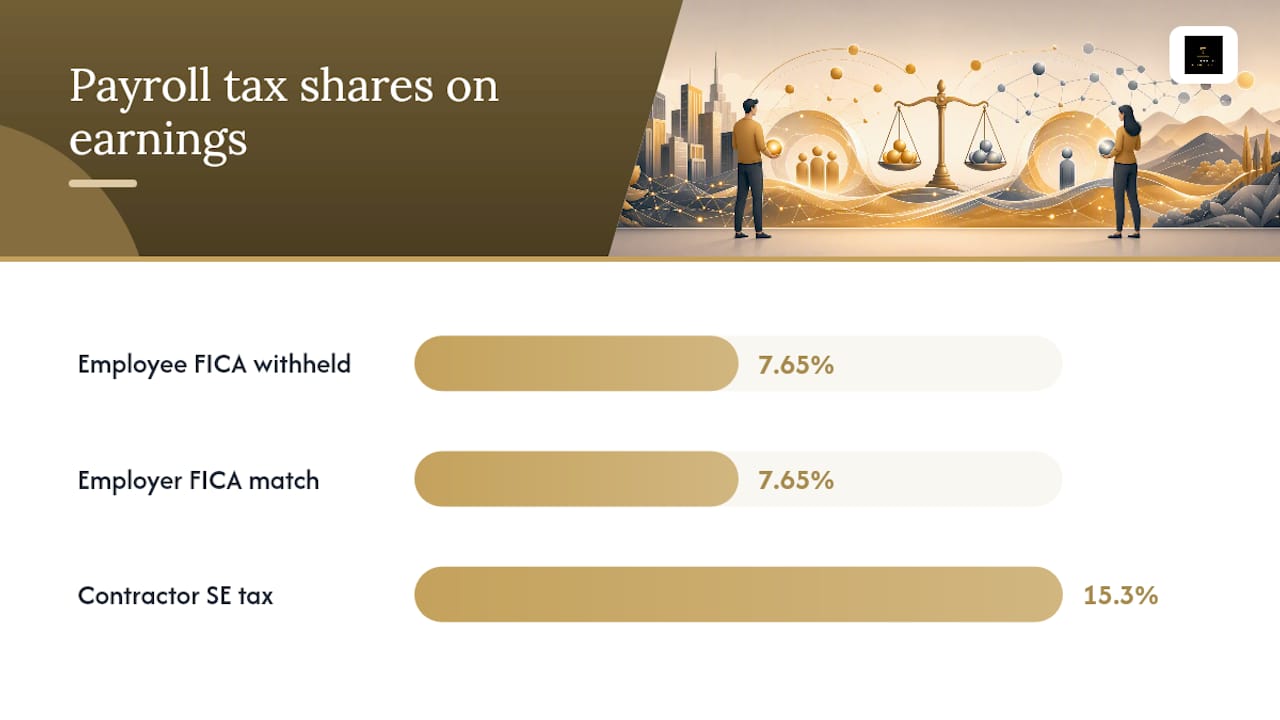
Sample cost comparison (illustrative, $100,000 gross compensation):
| Cost Line | W-2 Employee (employer view) | 1099 Contractor (contractor view) |
|---|---|---|
| Gross pay / contract amount | $100,000 | $100,000 |
| Federal income tax withheld | Yes (from employee wages) | Contractor pays via estimates |
| Total employer cost | — | $100,000 (contract price only) |
The contractor's higher gross rate is not a windfall. It compensates for self-funded benefits, self-employment tax, and the absence of employer-provided protections. Contractors who price their services at the same rate as a W-2 salary typically are undercharging.
Section 199A note: Qualifying 1099 contractors who operate as sole proprietors or pass-through entities may be eligible for the Section 199A qualified business income (QBI) deduction, which can reduce taxable income by up to 20%. Income limits and business-type restrictions apply, and this is one area where a tax strategist adds real value.
How the law decides: IRS factors, DOL tests, and state ABC rules
Classification is a legal determination, not a business preference. A contract that calls someone an independent contractor does not make them one if the facts say otherwise.
The IRS common-law factors
The IRS uses three categories of evidence to evaluate the worker relationship: behavioral control, financial control, and type of relationship.
Behavioral control asks whether the business controls how the worker does the job. Providing detailed instructions, requiring specific work hours, or mandating training all point toward employment. A contractor who sets their own methods and schedule points the other way.
Financial control looks at the economic arrangement. Does the worker invest in their own tools and equipment? Can they profit or lose money on the engagement? Do they work for multiple clients? A worker with a single client, company-provided tools, and a guaranteed hourly rate looks more like an employee.
Type of relationship examines the permanency and integration of the work. Written contracts, employee benefits (health insurance, pension, vacation pay), and whether the work is a key part of the business's regular operations all factor in. No single element is decisive; the IRS weighs all evidence together.
The DOL economic reality test
The Department of Labor applies the economic reality test under the Fair Labor Standards Act (FLSA). The DOL's focus is whether the worker is economically dependent on the employer or genuinely in business for themselves. This test looks at factors like the worker's opportunity for profit or loss, the permanency of the relationship, the degree of skill required, and the extent to which the work is integral to the employer's business. The DOL and IRS tests overlap but are not identical; a worker could be classified differently under each framework, which is why multi-agency exposure is a real risk.
State ABC tests
Many states go further than federal standards. The ABC test, used in California, Massachusetts, New Jersey, and others, presumes a worker is an employee unless the hiring business can prove all three conditions: (A) the worker is free from the company's control and direction in performing the work; (B) the work is outside the usual course of the company's business; and (C) the worker is customarily engaged in an independently established trade or occupation. Condition B is the one that trips up most businesses. A plumbing company that hires a plumber as a contractor will struggle to show that plumbing is outside its usual course of business.
Employers operating across multiple states should evaluate each state's rules independently. A classification that holds up under IRS scrutiny can still trigger state reclassification in a high-enforcement state.
Pro Tip: Keep a classification file for every contractor relationship. Include the signed contract, invoices, evidence of the contractor's other clients, proof of their own business entity, and a brief written memo explaining which IRS factors supported the contractor classification. That file is your first line of defense in an audit.
What misclassification costs employers and how to calculate the real difference
Employer costs: W-2 vs. contractor
Hiring a W-2 employee carries costs beyond the paycheck. Employer FICA (7.65%), FUTA, state unemployment insurance (SUTA), workers' compensation premiums, and any employer-sponsored benefits (health insurance, retirement contributions, paid leave) all add to the total cost of employment. A commonly cited rule of thumb is that benefits and payroll taxes add 20%–30% on top of base wages, though the actual figure varies by state, industry, and benefit package.
Contractors appear cheaper on paper because those costs shift to the contractor. But contractors typically price their services higher to cover self-employment tax and self-funded benefits. The net cost difference is often smaller than it looks, and the classification risk can make the contractor model more expensive in the long run if it triggers enforcement.
| Dimension | W-2 Employee | 1099 Contractor |
|---|---|---|
| Tax withholding | Employer withholds federal income tax and FICA | No withholding; contractor pays estimated taxes |
| Payroll taxes | Employer pays employer FICA, FUTA, SUTA | Contractor pays full self-employment tax (15.3%) |
| Benefits and protections | Unemployment insurance, workers' comp, employer benefits | None provided; contractor self-funds |
| Legal liability and audit risk | Lower misclassification risk when relationship is genuinely supervisory | High risk if behavioral/financial control exists but contractor label is used |
| Best for | Core, recurring staff; roles requiring direct supervision | Specialized, project-based, or short-term engagements with genuine independence |
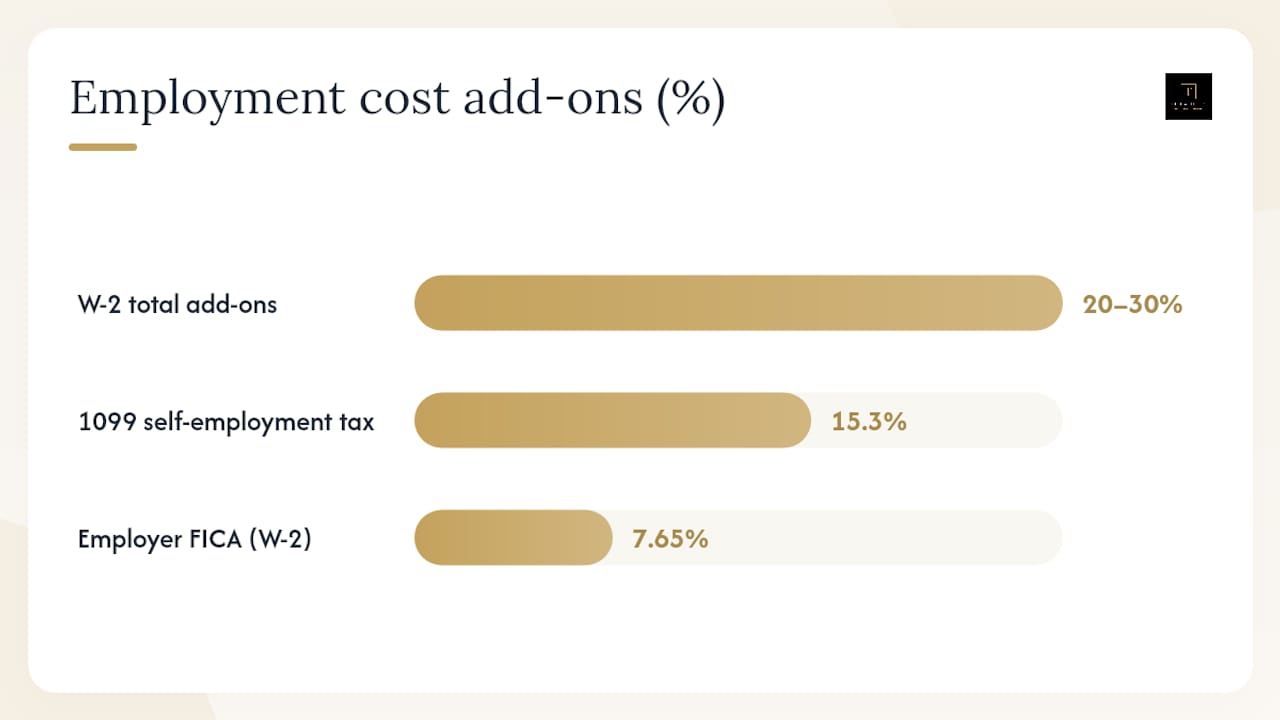
Misclassification penalties
When the IRS or DOL determines a worker was misclassified, the employer faces assessed payroll taxes for the periods in question, plus interest and penalties. State agencies can add wage-and-hour claims, back benefits, and civil penalties on top of federal exposure. Workers who were misclassified may also file claims for denied benefits, including unemployment compensation and workers' compensation coverage. For a detailed look at how misclassification affects denied benefit claims, the Cypress Contractor Misclassification: Denied Benefits Guide from Optimum Employment Lawyers walks through common employer exposure scenarios.
The Voluntary Classification Settlement Program (VCSP)
The IRS Voluntary Classification Settlement Program lets eligible employers reclassify workers as employees on a prospective basis and pay a reduced amount of federal employment taxes for past periods. To qualify, the employer must have consistently treated the workers as contractors, filed all required 1099s, and not be currently under audit. VCSP does not resolve state tax or wage-and-hour exposure, and it does not provide retroactive immunity for prior periods. It is a corrective tool, not a clean slate.
Pros and cons for workers and businesses: when each model makes sense
For workers
W-2 employee advantages:
- Employer pays half of FICA taxes
- Access to employer-sponsored health insurance, retirement plans, and paid leave
- Eligible for state unemployment insurance if laid off
- Covered by workers' compensation for on-the-job injuries
- Simpler tax filing (no Schedule C or SE required)
W-2 employee drawbacks:
- Less flexibility over schedule and work methods
- Income limited to salary or hourly rate; no ability to deduct business expenses directly
- Dependent on a single employer for income
1099 contractor advantages:
- Greater control over schedule, clients, and work methods
- Ability to deduct legitimate business expenses on Schedule C (home office, equipment, professional fees, health insurance premiums)
- Potential QBI deduction under Section 199A
- Income diversification across multiple clients
1099 contractor drawbacks:
- Full self-employment tax burden (15.3% on net income)
- No employer-provided benefits; must self-fund health insurance and retirement
- No unemployment insurance eligibility
- Quarterly estimated tax payments required
- More complex tax filing
For employers and business owners
When W-2 employment fits better:
- The role is ongoing, full-time, or integral to core operations
- The business needs to control how, when, and where work is done
- Consistent quality and supervision are required
- The worker will be client-facing in a way that reflects on the brand
When 1099 contracting fits better:
- The engagement is project-based, short-term, or specialized
- The worker has their own tools, methods, and other clients
- The business does not direct the day-to-day work process
- The work falls outside the company's primary line of business
Best-for guidance by role type: Recurring core staff in trades (HVAC technicians, commercial cleaners, plumbers) who work exclusively for one company and follow company procedures are almost always W-2 employees. Specialized consultants, freelance designers, or independent IT contractors who work across multiple clients and set their own methods are typically legitimate 1099 relationships. For industry-specific hiring patterns in the trades, Cleaning Business Taxes: A Practical Guide for Owners covers classification considerations relevant to recurring-service businesses.
How to choose the right classification and document your decision
The classification decision should be made before the first payment, not after the first audit notice.
Decision checklist
Ask these questions about the working relationship:
Control over work:
- Does the business set the worker's schedule and location?
- Does the business provide training on how to perform the work?
- Does the business direct the sequence or methods of the work?
Financial arrangement:
- Does the worker use their own tools and equipment?
- Can the worker profit or lose money on the engagement?
- Does the worker have other clients or customers?
Nature of the relationship:
- Is the work integral to the company's core business?
- Is the relationship ongoing and indefinite, or project-based with a defined end?
- Does the worker receive any employee-type benefits?
If most answers point toward business control, the relationship is likely employment. If most answers reflect genuine independence, a contractor arrangement may hold up.
Red flags that invite reclassification
- The worker has a set daily schedule dictated by the payer
- The payer provides all tools, equipment, and supplies
- The worker has only one client (the payer) and no independent business presence
- The contract contains clauses restricting the worker from taking other clients
- The worker performs the same tasks as W-2 employees doing the same job
Contract language to avoid
Avoid clauses that give the payer behavioral control: mandatory attendance at company meetings, required use of company systems or uniforms, or language that prohibits the contractor from working for competitors. Those clauses are evidence of employment, regardless of what the contract calls the relationship.
When the classification is genuinely unclear, either the worker or the business can file Form SS-8 to request an official IRS determination. Processing typically takes several months, and the IRS's determination is binding. Filing SS-8 also signals to the IRS that a classification question exists, so it is a step to take with legal or tax counsel, not unilaterally.
For workers navigating this question from the employee side, Am I an Employee or Independent Contractor? from Serendib Law Firm offers a practical legal checklist and state-by-state considerations.
Pro Tip: If you are a business owner who uses contractors regularly, create a standard onboarding packet that includes a signed contractor agreement, a W-9, proof of the contractor's business entity (LLC or sole proprietorship), and a copy of their business insurance certificate. This documentation package demonstrates the independence of the relationship and reduces audit exposure significantly.
Tax planning for 1099 workers and small-business owners
Being a 1099 contractor or small-business owner does not mean accepting a higher tax burden as fixed. The tax code offers several tools that W-2 employees simply do not have access to.
1. Evaluate the S-corp election
A sole proprietor pays self-employment tax on 100% of net profit. An S-corporation owner pays themselves a reasonable W-2 salary, pays payroll taxes only on that salary, and takes the remaining profit as a distribution not subject to self-employment tax. For contractors and business owners netting above roughly $50,000–$60,000 per year, the payroll tax savings can exceed the cost of running payroll and filing a corporate return.
The trade-off: you become both employer and employee. You must run actual payroll, file quarterly payroll returns, and pay yourself a salary the IRS considers reasonable for your industry and role. Underpaying yourself to minimize payroll taxes is a known audit trigger. For a detailed compliance walkthrough, Payroll for S Corp Owner: Your 2026 Compliance Guide covers the mechanics step by step.
2. Set up a retirement plan
Self-employed individuals can contribute to a SEP IRA (up to 25% of net self-employment income, subject to annual IRS limits) or a Solo 401(k) (which allows both employee and employer contributions, often resulting in higher total contribution limits). Both reduce taxable income dollar-for-dollar in the year of contribution. A contractor in a high-income year who maxes out a Solo 401(k) can shelter a substantial portion of earnings that would otherwise be taxed at the top marginal rate.
3. Use an accountable plan
If you operate as an S-corp, an accountable plan lets the business reimburse you for legitimate business expenses tax-free. Without one, expense reimbursements may be treated as taxable compensation. With one, the reimbursement is deductible to the business and not income to you. Common reimbursable expenses include home office costs, mileage, professional development, and equipment.
4. Deduct health insurance premiums
Self-employed individuals and S-corp owners who pay for their own health insurance can deduct those premiums from gross income, subject to specific rules. For S-corp shareholders who own more than 2% of the company, the treatment requires the premium to be included in W-2 wages first, then deducted on the personal return. S Corp Owner Health Insurance: How >2% Shareholders Deduct It explains the mechanics clearly.
5. Track and deduct business expenses on Schedule C
Sole proprietors report income and expenses on Schedule C. Legitimate deductions include home office (if used regularly and exclusively for business), vehicle mileage or actual vehicle expenses, software subscriptions, professional fees, and marketing costs. These deductions reduce the net profit on which both income tax and self-employment tax are calculated.
Sample after-tax comparison (illustrative, $120,000 net contractor income):
| Structure | Taxable Income (approx.) | Self-Employment / Payroll Tax | Notes |
|---|---|---|---|
| Schedule C (sole proprietor) | — | — | Full SE tax on net profit |
| S-corp ($60,000 salary + $60,000 distribution) | Salary subject to payroll tax; distribution is not | — | Requires payroll setup and reasonable compensation |
The S-corp structure does not eliminate taxes; it restructures them. Whether the savings justify the administrative cost depends on income level, state tax treatment of S-corps, and the cost of payroll administration. For professionals transitioning from W-2 employment to private practice or business ownership, When to Transition from Employee to Private Practice Owner addresses the tax implications of that shift in detail.
What happens when misclassification is discovered or audited
Discovering a misclassification problem after the fact is stressful, but the response matters as much as the original error.
The VCSP as a corrective option
The Voluntary Classification Settlement Program is the IRS's formal pathway for employers who want to correct prospectively. Accepted applicants pay a reduced federal employment tax amount for the most recent tax year, agree to treat the workers as employees going forward, and receive protection from IRS employment tax audits for prior years with respect to those workers. Eligibility requires that the employer has not been audited on the classification issue and has filed all required 1099s. VCSP does not cover state taxes or DOL wage-and-hour exposure.
Recommended immediate steps when misclassification is suspected
- Conduct a documentation review — Pull contracts, invoices, communications, and payment records for all contractor relationships. Assess each against the IRS three-factor framework.
Pro Tip: Do not rely on a contractor agreement alone to defend a classification. The IRS and DOL look at the actual working relationship, not the contract label. If the facts show control, the contract will not save you. Document the independence, not just the title.
Key Takeaways
W-2 employees and 1099 contractors are legally distinct classifications determined by the facts of the working relationship, not by contract language or preference.
| Point | Details |
|---|---|
| Tax burden split | Employers pay half of FICA for W-2 workers; 1099 contractors pay the full 15.3% self-employment tax themselves. |
| Classification is fact-based | The IRS, DOL, and state agencies apply multi-factor tests; a contract calling someone a contractor does not make them one. |
| Misclassification carries real cost | Enforcement can result in back payroll taxes, interest, penalties, and state wage-and-hour claims across multiple years. |
| Contractors have planning options | S-corp election, Solo 401(k), accountable plans, and Schedule C deductions can significantly reduce a contractor's effective tax rate. |
| Thetaxrefinery for complex cases | Thetaxrefinery provides classification reviews, S-corp payroll setup, and IRS audit representation for business owners navigating these decisions. |
Why proactive classification and tax planning matter more than most owners realize
Most business owners treat worker classification as a compliance checkbox. They sign a contractor agreement, skip the payroll setup, and move on. The problem is that the IRS and DOL do not care what the contract says. They care what the relationship looks like in practice, and they have enforcement programs specifically designed to find the gap between the two.
The businesses that get caught are rarely the ones that made a deliberate choice to misclassify. They are the ones that made a convenient choice and never revisited it. A contractor who has worked exclusively for one company for three years, follows the company's procedures, uses company equipment, and has no other clients is almost certainly an employee under any reasonable reading of the IRS factors. The contract is irrelevant.
What actually protects a business is documentation and structure. A well-drafted contractor agreement that reflects a genuinely independent relationship, combined with invoices, evidence of the contractor's other clients, and a written classification memo, creates a defensible record. That record is what an Enrolled Agent or tax attorney uses to push back in an audit.
On the contractor side, the tax planning opportunity is real and often underused. The self-employment tax burden is significant, but the tools to manage it, including S-corp election, retirement contributions, and accountable plans, are available to any contractor with consistent income. The difference between a contractor who plans and one who does not is often tens of thousands of dollars per year in retained income. Solo practices and freelance businesses build income. Smart tax structure helps you keep more of it.
How Thetaxrefinery helps with classification, S-corp planning, and audit defense

Thetaxrefinery works with business owners who are past the point of guessing and ready for a documented, strategic approach. If you are deciding whether to bring on W-2 employees or structure contractor relationships correctly, Thetaxrefinery provides classification reviews that assess your specific working relationships against IRS and DOL standards and produce a written determination you can rely on.
For contractors and S-corp owners, the firm handles payroll setup, reasonable compensation analysis, accountable plan design, and year-round advisory so your structure actually works the way it is supposed to. When the IRS comes calling, Thetaxrefinery's Enrolled Agent representation covers audit defense and IRS resolution, from initial correspondence through final settlement.
The clients who benefit most are business owners netting $300,000 or more per year who want a tax partner, not a seasonal filer. If that describes your situation, book a consultation or review the tax strategy and advisory services to see where the firm fits your needs.
Primary sources and further reading
The following official and authoritative sources were used in preparing this article. Each is worth bookmarking if you are managing classification decisions or planning for a contractor or S-corp structure.
- Independent contractor (self-employed) or employee? | Internal Revenue Service
- Self-employment tax (Social Security and Medicare taxes) | Internal Revenue Service
- About Form 1099-NEC | Internal Revenue Service
- ABC test | Legal Information Institute (Cornell Law)
- Voluntary Classification Settlement Program (VCSP) | Internal Revenue Service
- W-2 vs 1099: A Classification Guide for Payers | Tax1099
This article provides general tax and legal information for educational purposes. Tax laws change, and individual circumstances vary. Confirm current rules with the IRS, your state tax authority, or a qualified tax professional before making classification or planning decisions.
Recommended
- Partnership vs. Solo Practice: The Tax Mathematics (with S Corp Option) | The Tax Refinery
- The Tax Refinery — Tax Strategy, Preparation & Resolution | Boise, ID
- The Tax Refinery — Tax Strategy, Preparation & Resolution | Boise, ID
- When to Transition from Employee to Private Practice Owner: Tax Implications of the Switch | The Tax Refinery