
Cleaning business taxes consist of self-employment tax, federal and state income tax, and a range of deductible expenses that every cleaning business owner must understand reducing their tax burden legally. Self-employed cleaning business owners pay 15.3% self-employment tax on 92.35% of net profit, covering Social Security and Medicare. That rate applies before income tax, which means your total tax obligation is higher than most new owners expect. The Tax Refinery, a Treasure Valley, Idaho tax strategy firm founded by Enrolled Agent Melissa Korber, works specifically with cleaning and recurring-service business owners to build plans that reduce what they owe and keep more money in their business.
What are the key cleaning business tax obligations?
Self-employed cleaning business owners file taxes using Schedule C and Schedule SE. Schedule C reports business income and expenses. Schedule SE calculates the self-employment tax owed on net profit. These two forms are the foundation of how to file cleaning business taxes as a sole proprietor or single-member LLC.
All income must be reported, regardless of how it arrives. That includes 1099-NEC forms from commercial clients, 1099-K forms from payment platforms like Venmo or Stripe, and cash payments that no one issues a form for. The IRS requires you to report every dollar earned, and unreported cash income is one of the most common audit triggers for service businesses.

Quarterly estimated tax payments are required when you expect to owe $1,000 or more for the year. The 2026 due dates are april 15, june 16, september 15, and january 15. Missing these payments results in underpayment penalties averaging 8% annually. That penalty is avoidable with a simple calendar reminder and a dedicated savings habit.
The safest approach is to set aside 25–30% of net profit for taxes each time you get paid. That range covers both self-employment tax and federal income tax for most cleaning business owners. Owners who skip this step often face a large, unexpected bill in april.
Pro Tip: Use the safe harbor rule: pay at least 100% of last year's total tax liability across four equal quarterly payments, and the IRS cannot penalize you for underpayment even if you owe more at filing.
- Collect all income records: 1099-NEC, 1099-K, and cash payment logs.
- Calculate net profit on Schedule C by subtracting deductible expenses from gross income.
- Apply Schedule SE to determine self-employment tax owed.
- Pay quarterly estimates on time to avoid penalties.
- File your annual return by april 15 or request an extension.
What are the major tax deductions for cleaning services?
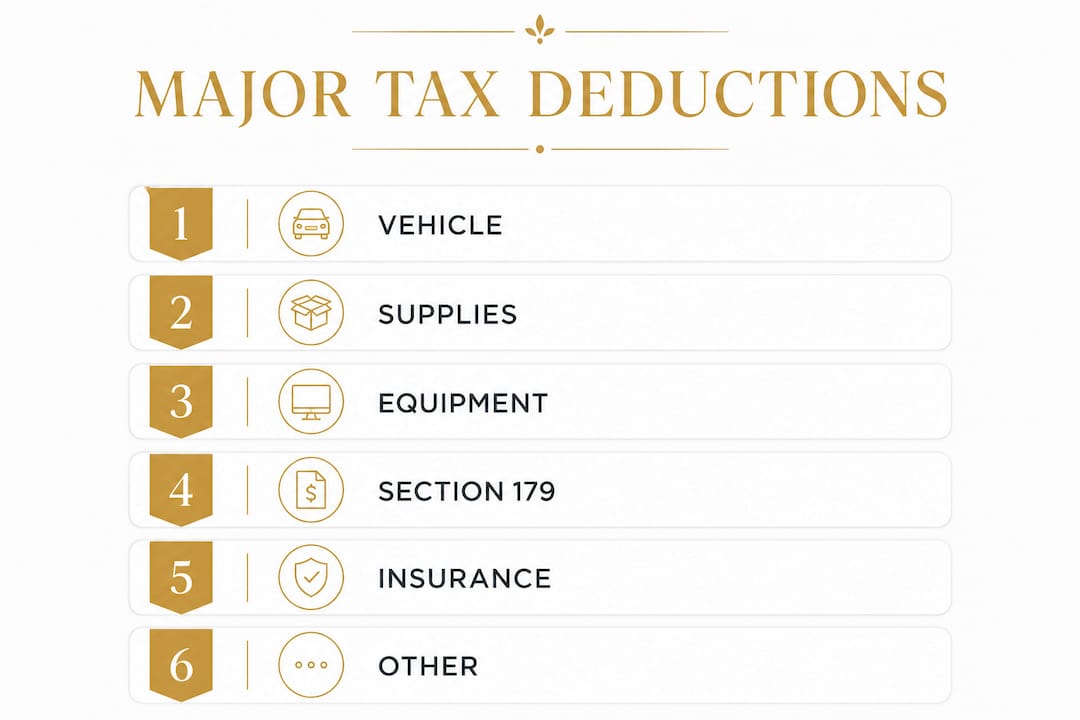
Tax deductions for cleaning services reduce taxable income directly, which lowers both income tax and self-employment tax. Most cleaning business owners underestimate how many legitimate deductions they qualify for. The categories below cover the most significant write-offs available in 2026.
Vehicle expenses
Vehicle costs are typically the largest deduction for cleaning businesses. The IRS 2026 standard mileage rate is 72.5 cents per business mile. A cleaner driving 6,200 business miles can deduct approximately $4,495 using this method alone. That is a meaningful reduction in taxable income for a single vehicle.
The actual expense method tracks fuel, insurance, repairs, registration, and depreciation instead of miles. Choosing between these two methods requires evaluating annual vehicle maintenance, fuel costs, and total mileage to determine which produces the higher deduction. Owners with older, high-maintenance vehicles often benefit more from the actual expense method.
| Method | Best for | Record requirement |
|---|---|---|
| Standard mileage (72.5¢/mile) | High-mileage, low-maintenance vehicles | Mileage log with dates, destinations, and purpose |
| Actual expense | High-maintenance or low-mileage vehicles | All receipts: fuel, repairs, insurance, registration |
Supplies, equipment, and Section 179
Cleaning supplies and equipment are fully deductible business expenses. Annual supply costs typically range from $2,000 to $6,000 depending on business scale. Vacuums, carpet extractors, pressure washers, and commercial floor machines all qualify.
Section 179 allows immediate expensing up to $1,160,000 for qualifying equipment in 2026. That means you can deduct the full cost of a major equipment purchase in the year you buy it rather than depreciating it over several years. Equipment costing over $2,500 that does not qualify for Section 179 must be depreciated on a standard schedule.
Other deductible expenses
- Business insurance and bonding: Premiums for general liability, workers' compensation, and janitorial bonds are fully deductible.
- Home office: If you use a dedicated space exclusively for business administration, you can deduct it using the simplified method ($5 per square foot, up to 300 square feet) or the regular method based on actual home expenses.
- Marketing and advertising: Website costs, business cards, Google Ads, and local directory listings all qualify.
- Software subscriptions: Scheduling, invoicing, and accounting software fees are deductible. Many owners miss these recurring costs, even though they can reduce taxable income by thousands annually.
- Uniforms and branded apparel: Clothing that is not suitable for everyday wear and is required for the job is deductible.
- Professional services: Fees paid to accountants, bookkeepers, and tax advisors like The Tax Refinery are fully deductible.
Pro Tip: Keep a dedicated folder, physical or digital, for every receipt. The IRS requires documentation for any deduction you claim, and a missing receipt means a disallowed deduction during an audit.
How to maintain accurate records for tax efficiency
Accurate recordkeeping is the single most controllable factor in your tax outcome. Without it, legitimate deductions get lost, and audit exposure increases. The good news is that a few consistent habits eliminate most of the risk.
Maintaining separate business accounts and storing digital receipts makes tax preparation faster and audit defense far stronger. A dedicated business checking account and business credit card create a clean paper trail that separates personal spending from deductible expenses. Mixing accounts is one of the most common and costly mistakes new cleaning business owners make.
- Bookkeeping software: Tools like QuickBooks Self-Employed or Wave allow you to categorize income and expenses in real time, generate profit and loss statements, and export data directly to your tax preparer.
- Digital receipt storage: Apps like Dext or Hubdoc photograph and store receipts automatically. The IRS accepts digital records.
- Mileage tracking: Apps like MileIQ or Everlance dramatically simplify deduction claims and IRS compliance. Log every trip with the date, destination, and business purpose.
- Document retention: Keep tax records, receipts, and mileage logs for at least 3 years from the filing date. The IRS generally has three years to audit a return.
- Payment platform records: If you accept payments through Venmo, Zelle, or Square, download transaction histories quarterly. These platforms issue 1099-K forms when thresholds are met, and the IRS receives a copy.
Pro Tip: Reconcile your business bank account monthly, not just at tax time. Catching a missing receipt in March is far easier than reconstructing a year of transactions in april.
What strategic tax planning tips can improve your tax outcome?
Proactive planning separates cleaning business owners who are surprised by their tax bill from those who are not. The difference is rarely about earning less. It is about making deliberate decisions throughout the year.
Cleaning business owners who plan cash flow and make quarterly payments consistently stay ahead of tax surprises and penalties. That discipline compounds over time. Owners who treat taxes as a year-end task consistently overpay or underpay, both of which cost money.
Choosing the right vehicle deduction method, claiming every software subscription, and making quarterly payments on time are not complicated moves. They are the difference between a tax bill that stings and one that does not. The cleaning businesses I work with that implement these three habits consistently retain thousands more each year. Tax strategy is not reserved for large companies. It works at every revenue level.
Key planning moves for cleaning business owners:
- Choose your vehicle method deliberately. Run the numbers both ways before committing. Once you use the actual expense method for a vehicle, you cannot switch to standard mileage for that vehicle.
- Claim every software subscription. Scheduling apps, accounting tools, and CRM platforms all qualify. These recurring deductions reduce taxable income in ways that add up quickly.
- Use Section 179 for equipment timing. If you plan to buy a vacuum or pressure washer, buying it before december 31 lets you deduct the full cost in the current tax year.
- Set quarterly payment reminders. Calendar alerts for april 15, june 16, september 15, and january 15 cost nothing and prevent an 8% penalty.
- Work with a tax professional. A firm like The Tax Refinery provides year-round strategy, not just annual filing. That ongoing relationship catches opportunities and problems before they become expensive.
Use the quarterly tax calculator at The Tax Refinery to estimate what you owe before each payment deadline. It takes the guesswork out of how much to set aside.
Key Takeaways
Cleaning business owners who understand their tax obligations, claim every available deduction, and make quarterly payments on time consistently pay less and face fewer surprises at filing.
| Point | Details |
|---|---|
| Self-employment tax rate | You owe 15.3% on 92.35% of net profit, covering Social Security and Medicare. |
| Quarterly payments | Pay estimated taxes four times per year to avoid an 8% underpayment penalty. |
| Vehicle deductions | The 2026 standard mileage rate is 72.5 cents per mile; compare to actual expenses annually. |
| Section 179 expensing | Deduct up to $1,160,000 in qualifying equipment costs in the year of purchase. |
| Recordkeeping standard | Keep receipts and mileage logs for at least 3 years; separate business and personal accounts. |
What I've learned from working with cleaning business owners on taxes
The biggest tax mistake I see from cleaning business owners is not missing a deduction. It is waiting until april to think about taxes at all. By then, the quarterly penalties are already locked in, the receipts are gone, and the options are limited. The owners who come to me in january with organized records and a full year of quarterly payments behind them are in a completely different position than those who show up in march with a shoebox.
Idaho cleaning businesses, especially those operating across the Treasure Valley, often have strong revenue but thin margins. Every deductible dollar matters. I have seen owners leave thousands on the table by skipping mileage logs, ignoring software subscriptions, or not knowing that their bonding premiums are fully deductible. These are not obscure tax strategies. They are basic compliance items that require only consistent habits.
The other thing I tell every new client: do not fear the IRS. Respect it. Keep clean records, pay on time, and work with someone who knows your industry. Taxes become manageable when you treat them as a monthly business task rather than a once-a-year crisis.
— Melissa
How The Tax Refinery supports cleaning business owners
Cleaning business owners in Idaho deserve more than a once-a-year tax filing. They need a tax partner who understands recurring-service businesses, knows the deductions that apply, and builds a plan that works all year.

The Tax Refinery, based in the Treasure Valley and founded by Enrolled Agent Melissa Korber, provides year-round tax strategy tailored to cleaning and trade businesses. Services include S-corp planning, accountable plans, quarterly payment planning, and full tax preparation. Cleaning business owners can review service pricing and plans online or book a consultation to get a personalized strategy built around their business. The Tax Refinery's approach turns tax planning into a measurable financial advantage, not just a compliance checkbox.
FAQ
What tax forms does a cleaning business owner need to file?
Most self-employed cleaning business owners file Schedule C to report income and expenses, and Schedule SE to calculate self-employment tax. These attach to Form 1040, the standard individual income tax return.
How much should I set aside for cleaning business taxes?
Set aside 25–30% of net profit for taxes. That range covers the 15.3% self-employment tax plus federal income tax for most cleaning business owners.
What are the best tax deductions for cleaning services?
The top deductions include vehicle mileage at 72.5 cents per mile, cleaning supplies and equipment, business insurance and bonding, software subscriptions, home office costs, and professional service fees.
When are quarterly estimated tax payments due in 2026?
The 2026 quarterly payment deadlines are april 15, june 16, september 15, and january 15. Owners who expect to owe $1,000 or more must make these payments to avoid penalties.
Does cash income from cleaning clients need to be reported?
Yes. All income must be reported on Schedule C, including cash payments that no client reports on a 1099 form. Unreported cash income is a common IRS audit trigger for service businesses.