
Yes, SSTB status matters, and for high earners it can eliminate the Qualified Business Income deduction entirely. A Specified Service Trade or Business is any activity in a listed service field, or one where the owner's reputation or skill is the main asset. Below the income thresholds, that label changes nothing. Above them, it can zero out a deduction that non-SSTB owners keep, at least in part, per IRS guidance on Form 8995-A.
TL;DR:
- Businesses with income below $201,750 for singles or $403,500 for couples face no SSTB-related deduction restrictions.
- Activities in fields like health, law, or finance qualify as SSTBs, but product sales and standardized services generally do not.
- Above the $403,500 threshold, SSTB owners lose the entire Qualified Business Income deduction, while non-SSTBs may still benefit from wage-based limits.
- Classifying a business requires sequential tests: matching the field, assessing reputation or skill dependence, and reviewing revenue composition.
- Early income modeling and diligent documentation before year-end help prevent surprises and optimize QBI and SSTB planning strategies.
Table of Contents
- What Counts as an SSTB Under Section 199A?
- Which Fields Are on the SSTB List (With Examples)?
- What Are the QBI Income Thresholds and Phase-Out Zones?
- How Do You Determine If a Business Is an SSTB?
- Non-SSTB Wage Limits vs. SSTB Exclusion: What's the Real Difference?
- Handling Mixed Activities and Aggregation
- Which Tax Forms Handle SSTB Reporting?
- Planning Steps Business Owners Should Run Now
- Why SSTB Classification Is a Strategy Question, Not Just a Filing One
- How Thetaxrefinery Helps You Navigate SSTB and QBI Planning
- Sources
- FAQ
What Counts as an SSTB Under Section 199A?
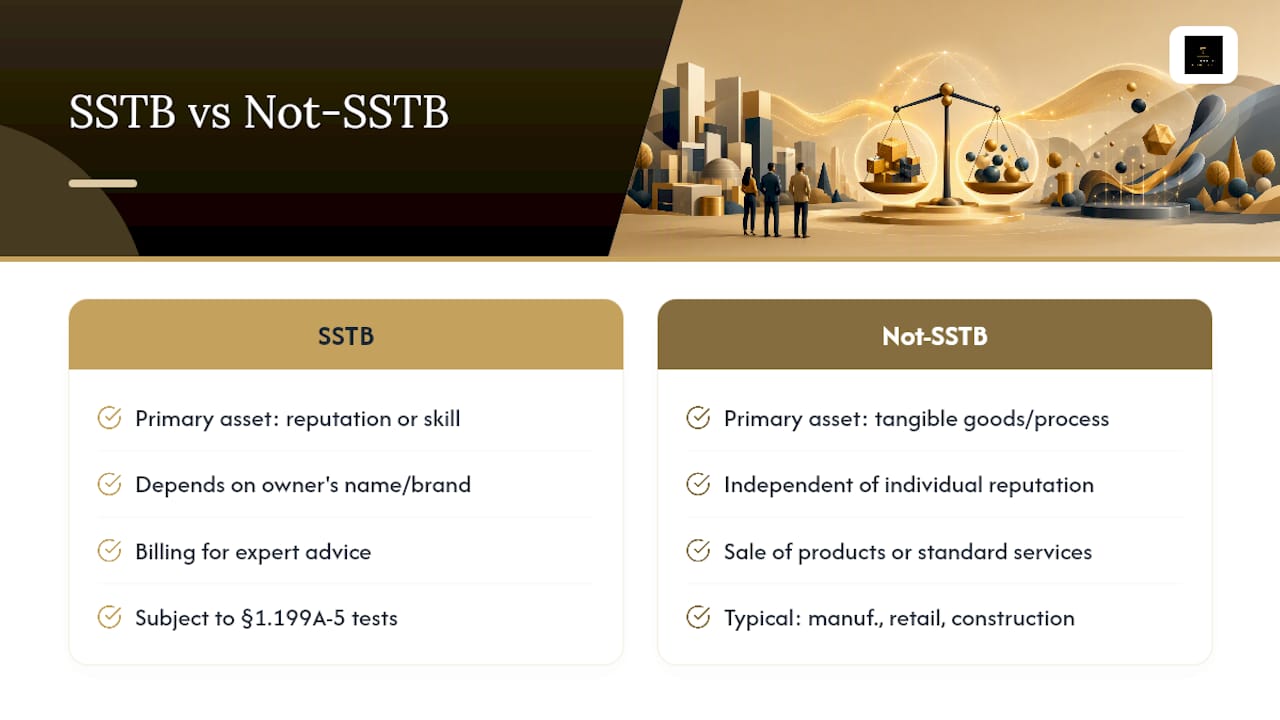
Section 199A and its regulations define an SSTB as a trade or business performing services in specific named fields, plus a catch-all category for any business whose principal asset is the reputation or skill of its owners or employees. That second part is where most disputes start.
Treasury Regulation §1.199A-5 lays out the actual tests the IRS uses, and it's worth reading if you're on the fence about a client's classification. The reputation-or-skill clause was written broadly on purpose. Congress didn't want a lawyer to escape SSTB treatment just by branding the practice as "legal consulting services" instead of "law firm." A business built entirely around one person's name, endorsement deals, or personal following tends to trip this wire, even outside the named fields.
Here's what keeps a lot of businesses out of SSTB territory: selling a product. Manufacturing, retail, wholesale distribution, and most construction trades fall outside the list because the value sits in a tangible good or a repeatable process, not in one person's expertise. A landscaping company that installs irrigation systems isn't an SSTB. A landscape design consultant who charges purely for expert advice might be, depending on the facts. The IRS's general Section 199A guidance confirms the intent: the rule targets services tied to individual expertise, not businesses selling goods or standardized services.
Which Fields Are on the SSTB List (With Examples)?
The named fields cover a specific set of professions, each with real-world variation in how the rule applies. Here's the canonical list, with the kind of business that typically qualifies and the kind that typically doesn't:
- Health: Physicians, dentists, and physical therapists providing direct patient care are SSTBs. A gym or health club that just sells memberships and equipment access is not, even though it's "health adjacent."
- Law: Attorneys and law firms qualify. A paralegal staffing agency that places workers but doesn't provide legal advice generally does not.
- Accounting: CPAs, bookkeepers providing advisory services, and tax preparers qualify; for specialized support in this sector, consider the beste boekhoudsoftware voor wervingsbureaus to manage financial details efficiently. A payroll processing company that just runs calculations without advisory input often falls outside the definition.
- Actuarial science: Actuaries and risk consultants qualify. Insurance sales agents who earn commissions on policies typically do not, since the IRS explicitly separated insurance agents and brokers from the SSTB definition.
- Performing arts: Actors, musicians, and directors qualify. A movie theater or concert venue owner does not, because they're selling access to a performance, not performing themselves.
- Consulting: Advice-for-fee arrangements qualify. Sales representatives who earn commissions on actual product sales generally do not, even if their pitch involves advice.
- Athletics: Professional athletes and coaches providing personal instruction qualify. A sports facility owner renting out courts or fields does not.
- Financial services: Financial advisors and wealth managers qualify. A bank teller or loan processor performing routine transactions typically does not.
- Brokerage services: Stockbrokers and real estate brokers advising on trades and negotiations qualify, though real estate agents closing standard transactions sit in a gray area often argued down to non-SSTB.
- Investing and investment management: Fund managers and portfolio advisors qualify. A real estate investor who buys and holds rental property for income does not, since that's treated as a non-SSTB trade or business.
- Trading: Businesses trading securities, commodities, or partnership interests for their own account qualify.
What Are the QBI Income Thresholds and Phase-Out Zones?
Taxable income, not gross receipts, is what determines whether SSTB status actually costs you anything. There are three zones, and where a business owner lands changes the entire calculation.
Pro Tip: Run last year's actual taxable income against these thresholds before assuming SSTB status is a problem. Plenty of owners worry about a label that has zero effect on their return.
For 2026, the lower thresholds are $201,750 for single filers and $403,500 for married filing jointly. Below these figures, SSTB status doesn't matter at all. The business gets the full 20% deduction treatment just like any non-SSTB, according to IRS guidance on QBI thresholds.
Above the lower threshold, a phase-in range begins, and the SSTB share of the deduction shrinks proportionally as income climbs toward the upper threshold. Once taxable income crosses the upper threshold, the SSTB portion of the deduction disappears completely.
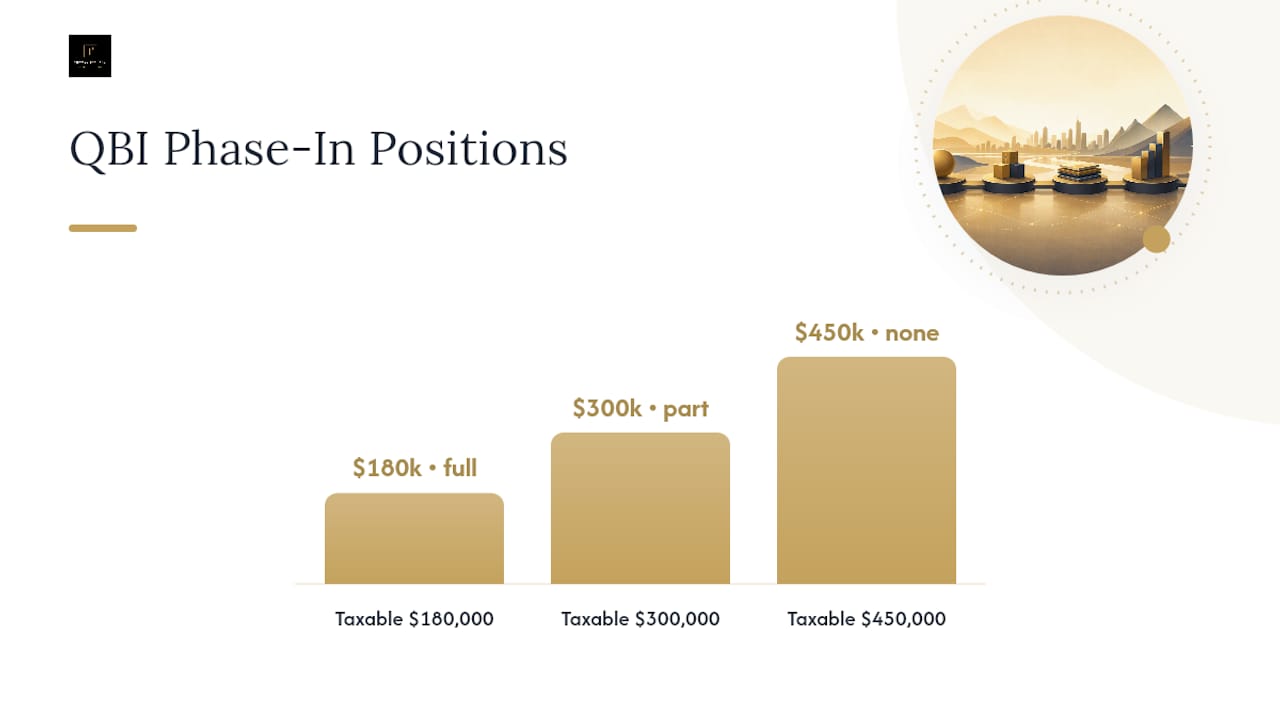
Picture three consulting business owners with identical $150,000 QBI. One reports $180,000 in taxable income and gets the full deduction, since they're below the lower threshold. A second reports $300,000, sitting mid-phase-in, and keeps only a partial deduction calculated on Schedule A. A third reports $450,000, above the upper threshold, and gets nothing from that consulting income. Same business, same income level, wildly different outcomes based purely on where taxable income lands.
How Do You Determine If a Business Is an SSTB?
Classifying a business isn't guesswork if you run through the tests in order. Here's the sequence that actually resolves most cases:
- Check the field match first. Does the activity fall under one of the named categories, health, law, accounting, and so on? If yes, move to the de minimis test. If no, check reputation-or-skill exposure before ruling it out.
- Apply the reputation-or-skill test for anything outside the named fields. Ask whether the business would exist without one specific person's name, following, or expertise attached to it. Endorsement income, licensing an individual's likeness, and personal-brand consulting often qualify here even when the field itself isn't listed.
- Run the de minimis calculation. If gross receipts are $25 million or less and less than 10% of those receipts come from specified service activities, the business isn't an SSTB for that year, regardless of what the activity looks like on paper, per the Form 8995-A instructions.
- Apply the test per trade or business, not per taxpayer. An owner with three separate LLCs runs this analysis three times. A restaurant and a separate catering-consulting arm aren't automatically bundled together just because one person owns both.
- Document the allocation. If a business has mixed revenue streams, keep separate books showing what share came from specified services versus product or non-service income.
Non-SSTB Wage Limits vs. SSTB Exclusion: What's the Real Difference?
Above the upper threshold, non-SSTB owners and SSTB owners face two completely different math problems, and the gap between them is larger than most people expect.
Non-SSTB businesses above the upper threshold don't lose the deduction outright. Instead, the deduction gets capped by the greater of 50% of W-2 wages paid, or 25% of W-2 wages plus 2.5% of unadjusted basis immediately after acquisition (UBIA) of qualified property. A manufacturing company paying substantial wages and holding real equipment can often still claim a meaningful deduction even at high income, because Treasury Regulation §1.199A-5 applies the wage and UBIA limits rather than a flat exclusion.
An SSTB above that same upper threshold gets none of that. The deduction on the specified service income drops to zero, full stop, regardless of how many employees it has or how much property it owns.
Say two businesses each generate $200,000 in QBI and pay $80,000 in W-2 wages, with taxable income above the upper threshold. The SSTB gets zero. Same numbers, same wage base, completely different result purely because of the classification.
One more clarification worth keeping straight: employee W-2 wages and C-corporation income never count as QBI in the first place. This deduction is built for pass-through owners, not employees or C-corp shareholders.
Handling Mixed Activities and Aggregation
Plenty of real businesses blend a specified service with something that clearly isn't one, a dental practice that also sells whitening kits, or a consulting firm that resells software licenses. The per-trade-or-business rule means you don't have to treat the whole entity as tainted just because one piece qualifies as an SSTB.
When the specified-service share of gross receipts stays under 10% (or 5% for businesses with receipts over $25 million), the de minimis rule keeps the entire operation out of SSTB territory. Cross that line, and the whole trade or business gets swept into SSTB treatment, even the product revenue.
Aggregation rules, which let commonly owned businesses combine for QBI purposes, work in the opposite direction here. Aggregating an SSTB with a clean non-SSTB business generally doesn't help, and can actually taint the non-SSTB side depending on how the businesses are structured, per the Form 8995-A instructions.
Practical steps that hold up under scrutiny:
- Keep separate general ledger accounts for service versus product revenue.
- Use distinct client contracts or invoices when a single customer buys both a service and a product.
- Document the reasoning behind any receipts allocation before filing, not after an audit letter arrives.
Which Tax Forms Handle SSTB Reporting?
Form selection comes down to income level and whether SSTB status is even in play. Form 8995 is the simplified version, and it works fine when taxable income sits below the lower threshold, since SSTB status has no effect there anyway.
Once taxable income crosses into the phase-in range or above, Form 8995-A becomes mandatory. Its Schedule A is where SSTB businesses calculate the applicable percentage during phase-in, and Schedule B is where taxpayers report aggregated trades or businesses.
Before sitting down with either form, gather:
- Taxable income before the QBI deduction
- QBI, W-2 wages, and UBIA of qualified property for each trade or business
- A clear determination of SSTB status for each entity
- Documentation supporting any de minimis or aggregation position taken
Planning Steps Business Owners Should Run Now
Waiting until filing season to discover SSTB exposure is the expensive way to find out. A few moves are worth doing well before year-end.
Model current-year taxable income against the thresholds now, not in March. If you're tracking close to the lower threshold, small timing decisions on income or deductions can keep you in the zone where SSTB status doesn't matter at all. If a business has mixed revenue, check the de minimis math today, before receipts patterns shift. Document service versus product revenue in real books, not a spreadsheet reconstructed after the fact.
For S corporation owners, salary levels interact directly with the wage limit calculation, and modeling that interaction alongside SSTB exposure is exactly the kind of scenario planning covered in Stop Losing QBI in 2026. This isn't a substitute for a specific consultation. Thetaxrefinery's service pages outline the structured advisory work that supports these decisions.
Why SSTB Classification Is a Strategy Question, Not Just a Filing One
SSTB status shapes decisions long before a tax return gets filed. It influences how owners price services, whether they split product lines into separate entities, and how they structure S corporation salaries against the wage test. Treating it as a once-a-year compliance question misses the point.
The owners who come out ahead are the ones who model their income against these thresholds mid-year and keep clean documentation before a dispute ever starts, not after.
— Melissa
How Thetaxrefinery Helps You Navigate SSTB and QBI Planning
Figuring out whether your business trips the reputation-or-skill test, or how close you're sitting to the phase-in range, isn't something you want to guess at with a generic calculator. Some tax strategy firms build SSTB and QBI modeling directly into their advisory engagements, running actual numbers instead of applying a one-size template.
For owners who need ongoing scenario planning as income shifts throughout the year, Monthly Tax Advisory and Quarterly Tax Strategy Sessions build SSTB exposure checks into the regular planning cycle rather than a once-a-year filing conversation. S corporation owners weighing salary levels against the wage limit and SSTB exclusion together have a more targeted path through the S-Corp Tax Strategy Accelerator. Start by reviewing the tax strategy comparison page to see which engagement model fits your current income situation and business structure.
Sources
This article is general information, not a substitute for advice from a qualified financial advisor. Consult a qualified financial professional about your own circumstances before acting on anything here.
FAQ
What Qualifies as an SSTB for QBI?
An SSTB is a trade or business performing services in a named field like health, law, accounting, consulting, or financial services, or any business where the owner's reputation or skill is the primary asset, per Treasury Regulation §1.199A-5. Product-based businesses like retail and manufacturing generally fall outside the definition.
What Is the QBI SSTB Threshold for 2026?
The lower threshold is $201,750 for single filers and $403,500 for married filing jointly, per IRS guidance. Below that level, SSTB status has no impact on the deduction; above the upper threshold, the SSTB deduction phases out completely.
How Do I Know if My Business Qualifies for QBI?
Check whether your taxable income falls below the lower threshold, since SSTB status doesn't matter there, then confirm whether your activity matches a named SSTB field or fails the reputation-or-skill test. The Form 8995-A instructions walk through the de minimis exception for mixed-activity businesses.
Who Is Excluded From QBI?
Employee W-2 wages and C-corporation income are excluded from QBI entirely, regardless of SSTB status. High-income SSTB owners above the upper threshold are also effectively excluded from claiming any deduction on their specified service income.