
Rental income can qualify for the 20% Qualified Business Income deduction, and the safe harbor under Rev. Proc. 2019-38 is the clearest, most defensible way to get there. Before you claim it, confirm three things: the required hours of rental services logged for the year, separate books kept by property or enterprise, and contemporaneous records showing who did what, when, and for how long. Miss the safe harbor, and you may still qualify under a facts-and-circumstances test, but exclusions like triple-net leases and personal-use properties can shut the door entirely, so a quick professional review is worth the hour it takes.
TL;DR:
- Meeting the 250-hour threshold and maintaining detailed, real-time logs are essential to qualify for the safe harbor under Rev. Proc. 2019-38.
- Properties involved in triple-net leases, used personally, or rented for short-term guest services generally cannot rely on the safe harbor and require a facts-and-circumstances analysis.
- If the safe harbor is not met, rental activity might still qualify as a trade or business under Section 162, depending on factors like regularity, profit motive, and scale.
- Proper grouping of rental properties early and precise recordkeeping, including timestamps and third-party documentation, are critical for audit defense and eligibility.
- The calculation of the QBI deduction starts at 20% of net rental income, with limits imposed by taxable income, W-2 wages, and unadjusted basis in qualified property.
Table of Contents
- What Are the Basic Tests for QBI for Rentals?
- How Does the Rev. Proc. 2019-38 Safe Harbor Work?
- What Counts as a Trade or Business Under Section 162?
- What Are the Common Pitfalls and Excluded Rentals for QBI?
- How Do You Calculate the QBI Deduction for Rental Income?
- What Recordkeeping Do You Need to Protect Your QBI Claim?
- What Does Practice-Based QBI Guidance Look Like?
- Why the Safe Harbor Deserves More Attention Than It Gets
- How Thetaxrefinery Helps Rental Owners Secure QBI
- Sources
- FAQ
What Are the Basic Tests for QBI for Rentals?
Before you dig into the paperwork, run through this self-screen. If you can check most of these boxes right now, you're in strong shape to claim the safe harbor on this year's return.
- 250-hour test: Did you, your employees, or your contractors log 250+ hours of rental services this year (or in 3 of the last 5 years for older enterprises)?
- Separate books: Do you maintain distinct financial records for each rental or your rental enterprise as a whole?
- Contemporaneous logs: Can you produce entries showing who performed the work, what they did, when, and how long it took?
- Red flags: Do any properties involve triple-net leases, personal use by you or family, or rentals to a business you or a relative control?
If you're missing the hour count or the logs, don't panic. The IRS QBI guidance makes clear that failing the safe harbor doesn't automatically disqualify you. It just means you're leaning on a different, less certain standard.
How Does the Rev. Proc. 2019-38 Safe Harbor Work?
The safe harbor gives you a structured way to treat your rentals as a trade or business for Section 199A purposes, and it works property by property or as a grouped "rental real estate enterprise." You can group similar properties consistently (all residential, or all commercial) as long as you don't mix residential and commercial in the same enterprise.
Here's the sequence the revenue procedure lays out:
- Define your enterprise. Decide whether each property stands alone or whether similar properties group together for the hour count and bookkeeping.
- Hit the 250-hour threshold. Count time spent on tasks like tenant communication, lease negotiation, rent collection, maintenance coordination, and advertising. Financing, arranging financing, and time spent as an investor (reviewing statements, planning) generally don't count.
- Keep separate books and records for each enterprise, reflecting income and expenses distinctly from your other activities.
- Log everything contemporaneously. Records should show the date, a description of the activity, how many hours it took, and who performed it.
- Attach a signed statement to your return each year you rely on the safe harbor, affirming you met all the requirements under Rev. Proc. 2019-38.
Pro Tip: Log your hours the same week you do the work, not the week before your return is due. A spreadsheet built in April to cover January through December almost never survives scrutiny, because it reads like a reconstruction rather than a record.
What Counts as a Trade or Business Under Section 162?
If your rental doesn't clear the safe harbor, you're not automatically out. The Journal of Accountancy's analysis confirms rentals can still qualify as a trade or business under the older Section 162 standard, which the IRS assesses based on facts and circumstances rather than a checklist.
The IRS generally weighs:
- Regularity and continuity of the rental activity, not sporadic or occasional involvement.
- Profit motive, demonstrated through pricing, marketing, and financial planning.
- Scale of operations, including how many units or properties you manage.
Evidence that helps your case includes signed leases, property management agreements, advertising records, and 1099s issued to contractors. Lease structure matters too: a single tenant on a long-term triple-net lease looks far more passive than a multi-unit residential property with active turnover and marketing. Because this test has no bright-line hour count, it carries more audit risk than the safe harbor, and it's the point where a professional review earns its cost.
What Are the Common Pitfalls and Excluded Rentals for QBI?
Some rental arrangements come with built-in complications, and knowing them early saves you from claiming a deduction you can't support.
- Triple-net leases (NNN) are explicitly excluded from the safe harbor under Rev. Proc. 2019-38, so NNN landlords must rely on the Section 162 facts-and-circumstances test instead.
- Personal-use and vacation homes fall under IRC §280A limits, and any property used personally for more than the allowed threshold generally can't qualify.
- Self-rentals to a commonly controlled business get special treatment. Renting to your own S-corp or partnership can trigger trade-or-business status automatically under related-party rules.
- Short-term rentals with active guest services (cleaning, concierge-style amenities) often push more clearly toward business status than a long-term lease with minimal owner involvement.
- Reconstructed logs built after an audit notice arrives carry far less weight than timestamped, real-time entries.
How Do You Calculate the QBI Deduction for Rental Income?
The math starts simple: your tentative QBI deduction is 20% of net rental income after deducting expenses, depreciation, and mortgage interest. From there, two sets of limits can reduce what you actually claim.
First, there's an overall taxable-income cap. Your combined QBI deduction can't exceed 20% of your taxable income minus net capital gains. Second, once your taxable income crosses the annual threshold set by the IRS, a wage and property test kicks in: your deduction is limited to the greater of 50% of W-2 wages paid by the business, or 25% of W-2 wages plus 2.5% of the unadjusted basis immediately after acquisition (UBIA) of qualified property.
Why UBIA matters for landlords: Most rental operations pay little or no W-2 wages, but they often carry substantial UBIA in buildings and improvements. That 2.5% UBIA prong is frequently what saves the deduction for high-income rental owners who'd otherwise fail the W-2 test entirely.
Say your rental nets $80,000 after expenses. Tentative QBI is $16,000. If your taxable income sits below the threshold, you likely claim the full amount. Above it, the wage/UBIA test applies, and a property with a $1,000,000 basis could support up to $25,000 under the UBIA prong alone, comfortably covering the $16,000 tentative deduction. Cost segregation studies can increase your UBIA calculation on qualifying components, which is worth exploring if you're bumping against these limits.
What Recordkeeping Do You Need to Protect Your QBI Claim?
Your logs need to hold up months or years after you write them, and that means capturing the right fields the moment the work happens.
- Date of the activity. Not the week, the specific day.
- Description of the task performed, using specific language ("replaced water heater," not "maintenance").
- Duration in hours or minutes.
- Who performed it, whether that's you, an employee, or a contractor.
- Which property or enterprise it benefited.
Digital, timestamped entries beat paper logs because the metadata itself proves the record wasn't created after the fact. If a property manager or contractor handles part of your 250 hours, request their own time records or invoices detailing hours worked, and keep those documents alongside your own log. Retain everything for at least the standard audit window, and attach your signed safe-harbor statement to your return every year you rely on it, since the election isn't automatic or permanent.
Pro Tip: Ask your property manager for a monthly activity export rather than a year-end summary. A single document produced in December covering twelve months of work raises the same red flag as a landlord's own reconstructed log.
What Does Practice-Based QBI Guidance Look Like?
Some tax advisors have observed recurring documentation gaps: landlords who cross the 250-hour threshold easily but never wrote down a single entry until tax season, or who mixed personal and rental bookkeeping into one account. Those failures don't show up until an audit letter arrives, and by then, the fix options are limited.
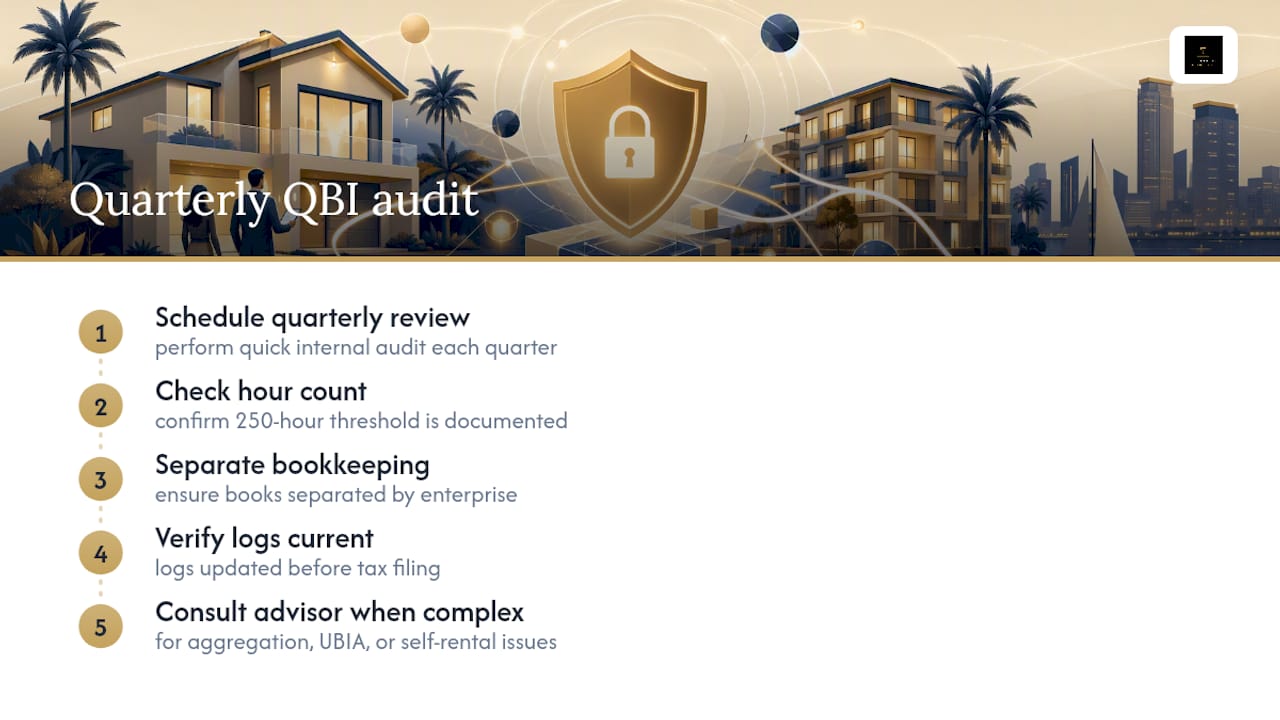
The workable next step is a quick internal audit each quarter: check your hour count, confirm your books are separated by enterprise, and verify your logs are current. When aggregation, UBIA planning, or a self-rental structure adds complexity, that's the point to bring in a tax advisor before the return gets filed, not after a notice.
Why the Safe Harbor Deserves More Attention Than It Gets
Most guidance on QBI for rentals treats the safe harbor and the Section 162 test as roughly equal options, presenting a menu and letting the reader pick. That framing undersells how much weight belongs on one side of the scale. The safe harbor is a defensive election you make in advance, and reconstructed logs assembled after the fact routinely fail to hold up under audit scrutiny. Facts and circumstances is a fallback, not a strategy.
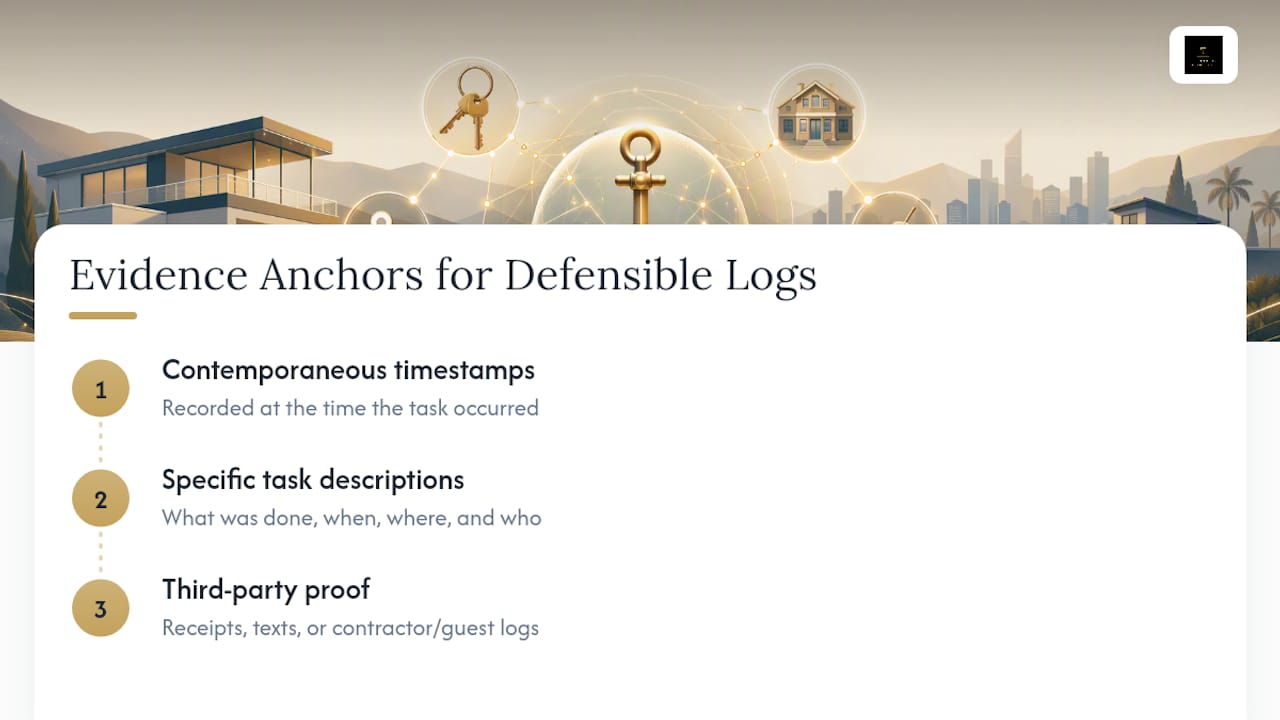
Where the conventional advice falls short is recordkeeping specificity. Most articles tell you to "keep records" without specifying what separates a defensible log from a vulnerable one: contemporaneous timestamps, specific task descriptions, and third-party corroboration for any hours you didn't personally log. A vague spreadsheet updated once a year is barely better than nothing.
If you own multiple properties, prioritize your grouping decision early. Once you elect to treat properties as a single rental real estate enterprise, that choice generally sticks. Get the grouping wrong, and you complicate every future year's hour count and bookkeeping. Get it right from year one, and the safe harbor becomes close to routine.
How Thetaxrefinery Helps Rental Owners Secure QBI
Some tax preparers offer rental owners year-round strategy support instead of a once-a-year filing conversation, so your 250-hour count and contemporaneous logs can be reviewed before the return is due, not after an audit notice.

If your rental portfolio involves multiple entities, self-rentals to your own S-corp, or UBIA calculations that need cost segregation input, the Monthly Tax Advisory and Quarterly Tax Strategy Sessions build the recordkeeping and grouping strategy into your ongoing planning rather than scrambling each spring. Owners running rental income through an S-corp structure can also look at the S-Corp Tax Strategy Accelerator to model W-2 wages against the QBI wage limit properly. And if you just need a rental return prepared with the safe-harbor statement attached correctly, the Investor or Rental Owner service covers that directly. Visit the fee schedule to see exact pricing, or start with a conversation about your specific properties at Thetaxrefinery.
This article is general information, not a substitute for advice from a qualified financial advisor. Consult a qualified financial professional about your own circumstances before acting on anything here.
Sources
- IRS news release: IRS finalizes safe harbor to allow rental real estate to qualify as a business for qualified business income deduction
- The QBI deduction for rental real estate activity - Journal of Accountancy
FAQ
Who Qualifies for the QBI Deduction on Rental Income?
Rental owners qualify if their activity meets the Section 162 trade-or-business standard, satisfies the Rev. Proc. 2019-38 safe harbor, or involves renting to a commonly controlled trade or business.
What Counts as Qualified Property for QBI Purposes?
Qualified property generally means tangible, depreciable property held by the business at year-end, and its unadjusted basis (UBIA) factors into the wage/property limit for higher-income filers, as described in IRS QBI guidance.
Who Cannot Take the QBI Deduction for Rentals?
Owners of properties that fail both the safe harbor and the facts-and-circumstances test, such as a single triple-net lease with no active management or a vacation home used mostly for personal purposes under IRC §280A, generally cannot claim the deduction.
What Income Is Excluded From QBI Calculations?
Capital gains, dividends, interest income not properly allocable to the business, and wages paid to the owner are excluded from QBI, and net capital gains also reduce the overall taxable-income limit used to cap the deduction.
Can Thetaxrefinery Help Determine if My Rental Qualifies?
Yes. Thetaxrefinery's advisory engagements review your hour logs, entity structure, and grouping decisions to confirm whether your rentals meet the safe harbor or need a facts-and-circumstances approach, with pricing listed on the fee schedule.