Section 179D is a federal tax deduction that lets owners or designers of qualifying commercial buildings claim a per-square-foot write-off for energy-efficient lighting, HVAC, hot water systems, and building envelope upgrades. The deduction scales with verified energy savings and multiplies significantly when a project meets prevailing wage and apprenticeship requirements. Claiming it requires certification from a qualified individual and close coordination between your engineering team and tax advisor. Construction must begin before June 30, 2026, under current law, so timing now drives the entire planning conversation.
TL;DR:
- The deduction amount depends on verified energy savings, with rates increasing from $0.50 to $1.00 per square foot, but PWA compliance can multiply this figure fivefold.
- Achieving significant energy savings and PWA compliance can greatly increase the deduction, making early planning and documentation essential.
- Certification by a qualified engineer or contractor is mandatory, and projects must begin construction before June 30, 2026, to qualify under current law.
- The deduction involves careful modeling or measurement of energy savings, with the measurement pathway often suited for retrofits and requiring specific baseline data.
- Proper documentation of prevailing wages, apprenticeships, and certification is critical to avoid audit risks and maximize the tax benefit.
Table of Contents
- How Does the Section 179D Deduction Amount Work?
- Which Buildings and Systems Qualify for 179D?
- Traditional Modeling vs Alternative Measurement: Which Pathway Fits?
- What Are the Prevailing Wage Rules and the 2026 Deadline?
- Who Can Certify a 179D Deduction?
- How Do Basis Reduction and Reporting Work?
- What Should You Do Right Now to Claim 179D?
- How The Tax Refinery Approaches 179D Planning
- Get Help Structuring Your 179D Claim
- Sources
- FAQ
How Does the Section 179D Deduction Amount Work?
The deduction is built on a sliding scale tied to energy savings, not a flat number. To qualify at all, a building must show at least a 25% reduction in energy and power costs compared to a reference building built to ASHRAE Standard 90.1.
Here's where it gets interesting for owners weighing project costs against tax benefit:
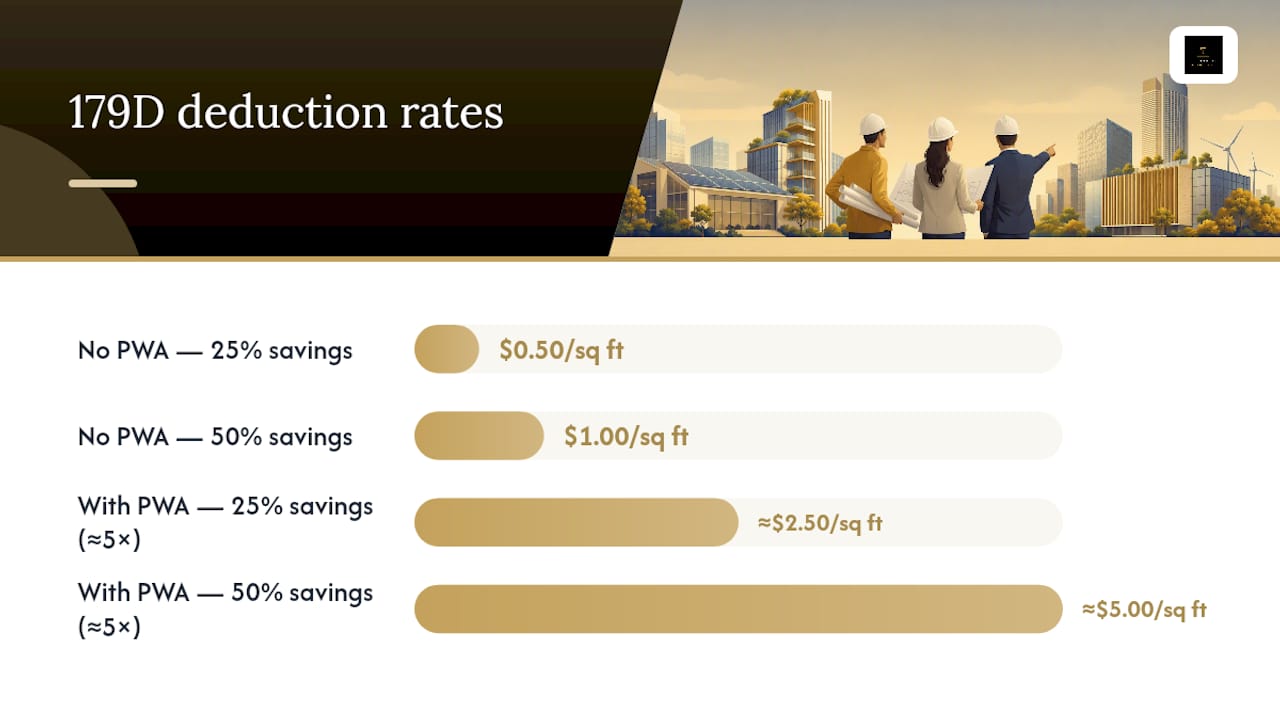
- Without meeting prevailing wage and apprenticeship (PWA) requirements, the base rate starts low, beginning at $0.50 per square foot at the 25% savings threshold and increasing by $0.02 per square foot for each additional percentage point of savings, up to $1.00 per square foot at 50% savings.
- Meeting PWA requirements multiplies that rate roughly fivefold, as detailed in IRS Publication 5832, which explains the calculation steps and partial deduction rules.
- A building achieving significant energy savings with PWA compliance can see deduction rates substantially higher, while those not meeting PWA get lower rates.
A large office building with considerable energy savings and full PWA compliance could generate a substantial deduction, much higher than one without PWA compliance. This difference underscores the importance of planning for prevailing wage compliance in the process.
One caveat worth flagging: the Internal Revenue Service periodically updates these dollar figures for inflation, so always verify the current year's rate table before running final numbers.
Which Buildings and Systems Qualify for 179D?
Eligibility hinges on three things: the building type, the systems installed, and who owns it. Commercial buildings of virtually any size qualify, along with multifamily properties of four stories or more, provided they're compared against ASHRAE Standard 90.1 for the relevant version year.
Three system categories count toward the deduction:
- Interior lighting systems, including controls and fixture upgrades.
- HVAC and hot water systems, covering equipment efficiency and distribution improvements.
- Building envelope components like insulation, roofing, windows, and air sealing.
New construction qualifies once placed in service. Retrofits qualify too, but the Alternative (measurement) pathway imposes a five-year rule: the building generally needs at least five years of operating history before a retrofit can use measured energy data as its baseline. There's also a depreciability requirement written into 26 U.S.C. § 179D: the property must be depreciable, which is why government and other tax-exempt owners rely on the allocation rules covered later.
Traditional Modeling vs Alternative Measurement: Which Pathway Fits?
You have two ways to prove energy savings, and picking the right one shapes your entire project timeline.
- Traditional pathway (modeling). An engineer runs energy and cost simulations comparing your building's design to a reference building under ASHRAE Appendix G, using qualified computer software. This is the standard route for new construction and major renovations where you have full design specifications before installation.
- Alternative pathway (measurement). Instead of modeling, you measure actual site energy use intensity against a baseline, typically for existing buildings undergoing retrofits. This route requires a Qualified Retrofit Plan and reliable pre-retrofit utility data.
Traditional modeling works best when you have design-phase access and want certainty before construction locks in. Measurement suits building owners retrofitting older assets where actual performance data tells a more convincing story than a simulation. Either way, DOE guidance is clear that lacking a qualified modeler or proper software risks the entire deduction getting unwound on audit. Bring your engineer in early, not after the fact.
What Are the Prevailing Wage Rules and the 2026 Deadline?
Meeting PWA requirements means paying laborers and mechanics prevailing wages, as determined by the Department of Labor, and using registered apprentices for a required percentage of labor hours throughout construction. This single requirement is what multiplies your deduction rate roughly fivefold, making it the biggest lever in the entire 179D calculation.
Documentation needs to start on day one, not at tax time:
- Certified payroll records showing wage rates paid to every worker on the project.
- Apprenticeship hour logs tied to registered programs.
- Contract language obligating subcontractors to track and report PWA compliance.
Pro Tip: Retroactive PWA compliance almost never works. If your contracts don't require wage and apprenticeship tracking before the first shovel hits dirt, you likely can't fix it after the fact.
The One Big Beautiful Bill Act terminates 179D for projects that begin construction after June 30, 2026, so anything not already underway needs to move now.
Who Can Certify a 179D Deduction?
Certification isn't optional paperwork. A qualified individual, generally a licensed engineer or contractor in the jurisdiction where the building sits, must inspect the property and confirm the energy modeling or measurement data meets IRS standards.
Key requirements to keep in mind:
- The certifier must be unrelated to the project in a way that avoids conflicts of interest under IRS rules.
- The certification package must document the modeling methodology, software used, and resulting energy savings percentage.
- Government and other tax-exempt building owners can allocate the deduction to the designer of record, converting an otherwise unusable tax benefit into real value for the architecture or engineering firm.
If you're negotiating a public-sector contract, include allocation language explicitly. A simple clause naming the designer as the allocee, tied to certification delivery, prevents disputes after the building is already occupied.
How Do Basis Reduction and Reporting Work?
Claiming 179D reduces your building's depreciable basis by the deduction amount, which means smaller depreciation deductions in future years. Model this trade-off before you file. A large 179D deduction today can be worth more than the depreciation you give up, but only your tax advisor can run that comparison against your specific holding period and depreciation schedule.
A few mechanics to track closely:
- Prior 179D claims on the same building reduce the lifetime cap available for future improvements, so keep records of every previous claim.
- Reporting typically flows through your business return with supporting certification kept in your files, not filed with the return itself, per IRS guidance.
- Common audit triggers include missing certification, PWA documentation gaps, and mismatched square footage between the energy model and the actual building.
Keep certification, modeling reports, and PWA payroll records for at least the standard statute of limitations period, longer if the building sees repeated capital improvements.
What Should You Do Right Now to Claim 179D?
Turning a project into a defensible claim takes coordination across design, construction, and tax teams. Here's the sequence that works:
- Before construction starts: Write PWA and apprenticeship tracking into every contract, engage a qualified modeler during schematic design, and set up measurement instrumentation if you're pursuing the Alternative pathway on a retrofit.
- During construction: Document certified payroll, apprenticeship hours, equipment installation dates, and commissioning reports as they happen, not months later.
- After placement in service: Get formal certification from a qualified individual, compile the technical report package, and bring your tax advisor in to model the basis reduction against your depreciation schedule before you file.
Pro Tip: Run a rough cost-benefit check before committing resources to full modeling. But add PWA compliance and the math often flips entirely.
Owners already working through year-end tax planning should fold 179D timing into that broader tax planning checklist rather than treating it as a separate decision.
How The Tax Refinery Approaches 179D Planning
We coordinate the engineers, modelers, and tax positioning so nothing falls through the gap between design and filing. Building owners and multi-entity operators benefit most. Expect a clear deliverable: certified documentation and a modeled basis-reduction impact before you file.
— Melissa
Get Help Structuring Your 179D Claim
Some tax advisory firms offer building owners proactive planning conversations that start before construction, not after your return is due. Unlike traditional accountants who react to what already happened, some advisory models involve modeling the PWA multiplier and basis-reduction trade-off while the project is still in design, when it actually changes outcomes.

Services covering the full 179D coordination chain can include connecting clients with engineering resources, running the basis-reduction math against depreciation schedules, and filing support once certification is in hand. Some tax strategy firms operate a year-round subscription model serving business owners, real estate investors, and multi-entity operators who need ongoing strategy rather than a once-a-year filing appointment. If a 179D-eligible project is already underway or in the design pipeline, start with our tax strategy comparison page to see which engagement model fits your situation, or check pricing to scope the cost of an advisory relationship built around your building portfolio.
This article is general information, not a substitute for advice from a qualified financial advisor. Consult a qualified financial professional about your own circumstances before acting on anything here.
Sources
- 179D Energy Efficient Commercial Buildings Tax Deduction | Department of Energy
- Publication 5832 (8-2023)
- 26 U.S. Code § 179D - Energy efficient commercial buildings deduction
- Everycrsreport
FAQ
Can You Write Off 100% of a 6,000 Pound Vehicle?
That question refers to Section 179 depreciation for vehicles, a completely different provision from Section 179D's commercial building deduction. Heavy vehicles over a certain gross weight threshold may qualify for accelerated Section 179 depreciation, but the rules, limits, and forms are separate from anything covered in this guide.
What Qualifies for Section 179 Depreciation?
Section 179 depreciation applies to tangible business equipment, machinery, and certain vehicles, letting businesses deduct the full purchase price in the year placed in service up to annual limits. This differs entirely from Section 179D, which covers energy-efficient improvements to commercial building systems like lighting, HVAC, and envelope components.
How Do I Report a 179D Deduction on My Tax Return?
You claim the 179D deduction on your business tax return using supporting certification and technical reports as backup documentation kept in your files, per IRS guidance. Your tax advisor applies the basis reduction to your depreciation schedule at the same time the deduction is claimed.
What Are Common Section 179D Mistakes?
The most frequent errors are missing PWA documentation that would have multiplied the deduction, using an uncertified or unqualified modeler, and failing to track prior claims against the lifetime cap on the same building. A structured advisory relationship, like the ongoing coordination Thetaxrefinery provides, catches these gaps before they become audit findings.
Is Section 179D the Same as the Residential Energy Efficient Home Credit?
No. Section 179D applies to commercial buildings, while residential energy credits like Section 25C apply to individual homeowners making qualifying improvements to a personal residence. The two programs have entirely separate eligibility rules, forms, and calculation methods.