
Under IRC §1362, an S election can also terminate involuntarily when the corporation fails to meet eligibility requirements. The single next action: prepare a signed statement of revocation and mail it to the IRS service center where you file your annual return. Keep reading for the exact statement contents, timing rules, tax consequences, and a sample you can adapt.
Key Takeaways
| Point | Details |
|---|---|
| Shareholder consent threshold | More than 50% of issued and outstanding shares (voting and nonvoting) must consent in writing. |
| March 15 filing deadline | For a calendar-year corporation, file by March 15 to make the revocation effective January 1 of that year. |
| Five-year re-election restriction | After termination or revocation, the corporation generally cannot re-elect S status for five tax years without IRS consent. |
| Key forms to expect | Final Form 1120-S with final K-1s, Form 1120 for the C period, and Form 966 if dissolving. |
| Thetaxrefinery | Provides revocation statement prep, split-year returns, AAA/E&P planning, and IRS representation for business owners navigating S-to-C transitions. |
Table of Contents
- How to revoke S corp status voluntarily
- Effective dates and deadlines you need to know
- When the IRS terminates S status without your consent
- Tax consequences and federal forms after revocation
- The 5-year restriction on re-electing S status
- Operational changes to make after revocation takes effect
- A sample revocation statement and filing checklist
- State-level effects you should not overlook
- Common mistakes that create delays or unwanted tax bills
- When revocation actually makes strategic sense
- Thetaxrefinery handles the complexity so you don't have to
- Sources
How to revoke S corp status voluntarily
The IRS does not have a dedicated form for revoking an S election. Instead, you submit a written statement to the IRS service center where you file your return. According to IRS guidance on revoking a Subchapter S election, the statement must include all of the following:
- A declaration that the corporation revokes its election under IRC §1362(a)
- The corporation's name, address, and Employer Identification Number (EIN)
- The name, address, taxpayer identification number (TIN), and number of shares owned by each consenting shareholder
- The date each consenting shareholder acquired their shares
- The corporation's taxable year-end
- The requested effective date of the revocation (if other than the default)
- Signatures of an authorized corporate officer and each consenting shareholder, signed under penalties of perjury
The shareholder-consent threshold is critical: you need consent from shareholders holding a majority of total issued and outstanding shares, counting both voting and nonvoting stock.
Delivery matters. Send the statement by certified mail with return receipt requested so you have documented proof of the filing date. Some practitioners file through a representative using IRS e-services when available. Retain a copy of the statement and the mailing receipt permanently.
Practical checklist for assembling a valid revocation:
- Confirm the corporation's EIN and legal name match IRS records exactly
- Pull a current shareholder ledger and calculate the 50%-plus threshold
- Collect TINs and acquisition dates for every consenting shareholder
- Decide on an effective date (see timing rules below)
- Draft the statement using the required language
- Obtain signatures from the authorized officer and all consenting shareholders
- Mail to the correct IRS service center via certified mail with return receipt
- File a copy in your corporate records alongside the proof of mailing
Effective dates and deadlines you need to know
Timing determines which tax year the revocation takes effect, and a missed deadline can push the effective date forward by a full year. The rules under IRC §1362 work as follows:
- First-day-of-the-tax-year effective date: The revocation must be received by the IRS by the 15th day of the third month of that tax year. For a calendar-year corporation, that deadline is generally mid-March.
- Filed after March 15: The revocation defaults to being effective on the first day of the next tax year.
- Midyear effective date: You may specify any future date as the effective date, but the IRS must receive the statement on or before that date.
Two concrete examples using a December 31 tax year:
- Example 1 — Clean January 1 start: You want the revocation effective January 1, 2026. File the statement by March 15, 2026. The corporation's S period ends December 31, 2025, and it files as a C corporation for all of 2026.
- Example 2 — Midyear effective date: You want the revocation effective February 14, 2026. The IRS must receive the statement on or before February 14, 2026. This creates two short tax years: an S period (January 1 through February 13) and a C period (February 14 through December 31).
Midyear revocations create split-year filing obligations, which carry their own complexity. Most business owners choose a clean January 1 effective date specifically to avoid that complication.
When the IRS terminates S status without your consent
Involuntary termination happens automatically when a corporation violates an S-corporation eligibility rule. You do not need to file anything for the termination to occur. Common triggers under IRC §1362 include:
- Exceeding 100 shareholders
- Admitting an ineligible shareholder (a nonresident alien, a C corporation, a partnership, or most trusts not specifically permitted)
- Issuing a second class of stock (different economic rights, not just voting differences)
- A prohibited transfer of shares to an ineligible party
The termination date is the day the disqualifying event occurs, not the date you discover it. That distinction matters because it determines which short period is taxed as an S corporation and which as a C corporation.
The IRS does provide late-election relief procedures for certain inadvertent terminations. If the termination was unintentional and the corporation acted to correct the disqualifying event promptly, you can request IRS relief to treat the S election as continuously in effect. This relief is not automatic and typically requires a private letter ruling request or a simplified procedure filing, depending on the circumstances.
If you discover an inadvertent termination, document the date and cause immediately, correct the disqualifying condition as quickly as possible, and consult a tax professional before filing any returns for the affected period.
Tax consequences and federal forms after revocation
Revoking S status does not erase the tax obligations that arose during the S period. It also triggers a set of new filing requirements that must be handled carefully.
Split-year treatment. When a revocation takes effect on any date other than January 1, the tax year splits into two short periods. The S period and the C period each require a separate return. Income is generally allocated between the two periods on a daily pro-rata basis, though shareholders and the corporation can elect an alternative allocation method based on actual closing of the books. That election requires the consent of all shareholders who held stock during the S period, per The Tax Adviser's analysis of S-to-C conversions.
Federal forms commonly involved:
| Form | Triggering Event | Typical Deadline |
|---|---|---|
| Form 1120-S (final) | Last S-period return; check "Final Return" box | 15th day of 3rd month after S period ends |
| Schedule K-1 (final) | Issued to each shareholder for the S period | Same as Form 1120-S |
| Form 1120 | C-corp return for the post-revocation period | 15th day of 4th month after C period ends |
| Form 966 | Adoption of a plan of dissolution or liquidation | Within days of adopting the plan |
| Form 1120 | Sale or exchange of business property | With the applicable year's return |
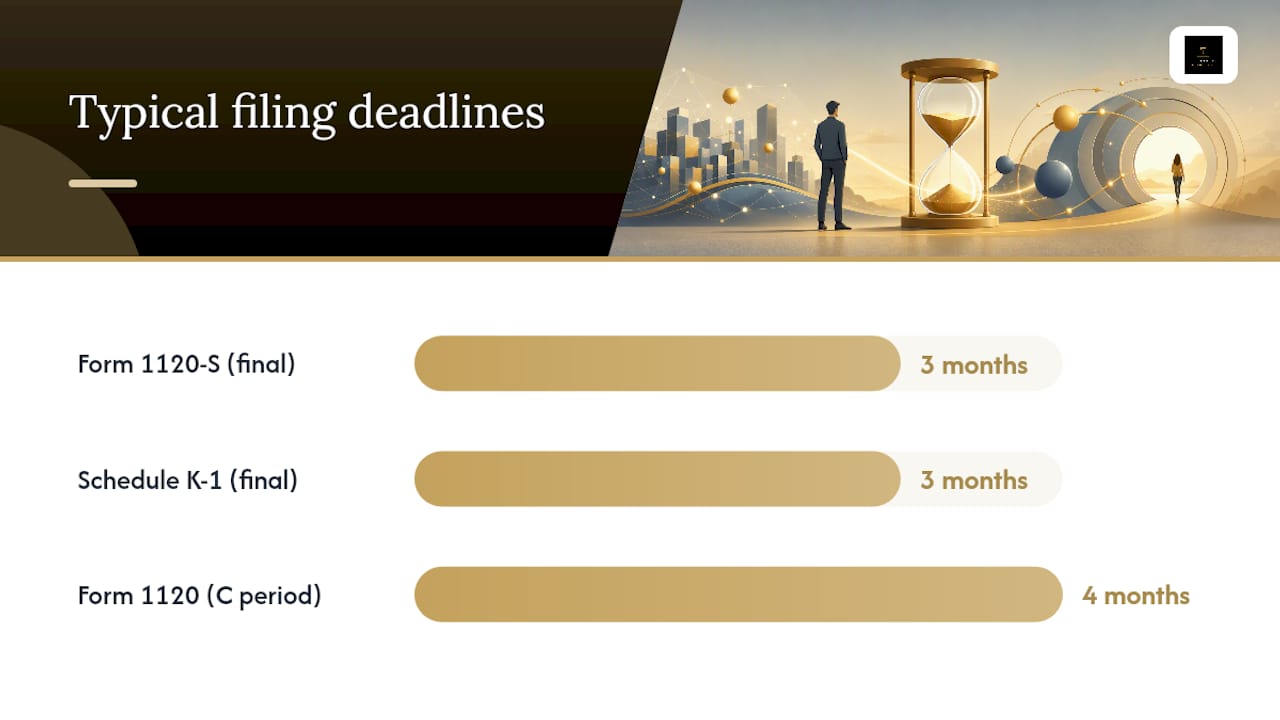
According to IRS closing-a-business guidance, S corporations that dissolve must file a final Form 1120-S, check the "Final Return" box, and issue final Schedule K-1s to all shareholders. Form 966 is required separately if the board adopts a formal resolution to dissolve or liquidate.
Beyond the returns themselves, revocation can trigger Section 481(a) accounting-method adjustments if the corporation used different methods as an S corporation versus what is required as a C corporation. Accumulated Adjustments Account (AAA) and Earnings and Profits (E&P) balances also require careful reconciliation.
Pro Tip: Get a CPA involved before filing split-year returns. AAA and E&P issues, Section 481(a) adjustments, and the alternative closing-of-books election all require professional judgment that goes well beyond standard return preparation.
The 5-year restriction on re-electing S status
Once an S election terminates, whether voluntarily or involuntarily, the corporation generally cannot re-elect S status for five tax years. This restriction under IRC §1362 runs from the first tax year for which the termination was effective.
There are two ways around the restriction:
- IRS consent: The IRS may grant permission to re-elect before the five-year window closes, but this requires a formal request and is not routinely granted without a compelling change in circumstances.
- Unanimous shareholder consent: If all shareholders who held stock on the first day of the first tax year for which the new election would be effective consent, re-election may be possible earlier in some circumstances.
The practical effect on planning is significant. If you revoke S status to raise venture capital from a corporate investor, and that deal falls through, you cannot simply flip back to S status the following year. Model the five-year window into any revocation decision, particularly if pass-through taxation is likely to be advantageous again in the near term.
Operational changes to make after revocation takes effect
Revocation changes how the corporation is taxed at the entity level, and several operational systems need to reflect that shift immediately.
- Payroll and withholding: As a C corporation, owner-employees are still W-2 employees, but the reasonable-compensation analysis that governed S-corp salary decisions may shift. Review payroll compliance obligations with your payroll provider before the first post-revocation payroll run.
- Estimated taxes: The corporation now pays entity-level federal income tax. Quarterly estimated payments on Form 1120-W become the corporation's responsibility. Shareholders no longer receive pass-through income to report on their personal returns for post-revocation periods.
- Retirement and benefit plans: Certain plan structures tied to S-corp shareholder-employee rules may need to be reviewed. Solo 401(k) contribution limits and health insurance deduction treatment for greater-than-2% shareholders change when S status ends.
- Bookkeeping classification: Chart-of-accounts entries for distributions, AAA, and shareholder loans need to be reclassified to reflect C-corp accounting conventions.
- State and franchise taxes: Several states impose separate franchise or minimum taxes on C corporations that differ from S-corp treatment. Confirm with your state's department of revenue whether additional deposits or filings are required immediately.
Coordinate the timing of these changes with your payroll provider and CPA so that no payroll run or quarterly deposit falls into a gap between the old and new tax treatment.
A sample revocation statement and filing checklist
The statement below mirrors the requirements in IRS guidance on revoking a Subchapter S election. Adapt it to your corporation's facts before signing.
STATEMENT OF REVOCATION OF S CORPORATION ELECTION
[Corporation Name], a corporation organized under the laws of the State of [State], with its principal place of business at [Address], and Employer Identification Number [EIN], hereby revokes its election under IRC §1362(a) to be treated as an S corporation.
This revocation is effective.
| Shareholder Name | TIN | Shares Owned | Date Acquired |
|---|---|---|---|
| [Name] | [TIN] | [Number] | [Date] |
The corporation's taxable year ends December 31.
I declare under penalties of perjury that I have examined this statement and, to the best of my knowledge and belief, it is true, correct, and complete.
Authorized Officer Signature: _________________________ Date: _________ Printed Name and Title: _________________________
Shareholder Signature: _________________________ Date: _________ Printed Name: _________________________
Filing checklist:
- Confirm EIN and legal name match IRS records
- Calculate the 50%-plus consent threshold from the current shareholder ledger
- Collect TIN and share-acquisition date for each consenting shareholder
- Choose and confirm the effective date
- Draft and review the statement
- Obtain all required signatures under penalties of perjury
- Mail via certified mail with return receipt to the correct IRS service center
- Retain a copy of the signed statement and the mailing receipt permanently
Pro Tip: Send the revocation by USPS certified mail with return receipt requested, or by a private delivery service designated by the IRS (such as FedEx or UPS). The postmark date is your proof of timely filing. Scan and store the green return-receipt card alongside the signed statement in your corporate records.
State-level effects you should not overlook
Federal revocation does not automatically cancel your state S-corporation status. State conformity varies considerably, and the gap between federal and state treatment can create unexpected tax bills.
- Non-conforming states: Some states require a separate state S-election and a separate state revocation filing. California, New York, and New Jersey, for example, each have their own S-election rules that do not automatically follow the federal election or termination.
- Franchise and minimum taxes: Several states impose a minimum franchise tax or a gross-receipts tax on C corporations that is higher than what S corporations pay. The rate change takes effect on the state's own effective date, which may differ from the federal date.
- State final returns and tax clearance: If you are dissolving the corporation entirely, most states require a final state income or franchise tax return and a tax-clearance certificate before the Secretary of State will accept Articles of Dissolution.
- State payroll and withholding: State income-tax withholding obligations for owner-employees may change when entity classification changes. Confirm with your state's department of revenue.
Contact a state-tax specialist or your state's department of revenue before finalizing the revocation date. A one-day difference in the effective date can shift an entire year of state tax liability from one rate structure to another.
Common mistakes that create delays or unwanted tax bills
Most revocation problems are avoidable. These are the errors that practitioners see most often:
- Incomplete shareholder consent: Missing one shareholder's signature, or miscounting shares to reach the 50%-plus threshold, renders the revocation invalid. The IRS will not process an incomplete statement.
- Wrong effective date: Choosing a midyear date without planning for split-year returns creates two filing obligations and potential penalties for late filing of the C-period Form 1120.
- Ignoring AAA before revocation: Distributing the Accumulated Adjustments Account balance before the effective date allows shareholders to receive those funds tax-free. Failing to do so means post-revocation distributions may be taxed as dividends.
- Inadequate proof of mailing: A regular first-class postmark does not establish the filing date for IRS purposes. Use certified mail or a designated private delivery service.
- Undisclosed ineligible shareholders: If an ineligible shareholder has already been admitted, the S election may have already terminated involuntarily. Filing a voluntary revocation on top of an existing involuntary termination creates conflicting records.
- Inconsistent reporting: Shareholder personal returns that do not match the final K-1s from the S period draw IRS scrutiny. Coordinate the final K-1 preparation with each shareholder's personal tax preparer.
- Late payroll deposits during the transition: Missing a federal payroll deposit during the period when payroll systems are being updated can trigger trust-fund recovery penalties personally against responsible officers.
If any of these red flags apply to your situation, consult a CPA or Enrolled Agent before filing anything. The cost of professional review is far lower than the cost of an amended return or an IRS notice.
When revocation actually makes strategic sense
Revoking S status is not inherently a mistake, but it is often treated as a default move when the real analysis is more nuanced.
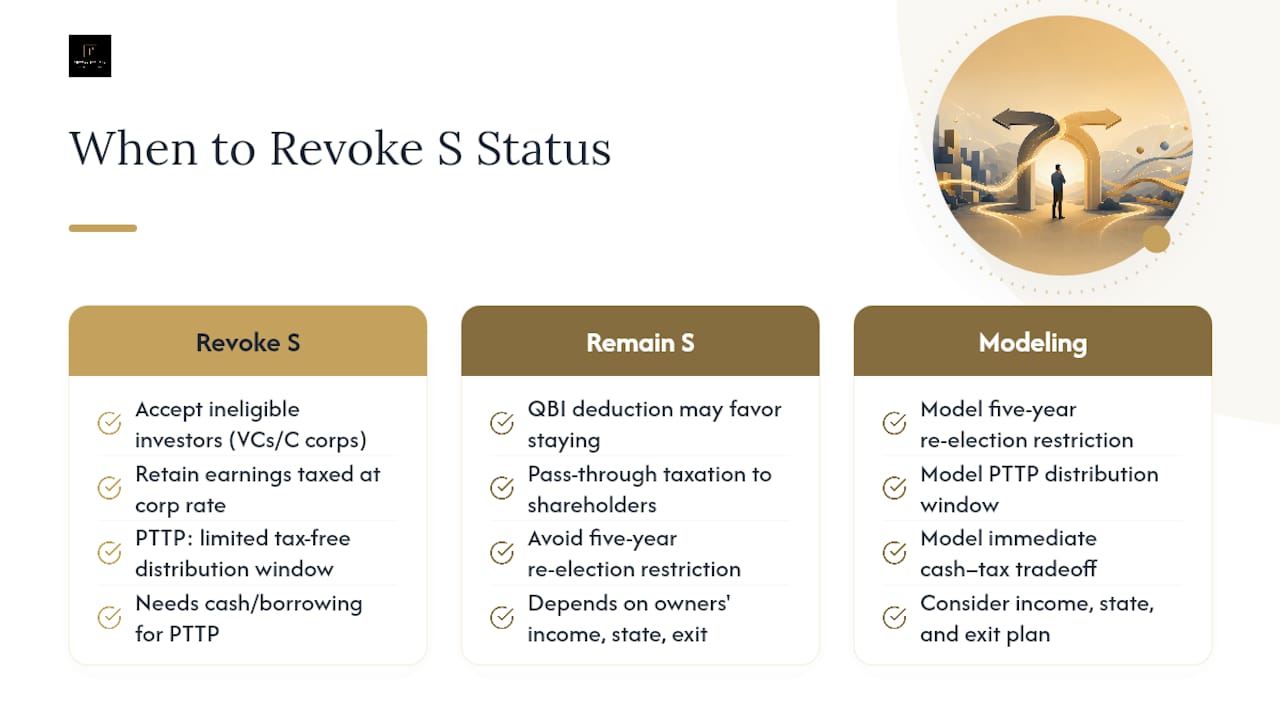
The clearest case for revocation is when the corporation needs to accept investors who are ineligible S shareholders, such as venture capital funds structured as partnerships or C corporations. Wolters Kluwer's practitioner analysis identifies this as one of the most common strategic drivers. A second legitimate reason is the desire to retain earnings inside the entity at the corporate tax rate rather than passing them through to shareholders who may face higher individual rates.
What gets underestimated is the post-termination transition period (PTTP). During the PTTP, shareholders can still receive distributions from the AAA balance and treat them as tax-free returns of basis, as if the S election were still in effect. That window is limited, and it requires the corporation to have sufficient cash or borrowing capacity to make those distributions. Owners who revoke without modeling the PTTP often leave a meaningful tax benefit on the table.
For some, that change made revocation more attractive. For others, the qualified business income deduction available to S-corp shareholders made staying as an S corporation the better outcome. The math is specific to each owner's income level, state of residence, and long-term exit plan.
Revocation is rarely a one-way door you should walk through quickly. Model the five-year re-election restriction, the PTTP distribution window, and the immediate cash-tax tradeoff before deciding. An Enrolled Agent or CPA with S-corp planning experience can run those numbers in a single planning session.
Thetaxrefinery handles the complexity so you don't have to
Revoking S status involves more moving parts than most business owners anticipate: the revocation statement itself, shareholder consent mechanics, split-year return preparation, AAA and E&P reconciliation, payroll system updates, and state-level filings that do not follow federal rules automatically.

Thetaxrefinery, founded by Enrolled Agent Melissa Korber, works with business owners through every stage of this process. Services include revocation statement preparation, split-year tax accounting, AAA and E&P planning, payroll coordination, and IRS representation when termination was involuntary or disputed. The firm's tax strategy services are built for business owners netting $300,000 or more annually who need a strategic partner, not a seasonal filer. Schedule a strategy consultation to get a clear picture of your revocation timeline, tax exposure, and next steps before you sign anything.
Sources
The following primary and practitioner sources underpin this article. Use the IRS sources for procedural filing rules and the practitioner sources for planning nuance.
- Revoking a Subchapter S election | Internal Revenue Service
- 26 U.S. Code § 1362 - Election under subchapter S
- Converting from S corp. to C corp.: Select issues for consideration | The Tax Adviser
- When is the best time to switch from S corp to C corp? | Wolters Kluwer
This article is general information, not a substitute for advice from a qualified financial advisor. Consult a qualified financial professional about your own circumstances before acting on anything here.