
When you sell depreciated rental or business property, the IRS recaptures a portion of the depreciation you claimed and taxes it differently from your capital gain. Personal-property components get taxed as ordinary income under Section 1245, while the structure itself typically triggers unrecaptured Section 1250 gain, capped at a 25% federal rate. Deferral tools like 1031 exchanges and installment sales exist, but each carries limits you need to model before you sign a purchase agreement.
TL;DR:
- Depreciation allowed or allowable, whether claimed or not, reduces your basis and triggers recapture that is taxed at higher rates than capital gains.
- The recapture split involves ordinary income under Section 1245 on personal property and capped at 25% under Section 1250 for straight-line depreciation on the structure.
- A cost segregation study can reclassify components as personal property, increasing immediate deductions but also raising potential recapture at sale.
- Proper modeling of sale scenarios, including 1031 exchanges and installment sales, before listing maximizes tax planning options and minimizes surprises.
- Maintaining detailed depreciation records, understanding state conformity, and planning at least 30 days before sale are key to managing recapture tax liabilities effectively.
Table of Contents
- What Is Real Estate Depreciation Recapture and Who Owes It?
- How Do You Calculate Section 1245 vs Section 1250 Recapture?
- Where Do You Report Depreciation Recapture on Your Tax Return?
- What Are Your Options to Defer or Reduce Recapture Tax?
- Worked Examples: How the Numbers Actually Split
- How The Tax Refinery Approaches Depreciation Recapture Planning
- Your Pre-Sale Checklist Before You List the Property
- Depreciation Isn't a Free Deduction, It's a Loan From Your Future Tax Bill
- Model Your Sale Before You List, Not After
- Primary Sources Worth Bookmarking
- Sources
What Is Real Estate Depreciation Recapture and Who Owes It?
Every year you own a rental property or commercial building, you deduct a portion of its cost against your income. That deduction lowers your tax bill during ownership, but it also lowers your adjusted basis, which is the number the IRS uses to calculate your gain when you sell. Depreciation recapture is the mechanism that claws back some of that benefit at the point of sale, taxing part of your gain at a higher rate than ordinary long-term capital gains.
Here's the part that catches owners off guard: the IRS doesn't just recapture depreciation you actually claimed. It recaptures depreciation you were allowed or allowable to claim, whether you took it or not. Publication 544 spells this out directly. If you owned a duplex for eight years and never bothered to depreciate it because your CPA forgot or you filed your own return without a Schedule E worksheet, the IRS still reduces your basis as though you had. You lose the deduction benefit and still owe the recapture. That single rule is why skipping depreciation is almost never a smart move.
Adjusted basis starts with what you paid for the property, plus capital improvements, minus depreciation allowed or allowable over the holding period. Accumulated depreciation is simply the running total of those deductions. When you sell, your recomputed basis (the original basis plus any depreciation adjustments) determines how much of your gain gets pulled into recapture treatment versus taxed as capital gain.
The policy logic behind this is straightforward. Depreciation deductions assume an asset loses value through wear and use. But real estate, especially well-located real estate, tends to appreciate. When you sell for more than your depreciated basis, the IRS treats part of that gain as a correction: you took deductions for value the asset didn't actually lose, so that portion gets taxed back.
Land never factors into this equation. Land doesn't wear out, so it isn't depreciable, and it generates no recapture exposure. Only the building and its depreciable components, structural elements, fixtures, equipment, certain land improvements, create the recapture liability. This distinction matters more than most owners realize when a cost segregation study starts breaking a property into components.
A few mechanics worth locking in before you move to the math:
- Depreciation reduces basis whether or not you claimed it on your return.
- Land value is carved out of the depreciable basis at purchase and stays untouched by recapture rules.
- Capital improvements increase your basis and, once placed in service, start their own depreciation clock.
- The character of recapture (ordinary income versus capped-rate gain) depends on what type of asset generated the deduction, not on how long you held the property.
How Do You Calculate Section 1245 vs Section 1250 Recapture?
The calculation runs through four steps: establish adjusted basis, total the accumulated depreciation, determine amount realized on sale, then split the resulting gain by asset type and depreciation method. Getting this split right is where the real tax exposure lives, because Section 1245 and Section 1250 property are taxed under completely different rules.
Section 1245 property covers personal property and certain other business assets: appliances, carpeting, specialized equipment, and, increasingly, components identified through cost segregation. When you sell Section 1245 property for more than its depreciated basis, the recapture is ordinary income up to the full amount of depreciation you claimed. There's no rate cap here.
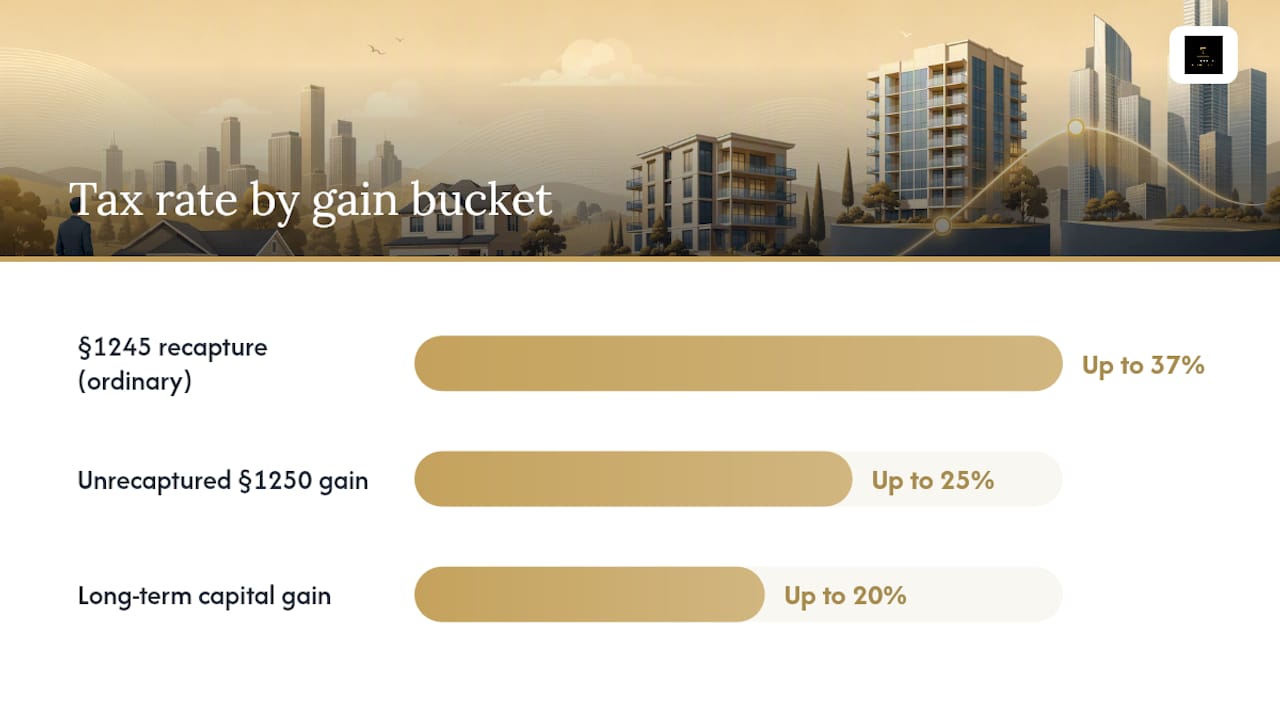
Section 1250 property is the real property itself, the building structure. Under current MACRS straight-line depreciation rules, true Section 1250 ordinary-income recapture almost never applies anymore, because that recapture provision only bites when a taxpayer used an accelerated depreciation method on real property, which hasn't been standard practice since the 1980s. What you'll actually encounter instead is unrecaptured Section 1250 gain, the portion of your gain attributable to straight-line depreciation on the building. 26 U.S. Code § 1250 defines this "additional depreciation" concept and how it interacts with gain characterization. This unrecaptured 1250 gain is taxed at a maximum federal rate of 25%, which is higher than the long-term capital gains rate most investors expect (0%, 15%, or 20%) but lower than ordinary income rates for most sellers.
Here's the calculation sequence in order:
- Start with adjusted basis: original purchase price, plus capital improvements, minus accumulated depreciation.
- Calculate amount realized: sale price minus selling expenses (commissions, closing costs, transfer taxes).
- Determine total gain: amount realized minus adjusted basis.
- Split the gain by asset category: allocate the portion attributable to Section 1245 personal property, the portion attributable to straight-line depreciation on the Section 1250 structure (unrecaptured 1250 gain), and any remainder as standard long-term capital gain.
- Apply the correct rate to each bucket: ordinary income rates for §1245 recapture, up to 25% for unrecaptured §1250 gain, and standard capital gains rates for the balance.
Rate comparison: Section 1245 recapture is taxed at your ordinary income rate with no ceiling, which can reach 37% federally. Unrecaptured Section 1250 gain is capped at 25% federally under Publication 544. Standard long-term capital gain tops out at 20% federally for most sellers. That spread, potentially 17 percentage points between your best-case and worst-case bucket, is exactly why the asset-category split matters more than the total gain figure.
Cost segregation studies change this calculation dramatically. A cost segregation study reclassifies portions of a building, parking lots, landscaping, certain electrical and plumbing components, carpeting, specialty equipment, from 27.5 or 39-year real property into 5, 7, or 15-year personal property. That reclassification lets you front-load depreciation deductions using bonus depreciation, which is powerful during ownership. But it also converts those components into Section 1245 property, meaning any gain attributable to them at sale is fully ordinary income, not capped at 25%. Practitioners who work with cost segregation regularly note that this reclassification often creates larger §1245 recapture exposure than owners anticipate when they elect the study, particularly when bonus depreciation percentages were high in the years the components were placed in service.
One more layer worth understanding: Section 1231 netting. Real estate used in a trade or business is generally Section 1231 property, and gains and losses from the sale of 1231 property net against each other and against other 1231 transactions in the same year. If you have prior-year 1231 losses that were treated as ordinary losses, the IRS "recaptures" that ordinary treatment against current-year 1231 gains under the lookback rule, which can shift the character of gain that would otherwise be capital. This interacts with, but is separate from, depreciation recapture, and it's a detail that trips up sellers who assume their only exposure is Sections 1245 and 1250.
Where Do You Report Depreciation Recapture on Your Tax Return?
Recapture amounts flow through a specific sequence of IRS forms, and getting the order wrong is one of the most common preparer errors on real estate sales. Understanding which form does what before you sell saves your CPA time and saves you from an amended return.
Form 4797, Sales of Business Property, is the central form for reporting the sale of depreciable real estate. Part III of Form 4797 calculates the ordinary-income portion of your gain, meaning your Section 1245 recapture, and carries it to Part II as ordinary income. The remaining Section 1231 gain (which includes your unrecaptured Section 1250 gain component) flows to Part I, and from there to Schedule D.
Form 6252, Installment Sale Income, applies when you're financing part of the sale and receiving payments over more than one tax year. This is where sellers get tripped up most often: Form 6252 instructions state plainly that any ordinary-income recapture under Section 1245 or Section 1250 is fully taxable in the year of sale, regardless of when you actually receive the cash. You can spread your capital gain over the installment period, but the recapture bill arrives immediately.
Schedule D, and specifically the Unrecaptured Section 1250 Gain Worksheet in the Schedule D instructions, is where the 25%-capped gain gets calculated and applied. This worksheet takes the unrecaptured 1250 amount computed on Form 4797 or the installment sale forms and runs it through the correct tax computation, separate from your standard capital gains rate brackets.
Before you can populate any of these forms accurately, gather the following documentation:
- Full depreciation schedules for every year of ownership, showing method, basis, and annual deduction.
- The cost segregation study report, if one was performed, with component-level basis allocations.
- Original purchase settlement statement and every capital improvement invoice since acquisition.
- Prior-year tax returns showing Section 1231 gains or losses that might affect the lookback rule.
Missing even one year of depreciation schedules forces your preparer to reconstruct figures, which increases both cost and audit risk.
What Are Your Options to Defer or Reduce Recapture Tax?
You have real, legal ways to manage when and how recapture tax hits you, but every one of them comes with a constraint that limits how much control you actually have. Knowing the trade-offs before you list the property changes which strategy makes sense.
Section 1031 exchanges remain the most complete deferral tool available. A properly structured like-kind exchange defers recognition of both your capital gain and your depreciation recapture by rolling your basis and accumulated depreciation into the replacement property. You're not eliminating the tax, you're pushing it forward, and the deferred recapture stacks onto the new property's basis. To preserve the deferral, you must identify replacement property within 45 days of closing on the sale and complete the acquisition within 180 days. Miss either deadline and the exchange collapses into a taxable sale. If you plan to hold real estate until death, the eventual step-up in basis for your heirs can erase the deferred recapture entirely, which is why long-horizon investors often chain exchanges across a career.
Installment sales let you spread capital gain recognition across multiple tax years as you receive payments, which can keep you in a lower bracket for the capital gains portion. But the limitation is significant: Section 1245 recapture must be recognized in full in the year of sale, even if you haven't collected the corresponding cash yet. If a large share of your gain sits in personal-property recapture because of a cost segregation study, an installment sale won't help with that piece at all.
Qualified Opportunity Funds offer a narrower benefit. Rolling capital gain into a QOF within the required window defers the gain until the fund investment is sold or 2026, whichever comes first, and can eliminate tax on the QOF investment's own appreciation if held long enough. QOFs don't defer depreciation recapture that's already been characterized as ordinary income; they only apply to the capital gain portion, so the math only works well when your recapture exposure is modest relative to your total gain.
Pro Tip: Run your recapture-only scenario before you get attached to a 1031 replacement property. Some sellers discover their unrecaptured 1250 gain is small enough that paying the tax and walking away with cash beats the hassle of finding and closing on a replacement within 180 days.
A few decision factors should drive which path you choose:
- Your expected marginal tax rate at sale versus during ownership, since accelerated depreciation is a timing bet, not a permanent savings.
- How long you plan to hold any replacement property, since stacking multiple exchanges compounds deferred recapture that eventually comes due.
- State tax treatment, since not every state conforms to federal capital gains or installment sale rules the same way.
- Whether estate planning is part of the picture, since a step-up in basis at death can be the cleanest exit from accumulated recapture exposure.
Cost segregation and bonus depreciation deserve a specific mention here because they cut both ways. Front-loading depreciation through a cost segregation study genuinely helps cash flow during ownership, sometimes dramatically. But it converts a chunk of your future gain into Section 1245 ordinary income with no rate cap, which means the study only pays off if you're confident about your exit timeline and expected tax bracket at sale. Investors who plan to exchange indefinitely often benefit more than investors planning a straightforward taxable sale in the near term. If you're evaluating a 1031 exchange versus a 721 exchange structure, the recapture deferral mechanics differ enough between the two that it's worth modeling both before you commit.
Worked Examples: How the Numbers Actually Split
Example 1: Straight-line rental property, no cost segregation.
You bought a rental duplex for a certain amount over a decade ago, allocating a portion to land and the remainder to the building. You've claimed straight-line depreciation over that period. Your adjusted basis reflects the original cost minus accumulated depreciation. You sell for a higher amount with some selling costs, giving you a net amount realized.
- Total gain: $530,000 minus $283,637 equals $246,363.
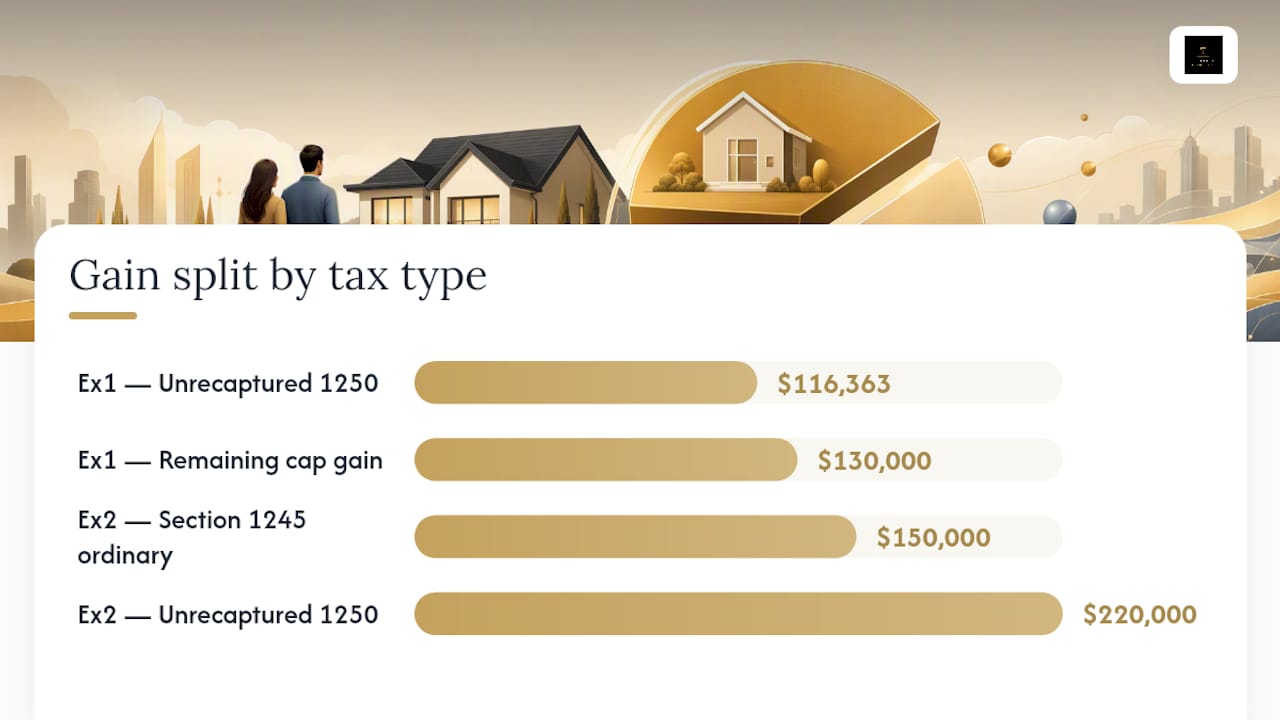
- Unrecaptured Section 1250 gain: since all depreciation was straight-line, the full $116,363 is unrecaptured 1250 gain, taxed at up to 25%.
- Remaining long-term capital gain: $246,363 minus $116,363 equals $130,000, taxed at your standard capital gains rate.
- Form mapping: the $116,363 unrecaptured 1250 amount runs through the Schedule D Unrecaptured Section 1250 Gain Worksheet; the $130,000 flows through Schedule D at standard rates.
Example 2: Cost-segregated property with bonus depreciation.
You bought a commercial building with a cost segregation study allocating portions to land, shorter-lived components (parking, landscaping, specialty electrical), and the long-life structure. You elected full bonus depreciation on the reclassified components early on plus straight-line depreciation on the structure over several years of ownership.
- Section 1245 recapture: the full amount of bonus depreciation on reclassified components is recaptured as ordinary income at sale, since that entire amount was depreciation claimed on personal-property-type assets.
- Unrecaptured 1250 gain: the $220,000 in straight-line depreciation on the structure is capped at a 25% federal rate.
- Remaining capital gain: computed after subtracting the $370,000 combined depreciation from your adjusted basis and comparing to your sale proceeds.
- Form mapping: the $150,000 flows through Form 4797 Part III as ordinary income; the $220,000 flows through the Schedule D worksheet.
The gap between these two examples illustrates the trade-off directly: the cost-segregated property generated larger tax deductions during ownership but created $150,000 of gain with no rate cap at sale, versus zero dollars of uncapped ordinary recapture in the straight-line example.
Example 3: Installment sale accounting.
Using the Example 1 numbers, suppose instead you sell on an installment basis, collecting payments over five years. Under Form 6252 rules, if any portion of your $116,363 depreciation were Section 1245 (say the property included $15,000 of depreciated appliances), that $15,000 in recapture is due in full in year one on Form 4797, regardless of how much cash you've actually collected. Only the remaining capital gain and unrecaptured 1250 gain spread across the five-year payment schedule.
How The Tax Refinery Approaches Depreciation Recapture Planning
The "allowed or allowable" rule is the single most consequential detail in this entire topic, and it's why we tell every client with depreciable real estate to track their depreciation schedule annually, not just at tax time. An owner who skips depreciation for three years to simplify their bookkeeping doesn't dodge anything. They lose three years of deductions and still owe the recapture on the amount they were entitled to claim.
Our approach at Thetaxrefinery is to model exit scenarios every year, not just when a sale is imminent. Markets shift, interest rates change your refinance-versus-sell math, and a cost segregation election you made five years ago has compounding effects on your eventual recapture exposure. We run this modeling annually for active real estate clients and always before a property gets listed.
When a client is deciding whether a cost segregation study makes sense, we weigh the near-term cash flow benefit against the future recapture character it creates. Sometimes accelerated depreciation is clearly the right call because a client plans to exchange indefinitely. Other times, a client planning a sale within five years is better served by standard straight-line depreciation and a cleaner exit.
Clients working with us on a sale should expect a few concrete deliverables:
- A recapture sensitivity model showing after-tax proceeds under a straight sale, a 1031 exchange, and an installment structure.
- A recommended transaction structure based on holding period, expected marginal rate, and estate planning goals.
- Prepared form filings, including Form 4797 and Form 6252 where applicable, or coordination with a qualified intermediary for exchange transactions.
This is the kind of planning that belongs in a year-round advisory relationship rather than a once-a-year conversation squeezed into filing season.
Your Pre-Sale Checklist Before You List the Property
Run this checklist 30 to 90 days before you list, not after you've accepted an offer, since some strategies (particularly 1031 exchanges) require setup before closing.
- Pull complete depreciation schedules for every year of ownership, plus the original cost segregation study if one exists.
- Gather your purchase settlement statement and every capital improvement invoice since acquisition.
- Request three after-tax proceeds models from your CPA or tax strategist: a straight sale with full recapture, a 1031 exchange, and an installment sale.
- Ask specifically how your state taxes unrecaptured 1250 gain and Section 1245 recapture, since state conformity to federal rules varies.
- Ask how prior-year Section 1231 losses on other properties might affect the character of this year's gain under the lookback rule.
Pro Tip: Bring your prior three years of tax returns to this conversation, not just this year's. Your CPA needs to see 1231 history and any suspended passive losses that could offset part of your recapture bill.
Depreciation Isn't a Free Deduction, It's a Loan From Your Future Tax Bill
Every depreciation deduction you take is really a deferral, not a gift, and I think most owners plan as if it's the opposite. The number that matters isn't how much you saved this year. It's how much of that saving gets billed back at sale, at what rate, and whether you structured the exit to control that timing.
Year-round planning beats episodic tax prep precisely because recapture exposure builds silently for a decade before it becomes visible on one closing statement.
— Melissa
Model Your Sale Before You List, Not After
Most owners find out their exact recapture exposure the week their CPA prepares the return, months after the sale already closed and every option to restructure it has disappeared. Thetaxrefinery works the opposite direction: we model your recapture-only, 1031, and installment scenarios while you still have room to choose between them.

Our real estate depreciation strategy work includes sale-date modeling, 1031 exchange coordination, cost segregation review, and preparation of Form 4797 and Form 6252 filings as part of a year-round advisory engagement rather than a one-time consultation. To get started, bring your depreciation schedules, purchase and improvement records, and a rough sale timeline. From there, we build the sensitivity model that shows your after-tax proceeds under each structure before you sign a listing agreement. Review our tax strategy and advisory packages to see which engagement fits a pending sale, or run a quick scenario yourself with our tax impact calculator before you talk to a strategist. If you'd rather see current pricing for tax preparation around a sale-year return, that's the place to start.
Primary Sources Worth Bookmarking
- Publication 544: the authoritative IRS explanation of allowed-or-allowable depreciation and the Section 1245/1250 distinction.
- Form 4797: the form that reports your sale and calculates ordinary-income recapture.
- Form 6252: required for installment sales, with the rule that recapture is due in year one regardless of payment timing.
- 26 U.S. Code § 1250: the statutory basis defining additional depreciation and unrecaptured gain treatment.
- For sale-process context beyond taxes, this seller's checklist covers transactional mechanics worth reviewing alongside your tax modeling.
This article is general information, not a substitute for advice from a qualified financial advisor. Consult a qualified financial professional about your own circumstances before acting on anything here.
Sources
- Publication 544 (Sales and Other Dispositions of Assets) — IRS
- Form 4797, Sales of Business Property — IRS
- Form 6252, Installment Sale Income — IRS (instructions)
- 26 U.S. Code § 1250 — Gain from dispositions of certain depreciable realty — Cornell LII