
You have 45 calendar days to identify replacement property and 180 calendar days to close, both starting the day your relinquished property sells. Miss either deadline and your capital gains tax deferral is lost, without exceptions for weekends, holidays, or good intentions.
Two things to know before you do anything else:
- Both clocks start on the same day: the closing date of the property you sold.
- The 180-day window can end earlier if your tax return's due date (including extensions) arrives first.
Pro Tip: Line up an independent Qualified Intermediary and draft your identification language before you close on the relinquished property. Once escrow closes, the clock does not pause for you to find one.
Key Takeaways
A 1031 exchange lives or dies on two calendar-day deadlines, 45 days to identify and 180 days to close, both triggered the moment your relinquished property sells.
| Point | Details |
|---|---|
| Two clocks, one start date | Both the 45-day and 180-day deadlines begin on the closing date of the relinquished property, and they run concurrently. |
| Calendar days, no exceptions | Weekends and federal holidays count fully; there is no business-day extension for either deadline. |
| Filing deadlines can shorten Day 180 | A Q4 sale can let your tax return due date arrive before Day 180, unless you file an extension first. |
| Never touch the proceeds | A Qualified Intermediary must hold all sale funds to avoid constructive receipt, which disqualifies the exchange. |
| Plan ahead with Thetaxrefinery | Thetaxrefinery structures pre-sale planning, QI coordination, and extension filing to protect the full 180-day window. |
Where to Verify These 1031 Exchange Rules
Primary references: IRC §1031, Rev. Proc. 2007-56, Rev. Proc. 2018-58, and IRS Publication 537.
This article is general information, not a substitute for advice from a qualified financial advisor. Consult a qualified financial professional about your own circumstances before acting on anything here.
Table of Contents
- What Is the Day 0 to Day 180 1031 Exchange Timeline?
- How Do You Correctly Identify Replacement Property?
- When Does Your Tax Filing Deadline Shorten the 180 Days?
- Why Must a Qualified Intermediary Hold Your Funds?
- What Mistakes Most Often Break a 1031 Exchange?
- How The Tax Refinery Structures the 1031 Timing Workflow
- Sources
What Is the Day 0 to Day 180 1031 Exchange Timeline?
Everything in a 1031 exchange traces back to one date: the day the relinquished property transfers and sale proceeds move to your Qualified Intermediary. That's Day 0. Under IRC §1031, two deadlines start running simultaneously from that date, and they run in calendar days, not business days.
- Day 0, the closing date. Proceeds from the sale go directly to the QI, never to you. This single fact is the foundation of the entire exchange.
- Day 45, identification deadline. You must deliver a written, signed, and dated identification of replacement property to your QI or another non-disqualified party by midnight. IRS Revenue Procedure RP-07-56 treats this deadline as strict.
- Day 180, closing deadline. You must acquire one or more of the identified properties by midnight of Day 180, or by your tax return's due date if that comes sooner.
A concrete example makes this easier to track. Sell your relinquished property on September 15, and your identification deadline lands on October 30. Your closing deadline, absent any tax filing complications, falls around March 14 of the following year. Both dates count every day on the calendar, including Thanksgiving, Christmas, and any Saturday your title company happens to be closed.
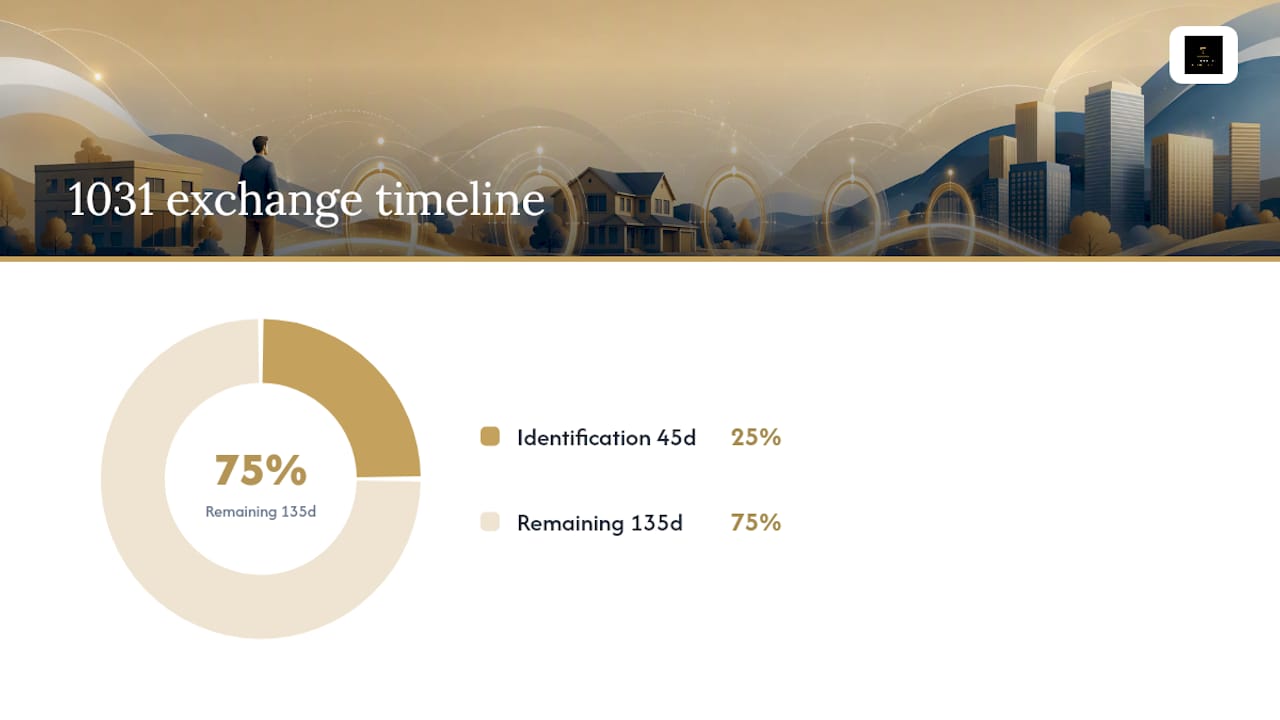
The two windows overlap rather than stack. You are not getting 45 days to identify and then a fresh 180 days to close. The 180-day period includes the 45-day period inside it, which leaves you roughly 135 days after identification to actually get to the closing table. That's tighter than most first-time exchangers expect, especially in a market where financing or inspections drag on.
How Do You Correctly Identify Replacement Property?
The IRS gives you three distinct methods for identifying replacement property, and picking the wrong one can quietly sink an otherwise solid exchange. IRS Publication 537 and the underlying Treasury regulations lay out the mechanics.
- Three-property rule: Identify up to three properties of any value. This is the default choice for most single-asset trades because it requires no valuation math.
- 200% rule: Identify more than three properties, as long as their combined fair market value doesn't exceed 200% of what you sold. Sell a property for $1 million, and your identified group can total up to $2 million in aggregate value.
- 95% rule: Identify unlimited properties with no value cap, but you must actually acquire at least 95% of the total identified value. This rule carries real execution risk. Fall short of that 95% threshold, and the entire exchange can unravel.
Every identification notice needs a legal description or clear street address, a signature, and a date, delivered to your QI or another qualifying party by midnight of Day 45. There's no grace period for a typo in a parcel number or a notice that arrives at 12:01 AM on Day 46.
When Does Your Tax Filing Deadline Shorten the 180 Days?
The statute sets your closing deadline at the earlier of 180 days or your tax return's due date for the year you sold, including extensions. That "earlier of" language catches investors who sell in the fourth quarter and don't realize their standard filing deadline arrives before Day 180 does.
- Spot the risk early. A property sold in November gives you a 180-day window stretching into May, but your individual return is normally due April 15, well before that.
- File the extension before it matters. A Form 7004 extension for a partnership, or the standard individual extension, pushes your filing deadline out and restores the full 180 days you're entitled to.
- Coordinate with your tax preparer immediately after closing, not in March. Waiting until your identification deadline approaches to check your entity's filing date is how investors accidentally shrink their own timeline.
Why Must a Qualified Intermediary Hold Your Funds?
Constructive receipt is the rule that ends more 1031 exchanges than any identification mistake. If sale proceeds touch your bank account, even briefly, even by accident, the exchange is disqualified. The IRS doesn't care that you intended to reinvest every dollar.
A properly structured Qualified Intermediary exists specifically to prevent that outcome. Your QI holds the proceeds, executes the closing paperwork on both the sale and the purchase, receives your written identification notice, and disburses funds directly to acquire the replacement property, all without the money ever passing through your hands.
- Confirm your QI agreement is signed and funded before the relinquished property closes.
- Get written acknowledgment that the QI received your identification notice, not just a verbal confirmation.
- Coordinate directly with the title company so everyone understands the funds path before closing day.
Pro Tip: Ask your QI in writing to confirm receipt of your identification notice the same day you send it. A dated email reply is worth more than a phone call if your exchange is ever questioned.
What Mistakes Most Often Break a 1031 Exchange?
Most failed exchanges don't collapse because of some obscure tax loophole; instead, careful tax compliance and avoiding business tax mistakes are essential to a successful transaction. They fail from operational errors that a little advance planning would have caught.
- Missing the midnight receipt deadline because a notice was sent but not confirmed as received by the QI on Day 45.
- Typos or vague descriptions in the identification notice, an incomplete address or missing legal description invalidates the whole notice.
- Assuming business-day extensions exist. They don't. If Day 45 lands on Thanksgiving, Day 45 is still Day 45, according to IRS Revenue Procedure RP-07-56.
- Skipping a Q4 filing extension, which lets the tax return due date quietly cut the 180-day window short.
- Touching the proceeds directly, even a brief transfer into a personal account triggers constructive receipt.
- Working with an unverified QI that lacks a track record or proper escrow controls.
Pro Tip: Identify more than one viable replacement property, even under the three-property rule, so a single failed financing or inspection doesn't take down your entire exchange. Reserve a backup property whenever the deal allows it, per practical guidance from Baker 1031.
Before you list a property you intend to exchange, run through this: select your QI, prepare identification language in draft form, pre-screen at least one backup property, confirm your filing deadline and file an extension if needed, and get written QI acknowledgments in hand. If your deal involves a related party, a reverse exchange structure, or a multi-property portfolio split, bring in tax counsel before you sign a purchase agreement, not after.
How The Tax Refinery Structures the 1031 Timing Workflow
Melissa Korber, an Enrolled Agent and founder of Thetaxrefinery, built the firm's exchange workflow around the same operational discipline this timeline demands. The approach starts with pre-sale planning 60 or more days out, engaging a QI before Day 0, drafting identification language ahead of closing, filing extensions proactively for Q4 sales, coordinating closing dates with title companies, and finishing with Form 8824 reporting. Complex entity structures, reverse exchanges, and related-party deals warrant advisory support well before you sign anything.
What reverse exchanges do differently
A reverse exchange flips the usual order: you acquire the replacement property first, then identify and sell the relinquished property within the same 45 and 180-day framework. The mechanics differ substantially, requiring an exchange accommodation titleholder and specialized escrow structuring that a standard forward exchange never needs.

A quick word on timing and preserved wealth
One case stands out: an investor selling in late November nearly lost a six-figure deferral because no one checked the partnership's filing deadline until December. A same-week Form 7004 extension preserved the full 180 days. Talk to your advisor before you sign a purchase agreement, not after the clock starts.
Timing Support That Fits Around Your Deal, Not the Other Way Around
Most investors don't lose a 1031 exchange to bad tax strategy. They lose it to a missed filing extension, a QI who wasn't lined up in time, or a closing that slipped past Day 180 because nobody was tracking the calendar against the tax return due date. Thetaxrefinery builds pre-sale planning, QI coordination, extension filing, and closing scheduling into one advisory engagement, so the operational risk that sinks most exchanges gets caught weeks before it becomes a problem instead of the week it happens.

If you're planning a sale and want your exchange timeline reviewed before you're locked into a closing date, compare Thetaxrefinery's tax strategy packages and get your pre-sale plan started.