
Most Idaho S corporations owe little to no entity-level income tax. Idaho's 5.3% business rate applies only to specific items like excess net passive income and net recognized built-in gains; the rest of your profit flows through to shareholders on their personal returns. What you cannot skip is Form 41S, the Permanent Building Fund's $20 minimum tax, and a decision on nonresident owner withholding, composite filing, or the Affected Business Entity election. Miss those and you're looking at penalties, not a bigger tax bill.
TL;DR:
- Idaho's entity-level income tax only applies to excess passive income and built-in gains, not ordinary pass-through business profits; the rest flow to shareholders personally.
- Filing Form 41S is required if the business operates in Idaho, is registered with the Secretary of State, or has Idaho-source income, even with zero activity, and must be submitted by April 15.
- Nonresident shareholders face mandatory withholding unless they sign a PTE-NROA agreement or the company files a composite return, which shifts tax obligations to the entity.
- The $20 minimum tax, plus $10 per shareholder for the Permanent Building Fund, applies regardless of profit, and calculated estimated payments should include these fixed amounts.
- Most Idaho S corps pay little at the entity level beyond these minimums unless they have excess passive income or recognize built-in gains from prior C-corp status.
Table of Contents
- Idaho S Corp Tax Rate and When You Owe at the Entity Level
- Filing Form 41S: Triggers, Attachments, and Deadlines
- Pass-Through Withholding, Composite Returns, and Form PTE-NROA
- ABE Election: Mechanics, Consequences, and When It Makes Sense
- Apportionment, Nexus, and Public Law 86-272 for Multistate S Corps
- Estimated Payments, PBF, and the Minimum Tax Worksheet
- Deadlines, Penalties, and the Compliance Traps That Cause the Most Damage
- Annual Idaho S-Corp Compliance Checklist and Three Real-World Scenarios
- Why Year-Round Advisory Prevents Idaho S-Corp Surprises
- How Thetaxrefinery Helps Idaho S Corps Stay Ahead of Filing Season
- Sources
- FAQ
Idaho S Corp Tax Rate and When You Owe at the Entity Level
Idaho's business income tax rate is 5.3% for 2025, and that figure matters more than most owners realize because it's the rate applied whenever an S corp does owe tax directly. It wasn't always this low. The Idaho State Tax Commission's rate table shows the rate at 5.8% in 2023 and 5.695% in 2024 before dropping to its current level, a trend worth tracking if you're modeling multi-year projections for a client or your own business.
Idaho Business Tax Rate, Recent History
| Tax Year | Rate |
|---|---|
| 2023 | 5.8% |
| 2024 | 5.695% |
| 2025 | 5.3% |
Here's the part that trips up a lot of new S-corp owners: the entity itself almost never pays income tax on ordinary business profit. Idaho follows the federal pass-through model. Income, deductions, and credits flow to shareholders through Schedule K-1, and each shareholder reports their share on their own Idaho return. The corporation pays entity-level tax only in two narrow situations, both carried over from federal S-corp rules.
The first is excess net passive income (ENPI). This applies to former C corporations, or S corps that acquired C-corp assets, when passive income like rents, royalties, interest, or dividends exceeds 25% of gross receipts and the corporation has accumulated earnings and profits from its C-corp years. The second is net recognized built-in gain, which hits when an S corp sells an asset it owned as a C corporation within the recognition period and that sale produces a taxable gain. Neither scenario is common for a business that has always operated as an S corp, but they're not rare either, especially for practices or firms that converted from C-corp status to capture pass-through benefits.
Then there's the Permanent Building Fund (PBF) tax, a flat $10 per shareholder that funds state building projects, and it stacks with a $20 minimum tax that every S corp owes regardless of income. A handful of quick facts worth pinning to your compliance calendar:
- The 5.3% rate applies only to ENPI and net recognized built-in gain, not ordinary pass-through income.
- The $20 minimum tax applies even to S corps with a loss year or zero Idaho activity.
- PBF tax is $10 per shareholder when the entity itself has a filing obligation.
- ENPI and built-in gain issues almost always trace back to a prior C-corp election.
Idaho's business tax rate has fallen for three straight years: from 5.8% in 2023 to 5.3% in 2025, according to the Idaho State Tax Commission. That's a meaningful shift if you're comparing Idaho against neighboring states for multistate planning.
Filing Form 41S: Triggers, Attachments, and Deadlines
You must file Idaho Form 41S if any one of three conditions applies, and it only takes one. According to the Idaho State Tax Commission's S-corporation guidance, an S corp files if it:
- Does business in Idaho.
- Is registered with the Idaho Secretary of State to do business in the state.
- Has income attributable to Idaho, even without a physical presence.
Notice that registration alone triggers the requirement. A lot of business owners assume that if they didn't generate Idaho revenue in a given year, they're off the hook. If your entity is still registered with the Idaho SOS, you likely still owe a return, even a zero-activity one, just to keep your minimum tax and PBF obligations current.
Form 41S isn't a standalone document. The Tax Commission expects a complete package, and an incomplete filing is one of the fastest ways to trigger a notice. Required attachments typically include:
- A complete copy of your federal Form 1120-S, all pages and schedules.
- Idaho Form ID K-1 for every shareholder, matching the federal K-1 allocations.
- Form 42 if you're apportioning income across multiple states.
- In your first year as an Idaho S corp, a copy of your IRS Form 2553 approval notice, proving the federal election was accepted.
That last item catches people off guard. Idaho doesn't run its own separate S-election process; it simply adopts your federal S status. But the state wants proof that the IRS actually approved it, not just that you filed the paperwork. Skip that attachment in year one and you risk the Tax Commission questioning your entire filing basis.
The deadline for Form 41S is the 15th day of the fourth month after your tax year closes, which lands on April 15 for calendar-year filers, matching the federal 1120-S due date. If you need more time, Idaho grants an automatic extension as long as you've paid at least the minimum tax and any known liability by the original due date. The extension buys you time to file, not time to pay.
A few filing mechanics worth knowing before you're in a time crunch:
- Idaho generally follows the federal extension; a valid federal extension typically satisfies the state requirement if you attach it.
- Amended Idaho returns use Form 41S with the amended box checked, and you should attach an amended federal 1120-S or explanation of the change.
- The statute of limitations for claiming a refund is generally three years from the original due date or two years from the date tax was paid, whichever is later.
- Missing the K-1 distribution to shareholders is one of the most common downstream errors, since a wrong K-1 forces every shareholder to amend their personal return too.
If you're managing a multistate S corp or one with several shareholders, build in a buffer before April 15 to reconcile K-1s against your federal return. Rushed K-1s are where most individual-level filing headaches begin.
Pass-Through Withholding, Composite Returns, and Form PTE-NROA
Idaho requires pass-through withholding on nonresident individual shareholders, and it's an obligation many out-of-state owners don't see coming until the state sends a notice. According to the Tax Commission's pass-through entity guidance, the entity must withhold Idaho tax on a nonresident shareholder's distributive share unless one of two alternatives applies: the shareholder signs a Nonresident Owner Agreement (Form PTE-NROA), or the entity files a composite return covering that shareholder.
Withholding is calculated on the nonresident's share of Idaho-source income at the applicable rate, and the S corp remits it directly to the state rather than leaving the shareholder to handle it independently. This protects Idaho's revenue when it has no other way to compel a nonresident to file, but it also means cash leaves your business before the shareholder ever sees a distribution.
Composite returns offer a middle path. The entity files on behalf of its nonresident individual shareholders and pays tax at the corporate rate directly, so those owners typically skip filing an individual Idaho return altogether. The trade-off is real: composite filing generally strips out individualized deductions, credits, and lower marginal rates that a shareholder might otherwise claim on their own return. For a nonresident with significant other Idaho deductions or losses, composite treatment can cost more than filing separately.
Form PTE-NROA is often the cleanest option for owners who want to file their own Idaho return but avoid mandatory withholding cutting into their distributions. The shareholder signs the agreement promising to file and pay Idaho tax on their own, and the entity keeps that signed form on file instead of withholding. Timing matters here: the agreement needs to be in place before the withholding requirement would otherwise apply, not scrambled together after distributions have already gone out.
Quick comparison of the three paths:
- Withholding: Default rule; entity remits tax on the shareholder's behalf, reducing their cash distribution.
- Composite return: Entity files and pays for the shareholder at the corporate rate; shareholder skips individual filing but loses some deduction flexibility.
- PTE-NROA: Shareholder self-certifies they'll file and pay; avoids withholding but requires the signed agreement on hand before it's needed.
Pro Tip: Collect signed PTE-NROA forms from nonresident shareholders at the start of the tax year, not at filing time. Waiting until March to chase signatures is how withholding gets triggered by default, even for owners who fully intended to file on their own.
ABE Election: Mechanics, Consequences, and When It Makes Sense
The Affected Business Entity (ABE) election lets an Idaho S corp choose to pay tax at the corporate rate on behalf of its owners, shifting the tax liability from the individual shareholder level to the entity level. It's voluntary, and critically, it's made fresh every year. There's no "set it and forget it" here; the Tax Commission's pass-through entity guidance treats the ABE as an annual decision, which means your planning conversation needs to happen before the tax year ends, not after.
Why would an S corp elect this? The most common driver is the federal state and local tax (SALT) deduction cap. By paying state tax at the entity level instead of passing it through, the corporation can generally deduct that state tax as a business expense on its federal return, sidestepping the $10,000 SALT cap that limits individual shareholders. Shareholders typically then receive a credit against their own Idaho tax liability for their share of the tax the entity already paid.
The ABE election also changes how net operating losses work. Under a standard pass-through structure, losses flow to shareholders and get used (or limited) at the individual level. Under ABE, the entity itself can carry and apply NOLs, which shifts the loss-utilization math entirely, and that's not always a win. A shareholder with substantial other income might have used a pass-through loss more efficiently on their own return than the entity can at the corporate level.
A few signals that make ABE worth serious consideration:
- Shareholders are already near or over the federal SALT deduction cap on their personal returns.
- The ownership group is stable and comfortable with the entity absorbing the state tax liability directly.
- Nonresident owners would otherwise face withholding or composite filing, and ABE simplifies that picture.
And signals that argue against it:
- The company has recent or projected NOLs that shareholders could use more effectively at the individual level.
- Ownership changes frequently, making annual re-election coordination messy.
- Shareholders have widely different marginal tax rates, where a flat entity-level rate doesn't serve everyone equally.
Pro Tip: Run the ABE decision as part of your fourth-quarter planning, not your tax return prep in March. Once the year closes, you've lost the ability to adjust withholding or shareholder distributions around the election.
If you're weighing ABE against a straightforward pass-through structure, it's worth walking through the math with a complete S-corp planning strategy before you commit, since the right answer depends heavily on your ownership structure and projected income.
Apportionment, Nexus, and Public Law 86-272 for Multistate S Corps
If your S corp operates only in Idaho, you use 100% Idaho apportionment and skip the multistate math entirely. Once you have income, property, or payroll tied to more than one state, Idaho requires you to apportion income using Form 42, which applies Idaho's apportionment factor to determine what share of your total income the state can tax.
Idaho's standard apportionment approach weighs sales, property, and payroll to calculate what portion of a multistate business's income is attributable to Idaho activity. Getting this wrong in either direction, overstating or understating your Idaho factor, is one of the more common triggers for a Tax Commission inquiry, particularly for service businesses that don't have obvious in-state property to anchor the calculation.
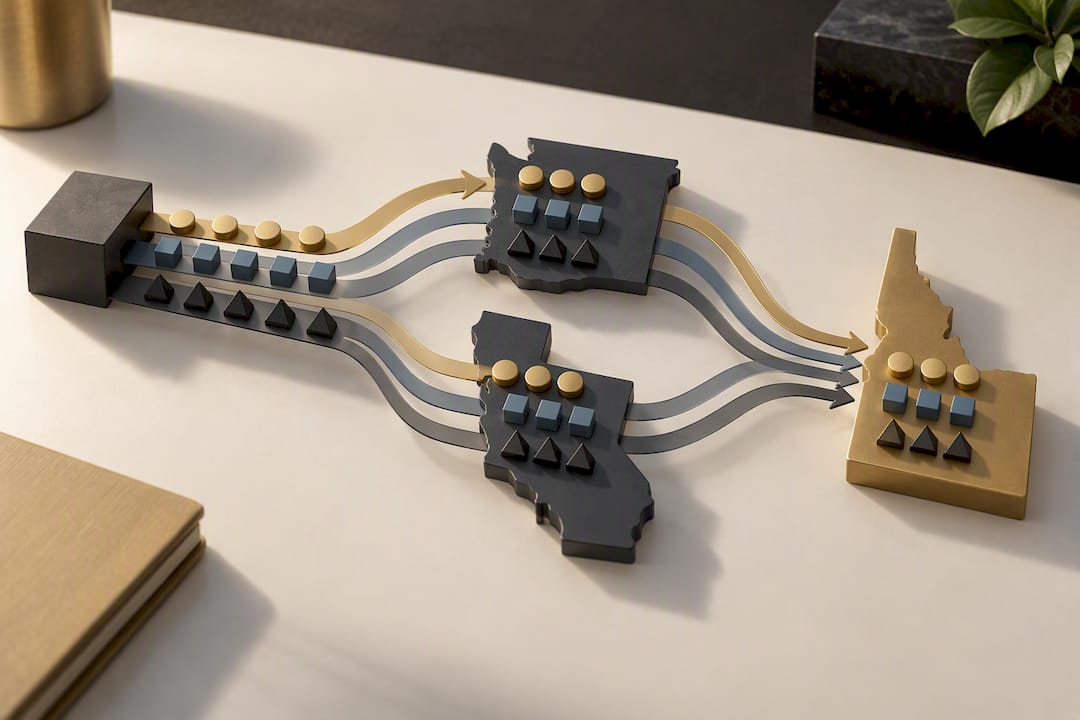
That brings up Public Law 86-272, a federal law that limits a state's ability to impose income tax on an out-of-state business whose only activity in that state is soliciting orders for tangible personal property, where the orders are approved and shipped from outside the state. According to Idaho's S-corporation guidance, this protection is narrow by design. It applies only to solicitation of orders for tangible goods, not services, not licensing, not most digital products.
That distinction matters enormously for how many Idaho-connected businesses actually qualify. Common activities that break PL 86-272 protection include:
- Maintaining a service business with any in-state performance of services.
- Having employees or independent agents conducting activity beyond order solicitation in another state.
- Owning or leasing real property or maintaining inventory in a state beyond the home state.
- Providing post-sale support, repair, or installation services in-state.
- Engaging in any non-solicitation business activity, even minor administrative tasks, within the state.
A remote consulting firm, an SaaS company, or a wellness practice with a satellite location almost never qualifies for PL 86-272 protection, because none of those business models are selling tangible personal property through pure solicitation. If you're a trades or product-based business shipping goods into other states with no other in-state footprint, you may genuinely qualify, and that's worth confirming before you assume you owe a return somewhere you don't.
For most service-based and multi-entity operators, the practical takeaway is simpler: assume you have a filing obligation in any state where you have meaningful activity, and treat PL 86-272 as a narrow exception rather than a default shield.
Estimated Payments, PBF, and the Minimum Tax Worksheet
Idaho requires corporations to make estimated tax payments if the state income tax liability is $500 or more, with due dates aligned to the federal calendar: April, June, September, and December for calendar-year filers, according to Idaho's business estimated tax guidance. Fiscal-year filers shift those dates to the corresponding months of their own tax year.
Here's where it gets specific to S corps. Since most pass-through income doesn't generate entity-level tax, your estimated payment calculation generally centers on two things: any projected ENPI or net recognized built-in gain tax at 5.3%, and the $20 minimum tax that applies regardless of income. If your entity has no exposure to excess net passive income or built-in gain, estimated tax payments commonly consist of the $20 minimum tax plus Permanent Building Fund tax.
S corps owe a flat $20 minimum tax even in a loss year, per the Tax Commission's Form 41S instructions. That single detail causes more late-notice surprises than almost anything else in this article, because owners assume a loss year means zero obligation.
The Permanent Building Fund tax adds a fixed amount per shareholder when the entity has a filing obligation. A three-shareholder S corp with no ENPI exposure and a break-even year still owes $20 minimum tax plus $30 in PBF, for a $50 total, before a single dollar of income tax enters the picture.
A simplified worksheet logic for S corps looks like this:
- Step 1: Calculate any projected ENPI or net recognized built-in gain and apply the 5.3% rate.
- Step 2: Add the $20 minimum tax if your calculated liability falls below that floor.
- Step 3: Add $10 per shareholder for PBF tax.
- Step 4: Divide the total by four (or your fiscal quarters) and remit by each due date.
- Step 5: Adjust mid-year if a shareholder change or a passive-income event shifts your ENPI exposure.
Common oversights on this front include forgetting PBF entirely when a new shareholder joins mid-year, and assuming a zero-income year means zero estimated payment obligation. Neither assumption holds up under Idaho's rules, and both are easy to catch with a quarterly review rather than a once-a-year scramble.
Deadlines, Penalties, and the Compliance Traps That Cause the Most Damage
Idaho's core deadlines are worth keeping in one place: Form 41S is due the 15th day of the fourth month after year-end (April 15 for calendar-year filers), estimated payments fall in April, June, September, and December, and extensions require at least the minimum tax paid by the original due date to stay valid.
Penalties stack in familiar ways: a late-filing penalty, a late-payment penalty, and interest on any unpaid balance. The Form 41S instructions list an example interest rate of 6% for 2026, which applies to unpaid tax from the original due date until it's paid in full. That rate moves periodically, so check the current-year instructions before assuming last year's figure still applies.
The compliance traps that generate the most Tax Commission notices tend to repeat across practices and industries:
- Missing or mismatched K-1s. If your Idaho Form ID K-1 doesn't match the federal K-1 allocation, expect scrutiny on both the entity and shareholder returns.
- Misapplied apportionment. Claiming 100% Idaho apportionment when you have meaningful multistate activity, or vice versa, invites a corrective notice and potential penalty.
- Late or skipped withholding decisions. Failing to withhold on a nonresident shareholder, without a valid PTE-NROA or composite return in place, shifts the liability back onto the entity.
- Forgetting the $20 minimum tax in a loss year. A common assumption that costs owners a penalty notice they didn't expect.
- Missing the first-year Form 2553 attachment. Skipping proof of federal S-election approval can call your entire filing basis into question.
Most of these traps share a root cause: treating the S-corp return as a once-a-year task rather than something to track quarterly alongside estimated payments and shareholder changes.
Annual Idaho S-Corp Compliance Checklist and Three Real-World Scenarios
Run this checklist once a quarter, not once a year, and most of the traps above simply stop happening.
- Confirm nexus: are you doing business in Idaho, registered with the Idaho SOS, or generating Idaho-sourced income?
- Distribute accurate Idaho Form ID K-1s to every shareholder, matched line-for-line against the federal K-1.
- Decide your nonresident owner approach: withholding by default, a composite return, or signed PTE-NROA forms collected in advance.
- Evaluate whether the ABE election makes sense for this specific tax year, not last year's decision carried forward.
- Compute your $20 minimum tax and $10-per-shareholder PBF obligation, even in a loss year.
- Set and calendar quarterly estimated payments aligned to the federal due dates.
- File Form 41S by the 15th day of the fourth month after year-end, attaching your federal 1120-S and, in year one, your Form 2553 approval.
Three scenarios show how these pieces fit together in practice.
Scenario A: The remote nonresident shareholder. A Boise-based S corp brings on a minority shareholder who lives in Washington and has no other Idaho ties. Without a signed PTE-NROA, Idaho requires withholding on that shareholder's distributive share, cutting into their distribution before they see a dollar. If the shareholder would rather file their own Idaho return and manage their own deductions, getting a signed PTE-NROA on file before distributions start avoids that withholding entirely.
Scenario B: Multistate operations. An Idaho-based service firm opens a second office in Oregon and starts billing clients there directly. Because the firm now has payroll and property outside Idaho, and the work isn't solicitation of tangible goods, PL 86-272 offers no protection. The firm needs Form 42 apportionment to split income between Idaho and Oregon, comparing the Idaho vs. Oregon pass-through entity tax treatment before assuming either state's rules mirror the other's.
Scenario C: High passive income. A converted C-corp-to-S-corp practice holds significant rental and investment income left over from its earlier structure. Restructuring how passive assets are held, or timing asset sales around the built-in gain recognition period, are the kinds of planning moves that head this off before it becomes a surprise liability.
Pro Tip: If your S corp fits any of these three scenarios, treat the decision as a planning conversation in the fall, not a filing task in April. Every one of these choices, withholding versus PTE-NROA, apportionment method, ABE timing, works better when it's made with time to adjust distributions and payroll around it.
Why Year-Round Advisory Prevents Idaho S-Corp Surprises
Most of the compliance traps covered in this article share the same root cause: a decision that needed to be made in October got made, or discovered, in April. The ABE election, the PTE-NROA timing, the apportionment method, all of these work better with lead time. A once-a-year conversation with your preparer doesn't leave room for that kind of planning; it leaves room for reporting what already happened.
Thetaxrefinery approaches S-corp clients with that timing problem in mind. Annual planning sessions happen before year-end, not after, so decisions about withholding, composite filing, or the ABE election get made while there's still time to adjust. K-1 accuracy gets checked against federal filings early, not discovered as a mismatch in March. For businesses with multistate activity or nonresident owners, that lead time is often the difference between a clean filing and a corrective notice.
Complex situations, multiple entities, significant passive income, cross-border ownership, deserve a conversation with a qualified Enrolled Agent who can walk through your specific numbers rather than general rules.
— Melissa
How Thetaxrefinery Helps Idaho S Corps Stay Ahead of Filing Season
Some tax advisory firms offer proactive planning for Idaho S-corp owners, helping them address withholding requirements or ABE elections before deadlines instead of after the year closes. The firm's S-Corp Tax Strategy Accelerator is priced at a flat $997 and walks through entity structure, K-1 accuracy, and election timing for owners who want a focused strategy session rather than an open-ended engagement.
If your business has multistate activity, nonresident owners weighing withholding against a PTE-NROA, or passive income exposure that could trigger ENPI tax, that's exactly the profile that benefits most from proactive planning rather than reactive filing. For owners who want ongoing support instead of a single session, Thetaxrefinery's Monthly Tax Advisory and Quarterly Tax Strategy Sessions keep the ABE decision, estimated payments, and K-1 review on a regular calendar instead of a springtime scramble. Form 41S preparation itself runs $1,800 under the fee schedule for Form 1120-S returns, with transparent pricing published upfront.
If any of the scenarios in this article sound like your business, book a consult and walk through your specific filing triggers before your next deadline arrives.
FAQ
How Much Will My S Corp Pay in Idaho Taxes?
Most Idaho S corps pay little beyond the $20 minimum tax and $10-per-shareholder PBF tax, since ordinary income passes through to shareholders instead of being taxed at the entity level. Entity-level tax at Idaho's 5.3% business rate only applies if you have excess net passive income or net recognized built-in gains, typically tied to a prior C-corp history.
How Much Is $100,000 After Taxes in Idaho?
Take-home pay depends heavily on filing status, deductions, and whether income comes through W-2 wages or S-corp distributions, so there's no single flat number. An S-corp structure can improve after-tax results compared to sole proprietorship income by limiting the portion subject to self-employment tax, but the exact figure requires running your own numbers against Idaho's current bracket structure.
Is Idaho a Tax-Friendly State for Business Owners?
Idaho's business tax rate has fallen for three consecutive years, landing at 5.3% for 2025, which makes it competitive compared to many neighboring states. Combined with a pass-through structure that spares most S-corp income from entity-level tax, Idaho is generally considered favorable for small and mid-sized business owners, though multistate operators still need to plan around apportionment.
How Much Will I Make After Taxes on $200,000 a Year in Idaho?
Your after-tax result depends on entity structure, deductions, and how much is paid as reasonable W-2 salary versus S-corp distribution. An S-corp election can reduce the portion of income exposed to self-employment tax compared to a sole proprietorship, which is one reason high-earning practitioners consider the structure, but a precise after-tax figure requires a full return calculation.
Does Public Law 86-272 Protect My Idaho S Corp From Filing in Other States?
Public Law 86-272 only protects businesses whose sole out-of-state activity is soliciting orders for tangible personal property, with orders approved and shipped from outside that state, according to Idaho's S-corporation guidance. Service businesses, companies with in-state employees or property, and most digital or professional service providers do not qualify and generally must file in every state where they have meaningful activity.