
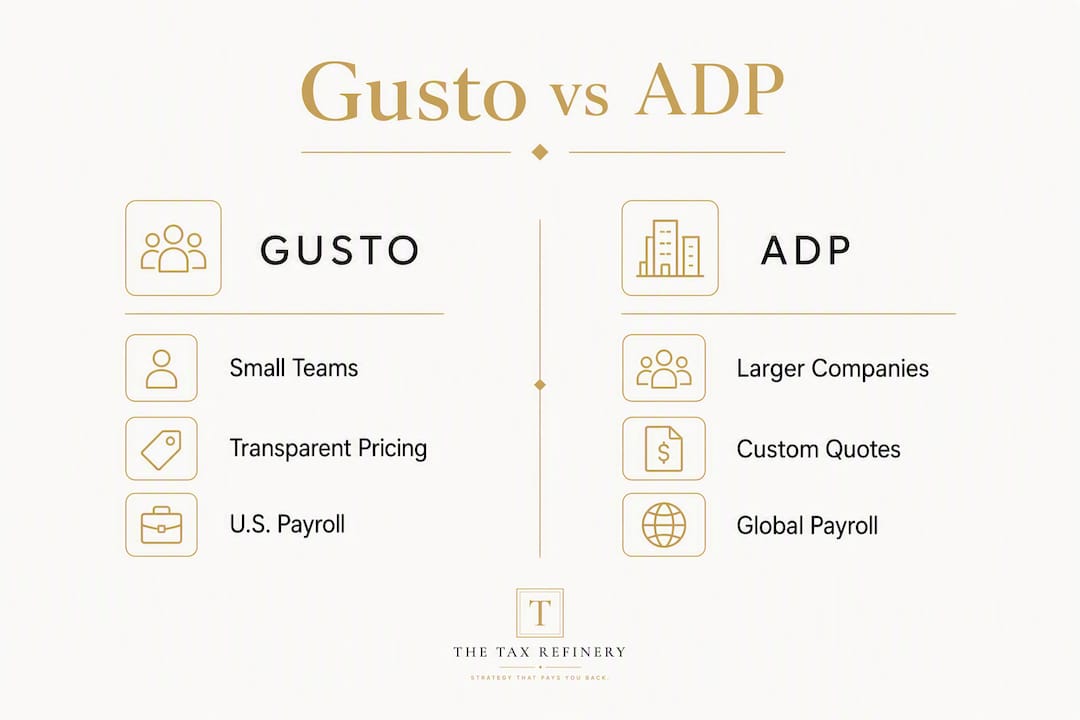
Gusto is the better choice for most U.S.-based small businesses with fewer than 150 employees. ADP earns its place when you need enterprise-grade compliance, global payroll across 140+ countries, or a dedicated HR advisory team on call.
- Under 150 employees: Gusto's published tiered pricing, unlimited payroll runs, and self-serve onboarding deliver lower total cost of ownership and less administrative drag than ADP's custom-quote model.
- 150+ employees or international hires: ADP's infrastructure, SUI/garnishment handling, and global reach justify the added complexity and cost.
Pro Tip: If you work with a tax advisor on S-corp reasonable compensation or multi-entity structuring, your payroll platform's reporting exports directly affect year-end accuracy. Choose a platform whose data integrates cleanly with your accounting stack before you sign.
Table of Contents
- How do Gusto and ADP compare side by side?
- Who should choose Gusto vs who should choose ADP?
- Feature-by-feature breakdown: what actually differs?
- What does each platform actually cost?
- What to expect when you switch platforms
- A decision checklist you can use right now
- How payroll platform choice affects your tax strategy
- Key Takeaways
- The payroll decision most founders get backwards
- Thetaxrefinery helps you align payroll with your tax strategy
- Useful sources
How do Gusto and ADP compare side by side?
| Dimension | Gusto | ADP |
|---|---|---|
| Best for / ideal size | 1–150 employees | 50–200 employees |
| Pricing model | Published tiers; per-employee monthly fee | Custom quote; sales call required |
| Payroll & tax filing | Automated; unlimited runs; tax penalty guarantee | Automated; per-run fees on some plans |
| HR features | Onboarding, PTO, self-service, handbook builder | Full HCM suite; dedicated HR advisor access |
| Benefits administration | Health, dental, vision, 401(k) bundled | Broader broker network; add-on fees common |
| Ease of use | High; intuitive UI; minimal training | Moderate; steeper learning curve |
| Support model | Self-serve + phone/chat | Consultative; dedicated rep on higher tiers |
| Integrations | QuickBooks, Xero, 100+ apps | Broader enterprise connectors |
| International payroll | U.S. employees + contractor payments abroad | Full-employee payroll in 140+ countries |
| Onboarding effort | Hours to days | Weeks to months |
Who should choose Gusto vs who should choose ADP?
Headcount is the single most reliable decision signal, but it is not the only one.
- Under 50 employees: Gusto. Published pricing, fast setup, and unlimited payroll runs make it the clear fit. Industry analysts note that small businesses frequently choose ADP on brand recognition and later regret the hidden complexity when headcount is low.
- 50–150 employees: Still Gusto for most. The platform handles multi-state payroll, benefits, and basic HR without requiring a dedicated HR administrator.
- 150–200 employees: Evaluate both. At this range, reporting depth, SUI handling, and HR workflow complexity start to favor ADP.
- 200+ employees or international hires: ADP. Comparative guides consistently place Gusto's practical ceiling at roughly 100–150 employees before enterprise HCM becomes necessary.
Operational signals also matter. If you operate across five or more states, carry workers' compensation in multiple jurisdictions, or plan to hire full-time employees abroad within 12 months, ADP's infrastructure is worth the premium. If your priority is predictable monthly billing and minimal setup, Gusto wins on both counts.
Pro Tip: When requesting an ADP quote, ask for a fully itemized proposal that separates base fees, per-employee charges, setup costs, and any implementation or training line items. Setup fees are negotiable, and the gap between the initial quote and a negotiated price can be significant.
Feature-by-feature breakdown: what actually differs?
Payroll processing and tax filing
Gusto runs payroll with no per-run fees and files federal, state, and local payroll taxes automatically on every plan. Its tax penalty guarantee covers errors Gusto causes, which reduces downstream liability for business owners who lack in-house payroll expertise. ADP automates tax filing as well, but off-cycle payroll runs may carry additional charges depending on your plan tier.

For S-corp owners managing reasonable compensation, the difference matters. Clean, automated tax deposits and accurate W-2 exports reduce the reconciliation burden at year-end and make your tax advisor's job faster and more accurate.
HR features and employee self-service
Gusto includes onboarding checklists, offer letter templates, a handbook builder, PTO tracking, and an employee self-service portal at its core tiers. ADP goes further with applicant tracking, performance management, and access to HR advisors on higher plans. ADP positions itself as an extension of your HR function, which has real value when you have no internal HR staff and need 24/7 specialist access.
Benefits administration
Gusto bundles health, dental, vision, and 401(k) administration into its plans with transparent per-employee pricing. ADP works through a broader broker network and offers more plan variety, but benefits administration often comes as a paid add-on. For a 20-person team, Gusto's bundled approach typically produces a lower total benefits-admin cost.
Integrations and reporting
Both platforms connect to QuickBooks and Xero. Gusto supports 100+ third-party integrations with a clean API. ADP's connector library is broader for enterprise tools like Workday and SAP. For tax planning purposes, the quality of your payroll-to-accounting data feed affects how quickly your advisor can close the books and model year-end scenarios.
International capabilities
ADP supports full-employee payroll in 140+ countries. Gusto handles U.S. employee payroll and contractor payments in many countries but relies on employer-of-record partners for full international employment. If a concrete international hiring plan is on your roadmap within 18 months, that alone justifies evaluating ADP now.
Pro Tip: Before finalizing your integration stack, confirm that your payroll platform exports a clean general ledger mapping to your chart of accounts. A misaligned payroll-to-accounting feed creates reconciliation errors that compound at tax time.
What does each platform actually cost?
Gusto publishes its pricing openly. ADP requires a sales call and custom quote, which slows vendor comparison and makes budgeting harder.
| Scenario | Gusto (est. monthly) | ADP (est. monthly) | Notes |
|---|---|---|---|
| 20 employees, basic payroll | ~$200 | Custom; typically higher | Gusto Simple/Plus tiers; ADP quote varies |
| ~150 employees, full HR + benefits | ~$800 | Custom; often multiples of hundreds | ADP setup fees add $2,000–$8,000 upfront |
| Admin time (no dedicated HR) | Low; 1–3 hrs/month | Moderate; around 4 hrs/month | Learning curve and configuration time |
ADP implementation and setup fees can be significant depending on configuration complexity. That upfront cost is negotiable but rarely waived entirely. Factor it into your 12-month TCO calculation, not just the monthly per-employee rate.
What to expect when you switch platforms
Gusto's self-serve onboarding typically takes hours to a few days for teams under 50. ADP implementations run weeks to months depending on configuration scope.
Before you migrate, export and validate these records from your current provider:
- Full payroll history (at least three years for tax substantiation)
- Year-to-date payroll tax filings and deposit confirmations
- Employee records: W-4s, direct deposit authorizations, benefit enrollments
- State unemployment insurance (SUI) account numbers and rates for every state
- Time and attendance records and PTO balances
- Active integration credentials and API connections
Common migration pitfalls include discovering setup fees only after signing, missing SUI registrations in new states, and broken accounting integrations that corrupt the general ledger on the first payroll run. Running parallel payrolls for one full cycle before cutting over catches most of these errors before they affect employee pay or tax deposits.
Pro Tip: The IRS generally requires payroll records to be retained for at least four years. Export complete records before deactivating your old account, and store them in a location your tax advisor can access during an audit.
A decision checklist you can use right now
Work through these in order. The first item that points clearly to one platform usually settles the decision.
- Legal and compliance exposure: Do you operate in 5+ states or carry workers' comp in multiple jurisdictions? ADP handles complex multi-state compliance more reliably.
- Current headcount and 18-month forecast: Under 150 and staying domestic? Gusto. Planning to cross 200 or hire abroad? Start ADP conversations now.
- Budget and pricing transparency: Need a predictable monthly number without a sales call? Gusto publishes its rates.
- Internal HR capacity: No dedicated HR staff? Gusto's self-serve model requires less training. Need an HR advisor on call? ADP's higher tiers include that.
- Benefits complexity: Simple health and 401(k)? Gusto bundles both. Complex broker arrangements or executive benefits? ADP's network is broader.
- Accounting integration: Confirm your platform exports a clean general ledger feed to QuickBooks or Xero before committing.
- Support hours: Need 24/7 phone support? ADP's enterprise tiers include it. Gusto's support is strong but more limited on lower plans.
- Contract terms: Ask both vendors for cancellation terms and any auto-renewal clauses before signing.
Pro Tip: When requesting quotes, include a line item asking how the platform handles S-corp owner payroll, reasonable compensation reporting, and year-end W-2 reconciliation. A vendor's answer tells you immediately whether their support team understands your tax situation.
How payroll platform choice affects your tax strategy
Payroll is not just an HR function. For S-corp owners, the platform you use directly shapes your tax reporting, your advisor's workflow, and your exposure to IRS scrutiny.
Gusto's tax penalty guarantee shifts some liability for payroll tax errors back to the platform, which simplifies risk modeling for tax advisors working with clients who lack in-house payroll expertise. ADP's consultative model adds a layer of human review, but that value depends on the quality of your assigned representative.
S-corp reasonable compensation is where payroll platform choice has the most direct tax consequence. The IRS requires S-corp owners to pay themselves a reasonable salary before taking distributions. Your payroll platform must generate accurate W-2s, support mid-year salary adjustments, and export clean data for Schedule K-1 reconciliation. A platform that handles these cleanly reduces year-end advisory time and lowers the risk of a compensation challenge. For a deeper look at S-corp payroll compliance, the S-corp payroll compliance guide at Thetaxrefinery covers the mechanics in detail.
Multi-state operations add another layer. Each new state registration triggers SUI account setup, withholding registration, and potentially new filing deadlines. Enterprise platforms handle this more reliably at scale, which is why multi-state growth is a legitimate trigger for moving from Gusto to ADP.
Payroll platform selection is one of the first conversations we have with new S-corp clients at Thetaxrefinery. The platform affects W-2 accuracy, reasonable compensation documentation, and how cleanly the data flows into year-end planning. A mismatch between your payroll system and your tax strategy creates reconciliation work that costs real money. We recommend aligning your platform choice with your entity structure and advisory workflow before the first payroll run, not after.
Retain payroll records for a minimum of four years to support tax substantiation in the event of an IRS inquiry. This is general guidance; confirm current retention requirements with your tax advisor or the IRS directly.
Key Takeaways
Gusto is the right choice for most U.S. small businesses under 150 employees; ADP earns its cost when headcount, global hiring, or enterprise compliance demands exceed what Gusto handles well.
| Point | Details |
|---|---|
| Headcount drives the decision | Gusto fits teams up to roughly 100–150 employees; ADP becomes necessary at 200+ or with international hires. |
| Pricing transparency matters | Gusto publishes tiered pricing; ADP requires a custom quote and setup fees can be significant. |
| S-corp owners need clean W-2 exports | Your payroll platform directly affects reasonable compensation documentation and year-end tax reconciliation. |
| Negotiate ADP setup fees | Implementation costs are negotiable; always request a fully itemized quote before signing. |
| Thetaxrefinery aligns payroll with tax strategy | Thetaxrefinery helps business owners choose and configure payroll platforms to support S-corp planning and advisory workflows. |
The payroll decision most founders get backwards
Most founders treat payroll platform selection as an IT or HR procurement decision. It is not. It is a tax infrastructure decision, and the cost of getting it wrong shows up on your tax return, not your HR dashboard.
The conventional wisdom says: pick the platform your bookkeeper knows, or pick the one with the best reviews on G2. Both are reasonable shortcuts, but neither accounts for how your payroll data flows into your entity structure. An S-corp owner running payroll on a platform that cannot produce clean mid-year W-2 previews or support salary adjustments without a support ticket is paying for that limitation every December when their advisor is trying to close the books.
Gusto wins for most founders not because it is the most feature-rich platform, but because its predictable pricing, clean integrations, and tax penalty guarantee reduce the administrative friction that compounds into advisory cost. ADP wins when the business has genuinely outgrown simplicity, not when the founder wants to feel like they are running an enterprise.
The question worth asking before you sign with either vendor: does your tax advisor know what data they need from your payroll platform, and have you confirmed the platform can deliver it? That conversation, held before the first payroll run, prevents most of the reconciliation problems that show up at year-end.
Thetaxrefinery helps you align payroll with your tax strategy
Choosing between Gusto and ADP is straightforward once you know your headcount trajectory, compliance exposure, and entity structure. What is harder is knowing whether your payroll setup actually supports your tax strategy, particularly for S-corp owners managing reasonable compensation, multi-entity operators, and business owners approaching significant income thresholds.
Thetaxrefinery works with business owners to align payroll platform selection with S-corp planning, accountable plans, and year-round tax advisory. Rather than discovering a payroll-to-tax mismatch at year-end, clients work through the tax strategy comparison process to identify the right setup before it costs them. If you want a clear picture of how your payroll choice affects your tax position, schedule a discovery call with Thetaxrefinery and bring your current payroll setup to the conversation.
Useful sources
- Gusto vs. ADP: Which Payroll Wins for Small Business? (Gusto) — Gusto's own comparison page covering features, switching timeline, and customer savings claims.
- Gusto vs. ADP Comparison (Forbes Advisor) — Independent editorial comparison covering UI, features, and business size fit.
- Gusto vs. ADP 2026: Which Is Better for Small Business? (YouCanCalculate) — Covers tax penalty guarantee, setup fee ranges, and pricing transparency.
- Gusto vs. ADP Comparison (Business.com) — Pricing transparency analysis and vendor comparison methodology.
- S-corp Payroll Compliance Guide (Thetaxrefinery) — Reasonable compensation, W-2 requirements, and S-corp payroll mechanics.