
A charitable remainder trust pays no income tax on the assets it holds, but every dollar it distributes to you is taxable under a mandatory four-tier ordering system. Donors also claim an immediate charitable deduction calculated with the IRS Section 7520 rate, subject to AGI limits, while trustees carry annual filing duties on Form 5227 and Schedule K-1.
TL;DR:
- Distributions from a CRT are taxed in a strict four-tier order, starting with ordinary income and ending with return of principal, regardless of how the trust is funded.
- The upfront deduction depends on the present value of the charity's future interest and is limited by IRS Section 7520 rates, AGI caps, and the 10% remainder test; timing funding around favorable rates can increase deductions.
- Trustees must annually file Form 5227 and issue Schedule K-1 forms to beneficiaries, with failure risking penalties and requiring meticulous recordkeeping of income and distributions.
- Assets that generate active income, such as operating business interests or debt-financed property, can trigger UBTI and immediate excise taxes, making pre-funding screening essential.
- Proper CRT setup involves thorough diligence on UBTI exposure, statutory payout and remainder tests, and state law considerations, emphasizing the importance of expert guidance before funding.
Table of Contents
- How Are Distributions From a Charitable Remainder Trust Taxed?
- How Is the Charitable Deduction Calculated for a CRT?
- What Filings Does a Trustee Need To Submit?
- What Triggers UBTI or Self-Dealing Penalties in a CRT?
- What Should Donors and Trustees Check Before Funding a CRT?
- How Thetaxrefinery Approaches CRT Tax Planning
- Get Hands-On Help Structuring and Filing Your CRT
- Where To Verify These Rules Directly
- Sources
- FAQ
How Are Distributions From a Charitable Remainder Trust Taxed?
The IRS requires every CRT payout to carry out its tax character to the beneficiary through four ranked layers, in this order: ordinary income, then capital gains, then other income (including tax-exempt interest), then corpus (return of principal). This is the four-tier system the IRS applies to CRTs, and it's not optional. You cannot elect to treat a distribution as tax-free principal while ordinary income sits unused in the trust. The rule is often described as "worst in, first out": the least favorable tax character gets paid out first, every year, until that tier is exhausted.
Trust accounting determines which bucket funds a given year's payout. If the trust earned dividend income and realized a stock sale gain during the year, those amounts (plus any undistributed income from prior years) get distributed and taxed before a single dollar of corpus moves.
Consider a CRT funded with appreciated real estate that sells the property in year one. Even though the donor avoided immediate capital gains tax on funding, the beneficiary's first-year distribution will likely carry out a heavy dose of capital gains character, not tax-free principal.
- Tier 1: Ordinary income (interest, nonqualified dividends, short-term gains)
- Tier 2: Capital gains (net long-term and short-term gains)
- Tier 3: Other income, including tax-exempt interest
- Tier 4: Corpus, taxed only after the first three tiers are empty
The trustee reports these amounts annually on Schedule K-1 (Form 1041), and beneficiaries transfer those figures directly onto their Form 1040. There's no shortcut around this reporting chain.
How Is the Charitable Deduction Calculated for a CRT?
Your upfront income tax deduction isn't the fair market value of what you contribute. It's the present value of the charity's eventual remainder interest, calculated using the Section 7520 rate and IRS actuarial tables, often drawn from the factors published in IRS actuarial guidance historically issued as Publication 1457. A higher 7520 rate generally shrinks the deduction for a unitrust and can shift the math for an annuity trust; a lower rate does the opposite.
Every CRT must also clear the "10% remainder test": the projected value passing to charity at trust termination must equal at least 10% of the initial funding value. Trusts that fail this test at drafting simply don't qualify as CRTs, no matter how well-intentioned the donor.
Quick fact: The 10% remainder test isn't a guideline. It's a statutory gatekeeper. A trust that fails it doesn't get a smaller deduction. It doesn't qualify as a charitable remainder trust at all.
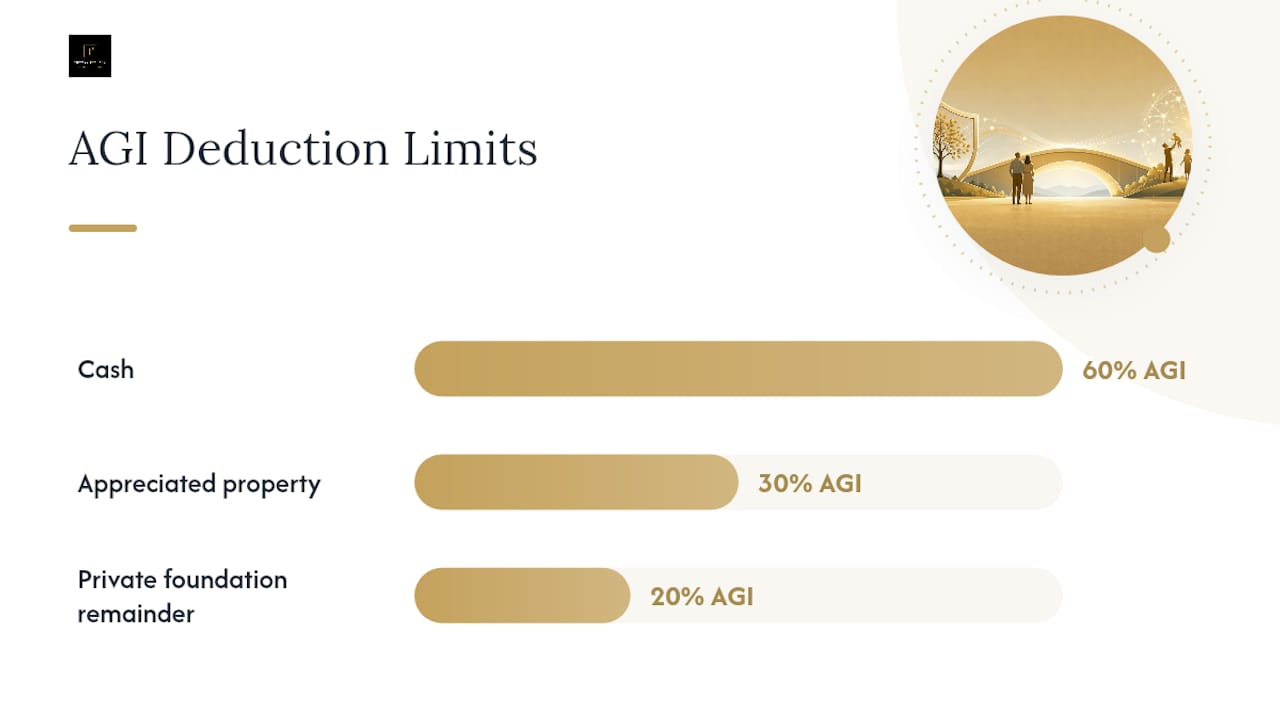
Your deduction is also capped by adjusted gross income, and the cap depends on what you contribute:
- Cash contributions: limited to 60% of AGI in the contribution year
- Long-term appreciated property (stock, real estate): limited to 30% of AGI
- Gifts where the remainder ultimately benefits a private foundation: limited to 20% of AGI
Any deduction you can't use in the funding year isn't lost. It carries forward for up to five additional years. Donors also have some control over timing: because the trust can elect the Section 7520 rate for the month of the gift or either of the two preceding months, choosing that month strategically can meaningfully change the deduction size. A charitable calculator that models different funding dates against current 7520 rates makes this trade-off easy to see before you sign anything.
What Filings Does a Trustee Need To Submit?
Trustees carry the compliance burden for the life of the trust, and the paperwork doesn't stop after year one. Here's the annual sequence:
- File Form 5227 every year the trust holds assets. This Split-Interest Trust Information Return reports trust income, distributions, and the four-tier characterization that flows to beneficiaries.
- Meet the deadline. Form 5227 is generally due annually, with applicable deadlines set by the IRS rules, with an automatic extension available through Form 8868.
- Issue Schedule K-1 to each beneficiary so they can report their share of ordinary income, capital gains, and other distributions accurately on their own returns.
- Watch the penalty clock. Late or incomplete Form 5227 filings can draw penalties per IRS regulations, which may accrue daily, and the IRS treats the return as public information subject to inspection, so errors don't stay quiet.
- File Form 4720 when triggered. If the trust incurs certain excise tax liabilities, such as those tied to self-dealing or UBTI, Form 4720 reporting becomes mandatory alongside Form 5227.
Sloppy trustee recordkeeping is the single most common source of avoidable CRT headaches. Keep contemporaneous records of asset sales, income allocation, and distribution calculations every year, not just at filing time.
What Triggers UBTI or Self-Dealing Penalties in a CRT?
This is where CRTs go from tax-advantaged to tax-hostile, and it happens faster than most donors expect. Under IRC § 664, a CRT is generally exempt from income tax, but that exemption evaporates the moment the trust earns even one dollar of unrelated business taxable income. The consequence isn't a modest surtax. It's an excise tax equal to 100% of the UBTI, applied directly against the trust.
The assets most likely to cause this disaster:
- S-corporation stock or active LLC interests that generate operating business income
- Debt-financed property purchased with borrowed funds inside the trust
- Any asset producing income that isn't passive investment return
Separately, CRTs are subject to private-foundation-style excise rules under the chapter 42 self-dealing and excess-holdings framework. A loan between the donor and the trust, a sale of trust property to a disqualified person, or retained excess business holdings can all trigger penalties reportable on Form 4720.
Pro Tip: Screen every asset for UBTI exposure before funding, not after. Once an operating business interest or debt-financed property sits inside the trust, unwinding the damage is far harder than avoiding it in the first place.
If a proposed contribution involves anything other than cash, publicly traded securities, or straightforward real estate, get specialized tax counsel involved before the transfer, not after.
What Should Donors and Trustees Check Before Funding a CRT?
Getting a CRT right is mostly a matter of sequencing. Do the diligence before the transfer, not after.
- Run every asset through a UBTI screen, especially business interests, debt-financed holdings, and anything generating active income.
- Check the Section 7520 rate for the funding month and the two preceding months to see which produces the more favorable deduction.
- Confirm the trust satisfies the 10% remainder test using current actuarial factors before finalizing the trust document.
- Decide between a CRAT and a CRUT based on payout stability needs. CRATs pay a fixed dollar amount, while CRUTs pay a percentage of trust assets revalued annually, and payout rates must generally fall within a range set by statute with trust terms limited to a term of years or lifetime.
- Verify the trust satisfies statutory payout tests before the first distribution cycle begins.
Pro Tip: Ask which state's law governs the trust before funding. Some states tax CRT income differently than the federal rules, and trust accounting defaults to state law whenever the trust instrument stays silent.
The most expensive mistakes are entirely avoidable: funding the trust after a sale is already legally binding (which can trigger gain recognition to the donor), transferring active business interests, or simply missing the annual Form 5227 and Schedule K-1 filings once the excitement of the initial gift wears off. Also remember that assets transferred to an irrevocable CRT generally leave your taxable estate, which matters for donors coordinating charitable giving with broader estate and high-earner tax planning.
How Thetaxrefinery Approaches CRT Tax Planning
Melissa Korber's take: the technical review has to happen before funding, not after. Screening for UBTI exposure, confirming the 7520 timing, and coordinating tax, estate, and investment advice up front is what separates a CRT that performs from one that quietly implodes. Trustees also need ongoing support for the annual filing cycle, since Form 5227 and K-1 issues don't end at setup.
— Melissa
Get Hands-On Help Structuring and Filing Your CRT
Thetaxrefinery gives high-earning donors and trustees something a once-a-year filer can't: year-round strategy support that catches UBTI exposure and 7520 timing decisions before they become costly mistakes, not after the return is filed.

If you're funding a CRT alongside an S-corp, rental portfolio, or multi-entity structure, the tax questions rarely stay contained to the trust alone. Thetaxrefinery's Monthly Tax Advisory and Quarterly Tax Strategy Sessions give trustees ongoing access to strategic guidance for the annual Form 5227 and Schedule K-1 cycle, asset screening before funding, and coordination with your broader entity structure. For donors who also run an S-corp, the S-Corp Tax Strategy Accelerator pairs naturally with CRT planning since both hinge on getting entity and income character right from day one. Schedule a strategy session through Thetaxrefinery's services page to get your CRT reviewed before the next funding decision, not after.
Where To Verify These Rules Directly
For primary confirmation, go straight to the source: the IRS overview of charitable remainder trusts covers the four-tier rules, the statutory text of IRC § 664 governs tax-exempt status and UBTI excise tax, and the Form 5227 instructions detail filing deadlines, penalties, and Form 4720 cross-references.
This article is general information, not a substitute for advice from a qualified financial advisor. Consult a qualified financial professional about your own circumstances before acting on anything here.
Sources
- Charitable remainder trusts | Internal Revenue Service
- 26 U.S. Code § 664 — Charitable remainder trusts
- CRT estate planning: tax benefits, types and setup rules — LegalClarity
- Charitable remainder trusts — Harvard Law School planned giving
FAQ
What Are the Downsides of Using a Charitable Remainder Trust?
CRTs are irrevocable, so you permanently give up direct control of the asset once it's transferred. Distributions are taxed under the four-tier ordering rather than at favorable capital gains rates across the board, and UBTI-generating assets can trigger a 100% excise tax that can wipe out the trust's economic benefit entirely.
What Is the 10% Rule for Charitable Remainder Trusts?
The 10% rule requires that the charity's projected remainder interest equal at least 10% of the trust's initial funding value, calculated using Section 7520 actuarial factors. A trust that fails this test at drafting doesn't qualify as a CRT under federal tax law.
What Are the Disadvantages of Qualified Charitable Distributions Compared to CRTs?
Qualified charitable distributions (QCDs) are simpler but capped annually and available only from IRAs to donors meeting IRS age requirements, with no deduction because the transfer is already excluded from income. CRTs work with a broader range of assets and donor ages but require far more setup, ongoing trustee filings, and actuarial calculations that QCDs never involve.
Does a Trustee Need To File Taxes Every Year for a CRT?
Yes. Trustees must file Form 5227 annually for as long as the trust holds assets, and issue Schedule K-1 to beneficiaries reporting the character of each year's distribution. Missing this filing can trigger daily penalties, and some specialized tax advisory services offer ongoing support tracking these deadlines as part of their engagement.