
A donor-advised fund gives you an immediate income-tax deduction, subject to AGI percentage limits, plus tax-free growth on assets held inside the fund. Contributing appreciated stock or property lets you skip capital gains tax and deduct the full fair market value in most cases. DAF assets sit outside your taxable estate, but the sponsoring organization keeps legal control, and misuse of grants can trigger excise taxes under IRC §4966.
TL;DR:
- Contributions of appreciated assets like stock or real estate can maximize deductions and avoid capital gains tax, but require careful valuation and timing.
- Excess deductions above IRS limits can be carried forward for future years, provided proper documentation such as appraisals and Form 8283 are completed.
- Grant payments benefiting personal or disqualified persons trigger excise taxes for donors and fund managers, with sponsors implementing protocols to prevent abuses.
- Bunching contributions into high-income years optimizes tax benefits, especially when combining appreciated securities with strategic timing and carryforward planning.
- A private foundation offers control but involves higher costs, ongoing taxes, and regulatory disclosures, making donor-advised funds more suitable for smaller-scale giving.
Table of Contents
- How Donor-Advised Fund Tax Rules Work: Deduction Mechanics and Limits
- What Triggers Excise Taxes Under IRC §4966?
- Bunching, Appreciated Assets, and Other Strategies That Move the Needle
- DAF or Private Foundation: Which Fits Your Giving Scale?
- What an Enrolled Agent Wants You to Confirm Before You Give
- How The Tax Refinery Thinks About DAF Planning
- Turning DAF Strategy Into a Documented Tax Plan
- Sources
How Donor-Advised Fund Tax Rules Work: Deduction Mechanics and Limits
The deduction attaches to the year you make the contribution, not the year the sponsor grants the money to a charity. This is the mechanic that makes donor-advised funds valuable for windfall-year planning: you can claim the deduction now and decide where the money goes later.
What counts as a contribution varies more than most donors expect. Cash is straightforward. Publicly traded securities, real estate, closely held business interests, and even cryptocurrency can qualify, but each asset type carries its own valuation and substantiation rules.
Your deduction ceiling depends on what you give:
- Cash gifts to a DAF sponsor can generally be deducted up to limits allowed by IRS rules for donor-advised funds.
- Appreciated long-term assets (stock held over a year, real estate) are typically capped at limits allowed by IRS rules for donor-advised funds, deducted at fair market value.
- Gifts exceeding these caps do not disappear. Charitable contribution deduction rules allow you to carry the excess forward according to IRS limits.
Non-cash gifts above $5,000 generally require a qualified appraisal and a completed Form 8283 attached to your return. Skip this step and the IRS can disallow the deduction entirely, regardless of how legitimate the gift was. Donors managing multi-year giving should track carryforward balances carefully. A charitable contribution calculator can help you see how much of a large gift rolls into future years before you file.
What Triggers Excise Taxes Under IRC §4966?
A "taxable distribution" happens when a DAF sponsor pays out to something other than a qualified public charity, or when the payout confers a personal benefit on the donor. Section 4966 of the tax code hits the sponsoring organization with a 20% excise tax on that distribution.
The exposure does not stop at the sponsor. Here is where individual donors and fund managers get caught:
- The manager tax. Any fund manager who knowingly agrees to a taxable distribution owes an excise tax as specified in IRC §4966, with a statutory cap.
- Self-dealing red flags. Grants that pay for a gala ticket, satisfy a personal pledge, or benefit a disqualified person (you, your spouse, certain family members) are the most common triggers.
- The fix is procedural. Sponsors that require grant-purpose documentation before disbursing funds catch most of these problems before a check ever goes out.
The IRS has flagged abusive DAF arrangements as an enforcement priority, so donors relying on informal "understandings" with a sponsor about how grants will be used are taking on real audit risk.
Bunching, Appreciated Assets, and Other Strategies That Move the Needle
The single most useful DAF tactic for high earners is bunching: contributing several years' worth of planned giving into one high-income year, then distributing grants over time while claiming the standard deduction in the leaner years between. A checklist for executing it looks like this:
- Estimate the AGI spike from a bonus, business sale, or equity vesting event.
- Contribute enough in that year to exceed the standard deduction meaningfully, not marginally.
- Confirm carryforward math with your advisor if the gift exceeds AGI caps.
- Set a grant-out schedule so the DAF doesn't sit idle for a decade.
Publicly traded appreciated securities are usually the best asset to give. You deduct the fair market value, not your cost basis, and neither you nor the DAF pays capital gains tax on the built-in appreciation. National Philanthropic Trust notes this combination, deduction plus gains avoidance, as the DAF's core tactical edge for high-income years.
Real estate and closely held business interests can work too, but they demand more legwork: a qualified appraisal, sponsor pre-approval of the asset, and enough lead time before year-end to avoid a rushed valuation.
Pro Tip: If you're gifting closely held stock, start the appraisal and sponsor acceptance conversation at least 60 to 90 days before your target contribution date. Rushed appraisals are one of the most common reasons the IRS challenges a deduction.
Coordinate the timing with your AMT exposure and any liquidity needs before year-end. A year-end tax strategy review is worth having with your advisor before a bunching contribution, not after.
DAF or Private Foundation: Which Fits Your Giving Scale?
Scale and control decide this, more than tax rate alone. A private foundation lets you hire staff, direct multi-year grants, and even pay reasonable family salaries, but it comes with mandatory 5% annual payout requirements, excise taxes on investment income, and public Form 990-PF filings that disclose grants and assets.
- DAFs offer higher AGI deduction ceilings and near-zero administrative burden compared with private foundations.
- Foundations offer full grant-making control but face lower deduction caps, ongoing excise taxes, and real setup and legal costs.
- Donors giving under roughly $1 to $2 million in lifetime assets rarely find a foundation's overhead worth it.
- Comparative analysis from City National Bank frames the foundation's appeal as control at scale, not tax efficiency.
What an Enrolled Agent Wants You to Confirm Before You Give
Every deduction you claim needs a contemporaneous written acknowledgment from the sponsor, stating the gift and confirming you received nothing of value in return. No acknowledgment, no deduction, regardless of how the gift was made.
Before recommending a grant, confirm the sponsor's process for a few things:
- How the sponsor documents its exclusive legal control over contributed assets.
- Whether an appraisal and Form 8283 are required for your specific asset type.
- How the sponsor discloses fees and grant-approval turnaround times.
- Whether the grant could touch a disqualified person, closely held stock, or a foreign organization, all of which warrant a tax counsel review.
Pro Tip: Inadequate acknowledgment letters and thin valuation files are the two most common reasons DAF deductions get challenged on examination. Build the file before you file the return, not after the IRS asks for it.
How The Tax Refinery Thinks About DAF Planning
We build DAF strategy into a client's multi-year advisory engagement, not a once-a-year decision. That means tracking carryforward balances, timing bunching contributions against windfall years, and coordinating grant documentation with estate planning goals before a return is ever filed. Use the checklist above with your advisor before your next contribution.
— Melissa
Turning DAF Strategy Into a Documented Tax Plan
Some firms build DAF timing into a full-year tax strategy instead of a single appraisal-season scramble, so bunching decisions, carryforward tracking, and grant documentation are planned before December, not patched together after.
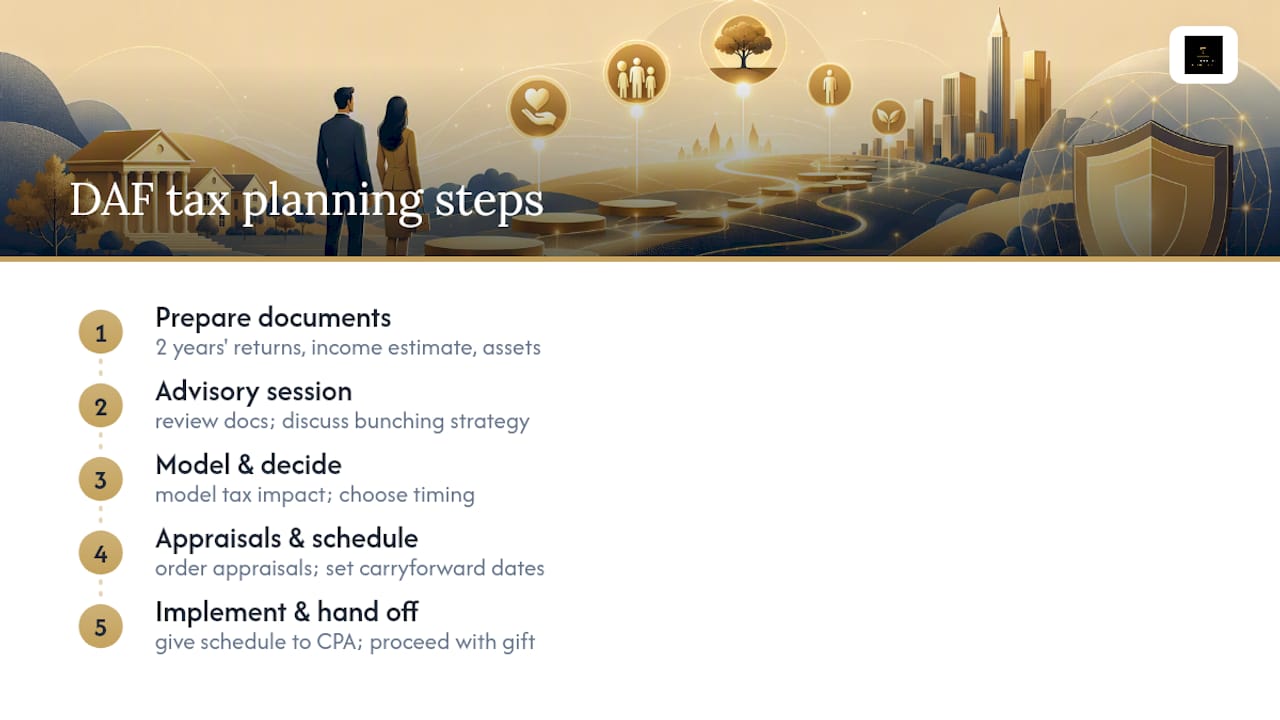
An initial advisory session works best when you bring your last two years of returns, a rough estimate of this year's income, and a list of appreciated assets you're considering for a gift. From there, we map out whether a bunching contribution makes sense, coordinate any appraisal needs, and set a carryforward schedule you can hand straight to your CPA. If cost is a factor, our fee schedule lays out engagement pricing upfront, no surprises after the fact.
If you're weighing a large appreciated-asset gift this year, start with a tax strategy consultation and get the numbers modeled before you sign anything with a sponsor.
This article is general information, not a substitute for advice from a qualified financial advisor. Consult a qualified financial professional about your own circumstances before acting on anything here.
Sources
- 26 USC 4966: Taxes on taxable distributions
- Charitable contribution deductions (IRS)
- Tax Advantages for Donor-Advised Funds (National Philanthropic Trust)