
Tax planning fees typically run from $1,000 to $5,000 for a focused, one-time engagement, $150 to $500 per hour for hourly advisory work, and $1,300 to $15,000 or more per year for ongoing retainer relationships. Where you land inside those ranges depends almost entirely on three things: how many entities you operate, whether you file in multiple states, and how clean your books are before an advisor ever opens them.
Simple returns and light planning sit at the bottom of every range. A business owner running two entities across three states, claiming depreciation on rental property, and catching up eighteen months of bookkeeping sits at the top, sometimes above it. If your situation includes an S-corp election, K-1 income, or a property portfolio, you should be requesting a written estimate and engagement letter before you pay for anything.
Here's the quick version of what drives the number:
- Complexity of your entity structure — one Schedule C is not the same job as an S-corp with a partnership K-1 feeding into it.
- Number of states involved — every additional state return adds hours, and hours cost money.
- Condition of your books — messy or missing records mean someone bills you to rebuild them before planning can even start.
- Scope of the engagement — a single strategy session costs far less than a year-round advisory relationship with quarterly check-ins.
Comprehensive planning engagements commonly range from $1,500 to $15,000 depending on scope, according to pricing data aggregated across CPA, EA, and tax attorney firms. That spread is wide on purpose. A retired W-2 filer asking about Roth conversion timing and a business owner restructuring three LLCs into an S-corp are both technically buying "tax planning," but they're buying wildly different amounts of an advisor's time.
Key Takeaways
Tax planning fees scale directly with entity complexity, state filings, and record quality, and a written engagement letter is the single best tool for comparing quotes accurately.
| Point | Details |
|---|---|
| Know your bracket | One-time planning runs $1,000 to $5,000; retainers run $1,300 to $15,000+ depending on complexity. |
| Hourly rates vary widely | Expect $150 to $500 per hour depending on credential level and firm specialization. |
| Clean books cost less | Bookkeeping catch-up commonly bills at $75 to $150 per hour separately from planning work. |
| Get it in writing | A legitimate engagement letter names the scope, billing model, timeline, and preparer credentials. |
| Thetaxrefinery maps price to complexity | Offers subscription advisory and project planning packages with a published fee schedule for business owners and real estate investors. |
Table of Contents
- How Much Does Tax Planning Cost? Billing Models Explained
- What Specific Factors Increase Your Tax Planning Fees?
- What Do Tax Planning Fees Look Like for Different Situations?
- What Questions Should You Ask Before Hiring a Tax Planner?
- Are Tax Planning Retainers Worth the Annual Fee?
- Tax Preparation vs. Tax Planning: Why the Fees Differ
- How Thetaxrefinery Prices Tax Planning and Advisory Work
- Tax Planning Fees: What to Expect and How to Budget
- Get a Transparent Tax Planning Quote from Thetaxrefinery
- Sources
How Much Does Tax Planning Cost? Billing Models Explained
Advisors bill four main ways, and each one tells you something different about what you're paying for. Understanding which model you're being quoted under matters more than the raw number, because the same total cost can feel very different depending on how it's structured.
Hourly billing is the most transparent model and the easiest to compare across firms. You pay for time spent, full stop. Most tax advisors and CPAs charge between $150 and $500 per hour, with the low end typically reflecting an EA or junior staff member and the high end reflecting a tax attorney or a partner-level CPA at a specialized firm. Hourly billing works well for narrow, well-defined questions. It works poorly when the scope keeps expanding, because the meter never stops.
Flat or project-based pricing covers a defined deliverable for a set price, agreed on before work begins. A one-time entity structuring analysis, an S-corp election review, or a single-year depreciation strategy usually gets quoted this way. Flat pricing protects you from scope creep, but only if the engagement letter spells out exactly what's included and what triggers an additional charge.
Retainers, also called year-round advisory plans, bundle ongoing access to an advisor into a recurring fee, usually billed monthly or annually. Year-round advisory retainers often range from about $1,300 to $2,500 per year for solo professionals, $3,000 to $8,000 per year for mid-tier firms, and $10,000 or more for full advisory packages that include quarterly strategy sessions, estimated tax calculations, and proactive planning around major transactions.
Per-return pricing is what most people associate with tax preparation rather than planning, but it's worth understanding because many firms bundle a discounted return into a planning retainer. This model charges based on which forms and schedules your return requires, not on time spent.
Here's how the four models compare on flexibility and predictability:
- Hourly: best for narrow questions, worst for open-ended scope, fully transparent billing.
- Flat/project: best for one-time decisions like an entity election, predictable cost, requires a tight scope document.
- Retainer: best for owners with recurring complexity, spreads cost across the year, requires trust in the advisor relationship.
- Per-return: best for compliance-only needs, cheapest option, offers no forward-looking strategy.
Pro Tip: Ask whether a quoted retainer fee includes your tax return preparation or sits on top of it. Some firms bundle prep into the annual fee; others bill it as a separate line item, and that difference can swing your total cost by thousands.
Seasonal timing also moves the number. Rates during January through April tend to run higher than the same scope requested in the summer or fall, when advisors have bandwidth for strategic work instead of compliance deadlines.
What Specific Factors Increase Your Tax Planning Fees?
Every advisor prices around a handful of discrete complexity signals. Knowing them lets you estimate your own bracket before you ever pick up the phone.
- S-corp election and payroll setup. Structuring reasonable compensation, running payroll, and coordinating an accountable plan adds meaningful planning hours in year one, then typically drops in subsequent years once the structure is in place.
- Schedule C business income. A single sole proprietorship adds moderate complexity; multiple business lines or a business with inventory adds more.
- Schedule E rental property. Each additional property generally adds incremental cost, and cost segregation or accelerated depreciation analysis adds a separate line item on top of that.
- K-1 income from partnerships or S-corps. Every K-1 an advisor has to trace back to its source return adds review time, especially when the entity itself wasn't prepared by the same firm.
- Multi-state filings. Additional schedules, K-1s, depreciation work, and multi-state filings are among the biggest drivers of higher fees, and adding even one extra state return commonly increases a quote by a noticeable margin.
- Bookkeeping cleanup. A clean, reconciled ledger materially reduces advisory time, and firms commonly charge catch-up bookkeeping separately at $75 to $150 per hour before planning work can even begin.
The math on a single added state return or rental property is worth internalizing. If your base planning engagement is quoted at $2,500 and you add a second state with its own filing requirement, expect that number to climb by several hundred dollars at minimum, more if the state has unique apportionment rules. Add a rental property with depreciation schedules that need to be built from scratch, and you're looking at a similar bump.
Pro Tip: If your books are more than a few months behind, ask for a bookkeeping cleanup quote separately from the planning quote. Bundling the two into one number makes it impossible to tell how much you're actually paying for strategy versus data entry.

Bookkeeping cleanup deserves its own line item because it's the single most controllable cost driver on this list. Everything else on it is a function of your business structure. This one is a function of how current your records are, and it's the easiest to fix before you ever request a quote.
What Do Tax Planning Fees Look Like for Different Situations?
Seeing your own situation mapped against a real bracket makes these numbers concrete instead of abstract. Here's how four common taxpayer profiles typically shake out.

The simple W-2 filer. If your income is a single W-2, you take the standard deduction, and you have no side business or rental property, you're barely a candidate for formal tax planning at all. Preparation alone typically runs $220 to $400 for a simple W-2 return, and planning conversations at this level tend to be a single consultation focused on withholding adjustments or retirement contribution timing rather than a paid engagement. Most advisors won't quote a full planning fee for this profile because there's rarely enough complexity to justify the cost.
The investor or itemizer. Once you're managing a brokerage account with realized gains, itemizing deductions, or filing in more than one state because of investment income sourcing, you cross into territory where a planning conversation starts to pay for itself. Schedule D activity, especially with wash-sale considerations or tax-loss harvesting, adds review time. Expect planning quotes in the $500 to $1,500 range for a focused annual strategy session, more if multiple states are involved.
The solo entrepreneur running Schedule C income. This is where planning fees start to matter in a real way. Self-employed Schedule C returns typically run $500 to $1,200 for preparation alone, and planning work layered on top, retirement plan selection, quarterly estimate strategy, entity structure evaluation, commonly pushes a combined engagement into the $1,500 to $3,000 range.
The rental property owner. A single Schedule E property with straightforward depreciation is a modest add-on to a standard return. A portfolio of properties, especially with a cost segregation study on the table, moves the conversation into specialized planning territory, often $2,000 to $5,000 depending on the number of properties and whether a segregation study is included.
The multi-entity owner or S-corp/partnership structure. This is the top of the range. S-corp and partnership business returns typically run $800 to $2,500 for preparation alone, and first-year planning and setup, entity election timing, reasonable compensation analysis, accountable plan documentation, commonly runs $2,500 to $10,000 or more.
- W-2 only: rarely a paid planning engagement, focus is on withholding and retirement timing.
- Investor/itemizer: $500 to $1,500 for an annual strategy session.
- Schedule C solo owner: $1,500 to $3,000 combined prep and planning.
- Multi-entity/S-corp owner: $2,500 to $10,000+ for first-year structuring, often less in subsequent years once the framework is set.
High-complexity planning for high-net-worth situations or advanced structures can exceed $25,000 annually, a bracket reserved for owners coordinating multiple entities, real estate holding companies, and estate planning integration simultaneously.
What Questions Should You Ask Before Hiring a Tax Planner?
Getting comparable quotes from two different firms requires asking the same specific questions of both. Vague requests get vague answers, and vague answers make it impossible to compare anything.
- What exactly is included in this fee? Ask for a line-item list of deliverables, not a general description of "planning."
- What billing model are you using? Hourly, flat, or retainer, and if hourly, what's the estimated total hour range for my situation?
- Who actually does the work? A partner-level CPA at $400 an hour and a staff preparer at $150 an hour might both be working under the same firm name.
- What's the expected timeline? From engagement to first deliverable, and how does that change during filing season?
- Does this include state filings, or is each state billed separately?
- Are there rush fees, and under what circumstances do they apply?
A legitimate engagement letter should specify the scope of work, the billing model, an estimated fee range, the credentials of who's performing the work, CPA, EA, or tax attorney, and a clear description of what happens if the scope changes mid-engagement. Getting a written scope and estimate before work begins is standard best practice across reputable firms, and any advisor who resists putting terms in writing is telling you something important.
Watch for these red flags:
- Refund-based fee structures, where the preparer's fee is tied to the size of your refund, which the IRS and most state boards consider a serious ethical violation.
- Vague scope language like "comprehensive tax help" with no itemized deliverables attached.
- Refusal to sign your return or provide a valid PTIN, both of which are required of anyone who prepares returns for compensation.
- Pressure to sign before reviewing terms, especially during the January through April rush when demand outpaces advisor availability.
Are Tax Planning Retainers Worth the Annual Fee?
A retainer buys you access, not just a single deliverable. That distinction is where most of the confusion about value comes from.
A typical annual retainer includes quarterly strategy check-ins, estimated tax payment calculations, entity structure reviews, and proactive planning around major life or business events, a property sale, a new hire, an equipment purchase. Monthly retainer structures spread that same scope into smaller recurring payments, which some business owners prefer for cash flow reasons even though the annual total is similar.
The ROI math is where retainers either justify themselves or don't. Tax planning fees typically pay for themselves in year one through self-employment tax reduction, entity election timing, and depreciation strategy, according to firms that track client outcomes. Consider a business owner netting $150,000 who elects S-corp status with proper reasonable compensation planning: the self-employment tax savings alone can run into the thousands annually, often several multiples of the retainer fee itself.
- Solo professionals with straightforward income typically see the smallest retainer relative to potential savings, often $1,300 to $2,500 per year.
- Business owners with $300,000 to $1,000,000+ in net income see the clearest ROI case, since entity structuring, accountable plans, and depreciation timing compound at higher income levels.
- Multi-entity operators and real estate investors often justify the highest retainer tiers because the planning surface, depreciation, entity coordination, multi-state issues, is genuinely larger.
Pro Tip: Before committing to a retainer, ask the advisor to walk through one concrete scenario from your own numbers, not a hypothetical, showing what specific strategy would generate savings and roughly how much. If they can't point to a specific lever, the retainer may not be priced for your actual complexity.
Retainers make the least sense for taxpayers whose situation genuinely doesn't change year to year. If you're a single-entity Schedule C filer with stable income and no major transactions on the horizon, a one-time annual planning session may cover everything a retainer would, at a fraction of the cost. Ongoing proactive planning earns its keep specifically when your situation has moving parts worth tracking quarterly.
Tax Preparation vs. Tax Planning: Why the Fees Differ
These two services get lumped together constantly, and that confusion is exactly why so many people overpay for one while underbuying the other.
Tax preparation is backward-looking. It takes what already happened during the tax year and reports it correctly on a return. Preparation fees run $220 to $400 for simple returns and $800 to $2,500 for S-corp or partnership returns, scaling with the number of forms and schedules required.
Tax planning is forward-looking. It's the work of deciding what should happen before it happens, timing an entity election, structuring a property purchase, choosing a retirement plan, so the return you eventually file reflects deliberate decisions instead of default outcomes. Planning fees run separately from preparation, typically $1,500 to $5,000 for a focused engagement, because the analysis and strategy work involved is fundamentally different from filling out forms.
Many firms bundle the two into a single annual engagement, particularly for business owners, because planning decisions made in March directly affect the return filed the following spring. Bundling makes sense when your situation has enough complexity that the same advisor benefits from continuity, seeing both the planning conversation and the resulting return.
- Buy preparation alone if your situation is stable and you're not making structural changes.
- Buy planning before any major transaction: buying property, changing entity type, hiring your first employee, or experiencing a large income jump.
- Bundle both if you're a business owner with recurring complexity, since separating them often means paying two firms to duplicate the same background research.
Timing matters more than most people realize. Planning conversations held in November or December, before the tax year closes, can still influence that year's outcome. Planning conversations held in March are limited to strategies for the year ahead, since most of the prior year's options have already closed.
How Thetaxrefinery Prices Tax Planning and Advisory Work
Thetaxrefinery structures its pricing around the same logic this article has walked through: complexity drives cost, and clients deserve to see that math before they commit to anything.
The firm, founded by Enrolled Agent Melissa Korber and based in the Treasure Valley, works primarily with business owners netting $300,000 to $1,000,000 or more, real estate investors, multi-entity operators, and high-earning professionals who need more than an annual filing conversation. Rather than a single flat rate, Thetaxrefinery offers a subscription-based advisory model alongside project-based strategic planning packages and form-based pricing for standard preparation and compliance work, mirroring the billing structures discussed throughout this article.
Clients working with Thetaxrefinery typically receive:
- Multi-entity tax structuring for owners running more than one business or holding company.
- S-corp entity planning, including reasonable compensation analysis and accountable plan setup.
- Real estate and depreciation strategy, covering cost segregation opportunities and rental property optimization.
- Year-round check-ins rather than a single annual meeting, so decisions get made when they still have tax-year impact.
Every engagement starts with a documented scope, consistent with the written engagement letter standard discussed earlier in this article, so clients know exactly what they're paying for before work begins. The firm's fee schedule lays out how pricing maps to complexity, and the tax strategy comparison page breaks down which service model fits which type of business owner.
Pro Tip: If you're comparing Thetaxrefinery's pricing against a local generalist CPA, ask both firms the same six questions from the quote checklist above. Specialized advisory pricing often looks higher on paper until you account for the tax savings a generalist wouldn't have identified in the first place.
Tax Planning Fees: What to Expect and How to Budget
Most of the pricing guidance floating around treats tax planning fees like a single number you can shop for, and that's the wrong frame entirely. The research supports a different conclusion: the fee is a proxy for how much genuine complexity exists in your financial life, and trying to negotiate the number down without addressing that complexity usually backfires.
The conventional advice, "get three quotes and pick the cheapest," falls apart once you realize two firms quoting the same dollar amount might be delivering completely different scopes. One might include quarterly check-ins and entity structuring. The other might be a single annual conversation.
What I'd prioritize first: clean books and a specific list of your own complexity drivers, entities, states, properties, before you ever request a quote. Advisors price around unknowns, and a business owner who walks in with organized records and a clear question gets a tighter, fairer number than one who hands over a shoebox and hopes for the best.
— Melissa
Get a Transparent Tax Planning Quote from Thetaxrefinery
Most generalist CPA firms quote tax planning the same way they quote a return, one flat number with little explanation of what's actually driving it. Thetaxrefinery works differently: pricing maps directly to your entity structure, your states, and your specific planning needs, so you see the same complexity drivers this article walked through reflected in your own quote.
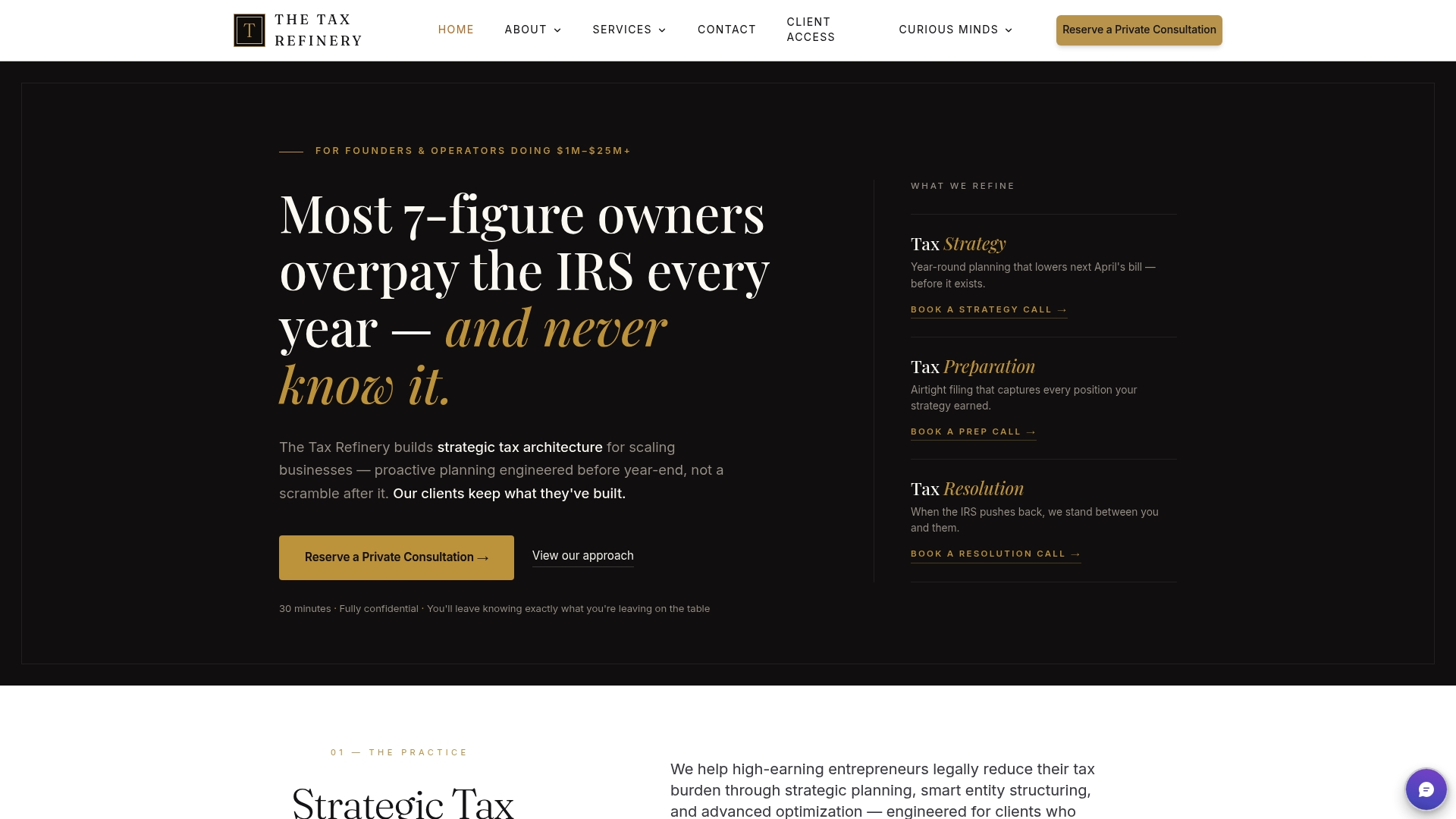
That transparency matters most for business owners netting $300,000 to $1,000,000 or more, real estate investors managing multiple properties, and multi-entity operators who've outgrown a once-a-year filing conversation. Thetaxrefinery's subscription advisory model gives you quarterly strategy access instead of a single meeting each spring, built specifically for owners in trades, recurring-service industries, and wellness practices who want a strategic partner rather than a seasonal filer.
If you fit that profile, the next step is straightforward: review the tax strategy comparison page to see which service model matches your situation, or go directly to Thetaxrefinery's pricing page to see current rates and book a consultation. Strategy that pays you back starts with knowing exactly what you're paying for.
This article is general information, not a substitute for advice from a qualified financial advisor. Consult a qualified financial professional about your own circumstances before acting on anything here.
Sources
- Beancount
- How Much Does a CPA Cost in 2026? Real Fee Ranges | Taxstra
- How much does tax planning cost? | JW Tax & Consulting
- How much does tax preparation cost? — ThePricer (extract)