
If you received a payroll tax notice, call a qualified payroll tax audit defense professional immediately and preserve every payroll and banking record you have. Do not volunteer additional information to the examiner, sign anything without review, or make informal statements about who controlled the checkbook. Request an extension rather than rushing a response, and get an Enrolled Agent, CPA, or tax attorney involved before your first conversation with the IRS or state agency.
TL;DR:
- Most payroll tax audits are triggered by specific issues like mismatched filings, late deposits, worker misclassification, or vendor errors, not random selection.
- The Trust Fund Recovery Penalty targets responsible individuals with actual authority who willfully fail to pay withheld taxes, regardless of their official title.
- Audits generally follow a timeline of notification, examination, assessment, and appeal, with deadlines for protests and extensions critically influencing case outcomes.
- Preparing detailed records upfront, including payroll registers, filed returns, bank statements, and delegation documents, significantly improves chances of favorable resolution.
- Engaging a payroll tax professional early in the process helps protect against personal liability and coordinates entity-level defense across multiple businesses.
Table of Contents
- Who Audits Payroll Taxes, and How Does the Process Work?
- Why Payroll Audits Turn Personal: Understanding the Trust Fund Recovery Penalty
- How Long Does the Audit Take, and What Deadlines Matter Most?
- What Records Do You Need, and How Do You Reconcile Them?
- When Should an Enrolled Agent or Tax Firm Step Into Your Audit?
- What Penalties Go Beyond the Trust Fund Recovery Penalty?
- How Do You Negotiate a Settlement or Payment Plan?
- Authoritative Forms and IRS Publications to Consult Now
- The Playbook Most Business Owners Get Backwards
- Get Audit Defense Built Around Your Full Business Structure
- Sources
Who Audits Payroll Taxes, and How Does the Process Work?
Payroll tax audits come from two different directions, and you can face both at once. The IRS examines federal employment tax returns (Form 941, Form 940, and related filings), while state agencies like California's EDD or your state's department of revenue audit state withholding, unemployment insurance, and disability contributions separately. A business can be under simultaneous federal and state scrutiny for the same payroll year, with different examiners asking different questions on different timelines.
Certain patterns almost guarantee attention. According to the IRS audits overview, most employment tax returns are accepted as filed, which means an audit usually starts because something specific stood out.
- Mismatches between quarterly 941 filings and annual W-2 totals
- Missed or late federal tax deposits
- Workers treated as independent contractors who look like employees under IRS tests
- Payroll vendor errors, especially after switching providers mid-year
Audits arrive in three formats: correspondence audits handled entirely by mail, office audits requiring an in-person meeting, and field audits where an examiner reviews records on-site. Publication 5146 and Publication 15 outline exactly what documentation examiners expect at each stage, and knowing which format you're in shapes how much lead time you get to prepare.
Why Payroll Audits Turn Personal: Understanding the Trust Fund Recovery Penalty
The Trust Fund Recovery Penalty targets a specific slice of unpaid payroll tax: the money withheld from employee paychecks for federal income tax and the employee's share of FICA. That money never belonged to the business. The IRS treats it as held in trust, and when it goes unpaid, the agency can assess the full amount personally against individuals, not just the entity.
Two elements decide who gets hit. First, "responsible person" status, meaning someone had actual authority over financial decisions like which bills got paid. Second, willfulness, meaning that person knew taxes were unpaid and paid other creditors anyway. Your job title on a business card carries no weight here. A bookkeeper with signing authority can qualify as responsible; a titled vice president locked out of banking decisions may not.
Strong defenses focus on documented facts, not titles.
- Lack of authority: organizational charts, banking resolutions, and board minutes showing who could actually sign checks
- Delegation with oversight: proof you assigned payroll duties and had no knowledge of shortfalls
- Reasonable cause: a documented disaster, embezzlement, or third-party failure that explains the missed deposits, which fits within the IRS's penalty relief framework
- Miscalculation: proof the assessed trust fund amount overstates what was actually withheld
Pro Tip: Gather email authorizations and signing cards before your first interview, not after. Once the IRS schedules a Form 4180 interview, you want the paper trail already organized, not reconstructed under pressure.
How Long Does the Audit Take, and What Deadlines Matter Most?
Payroll tax audits follow a fairly predictable sequence, but the deadlines inside that sequence are where cases get won or lost.
- Selection and initial contact. The IRS or state agency notifies you and requests records for examination.
- Examination. Examiners review deposits, returns, and often conduct a Form 4180 interview to establish responsible person status and willfulness.
- Proposed assessment. The audit closes as no change, agreed (often through a Form 2504 series agreement), or disagreed.
- Protest and appeal. A timely written protest sends your case to the IRS Independent Office of Appeals; missing the deadline can forfeit that right entirely.
The general statute of limitations runs three years from the return's due date or filing date, per IRS guidance on audits, though certain omissions extend that window to six years. Worker classification disputes carry their own pathway under IRC §7436, and Letter 3523 triggers Tax Court review rights. If collection action follows an assessment, Collection Due Process rights let you request a hearing before enforcement proceeds. Every one of these vehicles has a filing clock, and asking for a reasonable extension almost always beats submitting an incomplete response to protect a deadline.
What Records Do You Need, and How Do You Reconcile Them?
Start pulling records the day a notice arrives, before you even schedule your first call with a defense professional. You'll want payroll registers for the audited quarters, federal tax deposit histories, filed Forms 941 alongside any Form 941-X corrections, W-2s, bank statements, cancelled checks, your payroll vendor contract, and board resolutions establishing signing authority.
Reconciliation means lining up what was withheld from employees against what was actually deposited, quarter by quarter. Gaps there are exactly what examiners are hunting for, and a corrective Form 941-X filed proactively, before the audit finds the discrepancy, often changes the tone of the entire case.
- Payroll registers and deposit confirmations by quarter
- Filed 941s and any 941-X corrections
- Bank statements and cancelled checks tied to payroll dates
- Vendor contracts and board minutes on signing authority
If worker misclassification is the real issue and no formal audit has started yet, the Voluntary Classification Settlement Program lets eligible employers reclassify workers prospectively at a reduced cost of about a tenth of a full audit assessment. That door closes the moment a formal exam opens, which is why speed matters here more than almost anywhere else in this process. If you're making voluntary payments toward a payroll tax debt, put the designation in writing specifying which liability the payment should reduce; unspecified payments can get applied in ways that increase personal TFRP exposure rather than resolving it.
When Should an Enrolled Agent or Tax Firm Step Into Your Audit?
The earlier a payroll tax defense professional enters your case, the more options stay available. Once you're mid-interview with an examiner, some of the best defenses (VCSP eligibility, informal resolution before an assessment) have already closed.
Representation typically covers notice triage, direct communication with the examiner so you're not fielding questions alone, Form 4180 interview preparation and attendance, formal TFRP protests, advocacy before the Independent Office of Appeals, and negotiation of collection alternatives once liability is set.
- Notice review and response strategy within days of contact
- Coordinated attendance at any Form 4180 interview
- Drafting and filing formal protests before Appeals deadlines expire
- Negotiating installment agreements or other resolution once amounts are fixed
Thetaxrefinery works with multi-entity business owners where payroll exposure often crosses several related companies at once. It coordinates entity-level defense with individual TFRP exposure so one weak link doesn't sink the whole structure. Engagement usually starts with a triage call, moves to document review, and settles into either flat-fee representation for the audit itself or ongoing subscription advisory for owners who want compliance reviewed before problems start.
Pro Tip: Send your last four quarters of 941s and your most recent payroll register to any professional you consult, before the first call. It cuts diagnosis time roughly in half.
What Penalties Go Beyond the Trust Fund Recovery Penalty?
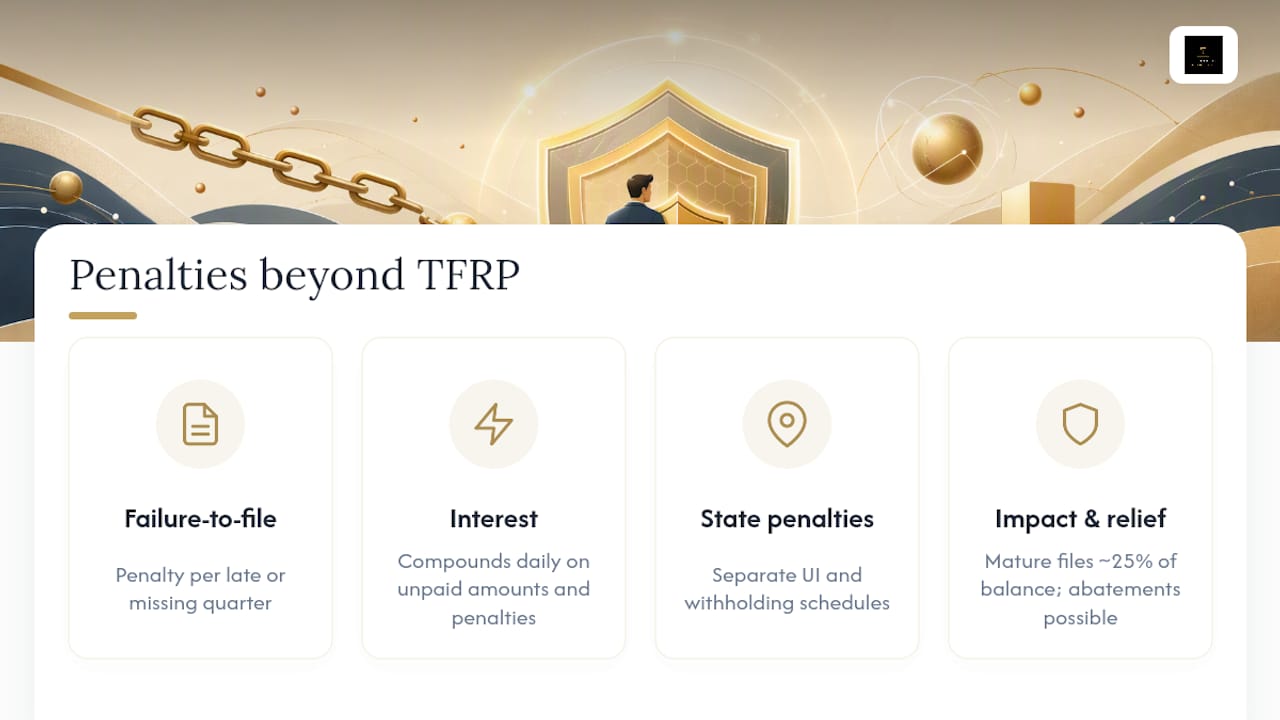
TFRP gets the attention, but it's rarely the only cost on the table. Failure-to-file penalties apply separately if quarterly returns went in late or not at all.
Interest compounds daily on top of every unpaid dollar, including the penalties themselves, which means a modest original shortfall can balloon fast across a multi-quarter audit period. In cases involving intentional disregard of filing requirements, the IRS can pursue civil fraud penalties, which run substantially higher than standard failure-to-pay assessments and carry a much longer statute of limitations.
Beyond direct IRS exposure, state agencies frequently impose their own separate penalty schedules for unemployment insurance and state withholding failures, meaning a single payroll shortfall can generate two independent penalty tracks running in parallel. In persistent nonpayment cases, the IRS can also pursue a federal tax lien against business or personal assets, or in rare, severe cases, seek to revoke a business's ability to operate certain licenses tied to compliance.
Penalty amounts in mature payroll debt files commonly total around a quarter of the balance owed, which is exactly why reasonable-cause abatement requests are worth pursuing even after an assessment is final. Documented third-party failures, natural disasters, or embezzlement can support a penalty reduction even when the underlying tax liability itself isn't in dispute.
How Do You Negotiate a Settlement or Payment Plan?
Once liability is established, the conversation shifts from defense to resolution, and that shift has its own sequence worth following deliberately.
Start by getting current on payroll deposits going forward. The IRS and most state agencies will not seriously negotiate back liabilities while new ones keep accruing; ongoing compliance is often a prerequisite before any settlement offer gets real consideration. From there, an installment agreement is the most common resolution for businesses with cash flow but not a lump sum, and terms depend heavily on how much financial documentation you can produce showing what the business can actually sustain monthly.
For TFRP amounts specifically, a personal installment agreement runs separately from any business-level payment plan, since the two liabilities are legally distinct even though they stem from the same shortfall. An offer in compromise is possible but far less common for trust fund liabilities than for income tax debt, and it requires demonstrating genuine inability to pay in full, not just a preference to settle cheap.
Whatever payment structure you agree to, specify in writing exactly how each payment should be applied, particularly if you're paying down both business and personal TFRP exposure at once. Unlabeled payments can get applied to the portion that helps you least. Document every agreement in writing before making a payment based on a verbal understanding with an examiner or revenue officer.

Authoritative Forms and IRS Publications to Consult Now
Before your first call, bookmark the IRS audits overview, Publication 5146, the Trust Fund Recovery Penalty page, and VCSP FAQs. If a state agency is also involved, check that state's revenue department or EDD site directly, since state procedures and deadlines often differ from federal ones.
The Playbook Most Business Owners Get Backwards
Most advice on payroll tax audits treats the Trust Fund Recovery Penalty as a late-stage worry, something to think about once an assessment letter arrives. That's backwards. TFRP exposure should shape your response from the first notice, because the Form 4180 interview, not the final assessment, is usually where willfulness gets decided. By the time a case reaches Appeals, the facts are largely locked.
The overrated move is trying to handle the first examiner call yourself to "see how serious it is." That call is often the single most consequential conversation in the entire audit, and unrepresented answers there are exactly what examiners use to establish personal liability later.
What actually works is unglamorous: pull your records before you're asked twice, know who had signing authority before someone asks you under oath, and treat every extension request as a tool, not a delay tactic. Business owners who prioritize documentation over persuasion consistently fare better than those who talk their way through an interview hoping goodwill will substitute for a paper trail.
— Melissa
Get Audit Defense Built Around Your Full Business Structure
A firm that already understands your entity structure, your accountable plan, and your payroll setup before the notice ever arrives, because ongoing tax strategy work is what we do. For business owners across multiple entities, that context turns a payroll audit from a scramble into a coordinated response, since we're not learning your organizational chart for the first time under deadline pressure.

If a notice just landed on your desk, start with our tax strategy and resolution services for a direct path to representation, or explore how ongoing advisory can catch payroll compliance gaps before an examiner does. Send us your last four quarters of 941s and a current payroll register, and we'll tell you exactly where your exposure sits before you say another word to an examiner.
This article is general information, not a substitute for advice from a qualified financial advisor. Consult a qualified financial professional about your own circumstances before acting on anything here.